What is a Hollow Grind?

Many people ask what is a hollow grind? A hollow grind is a type of sharpening that features symmetric concave surfaces and produces an edge that is very thin and sharp. This type of edge is not strong enough to be used for sustained use on fibrous or hard materials. A hollow grind is best suited for straight razors and other blades used for food preparation and slicing. In this article, we will cover the advantages of this type of grind and how to make a hollow grind for your knife.

what is hollow grind

Concave edge

Many woodworkers swear by the hollow grind. Its concave edges help slice through materials while flat surfaces tend to push the work away. Its concave edge also makes the blade much thinner and sharper than one with a flat edge. There are several advantages to hollow grinds, including a reduction in waterstone wear and increased blade sharpness. Listed below are the benefits of hollow grinds. Listed below are some pros and cons to each grind.

concave edge knife

The convex edge is slightly rounded on one side and tapers down to its finest point. It is considered the superior edge grind because of its longer life, reduced drag and reduced wear. The transition lines between flat and concave edges are smooth and gradual. This helps ensure a constant build of steel behind the cutting edge. Other grind types lack this feature and thus become duller more quickly. This is the primary reason why convex edges are more expensive than flat edges.

Increased bevel angle

Among the various sharpening techniques, hollow grinding increases bevel angle. This method reduces waterstone wear and hones only small flats on the bevel. It is not suitable for a wide range of sharpening tasks as the result may be a stoneing edge. However, there are many advantages of hollow grinding. One of them is that it is easier to use a plane freehand. Another benefit is that the hollow grind reduces the chance of overheating the blade.

increased bevel angle

In contrast to flat grinding, hollow grinding reduces metal removal and speeds up the sharpening process. The cutting edge is smoothed with intermediate polishing stones. This process removes very little metal from the steel, reducing the time necessary to sharpen it. It also reduces the possibility of over-sharpening a blade. Further, it reduces the risk of chipping the blade. This method is a great alternative for woodworkers who usually freehand hone their blades.

Parallel blade sides

The term “parallel” means parallel, which is a good description for a hollow grind. This grind consists of two parallel sides with the edge thinner than the blade itself. It is also known as an asymmetric grind because it uses two distinct bevel angles on each side of the blade. The parallel side grind is often used in combination with the asymmetric grind, but it has the advantage of retaining the edge of the blade even when the sides are parallel.

Parallel blade 1

The other kind of hollow grind is a sabre grind. This grind can either be flat or hollow. It depends on the purpose of the blade. The latter is used for precision cutting. It is characterized by an edge with a gradual transition from a flat bevel to a partial break angle. The sides of a sabre grind have a transition line from zero thickness to a slight burr.

Sharper edge

A hollow grind knife is usually easier to sharpen than its counterpart. Sharpening is typically less aggressive, but hollow grind knives should still be regularly maintained with a strop. If you are looking to sharpen a hollow grind knife, it’s important to understand its basic properties and how to use them. Here are some tips to keep your hollow grind knife sharp. You may want to use an aggressive sharpening method if you’re not accustomed to this type of knife.

Hollow grind knives are easier to sharpen because they require less steel mass behind the edge. Hollow grinds are generally used on blades with short lengths and for more delicate cutting tasks. Since the edge is thinner, it can be harder to break, but this can increase sharpness. The hollow grind is often used in conjunction with other edge shaping techniques, such as a hammer grind. Some woodworkers prefer a hollow grind, since it is more convenient.

Less common on modern knives

A knife’s grind is crucial for its function and appearance. The appropriate grind depends on the material and intended use. Many manufacturers offer the same blade in different grinds, and owners may choose the grind that suits their style. The grind type determines how easily the blade takes an edge and how well it holds its edge. Some grinds hold an edge longer than others, while others require more maintenance. Steels with a harder grind are easier to maintain and take sharper edges than softer steels. These types of knives are often used for carving or for cleaving.


modern pocket knives

Earlier knives used hollow grinds to slice potatoes, split wood, and make other cutlery. Today, this type of grind is rarer on knives. A hollow grind is typically flat or more convex. However, a hollow grind can be extremely sharp and effective for slicing potatoes, as it can be used to split wood. Many makers, however, do not use hollow grinds, which makes them less versatile for everyday use.

The Knife Steel Chart Breakdown

knife steel

Look at a knife steel chart before choosing a knife steel because you should know its composition and hardness . There are different points on the Rockwell scale, depending on the purpose of the knife.


knife steel chart
Source: Offgridweb.com

The following table lists the most common knife steels, along with the amount of each. It also includes the percentage of carbon and Chromium and other important attributes.

Most common knife steel

  • Carbon
  • Chromium
  • Chromium alloys
  • Carbon content
  • Hardness

If you’re planning to make production knives, you should pay attention to the Carbon and Chromium content. However, it may not be enough to find the perfect knife steel for your needs.

Carbon

Before buying a new knife, it is important to understand what type of steel you need. Different types of steel have different hardness levels, and it is important to know how you plan to use your knife to determine which one is best for your needs. A knife with a high carbon content, for example, can be very rigid and can chip easily. If you’re buying a knife for everyday use, you should look for a knife with a lower carbon content to keep it from bending or breaking when you’re using it.

carbon steel knife

Another important consideration is the knife’s performance. Stainless steel blades have superior corrosive resistance, but their edge retention is limited. This is because stainless steel requires a certain amount of carbon in order to resist corrosion. But carbon is not the only consideration. Heat treatment is also crucial. It’s essential to compare knife steel composition to other similar steels to ensure you’re getting the best quality. The chart  shows the most common temperatures that will cause your knife to rust, and the type of heat treatment used to make it.

Another important characteristic is corrosion resistance. While the highest-grade carbon steel is essentially the hardest steel, too much carbon will cause it to break or chip. If a knife is too hard, it’s likely to chip or break when used frequently. If it rusts under the right conditions, it will eventually break. So it’s best to choose a knife with a higher carbon content. The higher the carbon content, the harder the knife will be, but the trade-off is increased strength and anti-corrosion capabilities.

Chromium Steel

A knife’s performance is determined by the type of steel it is made of. Steel is a carbon and iron alloy that is enriched with certain elements, such as chromium. Different types of steel have different chromium content, depending on their use. While chromium increases corrosion resistance, it also absorbs some of the chromium in carbon steels. Chromium is added to the steel during the manufacturing process, making it a superior choice for blades.

chromium steel knife

Stainless steel contains the most chromium, and is the most common. Unlike carbon steel, stainless steel does not rust in air. Its sharpness isn’t very long-lasting, but it’s better than low-quality carbon steel. This steel also requires less sharpening than other types of knife steel, and can easily be sharpened without using power tools. 420 stainless steel, used in many Buck knives, has less chromium than 440. It’s tougher than 440, but will dull quickly.

Carbon is the main element in steel, and varies in percentage to create various properties. Chromium is an anti-rust additive, while manganese makes blades harder and more durable. High amounts of manganese, on the other hand, can make a knife steel brittle and prone to chipping on hard surfaces.

Carbon-based knife steel contains a high amount of carbon, but does not have the chromium content that stainless steel needs to resist corrosion. Additionally, a high amount of carbon also leads to rusting, which is undesirable for a knife’s performance.

Some chromium steels have a five-digit SAE/AISI designation instead of two, which indicates their carbon content. When comparing chromium content between two different knives, you can choose the best for your needs. You can even choose a knife that is made of different materials. Fortunately, there are plenty of high-quality stainless steel options available on the market. The main consideration is whether it is a good choice for your purposes.

Chromium alloys

Many knives use the SAE/AISI designation of D2, a Japanese tool steel containing almost enough chromium to be considered stainless steel. While D2 knife steel is tough and corrosion-resistant, it lacks hardness in comparison to cheaper alloys. Nevertheless, it retains a first-class edge for a long time. While D2 is prone to rust, it is still a good choice for a knife. This steel contains 12% chromium.


Chromium alloys

Other popular grades of steel used in knifemaking include CTS-204P, CPM-20CV, and ATS 34. CTS-204P is comparable to CPM-20CV, but has a higher percentage of vanadium. While M390 is very hard, it is difficult to sharpen, making it an ideal choice for knives that will be used frequently in salt water environments. ATS 34 is the toughest type of steel, although it also has an extra dose of chromium.

Another type of alloy is niobium. Niobium is a silver-gray transitional metal that can absorb chromium and contribute toughness. Niobium is a silver-gray transitional metal that adds toughness and improves corrosion resistance. Chromium is an essential element for knife steel, but some knives do not contain it. While all stainless steels have high chromium content, these blades are still susceptible to rusting when exposed to extreme environments.

SAE 300 series stainless steel is made from chromium-nickel alloy. It is made with a ferritic crystalline structure. It contains chromium and nickel, and has a higher corrosion resistance and harderness than austenitic structures. SAE 301 Full Hard is commonly used for knife blades and stainless trays. It is also more pliable than SAE 400 series stainless steel.

Carbon content

Knife steels can vary in the amount of carbon they contain. High carbon steels are tougher and more resistant to elements than low carbon steels. High carbon steels are typically used for knives that are subjected to aggressive environments. They can contain chromium, nickel, and titanium in various ratios. However, they can also contain other elements, including aluminum, silicon, and copper. In most cases, higher carbon content does not affect a knife’s hardness.

Some common Japanese carbon steels contain up to 1.3% carbon. CPM 4V, for example, has 0.74% carbon and 0.54% vanadium, which are good indicators of toughness and heat treatment characteristics. Alternatively, CPM 9V contains less carbon, and more vanadium to improve toughness. Another proprietary knife steel is CPM CRU-WEAR, which is an upgraded version of conventional Cru-Wear. The alloys added to this steel increase its wear resistance and ductility.

Stainless steel is another common type of knife steel. The carbon content in this steel ranges from 0.05% to 2.1%. Most knives are made of carbon steel, and manufacturers often refer to all of their steel as such. Carbon steel is hard, but other materials can add hardness and corrosion resistance. A hard knife will also be brittle and prone to rust. A good carbon steel is a balanced blend of high carbon content and minimal additions as describe in our knife steel chart above.

Another high carbon knife steel is ATS 34. This tool steel has a carbon content of 1.5 percent. This steel has an edge-holding performance comparable to ATS 34 and is considered tough enough for surgical use. This steel also has a high hardness level. In fact, it is almost as tough as CPM S90V steel. It is also more rust-resistant than CPM S90V, and is used in most cases.

Knife Steel Hardness

To choose the best knife steel, determine its hardness. Its hardness is measured on the Rockwell scale, and the harder the steel, the better the knife will hold its edge. Harder steel will hold an edge longer but is less durable. Knife steel with a HRC rating of 55 or higher will hold an edge longer, but they are more difficult to sharpen when dull. Knives made of soft steel are easier to maintain, but will lose their sharpness more easily.

Steel Hardness chart 1

A high-quality knife steel will also be tough. It is a measure of its resistance to breakage, chipping, and cracking. Toughness is the opposite of brittleness. However, testing for toughness is not standardized, and the results are often difficult to correlate with hardness measurements. Common toughness tests include various impact and bend fracture tests. In general, knives with a 57-59 HRC hardness rating are recommended, but some cheaper models may be as low as 50.

In general, the higher the Rockwell number, the more durable the knife. This is especially true of high-carbon steel knives. A good example of this is the Benchmade 581 Barrage, which is made of M390 steel. This knife is one of the few knives available with M390 steel. A similar model is made of CPM-S35VN steel. However, there are other hardness grades available, such as D2 and HRC.

In addition to the hardness, knife steel also has some other properties that determine its performance. For instance, knife steels are classified based on their toughness and wear resistance. They are also rated by their resistance to corrosion. All these factors can make the difference between a good knife and a great one. And, in general, the tougher the knife steel, the better. So, how do you decide which knife steel is best? Consult your knife steel chart beforehand.

How to Sharpen a Convex Blade

sharpening-a-convex-blade

If you’re new to blade making, learning how to sharpen a convex blade can be quite difficult. If you’ve already made some blades, however, you probably don’t find it difficult. In fact, you may have made many blades and have already learned how to hone them. Either way, it’s important to learn how to sharpen a convex blade properly and avoid common mistakes.

how to sharpen convex blade

Easy to make

How to sharpen a convex edge? Convex edges are the same as regular blades and can be sharpened at any angle, even a higher or lower angle. These edges are made up of many facets, the more facets there are, the smoother the curvature. As the angle and grit change, the convex edges will smooth themselves out and be sharper.

A convex edge is often known as a Moran grind. It is a rounded shape that tapers to the point where the blade cutting edge is sharpest. This grind type is considered superior to other types because of its durability and wear down properties. It also produces less drag when sharpening a blade than other types of edge. A convex edge is not a new blade sharpening technique, but it does require some basic knowledge.


convex edge

Once you’ve got the basic set-up and are ready to grind, you can begin sharpening your convex blade. You should first make sure that the edge is damaged before sharpening. If it’s not, you should start with a coarse edge and work evenly. You can also try to remove a burr, which is a piece of metal that pushed off the blade. This is similar to breaking a thin piece of metal by hand.

Easy to sharpen

One of the first things you should know about how to sharpen a convex blade is how it cuts. Blades do not always cut uniformly. Every cut has its own nuance. The shape of your blade, its steel type, and how it is crafted can all play a role in its ability to cut. It is important to know how to sharpen a convex blade properly so that you can use it effectively for different tasks.

how-to-sharpen


To sharpen a convex blade, you should start by soaking the stone with water. Generally, you should soak it for at least 10 minutes. The water can be dripped on the stone, so that it is wet but not saturated. The next step is to reverse the process and sharpen the other side of the blade. You can also use an Original Knife & Tool Sharpener to do the job for you.

Disadvantages of convex grinds

The disadvantages of convex grinds when sharpened blades are similar to those of flat grinds. The flat grind is a more palatable choice for some blades because of its middle ground strength and lack of binds and waviness. Flat grinds are similar to convex grinds in their curvatures and lack of secondary bevels, and some even call them Scandi grinds.


convex-grinds


A convex grind is a bit stronger than a hollow grind, but the flat grind is more efficient. Convex grinds also are easier to sharpen, which is an important feature when sharpening a blade. Regardless of their strength, however, they often dull the edge faster than their counterparts. This is why convex grinds are often called “Axe Grinds.”

A convex grind has an angled edge that is flat in the middle, but is slightly bowed outward. This grind tends to be the most durable and sturdiest grind, and it has the least contact with material. Because it is more expensive, convex grinds are usually used on custom-made blades. They require special equipment and are not widely available outside of the custom market.

Ways to maintain convexity while thinning blade


knife edge while thinning

There are several ways to maintain the convexity of your knife edge while thinning. Generally, convex edges have a longer and more supportive material than their V-grind counterparts, and they retain their edge better than their V-grind counterparts. However, when you switch from one type of edge to the other, you may find that it requires more grinding to achieve the desired result.

How to Use a Diamond Sharpening Rod

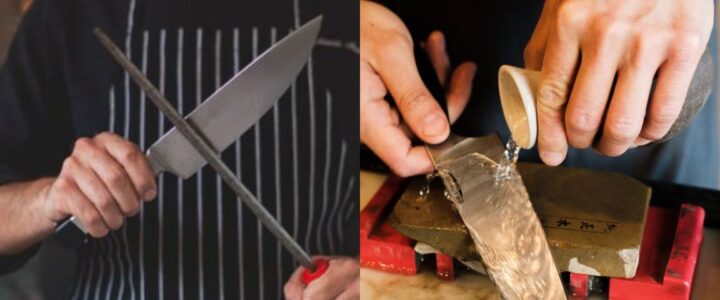
When you use a diamond sharpening rod, it is important to remember the right angle to apply the pressure. This is because you don’t want to push too hard. If you use too much pressure, the blade will get bent. So, to sharpen a blade, you should start with a small angle. Count the number of circles on one side, then repeat the same process on the opposite side.

A fine-grit sandpaper is preferred for this step because it will remove more material faster, while coarse-grit sandpaper is needed to smooth out the scratches. The medium-fine sandpaper is the best for maintaining a kitchen knife’s edge. You should start from the tang and move down the length of the rod, using light to moderate pressure. Try not to push too hard, as this may cause the rod to scrape off the diamond dust, which will reduce its life span.

When using the diamond sharpening rod, you must remember to use the correct angle. Make sure that the rod is held at a 45-degree angle, so that it can easily slide into the knife. Once you’ve done this, turn the knife upside-down and start applying light to moderate pressure. Be careful not to apply too much pressure, as this will scratch the rod and reduce its lifespan. And always remember that it is more important to apply moderate pressure when sharpening your knives than to apply too much pressure.

How to Sharpen Swiss Army Knife Scissors

You can learn how to sharpen swiss military knife scissors by following the steps below. First, clean the knife’s blade by immersing it in water, then running it under a hot tap. Let the water evaporate, then apply oil or solvent. You can use rubbing alcohol or isopropyl alcohol, but be sure to avoid these chemicals because they can damage the blade.

Then, use a sharpening stone made especially for Swiss army knives. You can purchase one from the company’s website. If you don’t have one, you can also use a paper to test the edge of the blade. This will ensure that you don’t make any mistakes while sharpening. Always remember to keep the edge of the blade sharp to ensure a good performance.

Once you have found the perfect angle, use the flat side of the knife to smooth the awl edge. You can also use the flat side to sharpen the awl edge. The awl edge is easier to sharpen, because it doesn’t have a pivot rivet. The awl edge is made of steel, so the awl needs lubrication to function properly.

Aside from these tools, you can also buy a sharpening stone. It is important to use a tool that can hold the blade at the proper angle for the blade to be sharpened. If you’re sharpening a Swiss army knife, you’ll need diamond or ceramic plates. If your scissors are dull, you’ll need a fine belt sharpener that can hold them in place.

How to Use an Ecco Knife Sharpener

The process for using an ekco knife sharpener is very easy. The first step is to wet a clean washcloth and hold the knife in the center. Next, place the knife in the wheel at a 45-degree angle. Pull the blade toward you. Repeat the process four to six times. Afterwards, wipe the blade to remove any excess sharpening compound.

You can also purchase a sharpening stone from a hardware store. The sharpening stone is available in different sizes, ranging from small to large. Each stone comes with a rough and smooth side. You should soak a new stone overnight in machine oil and keep it in a sealed container between uses. Then, simply apply light pressure to the knife and follow the manual to achieve a sharp edge.

If you’re a beginner, it’s best to start with the coarser grit. The coarser side of a stone will make your knife sharper-friendly. This is the recommended starting point for sharpening knives. The coarser side is for chopping vegetables and fruits. Depending on the size of your knife, a finer side will require a little more time to sharpen.

Similarly, a sharper is essential for knife maintenance. When a blade is blunt, you risk cutting yourself or spitting blood. A sharp blade will keep the blade sharp for months. A clumsy, blunt knife will not be as effective when it comes to cutting meat and vegetables. A good ekco knife sharpener will ensure that your knife stays razor-sharp for months.