
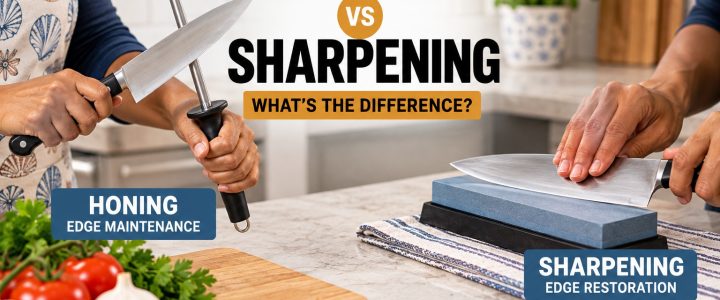
If your kitchen knife isn’t cutting as cleanly as it used to, you might assume it needs sharpening.
But not necessarily.
Sometimes the edge simply needs honing.
Although the words honing and sharpening are often used interchangeably, they describe two different types of knife maintenance.
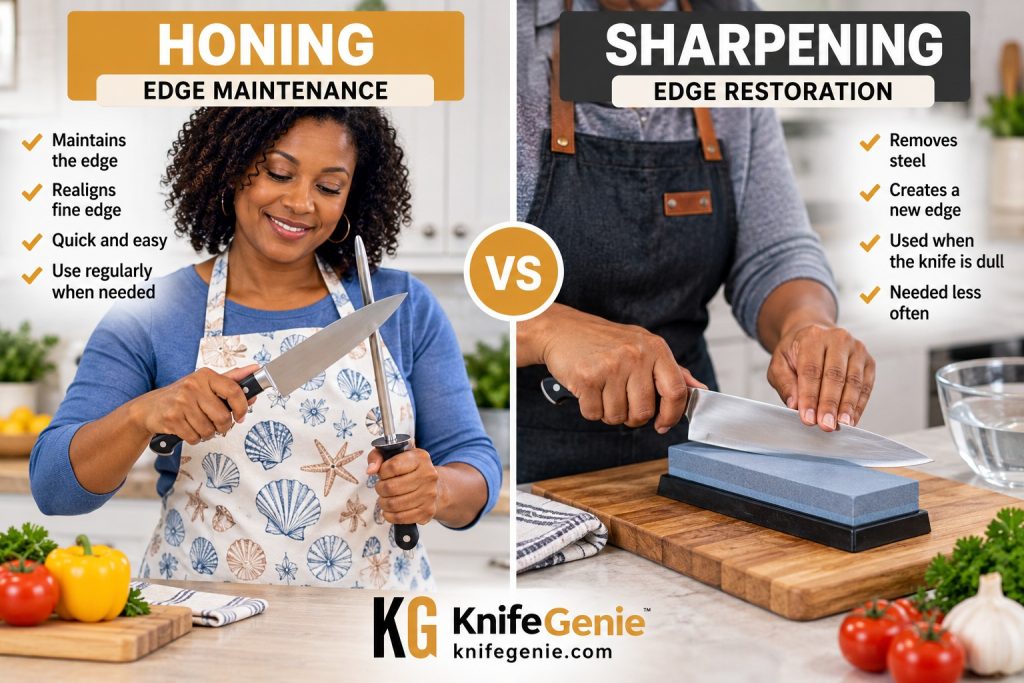
Honing primarily maintains or corrects an existing edge. Sharpening restores a worn edge by removing blade material to form a new cutting edge.
Knowing the difference between honing and sharpening can help you decide when to hone a knife and when to sharpen a knife, while avoiding unnecessary steel removal.
🔽 In This Honing vs Sharpening Guide
👉 Quick Answer
👉 Honing vs Sharpening at a Glance
👉 What Is Honing?
👉 What Is Sharpening?
👉 What Actually Happens to a Knife Edge?
👉 How to Tell Whether You Should Hone or Sharpen
👉 How Often Should You Hone?
👉 How Often Should You Sharpen?
👉 Types of Honing Rods
👉 Common Knife Sharpening Methods
👉 Can Honing Damage a Knife?
👉 Can You Sharpen Too Often?
👉 What About Japanese Knives?
👉 Common Honing and Sharpening Mistakes
👉 Simple Knife Maintenance Routine
👉 Frequently Asked Questions
👉 Overall Recommendation
🏆 Honing vs Sharpening: The Quick Answer
Here’s the simplest way to remember the difference:
🔧 Honing = Edge Maintenance
Honing helps maintain an existing cutting edge and can correct slight deformation or misalignment at the very edge.
🪨 Sharpening = Edge Restoration
Sharpening uses an abrasive to remove steel and create a fresh cutting edge.
Think of it this way:
Knife still reasonably sharp but doesn’t feel quite as crisp?
👉 Try honing.
Honing restores the cutting performance?
👉 Keep using the knife.
Knife remains dull after appropriate honing?
👉 It probably needs sharpening.
See our Why kitchen knives become dull guide.
🧙 KnifeGenie Rule
Hone to maintain. Sharpen to restore.
That’s the basic difference.
There are some important exceptions, however—particularly when ceramic and diamond honing rods enter the discussion.
HONING VS SHARPENING – Best knife sharpeners for beginners
📊 Honing vs Sharpening at a Glance
| Feature | 🔧 Honing | 🪨 Sharpening |
|---|---|---|
| Main purpose | Maintain the edge | Restore the edge |
| Removes steel? | Minimal or none with many traditional steels* | Yes |
| Creates a new edge? | Generally no | Yes |
| Used for | Slight loss of cutting performance | A genuinely dull or damaged edge |
| Typical tools | Honing steel, ceramic rod | Whetstone, guided sharpener, abrasive system |
| Frequency | Relatively often when appropriate | Much less frequently |
| Skill required | Low to moderate | Depends heavily on method |
| Best description | Maintenance | Restoration |
*Important: Not every tool called a “honing rod” behaves the same way. Ceramic and especially diamond-coated rods are abrasive and can remove some steel.
That distinction is important because the common claim that “honing never removes metal” is too absolute.
🔧 What Is Honing?
Honing is primarily a maintenance process.
As a knife is used, the extremely thin area at its cutting edge experiences repeated contact with food and the cutting board.
The knife may gradually feel less crisp even though the edge isn’t completely worn away.
A suitable honing rod can help maintain or improve that edge before full sharpening becomes necessary.
Traditional honing steels are particularly associated with maintaining Western-style kitchen knives.
What Honing Can Do
Depending on the knife and honing tool, honing can:
✔ Maintain cutting performance
✔ Correct minor edge deformation
✔ Help an edge feel crisp again
✔ Extend the useful interval between full sharpenings
✔ Reduce unnecessary sharpening
But honing has limits.
It cannot indefinitely restore an edge that has become genuinely blunt, rounded, chipped, or badly damaged.
At that point, you need to remove material and recreate the cutting edge.
That’s sharpening.
Read: Serrated vs plain edge kitchen knives
WHAT HONING DOES
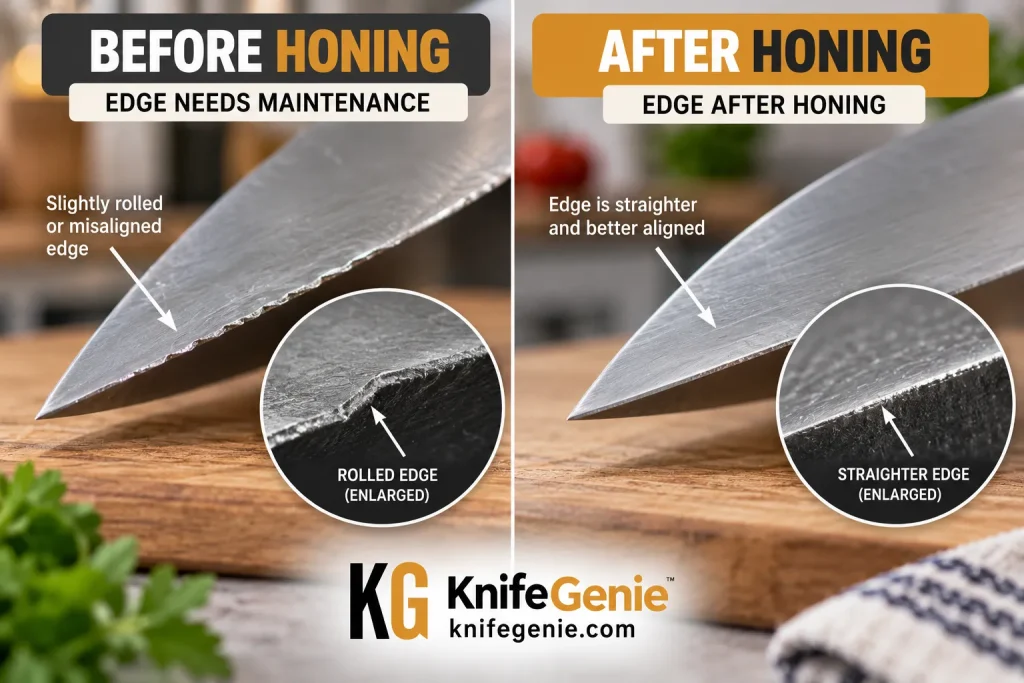
For many home cooks, knife honing is one of the simplest forms of routine kitchen knife maintenance, particularly when using a traditional Western chef’s knife.
🪨 What Is Sharpening?
Sharpening goes further.
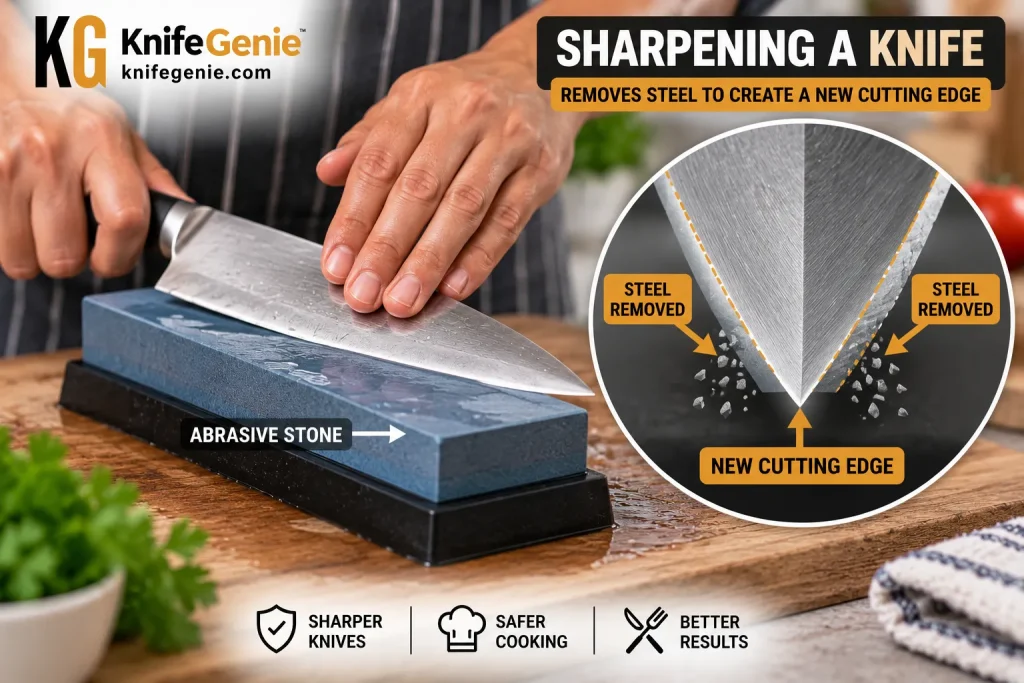
Instead of simply maintaining the existing edge, sharpening uses an abrasive surface to remove a controlled amount of steel.
Material is removed from the bevels until they meet to form a fresh cutting edge.
Depending on the method, sharpening may be performed using:
🪨 Whetstones
🔧 Guided sharpening systems
⚙️ Manual pull-through sharpeners
⚡ Electric sharpeners
👨🔧 Professional sharpening equipment
The principle remains essentially the same:
Steel is removed to restore the cutting geometry.
That’s why sharpening works when honing no longer does.
It is also why you shouldn’t sharpen a knife unnecessarily.
HOW SHARPENING WORKS
🔬 What Actually Happens to a Knife Edge?
A knife edge looks substantial to the naked eye.
At its very apex, however, it becomes extremely thin.
Every time you slice an onion, chop a carrot or portion boneless meat, that fine edge experiences stress.
Over time, several things can happen.
The edge may:
🔹 Become slightly deformed
🔹 Develop microscopic wear
🔹 Gradually round over
🔹 Develop small chips
🔹 Lose its original geometry
This explains why “my knife is dull” doesn’t always describe exactly the same problem.
A knife experiencing relatively minor edge deterioration may respond well to honing.
A heavily worn edge needs sharpening.
A badly chipped or damaged blade may require more substantial sharpening or professional repair.
Think Maintenance Before Restoration
If your knife is still reasonably sharp but has lost some of its crisp cutting feel, appropriate honing is often the logical first step.
If honing makes little or no difference, sharpening becomes the next step.
🧐 How to Tell Whether You Should Hone or Sharpen
You don’t need a microscope.
Pay attention to how the knife cuts.
🔧 Try Honing First If:
✔ The knife was sharp fairly recently
✔ Cutting performance has only declined slightly
✔ The edge isn’t visibly damaged
✔ The knife feels less crisp rather than completely blunt
✔ You use a knife designed to respond well to honing
After honing, carefully test the knife on normal food.
A ripe tomato is particularly revealing.
If the knife can start the cut cleanly without excessive pressure, the edge may simply have needed maintenance.
🪨 Sharpen If:
✘ Honing doesn’t restore satisfactory performance
✘ The knife slides over tomato skin rather than biting into it
✘ Onions require noticeably more pressure
✘ The edge has become rounded or genuinely dull
✘ Minor edge damage needs to be removed
✘ It has been a long time since the knife received proper sharpening
⚠️ Don’t Use Your Finger as a Sharpness Test
Avoid dragging a fingertip along the cutting edge.
Use food or another safe testing method instead.
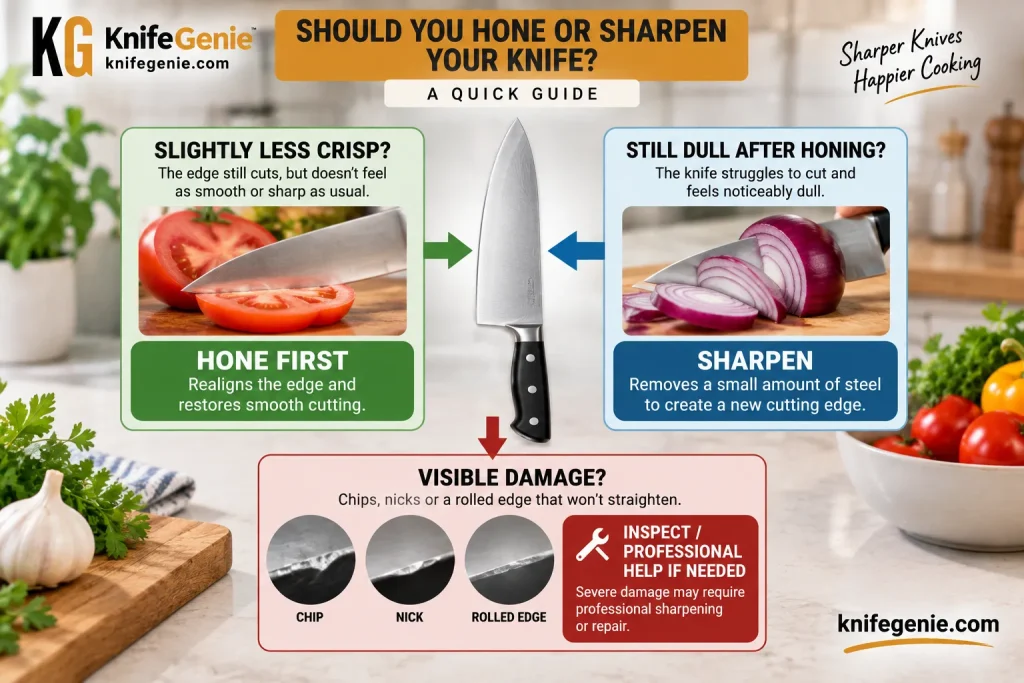
HONE OR SHARPEN?
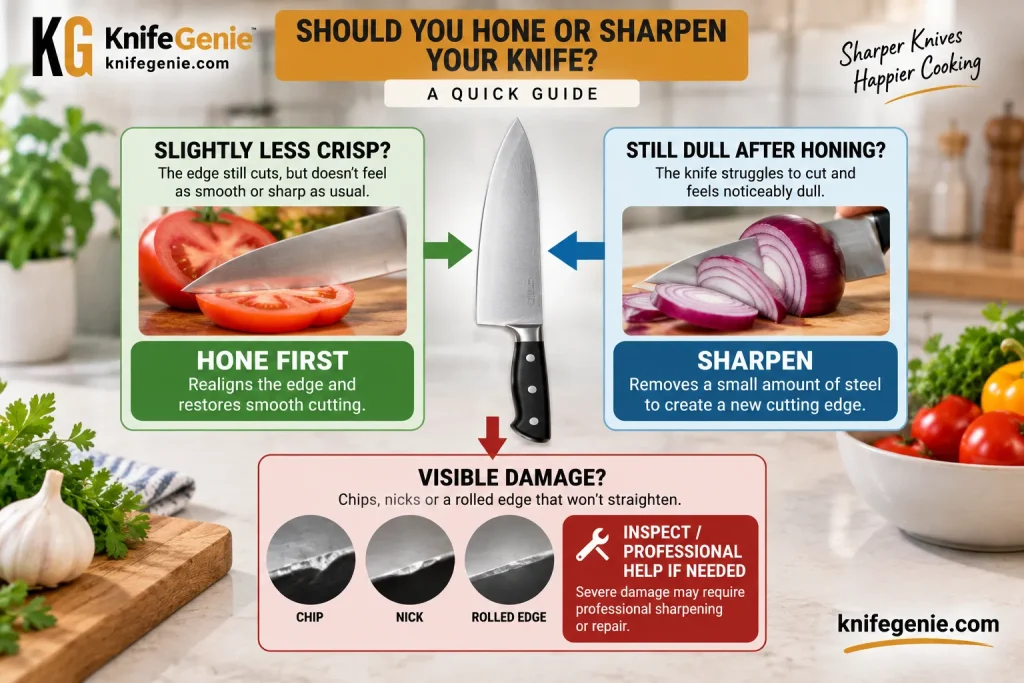
If a knife has only lost a little cutting performance, try honing first. If honing doesn’t restore the edge, it may be time to sharpen.
🔁 How Often Should You Hone?
There isn’t one schedule that works for every kitchen knife.
How frequently a knife benefits from honing depends on:
🔪 Blade steel
📐 Edge geometry
🍳 How frequently you cook
🥕 What you cut
🪵 Your cutting-board material
✋ Cutting technique
🔧 Type of honing tool
For a conventional Western chef’s knife that responds well to a honing steel, honing can be performed relatively regularly as cutting performance begins to decline.
But don’t turn honing into a ritual you perform automatically every time you pick up a knife.
Better Rule
Hone when the knife needs edge maintenance.
If the knife is already performing beautifully, there is little reason to keep running it over a rod.
🗓️ How Often Should You Sharpen?
Sharpening should generally happen much less frequently than routine edge maintenance.
For many home cooks, sharpening roughly once or twice a year can be a reasonable starting point, but that is not a rule.
Some knives may need it sooner.
Others may go considerably longer.
A cook preparing meals several times every day will wear an edge differently from someone using a chef’s knife twice a week.
Instead of sharpening according to a rigid calendar:
See: How Often Should You Sharpen guide.
Ask These Questions
Has cutting performance declined?
↓
Does appropriate honing restore it?
YES → Keep using the knife.
NO → Consider sharpening.
This avoids grinding away steel simply because six months have passed since the last sharpening.
🪄 Types of Honing Rods
This is where the honing-versus-sharpening discussion gets more interesting.
Not every rod works the same way.
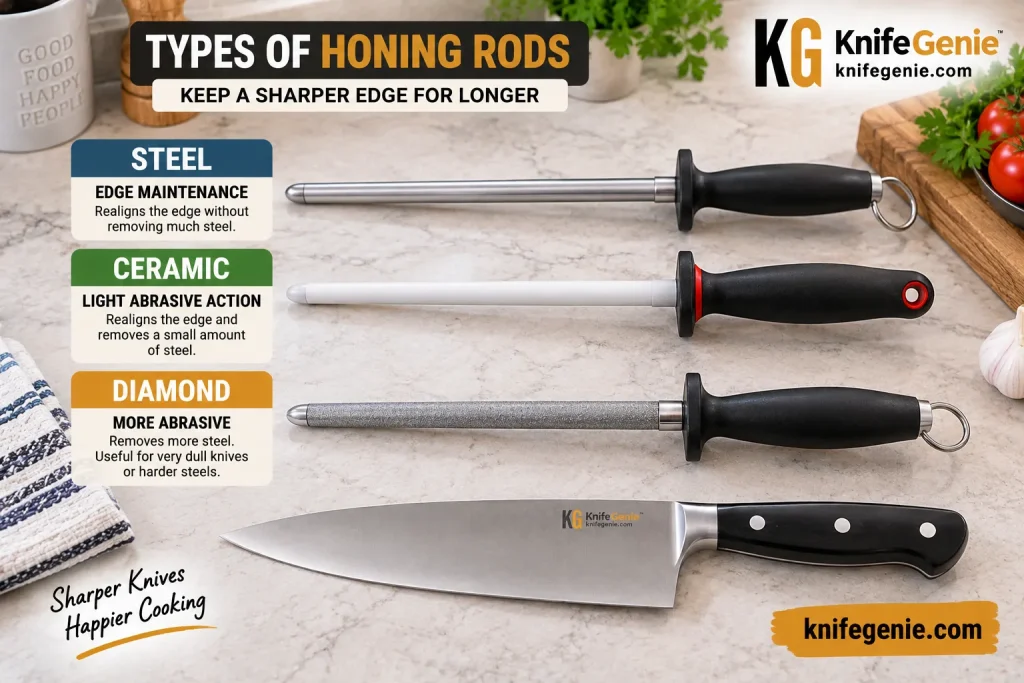
🔩 Traditional Steel Honing Rod
A conventional steel rod is primarily an edge-maintenance tool.
It is particularly familiar to owners of traditional Western kitchen knives.
⚪ Ceramic Honing Rod
Ceramic rods are abrasive.
They can provide relatively gentle edge refinement while removing a small amount of material.
That means the boundary between honing and sharpening starts becoming less clear.
💎 Diamond-Coated Rod
Diamond-coated rods are considerably more abrasive.
They can remove steel rather than merely maintaining or realigning an edge.
Consequently, don’t assume every rod-shaped tool should be used as frequently as a traditional honing steel.
🧙 KnifeGenie Tip
Choose the maintenance tool for the knife—not simply the tool that came with your old knife block.
HONING ROD TYPES
🪨 Common Knife Sharpening Methods
Once your knife genuinely needs sharpening, you have several choices.
🪨 Whetstone
A whetstone gives the user substantial control over the sharpening process.
Advantages
✔ Excellent control
✔ Works with many knives
✔ Different grits allow sharpening and refinement
✔ Can produce excellent results
Challenges
✘ Requires technique
✘ Maintaining a consistent angle takes practice
✘ Slower for beginners
A whetstone—also commonly called a sharpening stone—removes steel gradually as you work along the knife’s edge.
🎯 Guided Sharpener
Guided systems help control the sharpening angle.
Maintaining the correct knife sharpening angle is important because changing the angle too much can alter the original edge geometry.
Advantages
✔ Easier angle consistency
✔ Beginner friendly
✔ Repeatable results
Challenges
✘ Compatibility varies
✘ Some systems are relatively expensive
✘ Not every knife geometry fits every system
⚙️ Pull-Through Sharpener
Pull-through sharpeners prioritize convenience.
Advantages
✔ Fast
✔ Easy to understand
✔ Convenient
Challenges
✘ Less control
✘ Fixed angles may not suit every knife
✘ Aggressive models can remove more steel than necessary
👨🔧 Professional Sharpening
Professional sharpening makes sense when:
✔ You own an expensive knife and aren’t confident sharpening it
✔ The edge is chipped or damaged
✔ The knife has unusual geometry
✔ You simply don’t want to learn sharpening
But choose the sharpener carefully.
“Professional” describes a service—not automatically the quality of the work.
Work Sharp — Honing vs Sharpening guidance (Professional knife sharpeners)
⚠️ Can Honing Damage a Knife?
Yes, particularly when technique or equipment is inappropriate.
Common problems include:
❌ Using excessive pressure
❌ Holding the knife at an unsuitable angle
❌ Striking the blade rapidly against the rod
❌ Using an aggressive rod unnecessarily
❌ Honing a knife the manufacturer doesn’t recommend honing this way
You don’t need to imitate the lightning-fast honing technique sometimes seen on television.
For a home cook, slow and controlled beats fast and dramatic.
⚠️ Can You Sharpen a Knife Too Often?
Yes.
See our guide on how often should you sharpen kitchen knives.
Sharpening works by removing steel.
A tiny amount of material must disappear for a new edge to be created.
That’s perfectly normal.
But sharpening unnecessarily means removing steel that didn’t need to be removed.
The Goal Isn’t to Avoid Sharpening
Kitchen knives are tools.
Eventually, an actively used knife will need sharpening.
The goal is simply to sharpen when necessary rather than excessively.
🧙 KnifeGenie Rule
Don’t sharpen because the calendar says so. Sharpen because the edge says so.
Read: Sharpening a boning knife…
🇯🇵 What About Japanese Kitchen Knives?
This deserves special attention.
Don’t assume the honing routine you use for a traditional German chef’s knife automatically applies to every Japanese knife.
Japanese kitchen knives can differ considerably in:
🧱 Steel hardness
📐 Edge angle
🔪 Blade geometry
⚖️ Blade thickness
↔️ Bevel configuration
Some harder, thinner edges may not respond to a traditional grooved honing steel in the same way as a tougher Western chef’s knife.
Single-bevel knives require additional consideration.
Before Honing or Sharpening an Expensive Knife
Check the knife manufacturer’s maintenance recommendations.
You don’t want to spend hundreds of dollars on a precision kitchen knife and then force its carefully designed edge through an inappropriate sharpener.
Japanese knife honing deserves extra care because harder steels and thinner edge geometries may not be suitable for the same honing technique used on softer Western knives.
GERMAN VS JAPANESE EDGE MAINTENANCE
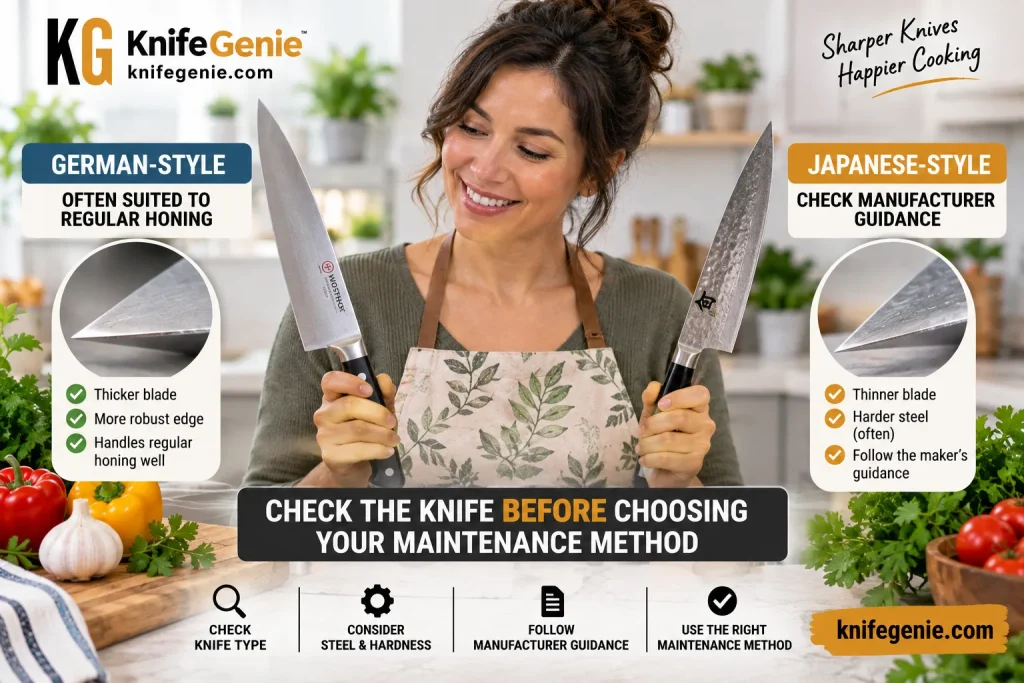
See our German and Japanese kitchen knives guide.
❌ Common Honing and Sharpening Mistakes
❌ Mistake #1: Assuming Honing and Sharpening Are the Same
They aren’t.
Knowing the difference prevents unnecessary sharpening.
❌ Mistake #2: Sharpening Every Time the Knife Feels Slightly Dull
Try appropriate honing first when the edge only seems slightly less crisp.
❌ Mistake #3: Assuming Honing Never Removes Steel
Traditional honing steels may remove very little material, but ceramic and diamond rods can be abrasive.
❌ Mistake #4: Using Too Much Pressure
More pressure doesn’t automatically produce a better edge.
Control matters more.
❌ Mistake #5: Guessing the Sharpening Angle
Don’t automatically use the same angle for every knife.
❌ Mistake #6: Using One Sharpener for Every Knife
An inexpensive Western chef’s knife, hard Japanese gyuto and serrated bread knife should not automatically receive identical treatment.
❌ Mistake #7: Ignoring Your Cutting Board
A freshly sharpened knife can lose performance faster when repeatedly used on unsuitable hard surfaces.
❌ Mistake #8: Expecting Honing to Repair Damage
A honing rod isn’t a magic wand.
Chips and heavily worn edges require sharpening or repair.
🔄 A Simple Knife Maintenance Routine
For most home cooks, knife maintenance doesn’t need to be complicated.
Step 1 — Use the Knife Normally
Pay attention to cutting performance.
Step 2 — Notice the Change
Does an onion require more pressure?
Does tomato skin resist the edge?
Does the knife simply feel less crisp?
Step 3 — Inspect the Edge
Look for obvious chips or damage.
Step 4 — Hone When Appropriate
If the knife and manufacturer support honing, use the appropriate tool and controlled technique.
Step 5 — Test Again
Has normal cutting performance returned?
Yes?
👉 Keep cooking.
No?
👉 The knife may need sharpening.
Step 6 — Sharpen Appropriately
Use a method suited to the knife and maintain its intended edge geometry.
Step 7 — Protect the Restored Edge
Use a knife-friendly cutting board, appropriate storage and sensible cutting technique.
That simple routine can prevent a lot of unnecessary sharpening.
See our How to Store Kitchen Knives Safely guide.
KNIFE MAINTENANCE ROUTINE
🧠 Research & Editorial Note
KnifeGenie’s guidance in this article is based on research into knife-edge maintenance principles, manufacturer guidance, and established sharpening practices rather than personal hands-on testing of every honing or sharpening product or method mentioned.
No specific honing rod, whetstone or sharpening system is being presented here as having been personally tested unless that is explicitly stated.
The purpose of this guide is to explain how honing and sharpening differ, when each process is appropriate, and what home cooks should consider before choosing a maintenance method.
Individual knives can require different care depending on their steel, hardness, bevel geometry, and manufacturer’s recommendations.
❓ Frequently Asked Questions
Is honing the same as sharpening?
No.
Honing primarily maintains an existing edge, while sharpening uses an abrasive to remove material and restore the cutting edge.
However, abrasive ceramic and diamond rods blur the distinction because they can remove some steel while refining the edge.
Should I hone or sharpen my knife first?
If your knife has simply lost some of its crisp cutting performance and is suitable for honing, try honing first.
If performance isn’t restored, the edge may need sharpening.
Does a honing steel actually sharpen a knife?
A traditional honing steel is primarily an edge-maintenance tool rather than a replacement for actual sharpening.
The terminology becomes confusing because some rods marketed for honing are abrasive. Ceramic and diamond-coated rods can remove material.
How often should I hone my kitchen knife?
There is no universal schedule.
Hone when an appropriate knife begins showing a modest decline in cutting performance rather than automatically honing before every use.
How often should I sharpen my kitchen knives?
For many home cooks, once or twice a year can be a useful starting point, but usage matters more than the calendar.
If honing no longer restores satisfactory performance, it’s probably time to sharpen.
Can honing replace sharpening?
No.
Honing can help maintain an edge and potentially extend the interval between sharpenings, but eventually normal wear changes the edge enough that sharpening becomes necessary.
Can you hone a Japanese knife?
Sometimes, but don’t assume every Japanese knife should be maintained using a conventional grooved steel.
Steel hardness, edge geometry and manufacturer recommendations matter. Check the instructions for your particular knife.
Does sharpening remove metal?
Yes.
Sharpening uses abrasive material to remove a controlled amount of steel so the bevels meet at a fresh cutting edge.
Can you sharpen a knife too much?
Yes.
Because sharpening removes steel, unnecessary sharpening gradually removes more blade material than required.
Is a ceramic rod for honing or sharpening?
It can perform aspects of both.
Ceramic is abrasive, so a ceramic rod can refine an edge while also removing a small amount of material. That makes it different from a conventional smooth or lightly grooved honing steel.
🏆 Overall Recommendation
The difference between honing and sharpening becomes much easier once you stop thinking of both processes as ways to “make a knife sharp.”
Think instead:
🔧 HONING = MAINTAIN
Use appropriate honing to help maintain an edge that still has useful sharpness.
🪨 SHARPENING = RESTORE
Sharpen when the cutting edge has genuinely worn enough that maintenance no longer restores satisfactory performance.
For the average home cook, the simplest sequence is:
Use → Notice declining performance → Hone if appropriate → Test → Sharpen when honing no longer works.
You don’t need to sharpen a good kitchen knife every time it feels slightly different.
And you don’t need to endlessly hone an edge that has genuinely become dull.
Learn to recognize what the knife is telling you.
🧙 KnifeGenie Final Verdict
If honing restores the edge, keep cooking.
If honing doesn’t restore the edge, it’s time to sharpen.
Knowing that difference is one of the simplest ways to take better care of your kitchen knives.
OVERALL RECOMMENDATION