

Have you ever sharpened a kitchen knife, enjoyed that wonderfully crisp edge for a while, and then wondered:
Why is this knife dull again already?
You’re not imagining it.
Every kitchen knife eventually loses sharpness. But if your knives seem to get dull unusually quickly, the knife itself may not be the main problem.
Your cutting board, storage method, cleaning habits, cutting technique and even the foods you prepare can all affect how long an edge lasts.
⚡ The Quick Answer
Kitchen knives get dull because their extremely thin cutting edges gradually wear, bend, roll or become damaged during normal use.
The process happens much faster when you:
❌ Cut on glass, ceramic or stone
❌ Scrape food sideways with the cutting edge
❌ Put knives in the dishwasher
❌ Store them loose with other utensils
❌ Cut bones, frozen foods or other materials the knife wasn’t designed for
❌ Ignore regular edge maintenance
The good news?
A few simple changes can help your kitchen knives stay sharp considerably longer.
🔎 About This Guide
This article is based on research into knife construction, sharpening, manufacturer care recommendations and established knife-maintenance practices. KnifeGenie has not personally tested every knife, steel or sharpening system mentioned. The goal is to explain the principles behind kitchen-knife edge wear so home cooks can make better care and maintenance decisions.
 Jump to What You Need
👉 Why Do Kitchen Knives Get Dull?
👉 9 Reasons Kitchen Knives Get Dull So Quickly
👉 What Makes a Kitchen Knife Dull Faster?
👉 How Can You Tell When a Kitchen Knife Is Dull?
👉 Is Your Knife Dull—or Does It Just Need Honing?
👉 How to Keep Kitchen Knives Sharp Longer
👉 Final Cut: Why Kitchen Knives Get Dull So Quickly
🔪 Why Do Kitchen Knives Get Dull?
A sharp knife has an extremely thin cutting edge.
That thin edge is precisely what allows the blade to bite into tomato skin, glide through onions and slice meat cleanly.
But there’s a trade-off.
Because the edge is so thin, it takes repeated stress every time you use the knife.
Think about what happens while chopping an onion.
The knife passes through the onion…
Then the edge hits the cutting board.
Again.
And again.
And again.
During a long food-preparation session, that contact can happen hundreds of times.
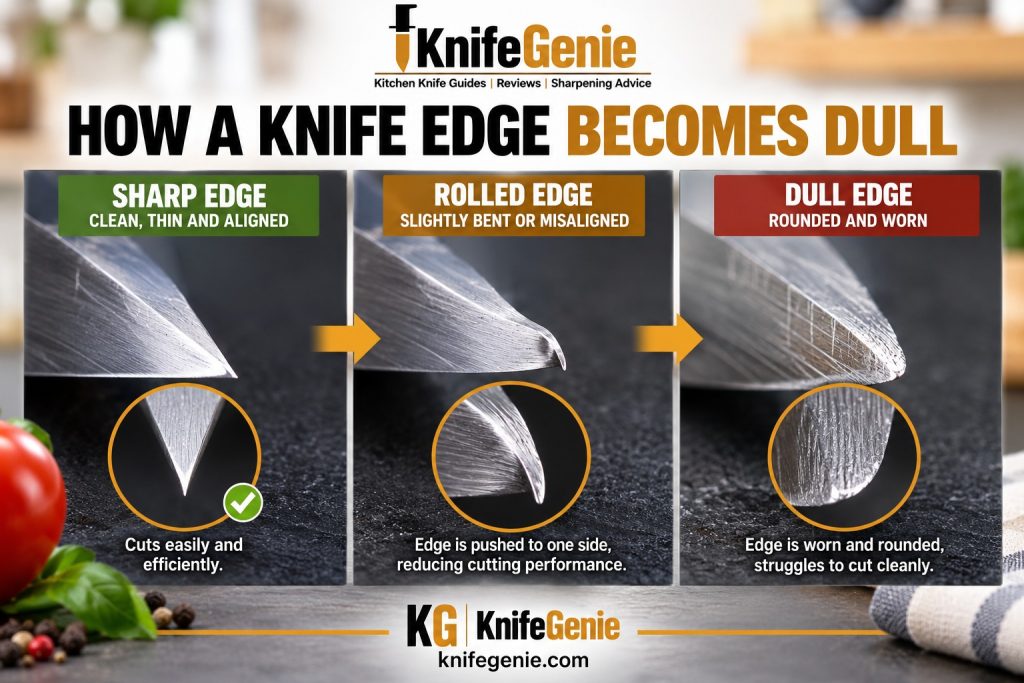
Over weeks and months, the edge gradually changes.
Depending on the knife and how it is used, the edge may:
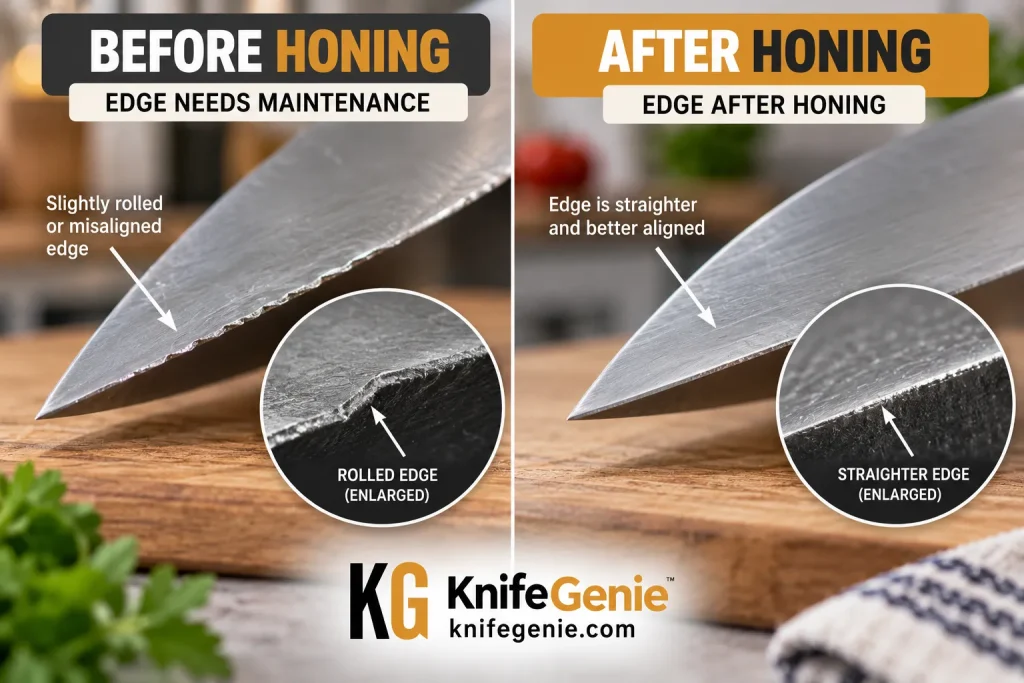
🔹 Become slightly misaligned
🔹 Roll to one side
🔹 Wear away microscopically
🔹 Develop tiny chips
🔹 Become rounded
Eventually, the edge no longer cuts as efficiently as it once did.
That is what we experience as a dull knife.
And some everyday kitchen habits accelerate that process dramatically.
🔍 9 Reasons Kitchen Knives Get Dull So Quickly
If your knife seems to lose its edge surprisingly fast, start with these common causes.
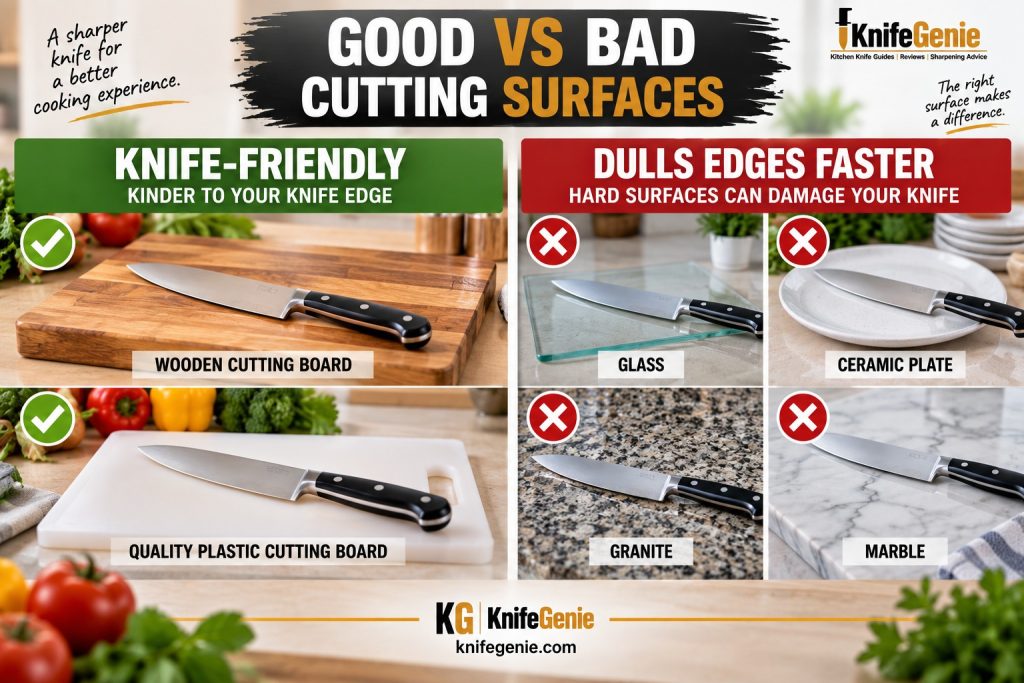
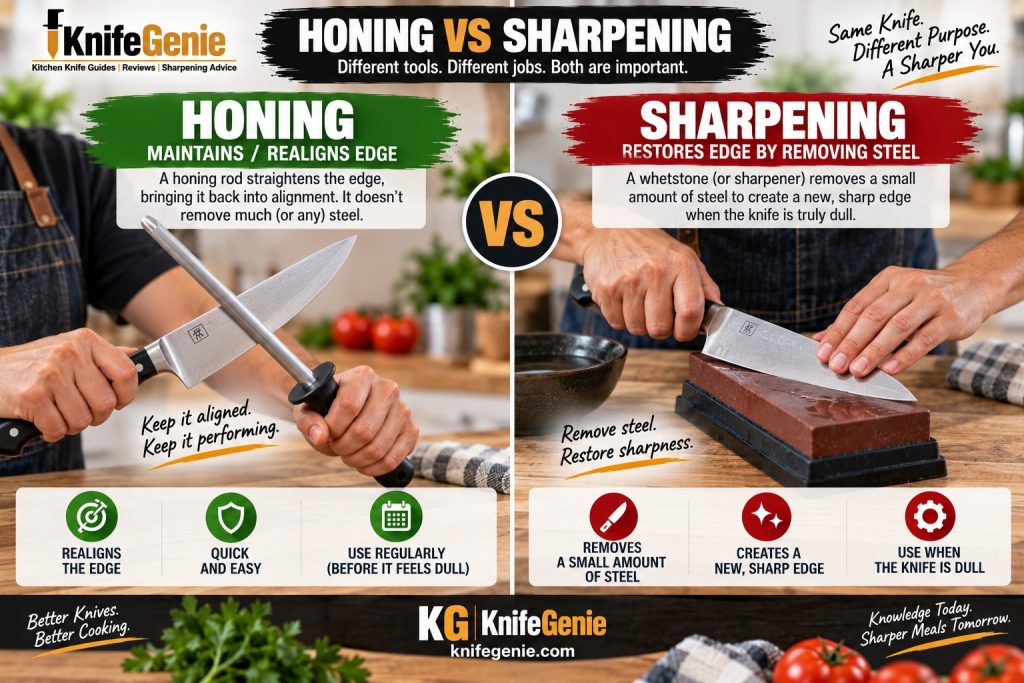
🪵 1. Your Cutting Board Is Too Hard
This is one of the first things to check.
Every time your knife completes a cut, its edge usually contacts the cutting board.
A forgiving cutting surface allows the knife edge to meet the board without taking unnecessary punishment.
A very hard surface does the opposite.
❌ Avoid Regularly Cutting On:
Glass
Granite
Marble
Ceramic plates
Stone countertops
Metal surfaces
These surfaces can be considerably harder and less forgiving than a suitable cutting board.
A beautiful glass cutting board might look hygienic and modern, but it is not friendly to a fine knife edge.
✅ Better Choices
For everyday kitchen use, wood and suitable plastic cutting boards are generally much kinder to knife edges.
If your expensive chef’s knife keeps becoming dull surprisingly quickly, check the board before blaming the blade.
💡 KnifeGenie Tip
Your cutting board is part of your knife-maintenance system.
A good knife on the wrong surface can lose performance far sooner than it should.
↔️ 2. You Scrape Food With the Cutting Edge
This habit is incredibly common.
You finish chopping onions.
Then you turn the knife sideways and drag the chopped pieces across the board using the sharp edge.
Convenient?
Absolutely.
Good for the edge?
Not really.
The knife is designed primarily to cut with forces directed through the edge.
Dragging that fine edge sideways across a cutting board subjects it to lateral stress.
💡 Better Habit
Turn the knife over and use the spine to move chopped food.
Even better, use a bench scraper when transferring larger quantities of vegetables.
It takes only a second and avoids unnecessary wear on your cutting edge.

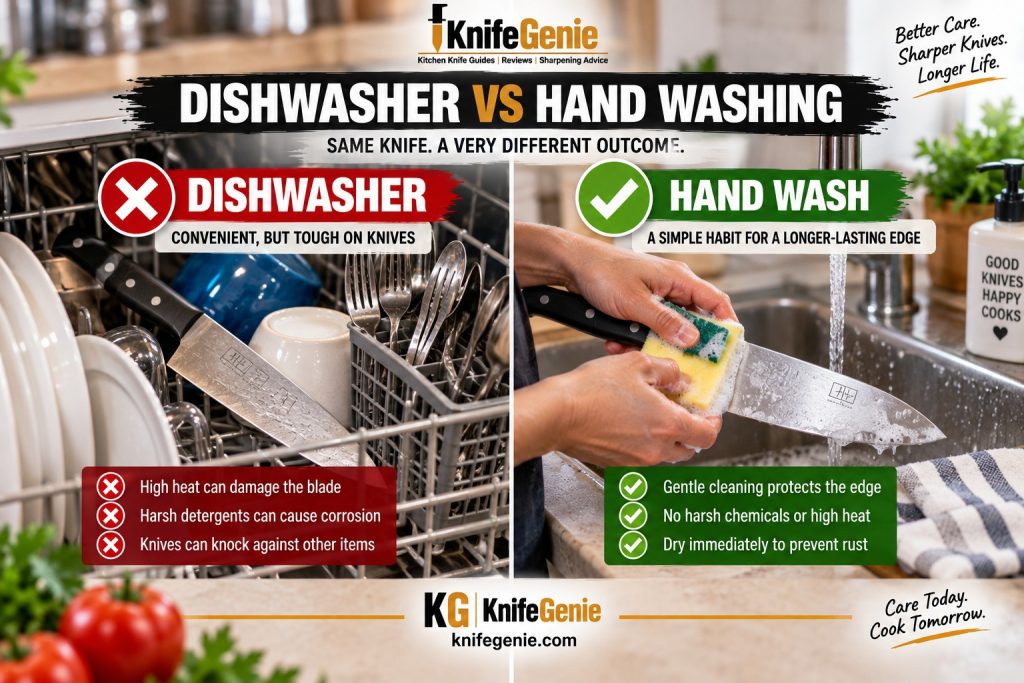
🧼 3. You Put Your Knives in the Dishwasher
A dishwasher might save time, but quality kitchen knives are generally better washed by hand.
Inside a dishwasher, several things can work against your knife.
There is prolonged moisture.
There are high temperatures.
There are strong detergents.
And the knife can potentially knock against racks, dishes or other utensils during the cycle.
That combination isn’t ideal for maintaining a fine cutting edge—or, depending on the knife, its handle and finish.
🏆 Better Routine
Wash your knife by hand with warm water, mild dishwashing liquid and a soft sponge or cloth.
Then dry it promptly.
It takes less than a minute.
And it is one of the easiest knife-care habits to adopt.
👉 Internal link: Can Kitchen Knives Go in the Dishwasher?
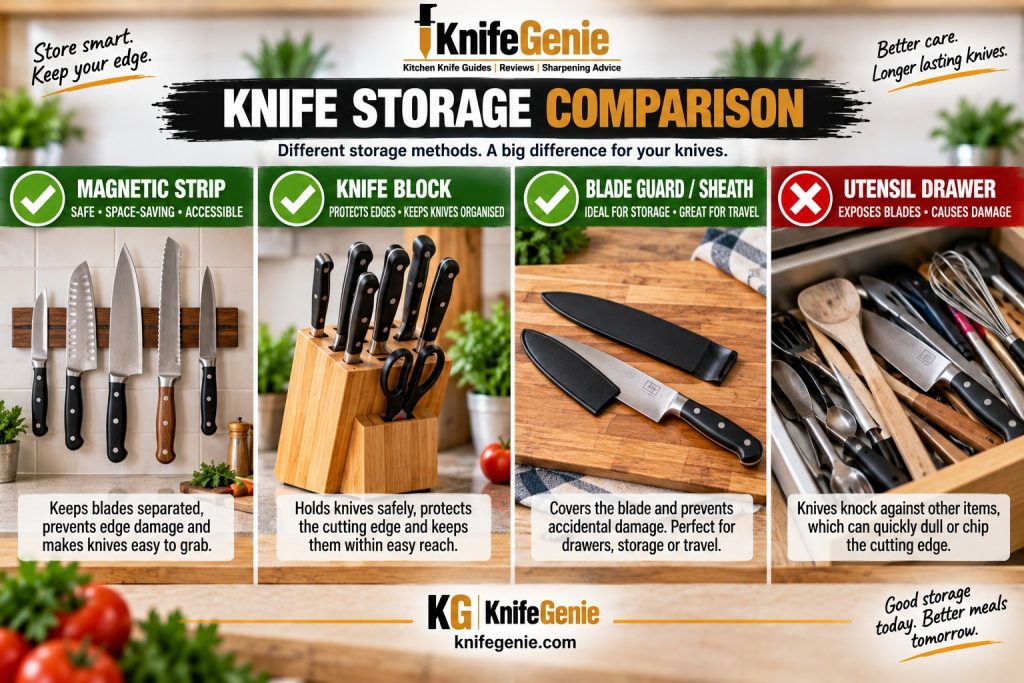
🗄️ 4. Your Knives Are Loose in a Drawer
You wash your chef’s knife.
You dry it.
Then…
Clunk.
Into a drawer with forks, spoons, peelers and other knives.
Every time the drawer opens and closes, those objects can contact one another.
That isn’t how you want to treat a fine cutting edge.
Better Storage Options Include:
🧲 A suitable magnetic knife strip
🪵 A knife block
🛡️ Individual blade guards
🗄️ A dedicated knife drawer insert
The important principle is simple:
Protect the edge from unnecessary contact when the knife isn’t being used.
👉 Internal link: How to Store Kitchen Knives Safely
🦴 5. You’re Cutting Things Your Knife Wasn’t Designed to Cut
Your chef’s knife is versatile.
But versatile does not mean indestructible.
Trying to force a thin kitchen knife through extremely hard materials can damage the edge.
Be particularly cautious with:
🦴 Bones
🧊 Frozen foods
🐚 Hard shells
🍖 Thick joints
Extremely hard food can put more stress on the edge than the knife was designed to tolerate.
Depending on the steel and edge geometry, the result may be rolling, deformation or chipping.
💡 Use the Right Tool
A chef’s knife is excellent for vegetables, herbs, boneless meat and general food preparation.
It is not a substitute for a meat cleaver, bone saw or other specialized tool.
Using the appropriate knife for the task protects both the edge and the user.
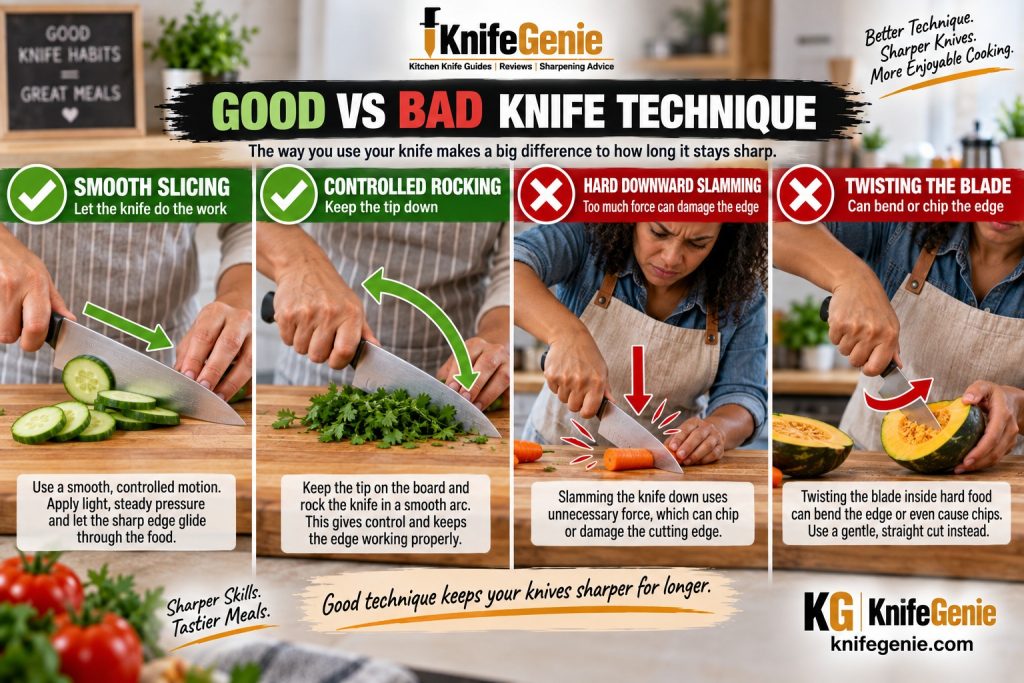
🔪 6. Your Cutting Technique Is Hard on the Edge
How you use the knife matters too.
You don’t need to baby a good kitchen knife.
It is a tool.
But repeatedly twisting the edge while it is embedded in food, slamming it into the board or using excessive force can accelerate wear or damage.
Watch Out for:
❌ Aggressive chopping into the board
❌ Twisting the blade while cutting hard food
❌ Using the knife as a pry bar
❌ Using the tip like a screwdriver
❌ Striking bones with a thin chef’s knife
A sharp kitchen knife should do much of the work for you.
If you regularly need excessive force, either the knife is already dull or you may be using the wrong tool or technique.
🔩 7. The Steel and Edge Geometry Affect Edge Retention
Not every knife dulls at exactly the same rate.
Two chef’s knives can be used in the same kitchen and behave quite differently.
That’s because edge retention depends partly on factors such as:
🧪 Steel composition
🌡️ Heat treatment
💎 Steel hardness
📐 Edge angle
🔪 Blade geometry
🧱 Edge thickness
A relatively hard steel may support a fine edge and offer excellent edge retention.
But hardness isn’t everything.
Harder steels can sometimes be less tolerant of impacts or twisting, while somewhat softer steels may be tougher and easier to maintain.
⚠️ Important
Don’t judge a kitchen knife by hardness numbers alone.
A knife is a complete system.
Steel, heat treatment, geometry, sharpening and intended use all matter.
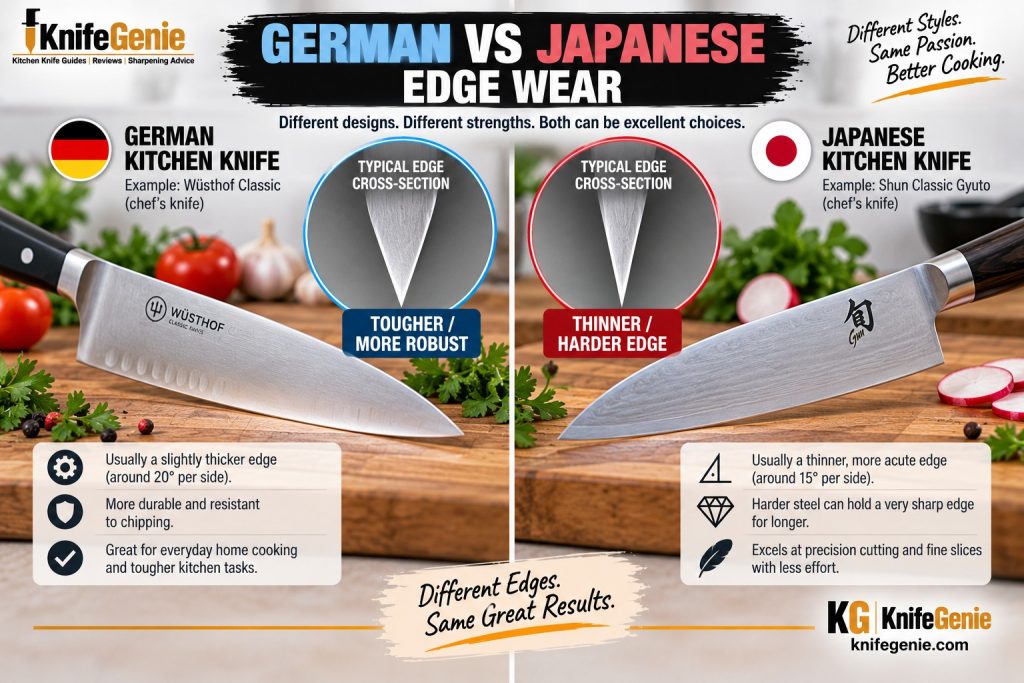
🇩🇪🇯🇵 8. German and Japanese Knives Can Dull Differently
This is where the difference between edge wear and edge damage becomes important.
Traditional German-style kitchen knives commonly use relatively tough steels and robust edge geometries.
Many Japanese knives use harder steels and thinner, more acute edges.
That can create different maintenance characteristics.
🇩🇪 German-Style Knife
Often:
✔️ Tough
✔️ Relatively forgiving
✔️ Suited to regular honing when appropriate
✔️ More likely to tolerate everyday Western-style kitchen use
🇯🇵 Japanese-Style Knife
Often:
✔️ Harder steel
✔️ Thinner blade geometry
✔️ Fine cutting performance
✔️ Excellent potential edge retention
But that thinner, harder edge may be less tolerant of twisting, bones and other abuse.
Neither approach is automatically better.
They simply represent different design priorities.
👉 Internal link: German vs Japanese Kitchen Knives
⏱️ 9. You Use the Knife a Lot
Sometimes there is nothing wrong with your knife.
You simply use it frequently.
Imagine two people buying identical chef’s knives.
Cook A
Prepares dinner two or three times per week.
Cook B
Prepares breakfast, lunch and dinner almost every day.
Cook B’s knife might make thousands more cuts over the same period.
Naturally, its edge experiences more wear.
That’s why there is no universal sharpening schedule that works for everyone.
How often you sharpen should depend more on actual cutting performance than an arbitrary date on the calendar.
👉 Internal link: How Often Should You Sharpen Kitchen Knives?
📊 What Makes a Kitchen Knife Dull Faster?
| Factor | Effect on Edge | Better Choice |
|---|---|---|
| Glass cutting board | Very hard on edge | Wood or suitable plastic |
| Ceramic/stone surface | Accelerates wear | Proper cutting board |
| Scraping with edge | Adds sideways stress | Use spine or scraper |
| Dishwasher | Heat, detergent and contact | Hand wash |
| Loose drawer storage | Edge can contact utensils | Block, guard or strip |
| Bones/frozen food | Can roll or chip edge | Correct specialized tool |
| Twisting blade | Lateral stress | Straight controlled cuts |
| Heavy use | Normal accelerated wear | Maintain as needed |
| No honing/maintenance | Performance gradually declines | Appropriate maintenance |
🧐 How Can You Tell When a Kitchen Knife Is Dull?
You don’t need laboratory equipment.
Usually, your food tells you.
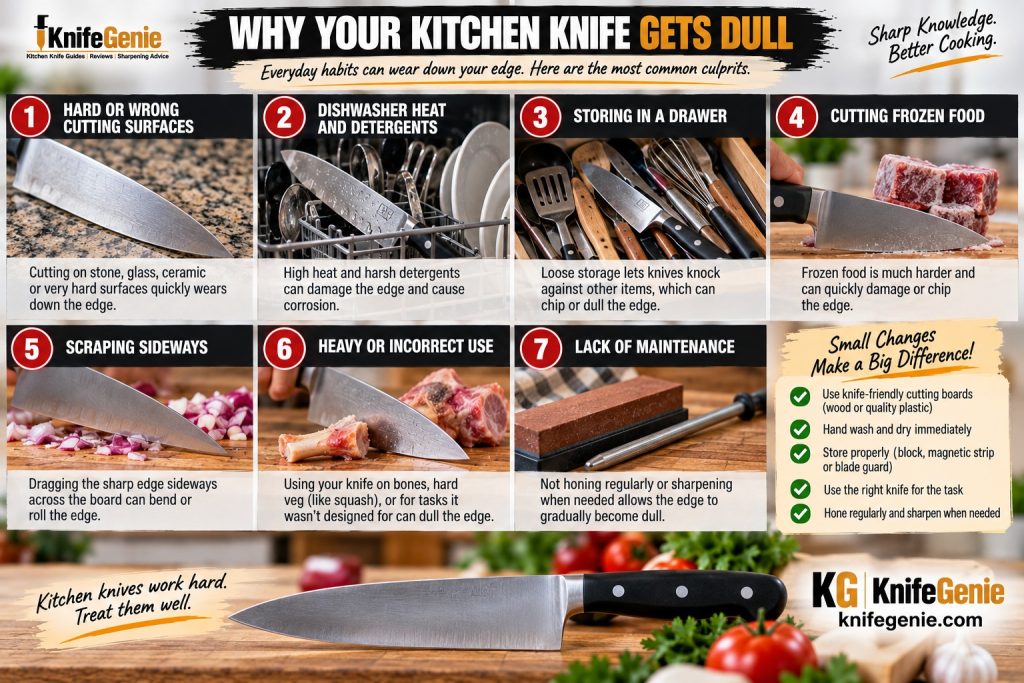
🍅 The Tomato Test
Place a ripe tomato on your cutting board.
Using normal safe cutting technique, try to begin a slice.
A properly sharp chef’s knife should bite into the skin without requiring excessive downward pressure.
If the blade slides across the skin or squashes the tomato before cutting, the edge needs attention.
🧅 Pay Attention During Normal Cooking
Other warning signs include:
❌ Onions becoming harder to slice
❌ Herbs bruising instead of cutting cleanly
❌ Meat requiring more sawing
❌ Carrots requiring noticeably more force
❌ The knife slipping rather than biting into food
❌ Cutting feeling less controlled
The change can happen gradually enough that you don’t notice it immediately.
Then you sharpen the knife and suddenly think:
“I forgot it was supposed to cut like this.”
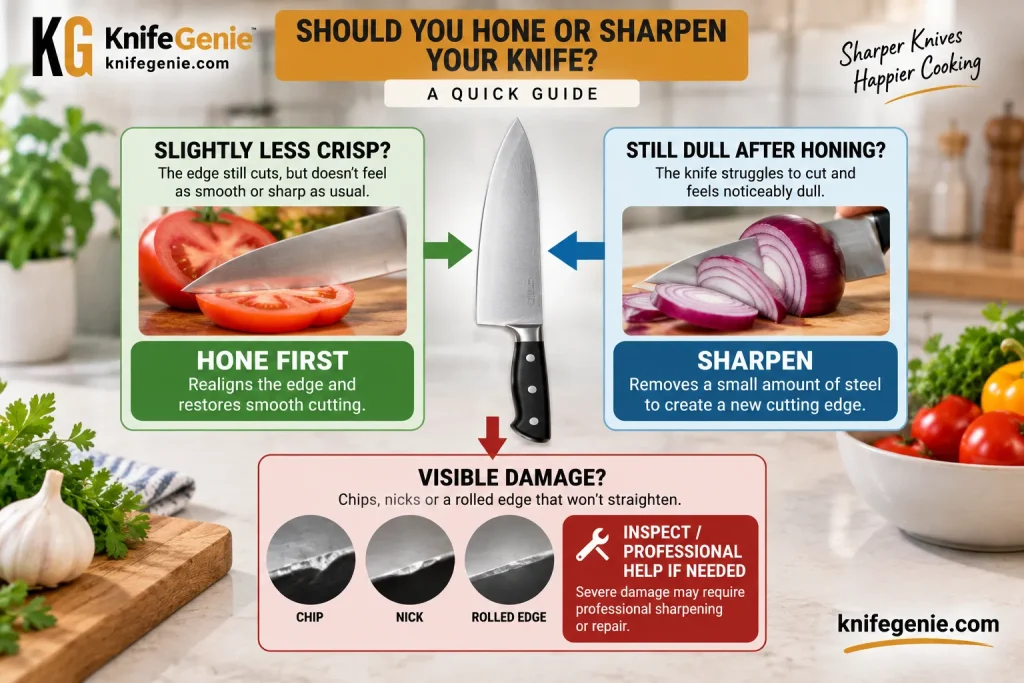
🔧 Is Your Knife Dull—or Does It Just Need Honing?
This distinction can save you from sharpening unnecessarily.
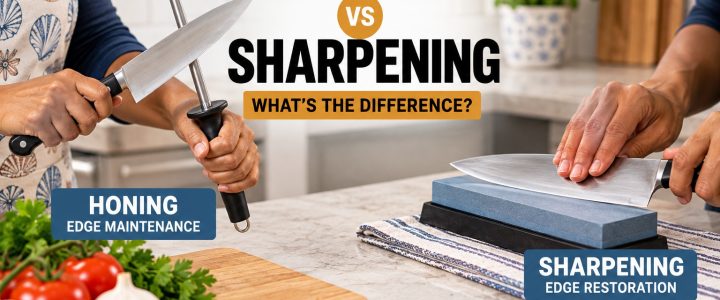
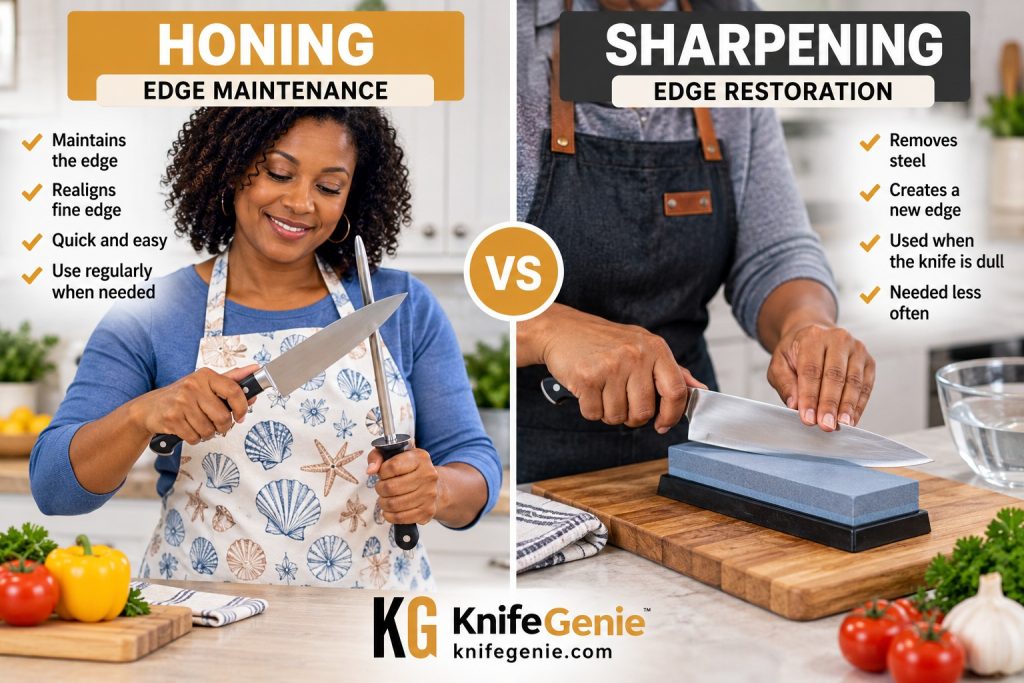
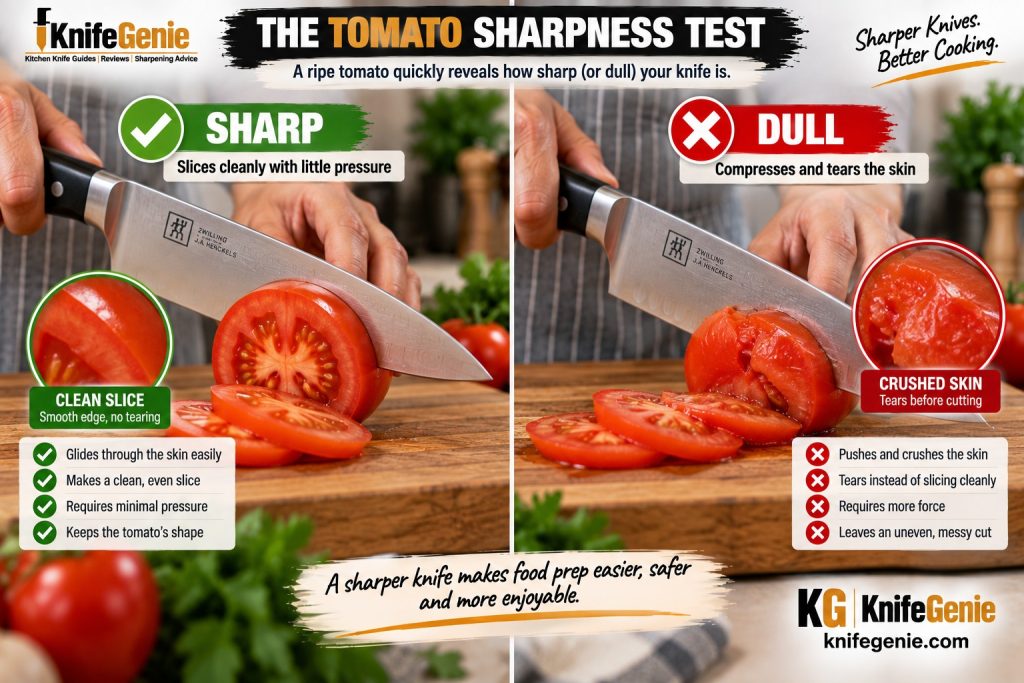
Honing and sharpening are not the same thing.
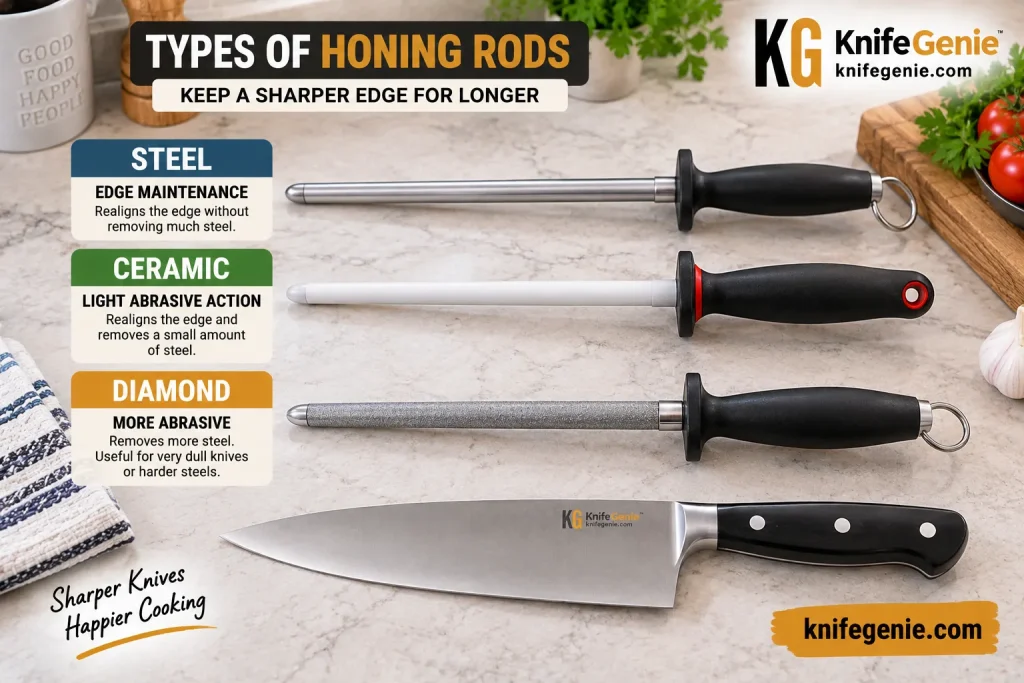
🔧 Honing
Honing primarily helps maintain or realign an existing edge.
Think:
Honing = edge maintenance
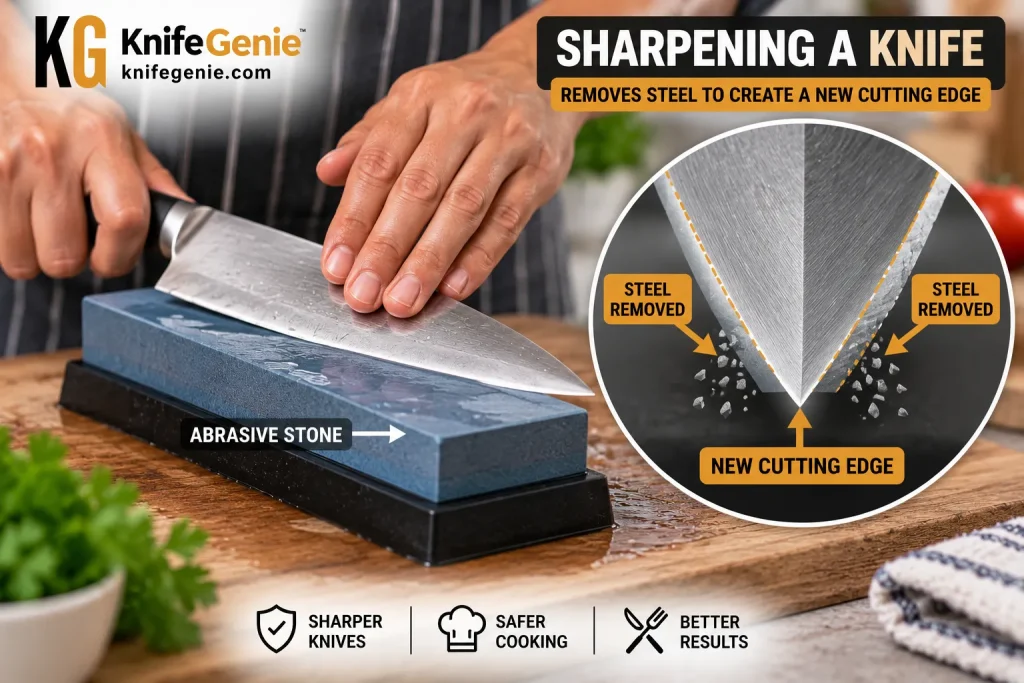
🪨 Sharpening
Sharpening uses an abrasive to remove blade material and restore the cutting edge.
Think:
Sharpening = edge restoration
If an appropriate honing method restores the knife’s performance, you probably don’t need to sharpen it yet.
If honing no longer helps, the edge may need actual sharpening.
👉 Internal link: Honing vs Sharpening: 7 Critical Mistakes to Avoid
🛡️ How to Keep Kitchen Knives Sharp Longer
Fortunately, preventing premature dulling isn’t complicated.
🏆 KnifeGenie Edge-Saving Routine
1. Use the right cutting board.
Choose wood or suitable plastic rather than glass, stone or ceramic.
2. Stop scraping with the cutting edge.
Flip the knife and use its spine, or use a bench scraper.
3. Hand wash your knives.
Clean them promptly and dry them thoroughly.
4. Store the edge safely.
Use a knife block, suitable magnetic strip, drawer insert or blade guard.
5. Match the knife to the task.
Don’t expect a thin chef’s knife to function like a meat cleaver.
6. Avoid twisting the edge.
Cut cleanly through food rather than applying unnecessary lateral force.
7. Hone when appropriate.
Regular maintenance can help certain knife edges continue performing between sharpenings.
8. Sharpen when necessary.
Once honing no longer restores satisfactory performance, it may be time to sharpen.
9. Don’t over-sharpen.
Sharpening removes steel. There’s no benefit in grinding away blade material when the knife doesn’t need it.
⚠️ A Dull Knife Isn’t Just Annoying
A dull knife makes food preparation slower and more frustrating.
It can also encourage you to compensate by pushing harder.
That’s not ideal.
A sharp knife generally requires less force to perform the same cutting task.
The goal isn’t to keep your kitchen knives razor-sharp simply for bragging rights.
The goal is to maintain a controlled, predictable cutting tool.
If you notice yourself forcing the knife through foods it once cut easily, investigate why.
It may need honing.
It may need sharpening.
Or your cutting board and maintenance habits may be wearing the edge prematurely.
🧠 The Biggest Mistake: Blaming the Knife
If your knife becomes dull quickly, it is tempting to assume:
“This must be bad steel.”
Sometimes poor steel or poor heat treatment can certainly contribute to disappointing edge retention.
But don’t jump to that conclusion immediately.
First check:
🪵 What are you cutting on?
🧼 How are you washing it?
🗄️ How are you storing it?
🔪 What are you cutting?
↔️ Are you scraping the board with the edge?
🔧 Are you maintaining the edge appropriately?
🍳 How frequently are you using it?
A reasonably good knife can perform poorly when treated badly.
Likewise, good maintenance can help a modest kitchen knife perform reliably for a long time.
🔗 Related KnifeGenie Guides
If you’re working on keeping your kitchen knives sharper and in better condition, continue with:
👉 How Often Should You Sharpen Kitchen Knives? — Learn when a knife actually needs sharpening.
👉 Honing vs Sharpening: 7 Critical Mistakes to Avoid — Understand when to hone and when to remove steel.
👉 Best Knife Sharpeners for Beginners — Compare beginner-friendly ways to restore an edge.
👉 Can Kitchen Knives Go in the Dishwasher? — Learn why hand washing is usually the better choice.
👉 How to Store Kitchen Knives Safely — Protect your knives between uses.
👉 German vs Japanese Kitchen Knives — Understand how steel, hardness and blade geometry affect performance and maintenance.
❓ Frequently Asked Questions
Why does my kitchen knife get dull so fast?
Common causes include cutting on hard surfaces, scraping the cutting edge across the board, dishwasher cleaning, poor storage, cutting hard or frozen foods, heavy use and inappropriate maintenance. The knife’s steel, heat treatment and edge geometry also affect edge retention.
Do cutting boards dull knives?
All cutting involves some edge wear, but extremely hard surfaces can accelerate it. Wood and suitable plastic cutting boards are generally more forgiving than glass, ceramic, stone and metal.
Does cutting meat dull a knife?
Normal slicing of boneless meat is an appropriate job for many kitchen knives. Problems are more likely when the knife contacts bones, hard joints or other materials its edge wasn’t designed to cut.
Does cutting vegetables make knives dull?
Yes, eventually. Every time the edge passes through food and contacts the cutting board, it experiences wear. That’s normal. The goal isn’t to prevent all dulling but to avoid premature dulling.
Why shouldn’t I scrape food with my knife?
Dragging the cutting edge sideways across a board places lateral stress on the fine edge. Use the knife’s spine or a bench scraper instead.
Can a dishwasher make kitchen knives dull?
Dishwasher conditions can be unfriendly to knife edges because of strong detergents, heat, long wash cycles and potential contact with other items. Hand washing and prompt drying are generally safer for quality kitchen knives.
How often should kitchen knives be sharpened?
There isn’t one schedule that works for everyone. For many home cooks, sharpening roughly once or twice per year can be a useful starting point, but actual cutting performance is more important than the calendar. Heavy users may need sharpening sooner, while occasional users may go considerably longer.
Should I hone or sharpen my knife?
If the knife’s edge is simply slightly misaligned and appropriate honing restores cutting performance, sharpening isn’t necessary yet. If honing no longer restores the edge, actual sharpening may be required.
Do expensive knives stay sharp forever?
No. Every kitchen knife eventually requires maintenance. Better steel, heat treatment and geometry may improve edge retention, but price does not eliminate normal edge wear.
Do Japanese knives stay sharp longer?
Many Japanese kitchen knives use relatively hard steels and thin edge geometries that can provide excellent edge retention. However, those fine edges may also be less tolerant of twisting, bones or other misuse. Individual knife design matters more than country of origin alone.
🏁 Final Cut: Why Kitchen Knives Get Dull So Quickly
So why do kitchen knives get dull so quickly?
Because a knife edge is incredibly thin—and every cut puts that edge under stress.
Some dulling is unavoidable.
That’s simply what happens when you use a cutting tool.
But premature dulling is often preventable.
🏆 KnifeGenie Takeaway
If you want your knives to stay sharp longer:
🪵 Use a knife-friendly cutting board.
↔️ Don’t scrape the cutting edge across it.
🧼 Hand wash and dry your knives.
🗄️ Protect the edge during storage.
🦴 Don’t force chef’s knives through bones or frozen foods.
🔧 Hone appropriately.
🪨 Sharpen when the edge genuinely needs restoring.
And remember:
A knife that gets dull doesn’t automatically mean you bought a bad knife.
Sometimes the biggest improvement isn’t buying a more expensive blade.
It’s changing how you use the one you already have.
Sharp knives. Smart choices.
— KnifeGenie