Keep Your Sharpening Stone Flat, Clean, and Ready to Use
A good whetstone can serve you for years, but it needs occasional maintenance to keep sharpening your kitchen knives effectively. Learn how to clean and flatten a whetstone because, over time, metal particles and worn abrasive collect on its surface, while repeated sharpening can gradually wear a hollow into the middle.
Fortunately, cleaning a whetstone is usually straightforward, and flattening one is easier than it might sound.
In this guide, you’ll learn how to remove sharpening residue, check whether your stone is still flat, choose a suitable flattening plate, and restore a worn sharpening surface. We’ll also explain why water stones, oil stones, and diamond sharpening plates require different care.
Whether you’re maintaining your first sharpening stone or looking after a collection, a few good habits will help you get more consistent results.
Quick Answer: How Do You Clean and Flatten a Whetstone?
To clean a typical water whetstone, rinse away sharpening residue with clean water and gently loosen stubborn particles with a soft brush or sponge. To flatten it, draw a pencil grid across the surface, wet the stone as directed, and rub it against a compatible flattening plate until the pencil marks disappear evenly.
Rinse the stone thoroughly, let it dry naturally according to the manufacturer’s instructions, and store it safely.
Important: Oil stones need a different cleaning method, and diamond sharpening plates generally should not be flattened like conventional water stones.
 Jump to What You Need
🔍 Why Whetstones Need Regular Maintenance
Every time you sharpen a kitchen knife on a traditional whetstone, tiny particles of steel and abrasive material are released. Depending on the stone, these particles may form a gray slurry on the surface.
Some slurry is useful during sharpening. However, accumulated debris can clog the abrasive surface and make the stone feel unusually smooth or slippery.
There’s another issue: uneven wear.
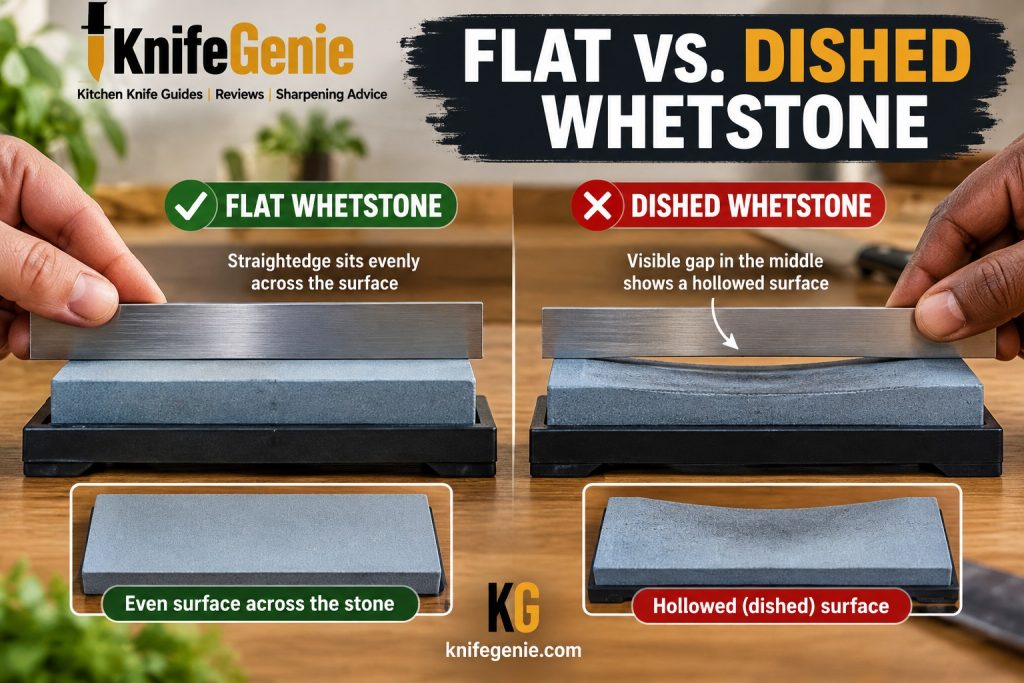
Most people sharpen their knives using the middle portion of a stone more frequently than its ends. As a result, the center may gradually become lower than the surrounding surface.
This is called dishing.
Flat Whetstone vs. Dished Whetstone
⚠️ Why a Dished Whetstone Is a Problem
A hollowed sharpening surface can make it harder to maintain a consistent sharpening angle, particularly when sharpening long kitchen knives.
It may also cause uneven contact along the blade and complicate sharpening near the tip.
Flattening restores a level working surface and makes your sharpening technique more predictable.
If you’re still learning the basic sharpening process, start with our How to Sharpen a Chef Knife With a Whetstone tutorial.
🪨 Know Your Sharpening Stone Before Cleaning It
Not every sharpening stone should be cleaned or flattened the same way.
Before beginning, identify the type of stone you’re using.
| Stone type | Cleaning method | Flattening requirements |
|---|---|---|
| Water stone | Water and gentle brushing | Often needs periodic flattening |
| Oil stone | Appropriate honing oil or manufacturer-approved cleaner | Flatten only when needed, using a compatible method |
| Diamond plate | Brush and approved cleaning method | Normally not flattened |
| Natural stone | Depends on the stone’s composition | Use manufacturer or specialist guidance |
💧 Water Stones
Water stones are common among home cooks who sharpen Japanese and Western kitchen knives.
They use water as their sharpening lubricant, although preparation varies. Some stones require soaking, while others need only a splash of water.
Softer water stones may wear relatively quickly, making regular flattening particularly important.
🛢️ Oil Stones
Oil stones traditionally use honing oil to lubricate the sharpening surface and carry away metal particles.
Examples include Arkansas stones and manufactured aluminum oxide or silicon carbide oil stones.
They are often harder and more wear-resistant than softer water stones, although they can still become clogged or uneven.
Do not assume that water alone will remove accumulated oil and metal debris. Use a cleaning method appropriate to the stone.
💎 Diamond Sharpening Plates
Diamond sharpening plates have abrasive diamond particles attached to a rigid backing.
Unlike conventional water stones, they do not usually develop a hollow through normal abrasive wear. However, their diamond coating can become damaged or worn.
A damaged diamond plate generally needs replacement rather than conventional flattening.
KnifeGenie Tip: Check the manufacturer’s instructions before soaking, scrubbing, cleaning with detergent, or flattening any sharpening stone. Even stones within the same general category can have different care requirements.
🧽 How to Clean a Whetstone After Sharpening
Cleaning a water stone immediately after sharpening is one of the simplest ways to prevent residue from accumulating.
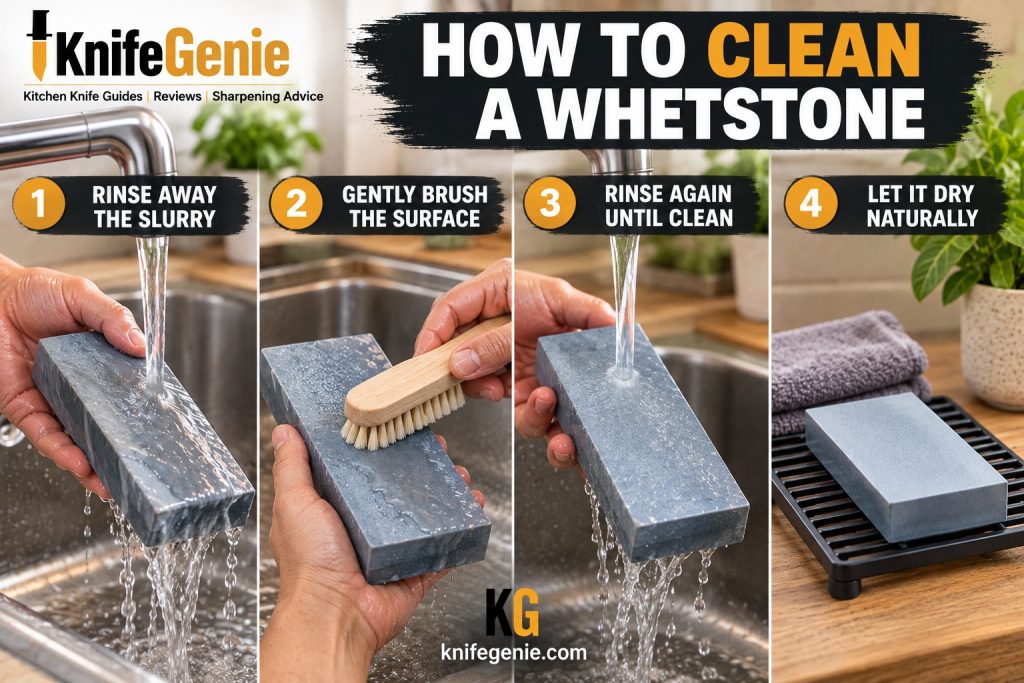
Remove sharpening residue after every session to help keep your stone working effectively.
Suggested image: Four-panel realistic instructional infographic showing rinsing gray slurry from a water stone, gently brushing its surface, rinsing again, and placing it on a drying rack. Embedded title “HOW TO CLEAN A WHETSTONE.” Use KnifeGenie branding.
Step 1: Remove Loose Sharpening Residue
After sharpening, remove the knife and set it safely aside.
Rinse the water stone under a gentle flow of clean, cool water, if its manufacturer permits this.
Use your fingers or a soft sponge to loosen the gray slurry and abrasive residue.
Avoid using excessive pressure.
Step 2: Gently Clean the Surface
If particles remain embedded in the stone, use a soft nylon brush or nonabrasive sponge.
Work gently across the surface.
Avoid stiff wire brushes, harsh cleaning chemicals, or aggressive scrubbing that could damage the stone.
Step 3: Address Glazing or Stubborn Clogging
Sometimes a whetstone develops a smooth, shiny area that no longer cuts efficiently. This is often called glazing.
A normal rinse may not remove it.
For compatible water stones, a manufacturer-approved dressing stone or lapping tool can refresh the abrasive surface.
Remember that dressing and flattening are related but different operations: dressing restores cutting action, while flattening restores surface geometry.
Step 4: Rinse Thoroughly
Remove loosened residue and any coarse particles left behind by a dressing tool.
This is particularly important when switching from a coarse stone to a fine finishing stone. Stray coarse particles can scratch a polished knife edge.
Step 5: Prepare the Stone for Drying
Shake off excess water gently or allow it to drain.
Place the stone on a clean, ventilated surface and follow its specific drying instructions.
Do not immediately seal a wet stone inside a storage box unless the manufacturer specifically recommends that method.
🛢️ How to Clean an Oil Stone
Oil stones require a different approach.
Wipe away used honing oil and metal particles with a lint-free cloth or paper towel. Apply a small amount of fresh, compatible honing oil if needed to loosen residue, then wipe again.
For heavily clogged stones, follow the manufacturer’s recommended cleaning procedure. Some oil stones permit specific cleaners, while others require more conservative care.
Avoid automatically applying water-stone cleaning methods to oil stones.
💎 How to Clean a Diamond Plate
Brush away loose metal particles with a soft nylon brush.
Clean with water or a manufacturer-approved cleaner, depending on the plate’s construction and instructions.
Dry the plate thoroughly, including its backing and any exposed metal surfaces.
Do not use an abrasive flattening plate on a diamond sharpening plate.
📏 How to Check Whether a Whetstone Is Flat
A stone doesn’t need to develop a dramatic hollow before flattening becomes useful.
Checking flatness takes less than a minute.
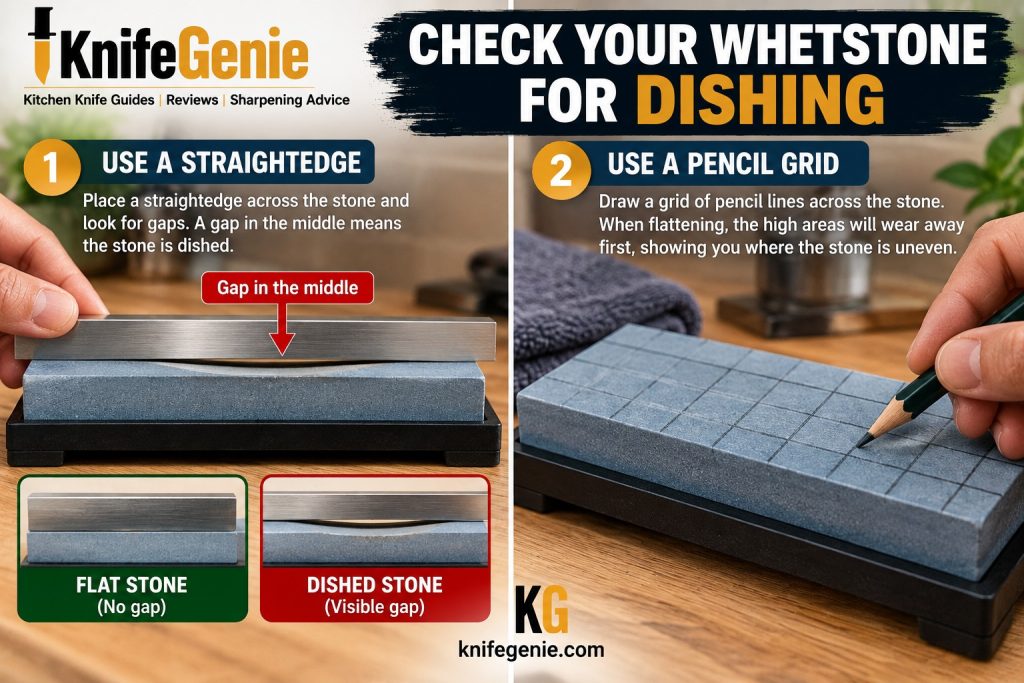
Method 1: Use a Straightedge
Place a clean, reliable straightedge across the sharpening surface.
Check the stone lengthwise, across its width, and diagonally.
Look for gaps between the straightedge and the stone.
A visible gap in the middle suggests that the surface has become dished.
Method 2: Use the Pencil Grid Test
Draw a light crosshatch pattern across the entire sharpening surface with an ordinary graphite pencil.
The grid will help you see which areas contact the flattening plate first.
When flattening begins, pencil marks on the high areas usually disappear before those in the low areas.
Continue until the marks disappear evenly.
This technique is also described in Shapton’s official sharpening stone maintenance guidance.
KnifeGenie Tip: Don’t wait until a deep hollow develops. Light, frequent flattening is generally easier than correcting a heavily dished stone.
🧰 How to Choose the Right Whetstone Flattening Plate
A flattening plate, sometimes called a lapping plate, is a tool designed to remove small amounts of material from a sharpening stone until its working surface becomes level.
Choosing the right tool matters because not every plate works with every type of stone.
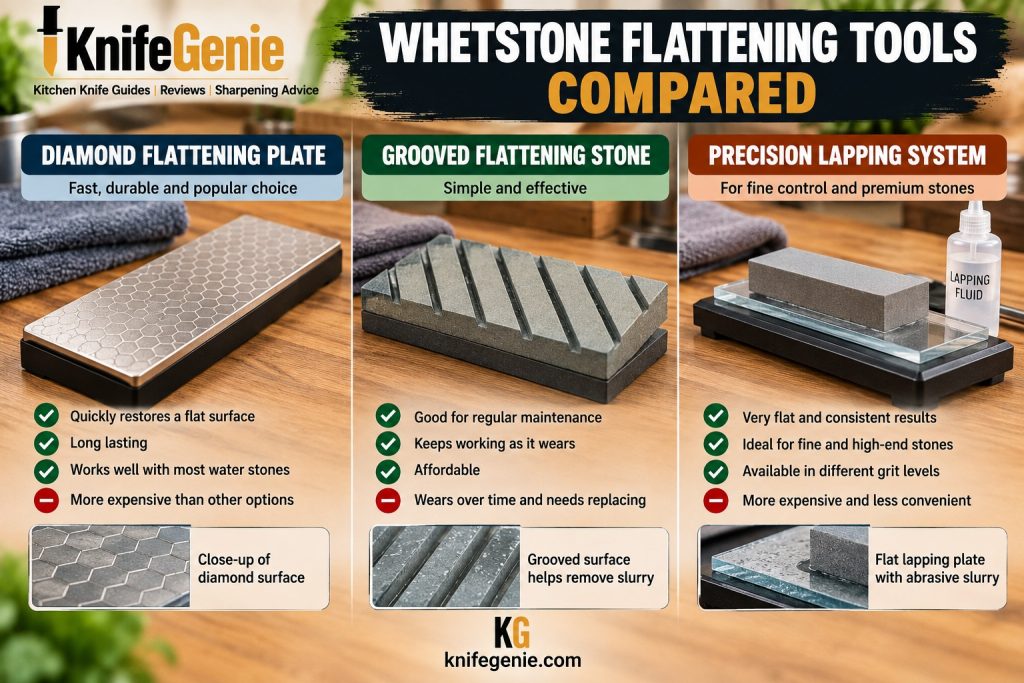
Choose a flattening tool compatible with your sharpening stone and its grit.
| Flattening tool | Best use | Main consideration |
|---|---|---|
| Diamond flattening plate | Routine maintenance of compatible water stones | Fast, convenient, and relatively easy to use |
| Grooved flattening stone | Basic water-stone maintenance | May wear and need checking itself |
| Precision lapping system | Specialized stones and fine finishing work | Requires correct abrasive selection |
| Abrasive paper on a flat surface | Only where manufacturer-approved | May contaminate or clog certain stones |
⭐ Best Choice for Most Home Cooks
A good-quality diamond flattening plate designed for water stones is usually the most convenient choice.
Look for a plate with a stable, accurately flat backing, an abrasive grade suitable for your stone, and clear manufacturer compatibility instructions.
For very fine finishing stones, an overly coarse plate may leave the surface too rough. Additional fine lapping may be necessary.
Shapton, for example, specifies different lapping media for different stone grades. Its NAORU lapping system instructions explain how coarse, medium, and fine lapping powders affect the final surface.
🛠️ How to Flatten a Whetstone: Step-by-Step
For this procedure, we’ll use a conventional water stone and a compatible diamond flattening plate.
Check that both tools are designed to work together before starting.
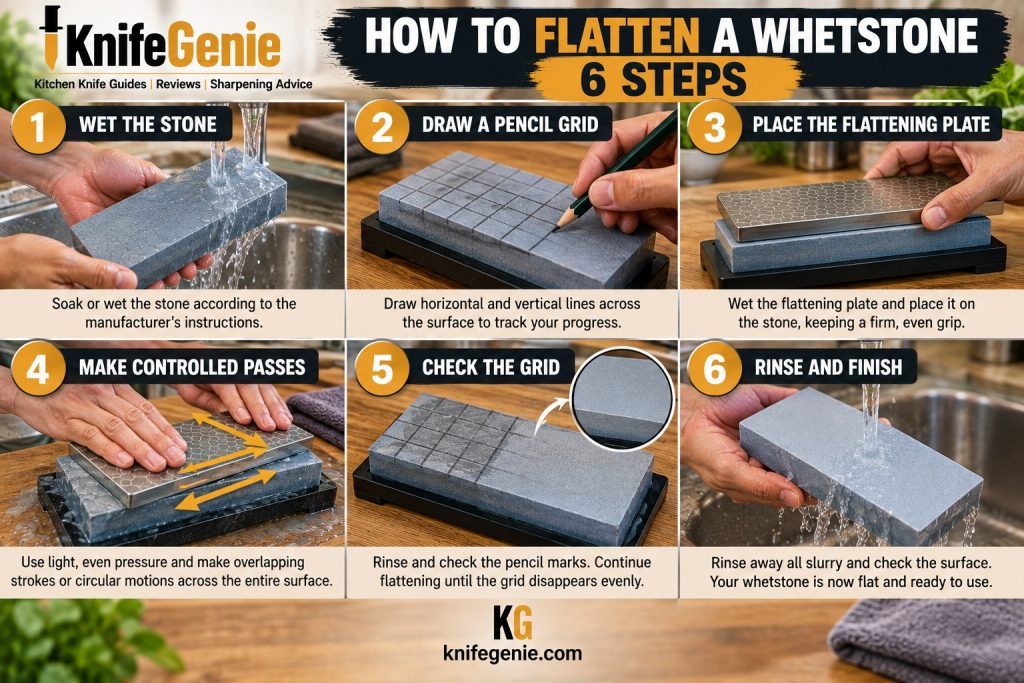
Step 1: Prepare a Stable Work Area
Place a damp non-slip mat or stone holder on a sturdy work surface.
Keep your hands away from sharp kitchen knives, and remove any knife from the work area before flattening.
Prepare clean water and a towel for controlling splashes.
Step 2: Wet the Whetstone
Wet or soak the stone according to its manufacturer’s instructions.
Some water stones need several minutes of soaking, while splash-and-go stones require only surface moisture.
Do not soak a stone simply because it is labeled a water stone.
Step 3: Draw a Pencil Grid
Use a graphite pencil to draw several horizontal and vertical lines across the working surface.
Make sure the grid extends toward the edges and corners.
These marks will help you track your progress.
Step 4: Begin Flattening
Wet the flattening plate as instructed by its manufacturer.
Hold the plate securely and move it across the stone using overlapping strokes or a controlled circular motion.
Apply light, even pressure rather than forcing the abrasive against the stone.
Keep the plate moving across the entire surface instead of concentrating only on the center.
Step 5: Inspect the Pencil Marks
Pause periodically and rinse away loose abrasive slurry.
Check the pencil grid.
If the marks remain in the center while those around the edges have disappeared, the stone is still hollow.
Continue flattening until the pencil marks disappear across the entire working surface.
Check again with your straightedge.
Step 6: Rinse and Finish the Surface
Rinse away all remaining slurry and loosened abrasive particles.
For fine finishing stones, use any additional fine-lapping step recommended by the manufacturer.
A coarse flattening finish may be unsuitable for a stone intended to produce a highly polished knife edge.
Once the surface is clean and suitably finished, the stone is ready for drying or further sharpening.
KnifeGenie Tip: How Much Material Should You Remove?
Remove only enough material to restore a properly flat surface. Excessive flattening shortens the life of the stone without improving its performance.
A lightly dished stone may need only a short maintenance session. A deeply hollowed stone can require considerably more work.
🌬️ How to Dry and Store a Whetstone Properly
Proper drying is just as important as cleaning and flattening.
Some water stones are vulnerable to cracking when exposed to rapid temperature changes or uneven drying.
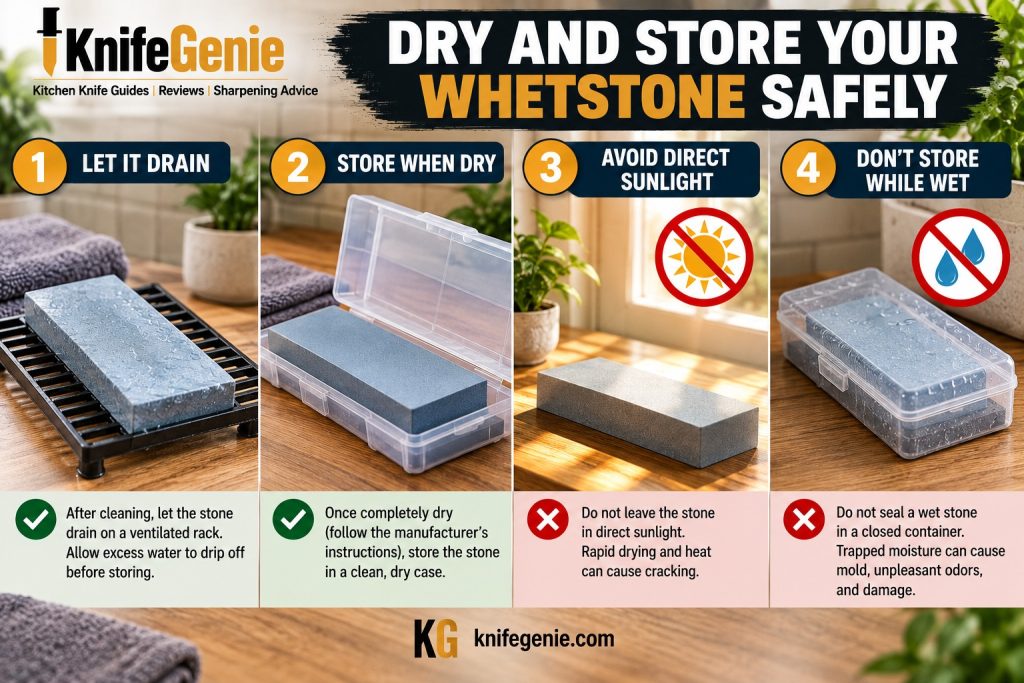
Follow manufacturer instructions to protect your whetstone during drying and storage.
✅ Let Water Stones Dry Naturally
For stones that require drying between uses, place them in a ventilated area at room temperature.
Avoid direct sunlight, ovens, hair dryers, heaters, and forced rapid drying.
Shapton specifically warns against rapid drying, prolonged soaking, and exposure to direct sunlight for its stones.
✅ Keep Storage Cases Clean
Before returning the stone to its case, check whether the stone and case need to be completely dry.
Remove any accumulated slurry, standing water, or residue from the case.
Do not wrap a damp stone in an absorbent towel and leave it sealed away unless the manufacturer specifically recommends that storage method.
✅ Protect the Stone From Damage
Store sharpening stones where they cannot fall, be struck by heavy kitchen tools, or experience extreme temperature changes.
Thin stones and stones bonded to glass or other backing materials may have additional handling requirements.
⚠️ What About Stones Designed for Permanent Soaking?
Some water stones are specifically designed to remain immersed between uses.
Follow the instructions for that exact stone. Do not assume that permanent soaking is suitable for every soaking stone.
📅 How Often Should You Clean and Flatten a Whetstone?
There isn’t one universal schedule for every sharpening stone.
The ideal frequency depends on how often you sharpen, how much pressure you use, the stone’s hardness, and the condition of its surface.
| Maintenance task | Suggested frequency |
|---|---|
| Remove slurry and residue | After every sharpening session |
| Inspect surface flatness | Before or after each session |
| Flatten a water stone | Whenever uneven wear appears; light maintenance may be done each session |
| Check for glazing or clogging | Whenever sharpening performance declines |
| Clean the storage case | Whenever residue or moisture accumulates |
A softer water stone used frequently may require more flattening than a hard, slow-wearing stone.
Norton recommends lapping its compatible stones whenever sharpening, illustrating why manufacturer-specific guidance matters.
❌ Common Whetstone Maintenance Mistakes
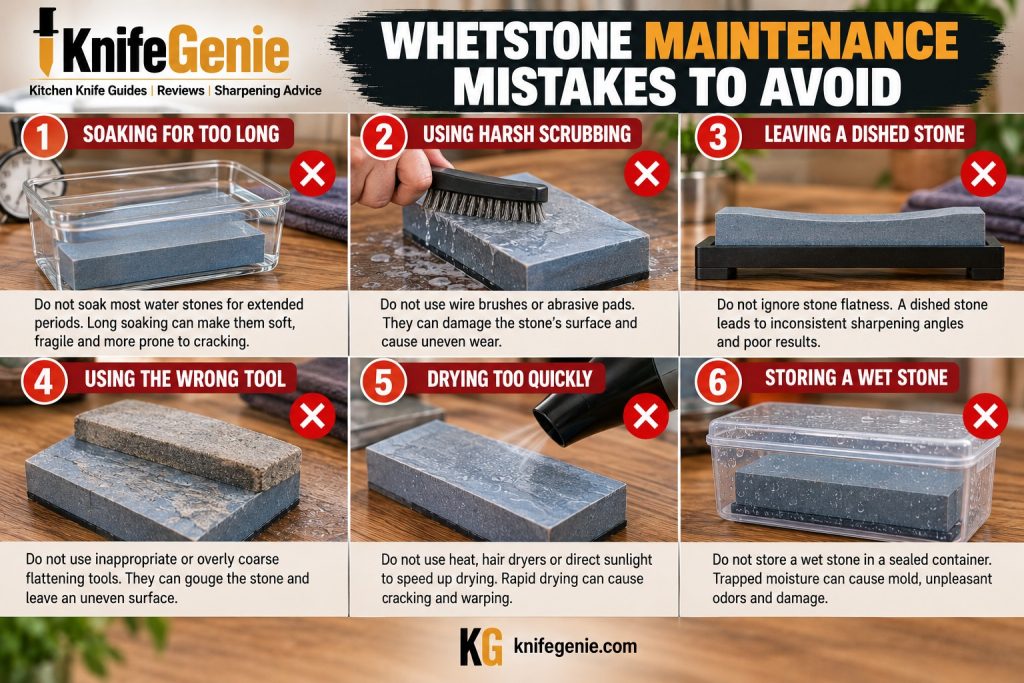
Avoid improper soaking, aggressive cleaning, and incompatible flattening tools.
1. Leaving Sharpening Slurry to Dry
Dried residue can clog the abrasive surface. Clean your stone after use.
2. Ignoring a Hollowed Surface
Even a moderate depression can make sharpening less consistent.
3. Using the Wrong Flattening Tool
An incompatible abrasive may damage the stone or leave an unsuitable surface finish.
4. Soaking Every Water Stone
Some stones are designed for splash-and-go use and may deteriorate when soaked excessively.
5. Drying a Stone Too Quickly
Direct heat and rapid drying may cause cracking.
6. Treating Diamond Plates Like Water Stones
Diamond plates normally require cleaning, not abrasive flattening.
✅ Whetstone Maintenance Checklist
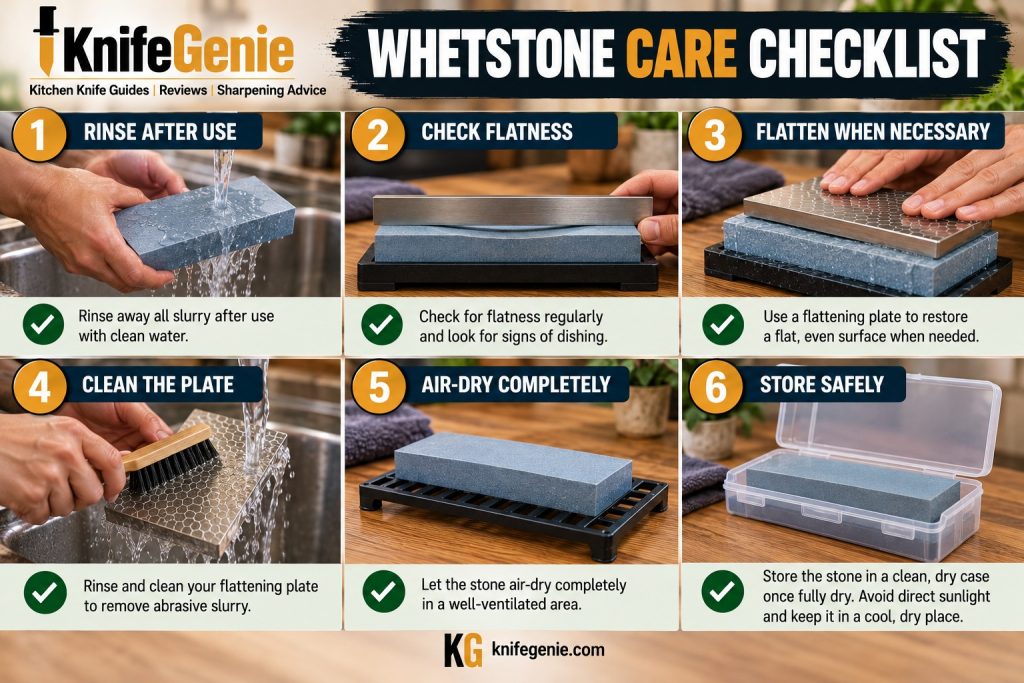
A simple maintenance routine helps keep your sharpening stone ready for use.
Your Maintenance Checklist
❓ Frequently Asked Questions
Can I clean a whetstone with dish soap?
Not unless the manufacturer permits it. Some sharpening stones can be damaged or altered by detergents. DMT, for example, advises against using detergent on its stones.
Can I flatten a whetstone without a diamond plate?
Yes. Compatible flattening stones and precision lapping systems can also be used. The important consideration is that the tool and abrasive are suitable for your particular whetstone.
How do I know when my whetstone needs flattening?
Use a straightedge to check for gaps, or draw a pencil grid and inspect how evenly it disappears during flattening. A visible hollow is a clear sign that the surface needs attention.
Can I use sandpaper to flatten a whetstone?
Some manufacturers permit specific abrasive-paper methods, but this is not universally suitable. Some manufacturers warn that abrasive paper can clog their stones, so check the manufacturer’s instructions first.
Can a cracked whetstone still be used?
It depends on the location and severity of the crack. A cracked stone can break during sharpening or produce an unstable surface. Stop using it until the manufacturer confirms whether repair or continued use is safe.
Do diamond sharpening plates need flattening?
Normally, no. Their rigid backing is designed to maintain the working surface. If the plate becomes warped or its diamond coating is damaged, conventional lapping is generally not the solution.
Should I flatten a new whetstone?
Not automatically. First check whether its working surface is flat and ready for use. Some stones are factory-finished, while others may benefit from initial surface preparation according to the manufacturer’s instructions.
🔪 Final Thoughts: A Flat, Clean Stone Makes Sharpening Easier
You don’t need complicated equipment or a lengthy maintenance routine to keep a whetstone in good condition.
For most home cooks, the essentials are simple: remove sharpening residue after use, check the stone’s flatness regularly, correct dishing with a suitable flattening tool, and follow the proper drying and storage instructions.
A well-maintained whetstone helps you sharpen more consistently and makes it easier to care for your kitchen knives over the long term.
If you’re ready to put your freshly maintained stone to work, continue with our Whetstone Sharpening Guide.
You can also explore Best Knife Sharpeners for Beginners or visit the KnifeGenie Sharpen & Care hub for more practical maintenance advice.