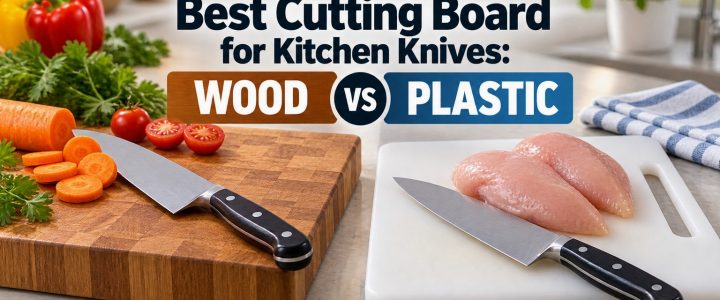
Best Cutting Board for Kitchen Knives: Wood vs Plastic

Wood vs plastic cutting boards with chef knives for kitchen food preparation

Wood vs plastic cutting boards with chef knives for kitchen food preparation

Wood vs plastic cutting boards: compare knife friendliness, cleanup, and everyday kitchen use.The cutting board underneath your knife may seem like a simple piece of kitchen equipment, but the best cutting board for kitchen knives is very important.

Every time you chop an onion, slice a tomato or dice vegetables, the knife edge eventually meets the board. A surface that is reasonably forgiving allows the edge to make contact without excessive stress. A very hard surface can accelerate dulling and may increase the risk of edge damage.

For most home cooks, a good wooden cutting board is the better everyday choice when protecting kitchen knife edges is the priority. Plastic boards, however, have an important advantage: they are inexpensive, easy to maintain and many can be cleaned in a dishwasher.

In practice, you don’t necessarily have to choose only one.

A sensible home-kitchen setup is often a wooden board for everyday vegetable, fruit, bread and general knife work, plus a separate dishwasher-safe plastic board for raw meat, poultry or seafood.

💡 Quick Answer: For everyday knife work, choose a quality wood cutting board such as maple or walnut. Wood provides a durable but relatively forgiving cutting surface. Keep a separate plastic board if you want something inexpensive and easy to sanitize after preparing raw meat, poultry or seafood.

🔬 Research Note: This guide is based on published food-safety guidance, cutting-board research and manufacturer information. It is not presented as personal testing or firsthand experience with the individual products or materials discussed.

Also read about proper chef knife grip when using a cutting board.


🔽 Jump to

👉 Wood vs Plastic: Quick Comparison
👉 Why Your Cutting Board Matters
👉 Is Wood Better for Kitchen Knives?
👉 Are Plastic Cutting Boards Good for Knives?
👉 Wood vs Plastic for Food Safety
👉 End-Grain vs Edge-Grain Wood
👉 Best Woods for Cutting Boards
👉 What About Bamboo Cutting Boards?
👉 Cutting Board Materials to Avoid
👉 What Size Cutting Board Should You Buy?
👉 How Thick Should a Wooden Cutting Board Be?
👉 How to Keep a Cutting Board From Sliding
👉 How to Clean a Wooden Cutting Board
👉 How to Clean a Plastic Cutting Board
👉 Don’t Scrape Food With Your Knife Edge
👉 When Should You Replace a Cutting Board?
👉 Which Cutting Board Should You Choose?
👉 Final Recommendation
👉 Frequently Asked Questions


⚖️ Wood vs Plastic Cutting Boards: Quick Comparison

Both materials can work well in a home kitchen, but they have different strengths.

Feature 🪵 Wood ◻️ Plastic
Knife-edge friendliness Excellent with suitable woods Good to moderate
Maintenance Requires more care Easy
Dishwasher compatible Usually no Often yes
Longevity Potentially many years Usually shorter
Deep groove resistance Good on quality boards Grooves develop with use
Cost Usually higher Usually lower
Raw-meat convenience Good if cleaned correctly Excellent
Appearance Excellent Functional
Best use Everyday prep Raw meat / easy cleanup

✅ Bottom line: If preserving your knife edges is the main concern, quality wood is generally the stronger choice. If easy cleanup is the priority, plastic has a clear advantage.

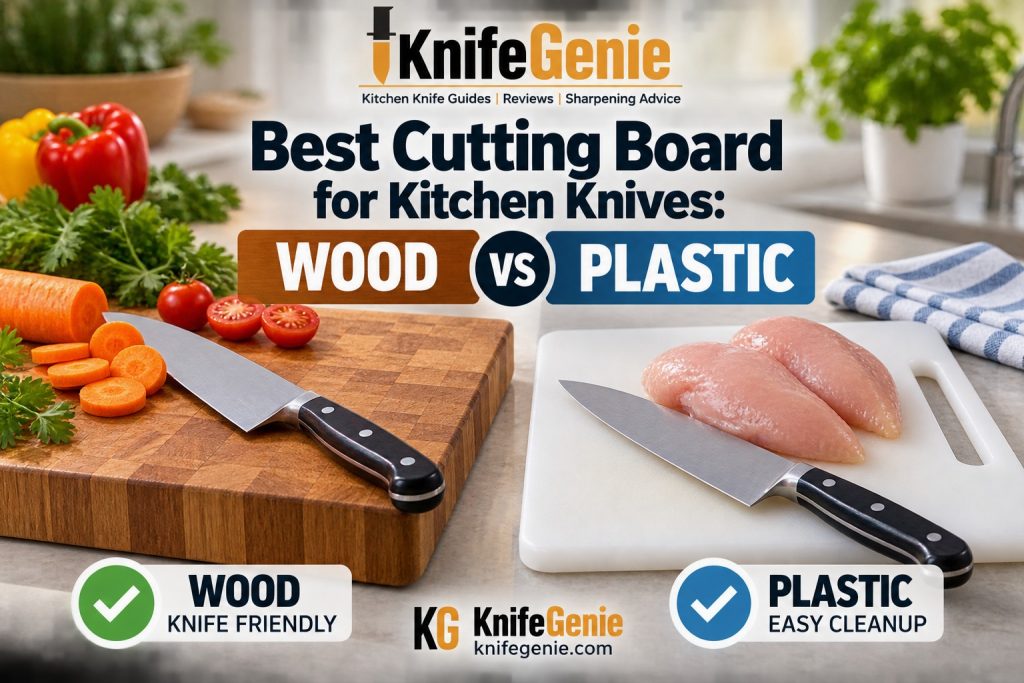
WOOD VS PLASTIC QUICK COMPARISON

Wood vs plastic cutting board comparison for kitchen knives
Wood is an excellent everyday cutting surface, while plastic offers convenient cleanup.


🔪 Why Your Cutting Board Matters to Your Knives

A sharp kitchen knife has a very thin cutting edge. During normal cutting, that edge repeatedly contacts the board beneath the food.

The harder and less forgiving that surface is, the greater the stress placed on the fine edge.

A knife-friendly cutting board protects the edge during prep, while correct honing technique helps maintain a compatible knife between sharpenings.

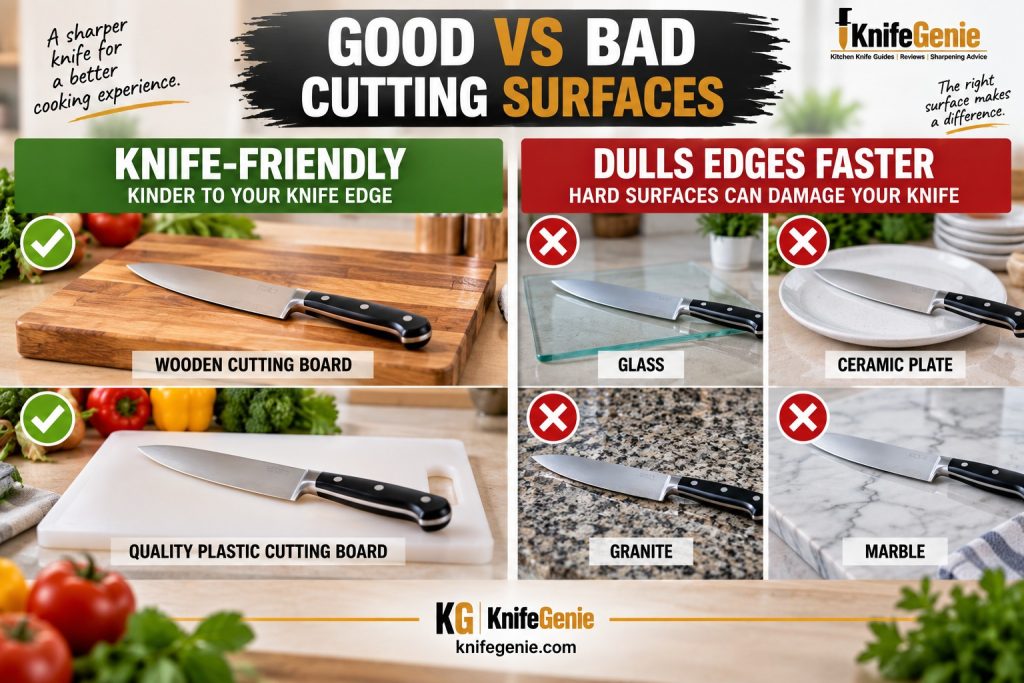
That is why chopping directly on glass, ceramic, stone, granite or a plate is a poor habit. These surfaces provide very little cushioning when the knife contacts them.

A suitable cutting board does something different: it provides a stable working surface while allowing the knife to finish the cut without repeatedly striking an extremely hard material.

This becomes particularly important with thin, finely sharpened knives.

See our How often to sharpen kitchen knives guide.

💡 KnifeGenie Tip: If your kitchen knives seem to lose their sharpness unusually quickly, the cutting surface is one of the first things worth checking. It is still important to keep kitchen knives sharp to prolong the life of your cutting board.

🔗 Related guide: Read Why Kitchen Knives Get Dull So Quickly for other common causes of premature dulling.

WHAT HAPPENS TO THE KNIFE EDGE
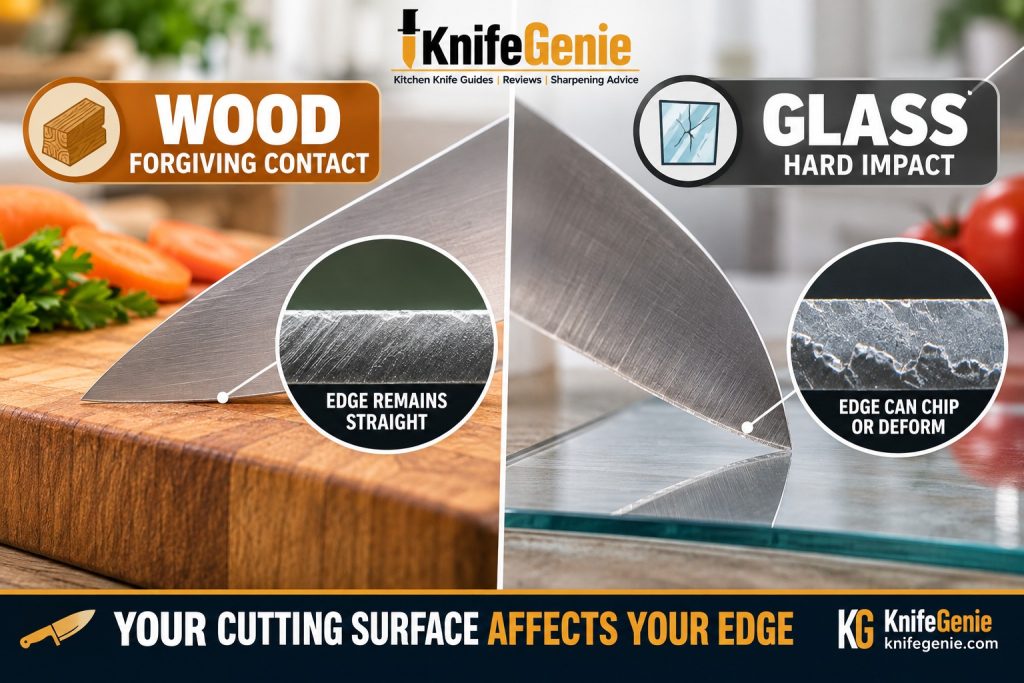
How cutting board material affects a kitchen knife edge
Hard cutting surfaces place greater stress on a fine knife edge.


🪵 Is Wood Better for Kitchen Knives?

For most everyday kitchen cutting, wood is an excellent choice.

Suitable cutting-board woods provide a balance between durability and resilience. The surface is firm enough to support controlled cutting without feeling excessively hard underneath the blade.

Common choices include:

  • Maple
  • Walnut
  • Cherry
  • Beech

Hard maple is particularly well established as a cutting-board material. FDA food-service guidance specifically recognizes hard maple and equivalently hard, close-grained woods for cutting boards.

But simply being made from wood doesn’t automatically make a board ideal. Because it’s wood doesn’t make it the best cutting board for kitchen knives.

Very hard or abrasive materials can be less forgiving, and poorly constructed wooden boards can warp, split or develop rough surfaces.

✅ Advantages of Wood

A good wooden cutting board can:

  • provide a forgiving cutting surface;
  • offer excellent stability;
  • last for years with proper maintenance;
  • be resurfaced in some cases;
  • develop fewer obvious knife scars than many plastic boards; and
  • double as an attractive preparation or serving surface.

⚠️ The trade-off: Most traditional wooden boards should be washed by hand rather than repeatedly exposed to the heat and prolonged moisture of a dishwasher. Follow the board manufacturer’s instructions because construction methods vary.


◻️ Are Plastic Cutting Boards Good for Knives?

Yes. A quality plastic cutting board is still a perfectly practical cutting surface.

Plastic is considerably more knife-friendly than glass, ceramic or stone.

Its greatest advantage, however, is convenience.

Many plastic boards are:

  • inexpensive;
  • lightweight;
  • nonporous;
  • easy to wash;
  • dishwasher safe; and
  • easy to dedicate to a particular food category.

That makes them particularly useful when preparing raw chicken, meat or seafood.

⚠️ Watch for wear: Repeated cutting creates scratches and eventually deeper grooves. Once those grooves become difficult to clean properly, the board should be replaced.

USDA on cutting boards specifically recommends replacing cutting boards that become excessively worn or develop hard-to-clean grooves.

WORN PLASTIC BOARD
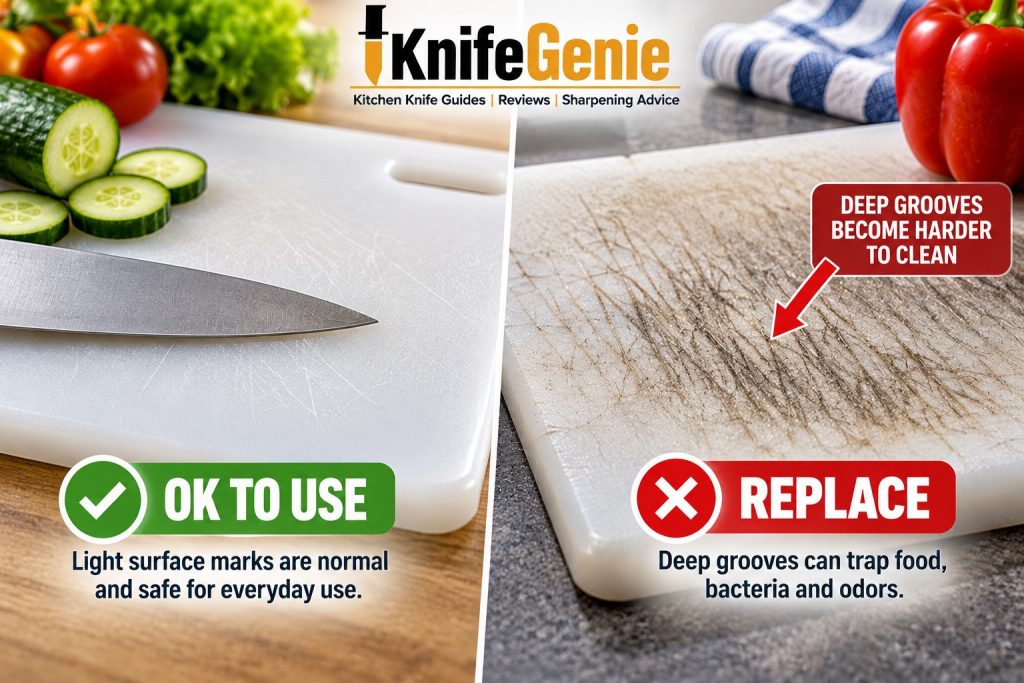
Worn plastic cutting board with deep knife grooves
Replace plastic cutting boards when deep grooves become difficult to clean.


🧼 Wood vs Plastic for Food Safety

This is where the comparison often becomes unnecessarily confusing.

You’ll sometimes hear that plastic is always more sanitary because it is nonporous. You’ll also encounter claims that wood is naturally safer.

For a home cook, the more useful conclusion is simpler:

✅ Either material can be used safely when it is properly cleaned, maintained and kept in good condition.

The USDA recommends using separate boards where possible: one for fresh produce and bread and another for raw meat, poultry and seafood.

That separation helps reduce cross-contamination.

After preparing raw animal products, cutting boards and utensils should be thoroughly cleaned before they are used for other foods.

🍎 A Practical Two-Board System

🪵 BOARD 1 — WOOD

Use for:

🥕 Vegetables → 🍎 Fruit → 🌿 Herbs → 🍞 Bread → 🔪 General preparation

◻️ BOARD 2 — PLASTIC

Use for:

🍗 Raw poultry → 🥩 Raw meat → 🐟 Raw seafood

💡 Why this works: This isn’t because wood cannot be cleaned safely. It simply makes the workflow easier and provides an additional barrier against accidental cross-contamination.
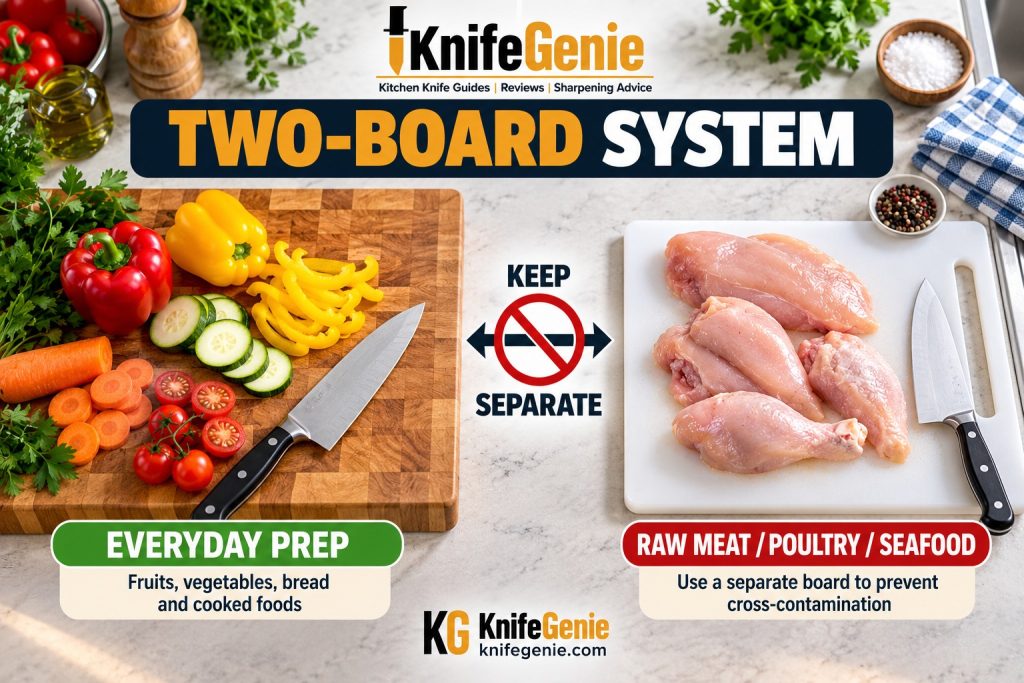
 

Separate wood and plastic cutting boards for food preparation
Using separate boards can help reduce cross-contamination during food preparation.


🌳 End-Grain vs Edge-Grain Cutting Boards

Once you’ve decided on wood, there is another choice to make.

Edge-Grain Boards

On an edge-grain board, long strips of wood are arranged with their edges forming the cutting surface.

These boards are commonly available and usually less expensive than comparable end-grain boards.

💰 Best value: For most home cooks, a good edge-grain maple or walnut board offers an excellent balance of performance, durability and price.

End-Grain Boards

An end-grain board is constructed so that the ends of the wood fibers face upward.

Think of the surface as thousands of tightly packed fibers.

When a knife contacts the board, the edge meets those fibers rather than repeatedly cutting across long grain.

End-grain boards are often prized for their forgiving cutting feel and ability to hide light knife marks.

⭐ Main advantage: Excellent cutting feel and premium construction.

⚠️ Main drawbacks: Higher price, greater weight and additional maintenance.
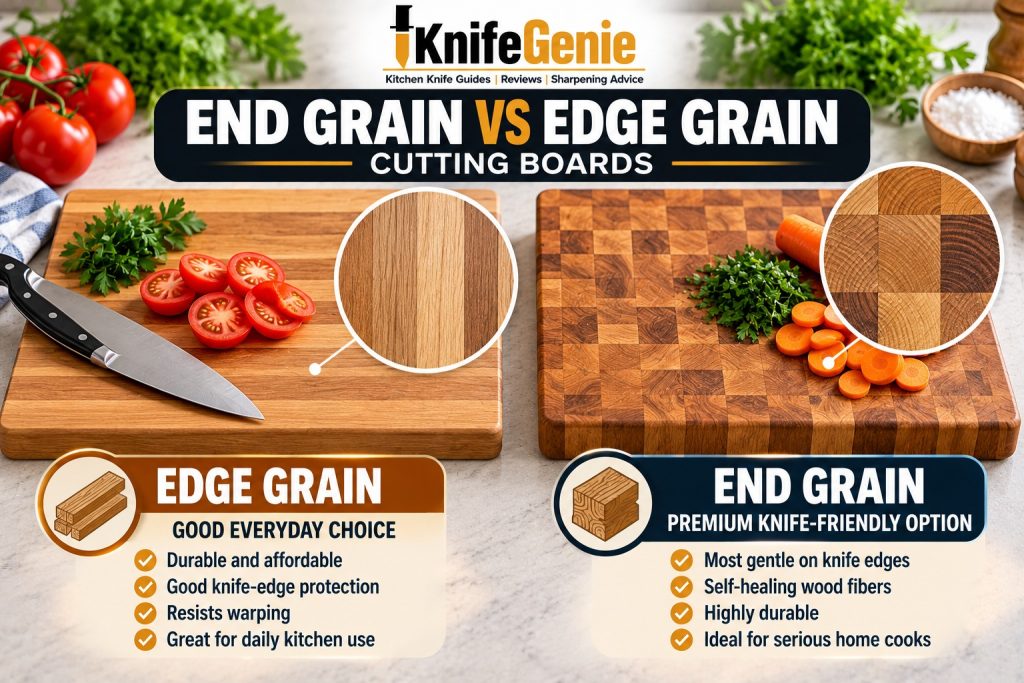
 

End-grain vs edge-grain wood cutting board comparison
Both constructions work well, although end-grain boards are often considered the premium option.


🌲 What Is the Best Wood for a Cutting Board?

For a general-purpose kitchen board, look for a relatively close-grained hardwood that is durable without being excessively hard.

🍁 Maple

Hard maple is one of the classic choices.

It is durable, relatively light in color and widely used for butcher blocks and professional work surfaces.

Best for: Someone looking for a traditional all-purpose board.

🌰 Walnut

Walnut is somewhat darker and attractive enough to remain on the countertop.

It provides an excellent work surface but generally costs more than basic maple.

Best for: Knife care plus appearance.

🍒 Cherry

Cherry offers another relatively forgiving hardwood surface and develops a deeper color as it ages.

Best for: Someone wanting an attractive board that can also serve as a permanent countertop piece.

🌳 Beech

Beech is another traditional cutting-board hardwood.

It can provide good value, although—as with other wooden boards—it needs proper drying and occasional maintenance.

Best for: Practical everyday use.


🎋 What About Bamboo Cutting Boards?

Bamboo boards are inexpensive, widely available and often marketed as environmentally friendly alternatives to hardwood.

But bamboo is not actually wood; it is a grass.

Many bamboo boards are relatively hard, and their construction commonly involves laminated strips.

💡 KnifeGenie Takeaway: That doesn’t mean a bamboo board will immediately damage a kitchen knife. It simply means that if knife-edge preservation is your primary objective, maple, walnut or another suitable hardwood would generally be the first choice instead.

See our honing vs sharpening guide to a better knife edge.


⛔ Cutting Board Materials to Avoid for Kitchen Knives

Some kitchen surfaces may look attractive but make poor cutting boards.

❌ Glass

Glass is easy to clean but extremely hard compared with a suitable cutting surface.

Use a glass board as a serving or decorative surface—not as the primary surface for chopping with a good knife.

❌ Marble and Granite

The same principle applies to stone.

Your countertop may seem convenient, but cutting directly on granite, marble or engineered stone repeatedly puts the edge against a very hard surface.

❌ Ceramic Plates

Avoid using a dinner plate as an improvised cutting board.

The glazed eating surface is not an appropriate chopping surface for a quality kitchen knife.

These are generally not the best cutting boards for kitchen knives to use.
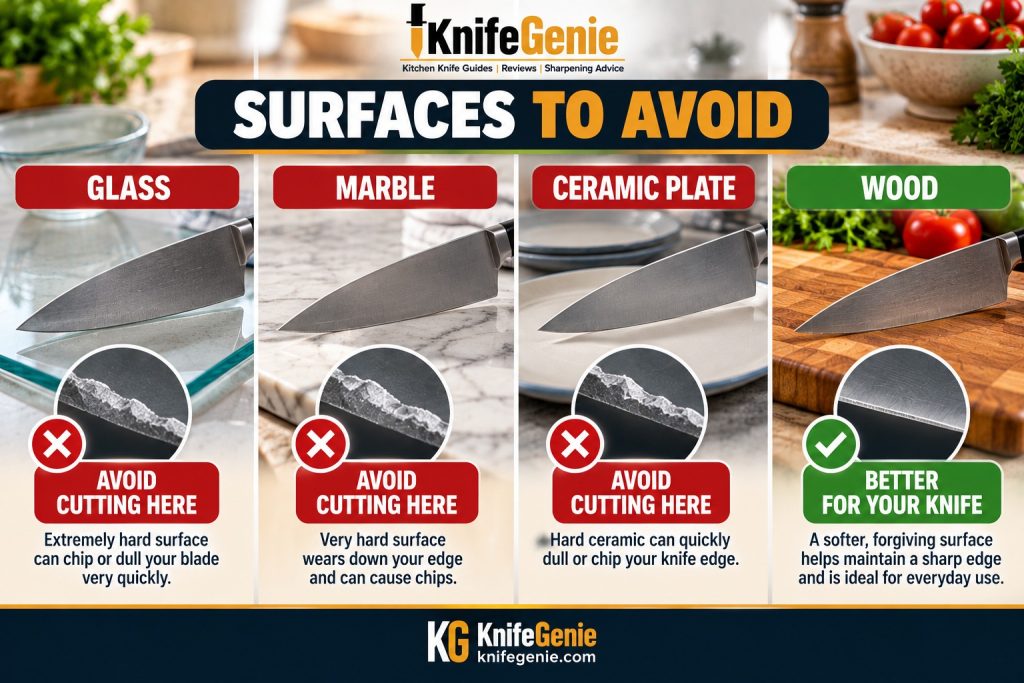
Glass marble and ceramic cutting surfaces compared with wood
Avoid routinely cutting on glass, stone or ceramic surfaces.

The above advice applies to imported German and Japanese knives also.


📏 What Size Cutting Board Should You Buy?

A cutting board should give you enough room to work without food constantly falling off the edges.

For an 8-inch chef’s knife, a board around 12 × 18 inches is a useful general-purpose size for many kitchens.

Larger boards provide more working room, particularly when chopping several vegetables.

Choosing the right chef knife size for your cutting board is also very important to give you the right space to work with.

⚠️ Don’t forget the sink: A huge board that won’t fit comfortably in your sink may become frustrating very quickly.

Before buying, check:

  1. 📐 Available countertop space
  2. 🚰 Sink dimensions
  3. 🗄️ Storage space
  4. 🔪 Knife length
  5. 🥕 Amount of food you normally prepare

📐 How Thick Should a Wooden Cutting Board Be?

Thickness becomes particularly important with larger wooden boards.

Thin wood boards are lighter and easier to store, but substantial boards generally feel more stable.

For a board that will stay on the counter, a thicker butcher-block-style design can provide an excellent work surface.

For something you intend to lift, wash and store after every meal, however, moderate thickness may be more practical.

✅ Choose stability before appearance.

A beautiful cutting board isn’t much help if it moves every time you start chopping.


🛑 How to Keep a Cutting Board From Sliding

This is an important knife-safety habit.

Before cutting, place the board on a stable, dry counter and check whether it moves.

If it slides, place a slightly damp kitchen towel or nonslip mat underneath it.

Then press down on each corner.

The board should remain stable before the knife comes anywhere near the food.

💡 KnifeGenie Tip: This simple step is especially useful with lightweight plastic boards.
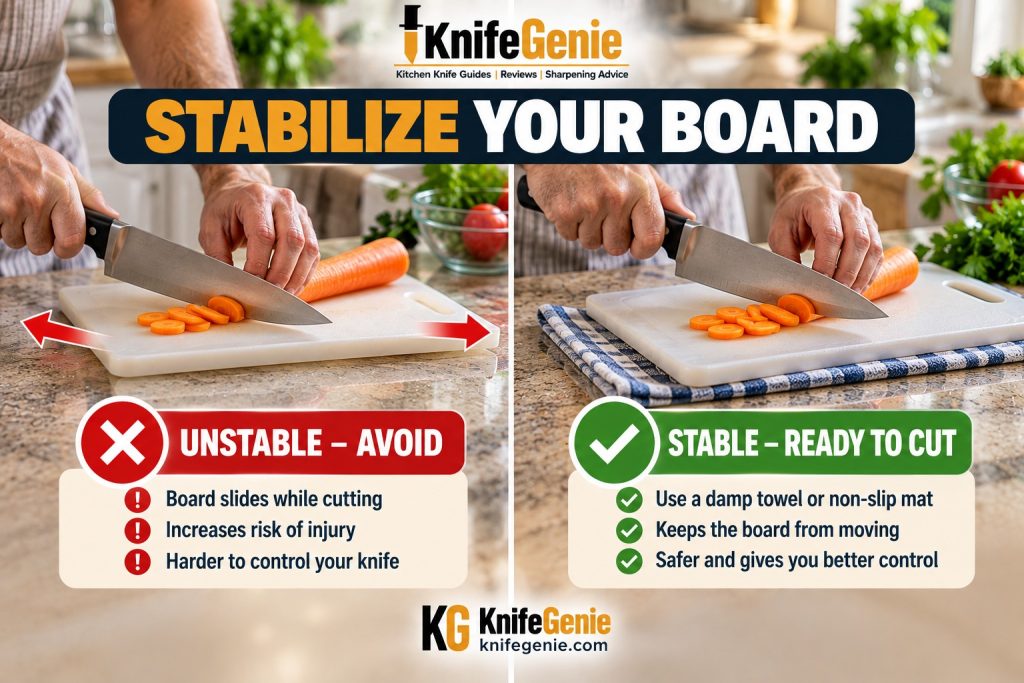
 

How to keep a cutting board from sliding while using a knife
Stabilize a moving cutting board before beginning any knife work.

🔗 Related guide: See How to Use a Chef Knife: Beginner’s Guide to Cutting Safely for grip, claw-hand position, stance and controlled cutting technique.


🧽 How to Clean a Wooden Cutting Board

For most traditional wooden boards:

1️⃣ Remove Food Debris

Scrape remaining food into the trash or compost.

Use a bench scraper rather than dragging the sharp edge of your knife sideways across the board.

2️⃣ Wash Promptly

Wash the surface with warm water and dish soap according to the manufacturer’s care instructions.

🚫 Avoid leaving a wooden board soaking in a sink.

3️⃣ Rinse

Remove soap and food residue thoroughly.

4️⃣ Dry Immediately

Wipe away excess water and allow air to circulate around the board.

Standing a board upright can help both sides dry more evenly.

5️⃣ Oil When Necessary

If the manufacturer recommends it, periodically apply food-grade mineral oil or an appropriate cutting-board conditioner.

⚠️ Avoid ordinary cooking oils that can become rancid.
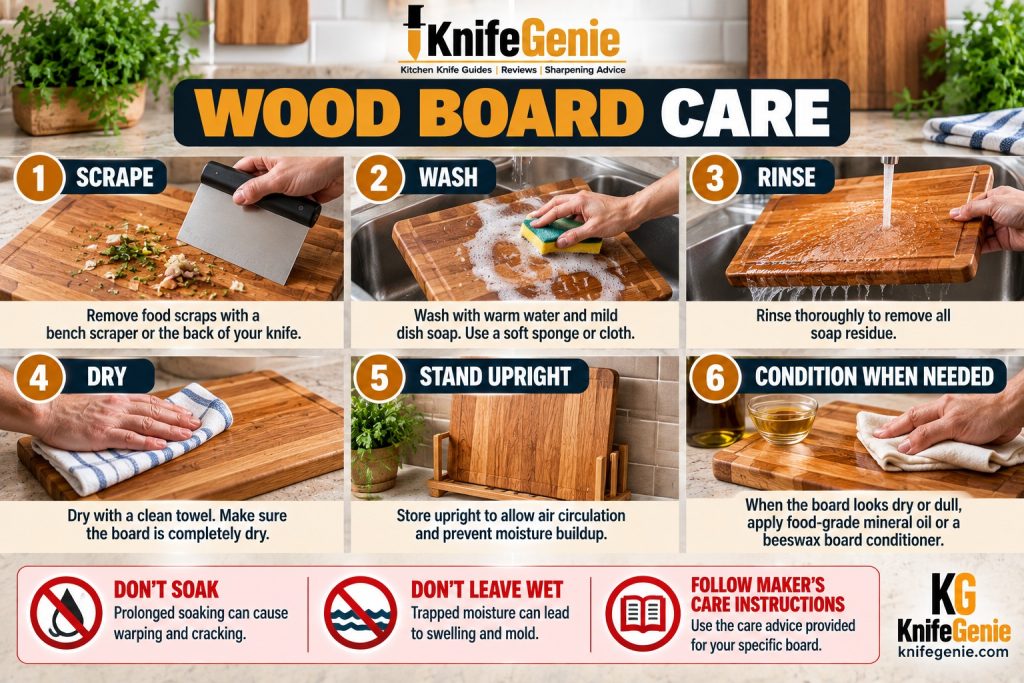
 

How to clean and maintain a wooden cutting board
Prompt washing and thorough drying help maintain wooden cutting boards.


🚿 How to Clean a Plastic Cutting Board

Plastic is simpler.

After use:

  1. 🧹 Remove food debris.
  2. 🧼 Wash thoroughly with hot, soapy water.
  3. 🚿 Rinse thoroughly.
  4. ✨ Sanitize when appropriate.
  5. 💨 Air-dry completely.

If the manufacturer identifies the board as dishwasher safe, the dishwasher provides a convenient cleaning option.

⚠️ Food-safety reminder: Wash cutting boards, utensils and work surfaces thoroughly between preparing raw meat, poultry or seafood and preparing foods that will not subsequently be cooked.


🚫 Don’t Scrape Food With Your Knife Edge

The cutting board isn’t the only part of this relationship that matters.

After chopping vegetables, many cooks turn the knife sideways and drag the sharpened edge across the board to gather the food.

Try not to do this.

Repeated sideways scraping can be unnecessarily hard on a fine cutting edge.

✅ Better method: Turn the knife over and use the spine, or use a bench scraper.
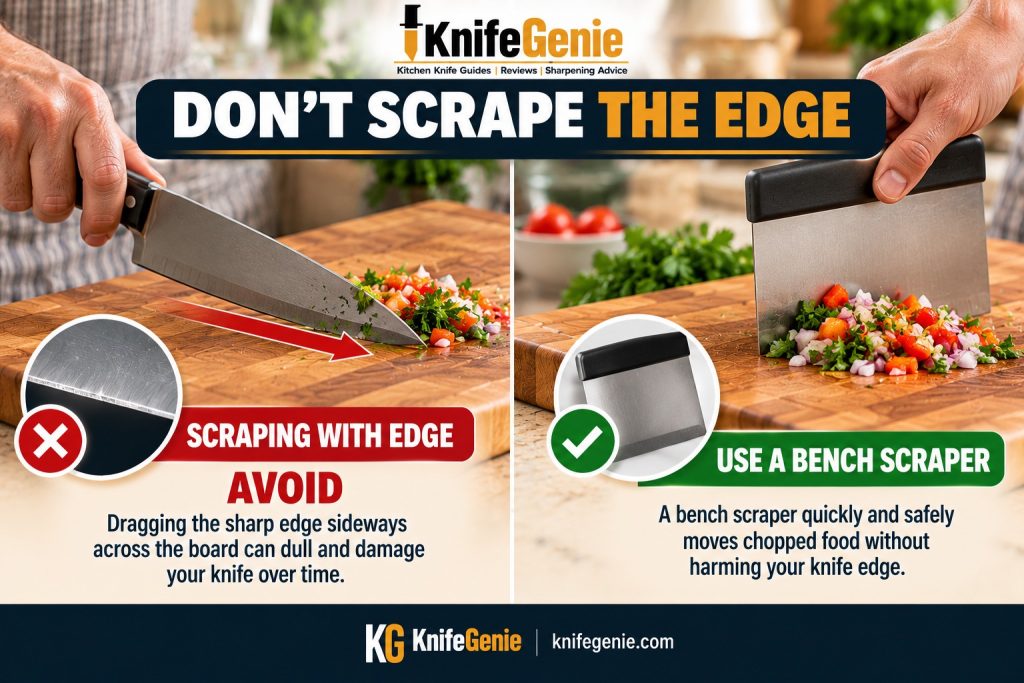
 

Avoid scraping a kitchen knife edge across a cutting board
Use the knife spine or a bench scraper to move chopped food.


♻️ When Should You Replace a Cutting Board?

A wooden board can often remain useful for years if it is properly cared for.

Replace it—or have it professionally resurfaced where appropriate—if it develops:

  • ❌ Major splits
  • ❌ Deep cracks
  • ❌ Loose sections
  • ❌ Severe warping
  • ❌ Persistent contamination or odors
  • ❌ Damage that prevents thorough cleaning

Plastic boards usually have a shorter practical life.

Light scratches are normal. Deep, heavily scored grooves that are difficult to clean are a sign that replacement is due.

💡 Don’t judge a cutting board by age alone. Judge it by its condition.


🎯 Which Cutting Board Should You Choose?

For most home cooks, the decision can be simplified.

🪵 Choose Maple or Walnut Wood If:

You want an excellent everyday surface for a chef’s knife and don’t mind hand washing and occasional maintenance.

⭐ Choose End-Grain Wood If:

You want a premium, substantial work surface and are comfortable paying more and maintaining it.

🧼 Choose Plastic If:

Easy cleaning, low cost, light weight and dishwasher compatibility are priorities.

🪵 + ◻️ Use Both If:

You want perhaps the most practical home-kitchen arrangement.

Use a quality wood board for most everyday cutting and keep a separate plastic board for raw meat, poultry and seafood.
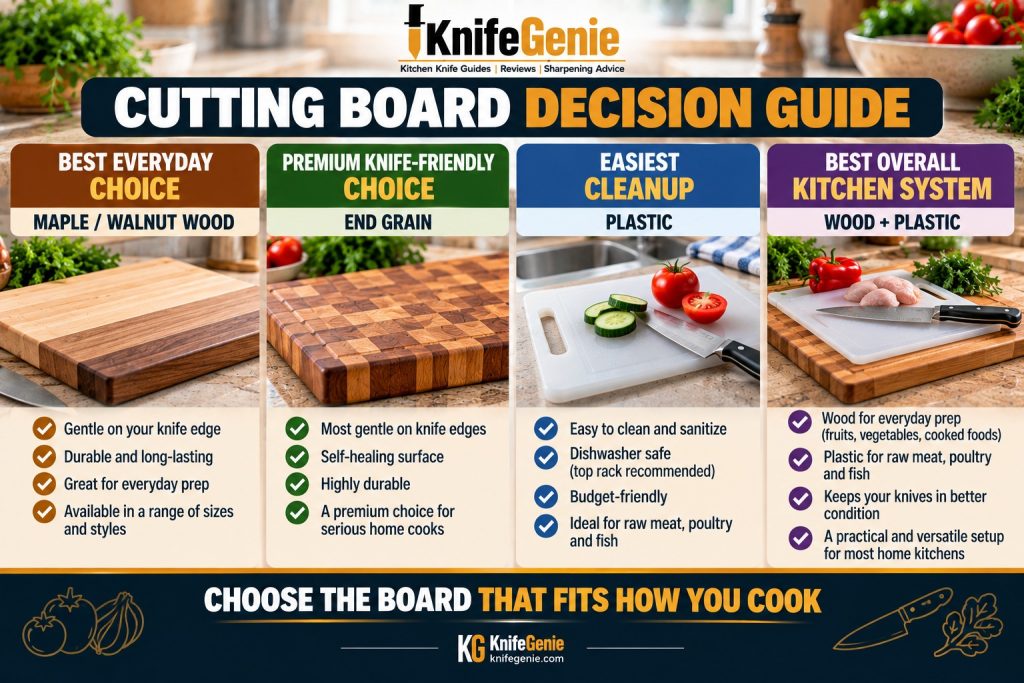
 

Best cutting board decision guide for kitchen knives
Wood and plastic each have advantages, which is why many kitchens benefit from having both.


🏆 Final Recommendation

If your main concern is keeping your kitchen knives sharp, start with a quality maple, walnut, cherry or similar close-grained hardwood cutting board.

It provides a durable everyday workspace without subjecting your knife edge to the harsh contact associated with glass, stone or ceramic.

But plastic shouldn’t be dismissed.

An inexpensive dishwasher-safe plastic board makes an excellent companion to a wooden board, particularly for handling raw meat, poultry and seafood.

For many home cooks, therefore, the best answer to wood vs plastic isn’t really one or the other.

🪵 Wood for everyday knife work + ◻️ plastic for easy-clean raw-protein preparation.

Whichever board you choose, keep it clean, keep it stable and replace it when damage makes it difficult to maintain properly.

Your cutting board is part of your knife-care system. Pairing a sharp knife with an appropriate cutting surface can help that edge perform as intended for longer.


❓ Frequently Asked Questions

🔪 What cutting board is best for keeping knives sharp?

A quality wooden cutting board made from a suitable hardwood such as maple or walnut is an excellent choice for protecting kitchen knife edges during everyday use.

🪵 Is wood or plastic better for kitchen knives?

Wood generally offers an excellent balance of durability and knife friendliness. Plastic is also suitable for knives and offers easier cleaning, particularly when dishwasher safe.

◻️ Are plastic cutting boards bad for knives?

No. Plastic boards are far more appropriate cutting surfaces than glass, ceramic or stone. However, plastic becomes scratched and grooved over time and should be replaced once those grooves become difficult to clean.

🚫 What cutting boards should you avoid?

Avoid using glass, marble, granite, ceramic plates and other very hard surfaces as regular cutting surfaces for quality kitchen knives.

🎋 Is bamboo good for kitchen knives?

Bamboo boards are usable, but many are relatively hard. If protecting a fine knife edge is the priority, a suitable hardwood such as maple or walnut is generally a stronger choice.

🥩 Can wooden cutting boards be used for raw meat?

Wooden cutting boards can be used safely when properly cleaned and maintained. For convenience and reducing cross-contamination risk, however, many home cooks may prefer keeping a separate dishwasher-safe plastic board specifically for raw meat, poultry and seafood.

🚿 Should I put a wooden cutting board in the dishwasher?

Usually not unless the manufacturer specifically states that the board is dishwasher safe. Heat and prolonged exposure to water can warp, split or damage many traditional wooden boards.




Why Kitchen Knives Get Dull So Quickly

Why kitchen knives get dull so quickly
Several everyday kitchen habits can make a knife lose its sharp edge faster.

Have you ever sharpened a kitchen knife, enjoyed that wonderfully crisp edge for a while, and then wondered:

Why is this knife dull again already?

You’re not imagining it. Here’s Why Kitchen Knives Get Dull, sometimes really quickly.

Every kitchen knife eventually loses sharpness. But if your knives seem to get dull unusually quickly, the knife itself may not be the main problem. Using a chef knife correctly is also very important.

Your cutting board, storage method, cleaning habits, cutting technique and even the foods you prepare can all affect how long an edge lasts.

⚡ The Quick Answer

Kitchen knives get dull because their extremely thin cutting edges gradually wear, bend, roll or become damaged during normal use.

The process happens much faster when you:

❌ Cut on glass, ceramic or stone

❌ Scrape food sideways with the cutting edge

❌ Put knives in the dishwasher

❌ Store them loose with other utensils

❌ Cut bones, frozen foods or other materials the knife wasn’t designed for

❌ Ignore regular edge maintenance

The good news?

A few simple changes can help your kitchen knives stay sharp considerably longer.


🔎 About This Guide

This article is based on research into knife construction, sharpening, manufacturer care recommendations and established knife-maintenance practices. KnifeGenie has not personally tested every knife, steel or sharpening system mentioned. The goal is to explain the principles behind kitchen-knife edge wear so home cooks can make better care and maintenance decisions.


 Jump to What You Need

⚡ The Quick Answer

👉 Why Do Kitchen Knives Get Dull?

👉 9 Reasons Kitchen Knives Get Dull So Quickly

👉 What Makes a Kitchen Knife Dull Faster?

👉 How Can You Tell When a Kitchen Knife Is Dull?

👉 Is Your Knife Dull—or Does It Just Need Honing?

👉 How to Keep Kitchen Knives Sharp Longer

👉 Frequently Asked Questions

👉 Final Cut: Why Kitchen Knives Get Dull So Quickly


Why kitchen knives get dull so quickly

Several everyday kitchen habits can make a knife lose its sharp edge faster.


🔪 Why Do Kitchen Knives Get Dull?

A sharp knife has an extremely thin cutting edge.

That thin edge is precisely what allows the blade to bite into tomato skin, glide through onions and slice meat cleanly.

But there’s a trade-off.

Because the edge is so thin, it takes repeated stress every time you use the knife.

Think about what happens while chopping an onion.

The knife passes through the onion…

Then the edge hits the cutting board.

Again.

And again.

And again.

During a long food-preparation session, that contact can happen hundreds of times.

Over weeks and months, the edge gradually changes.

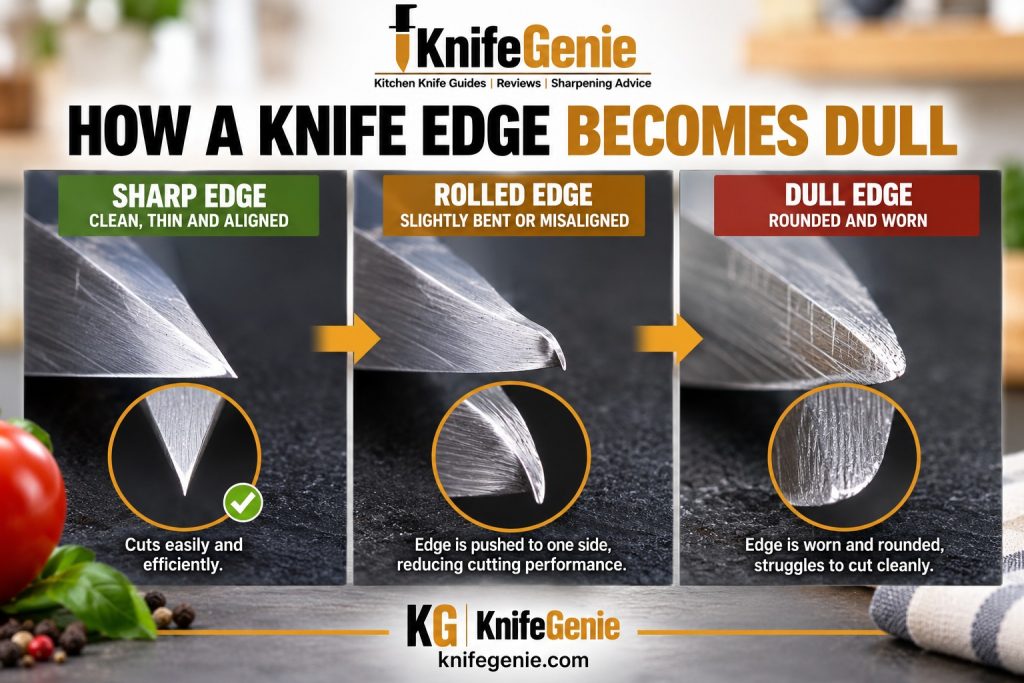
Depending on the knife and how it is used, the edge may:

🔹 Become slightly misaligned

🔹 Roll to one side

🔹 Wear away microscopically

🔹 Develop tiny chips

🔹 Become rounded

Eventually, the edge no longer cuts as efficiently as it once did.

That is what we experience as a dull knife.

And some everyday kitchen habits accelerate that process dramatically.


Sharp rolled and dull kitchen knife edges compared

A fine knife edge can gradually become misaligned, rolled or rounded through use.


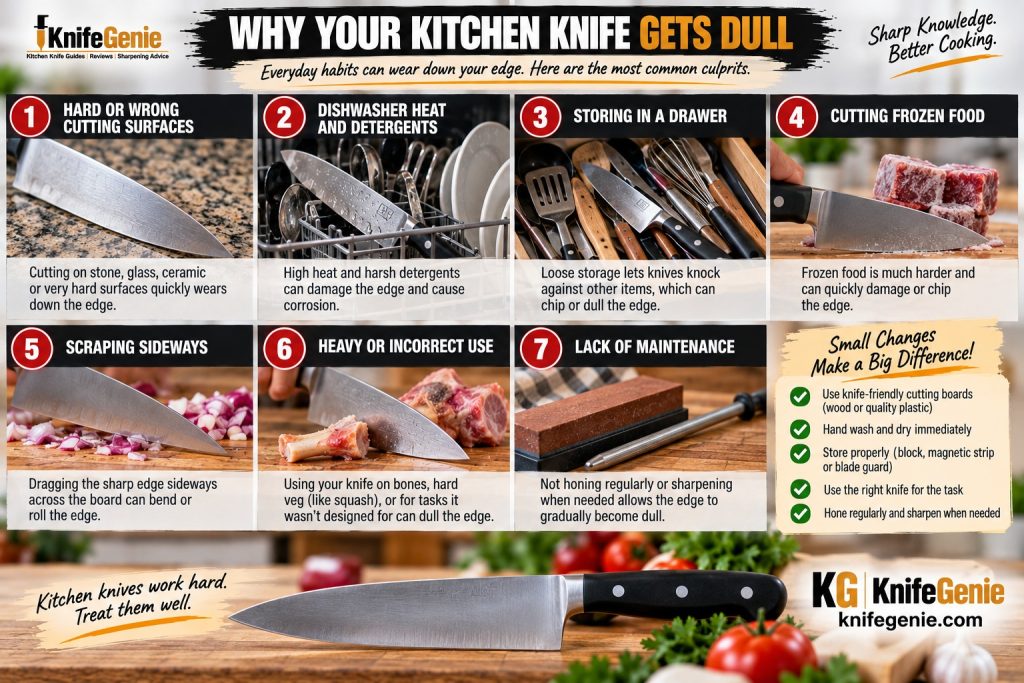
🔍 9 Reasons Kitchen Knives Get Dull So Quickly

If your knife seems to lose its edge surprisingly fast, start with these common causes.


🪵 1. Your Cutting Board Is Too Hard

This is one of the first things to check.

Every time your knife completes a cut, its edge usually contacts the cutting board.

A forgiving cutting surface allows the knife edge to meet the board without taking unnecessary punishment.

A very hard surface does the opposite.

❌ Avoid Regularly Cutting On:

Glass

Granite

Marble

Ceramic plates

Stone countertops

Metal surfaces

These surfaces can be considerably harder and less forgiving than a suitable cutting board.

A beautiful glass cutting board might look hygienic and modern, but it is not friendly to a fine knife edge.

✅ Better Choices

For everyday kitchen use, wood and suitable plastic cutting boards are generally much kinder to knife edges.

If your expensive chef’s knife keeps becoming dull surprisingly quickly, check the board before blaming the blade.

💡 KnifeGenie Tip

Your cutting board is part of your knife-maintenance system.

A good knife on the wrong surface can lose performance far sooner than it should.


Knife-friendly wood and plastic cutting boards compared with glass and stone

Hard cutting surfaces can accelerate kitchen knife edge wear.


↔️ 2. You Scrape Food With the Cutting Edge

This habit is incredibly common.

You finish chopping onions.

Then you turn the knife sideways and drag the chopped pieces across the board using the sharp edge.

Convenient?

Absolutely.

Good for the edge?

Not really.

The knife is designed primarily to cut with forces directed through the edge.

Dragging that fine edge sideways across a cutting board subjects it to lateral stress. And, depending on the cutting board material, it can be detrimental to your knife’s edge.

💡 Better Habit

Turn the knife over and use the spine to move chopped food.

Even better, use a bench scraper when transferring larger quantities of vegetables.

It takes only a second and avoids unnecessary wear on your cutting edge.


Wrong and correct ways to move chopped food with a kitchen knife

Use the knife’s spine or a bench scraper instead of dragging the cutting edge sideways.


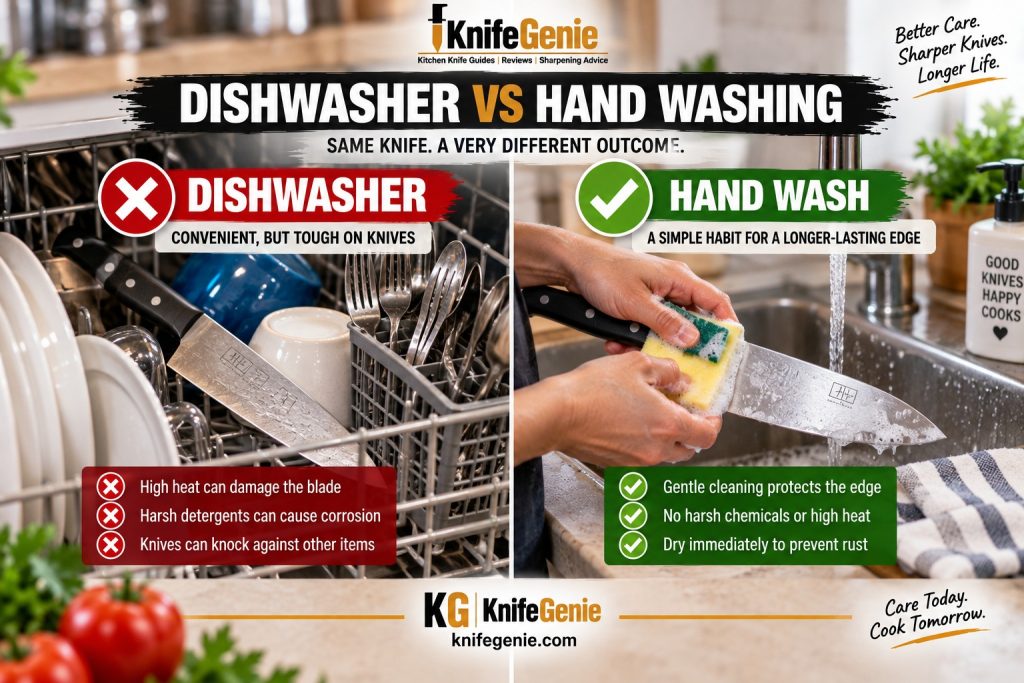
🧼 3. You Put Your Knives in the Dishwasher

A dishwasher might save time, but quality kitchen knives are generally better washed by hand.

Inside a dishwasher, several things can work against your knife.

There is prolonged moisture.

There are high temperatures.

There are strong detergents.

And the knife can potentially knock against racks, dishes or other utensils during the cycle.

That combination isn’t ideal for maintaining a fine cutting edge—or, depending on the knife, its handle and finish.

🏆 Better Routine

Wash your knife by hand with warm water, mild dishwashing liquid and a soft sponge or cloth.

Then dry it promptly.

It takes less than a minute.

And it is one of the easiest knife-care habits to adopt.

👉Read: Can Kitchen Knives Go in the Dishwasher?


Kitchen knife in dishwasher compared with hand washing

Hand washing helps avoid the harsh conditions kitchen knives can encounter in a dishwasher.


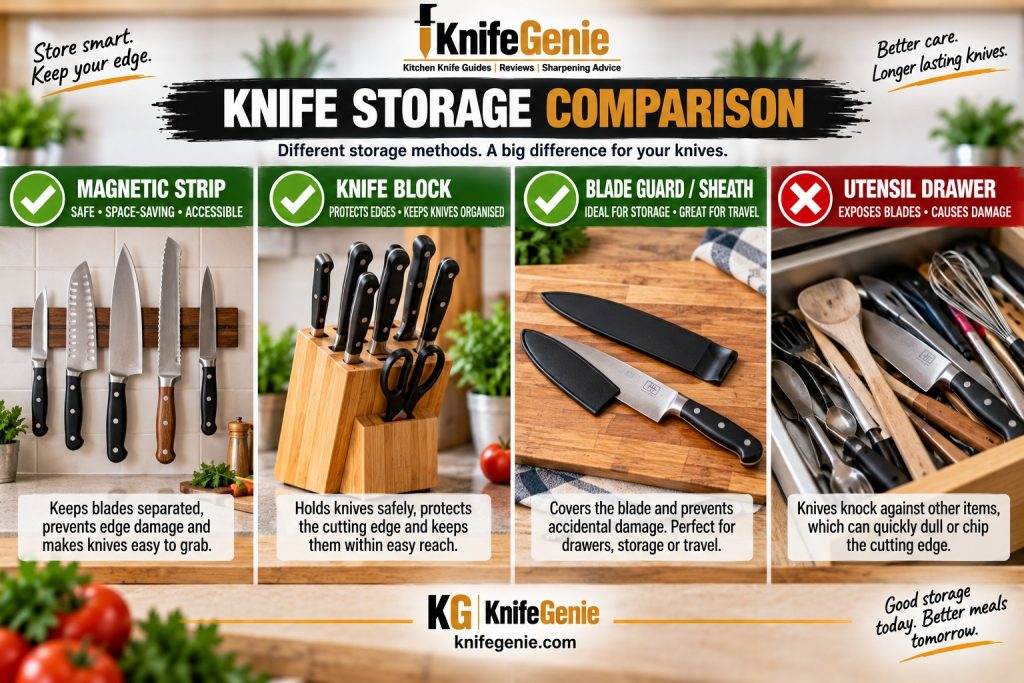
🗄️ 4. Your Knives Are Loose in a Drawer

You wash your chef’s knife.

You dry it.

Then…

Clunk.

Into a drawer with forks, spoons, peelers and other knives.

Every time the drawer opens and closes, those objects can contact one another.

That isn’t how you want to treat a fine cutting edge.

Better Storage Options Include:

🧲 A suitable magnetic knife strip

🪵 A knife block

🛡️ Individual blade guards

🗄️ A dedicated knife drawer insert

The important principle is simple:

Protect the edge from unnecessary contact when the knife isn’t being used.

👉 How to Store Kitchen Knives Safely


Knife block magnetic strip blade guard and loose drawer storage compared

Protecting the cutting edge during storage helps prevent unnecessary damage.


🦴 5. You’re Cutting Things Your Knife Wasn’t Designed to Cut

Your chef’s knife is versatile.

But versatile does not mean indestructible.

Trying to force a thin kitchen knife through extremely hard materials can damage the edge.

Be particularly cautious with:

🦴 Bones

🧊 Frozen foods

🐚 Hard shells

🍖 Thick joints

Extremely hard food can put more stress on the edge than the knife was designed to tolerate.

Depending on the steel and edge geometry, the result may be rolling, deformation or chipping.

💡 Use the Right Tool

A chef’s knife is excellent for vegetables, herbs, boneless meat and general food preparation.

It is not a substitute for a meat cleaver, bone saw or other specialized tool.

Using the appropriate knife for the task protects both the edge and the user.


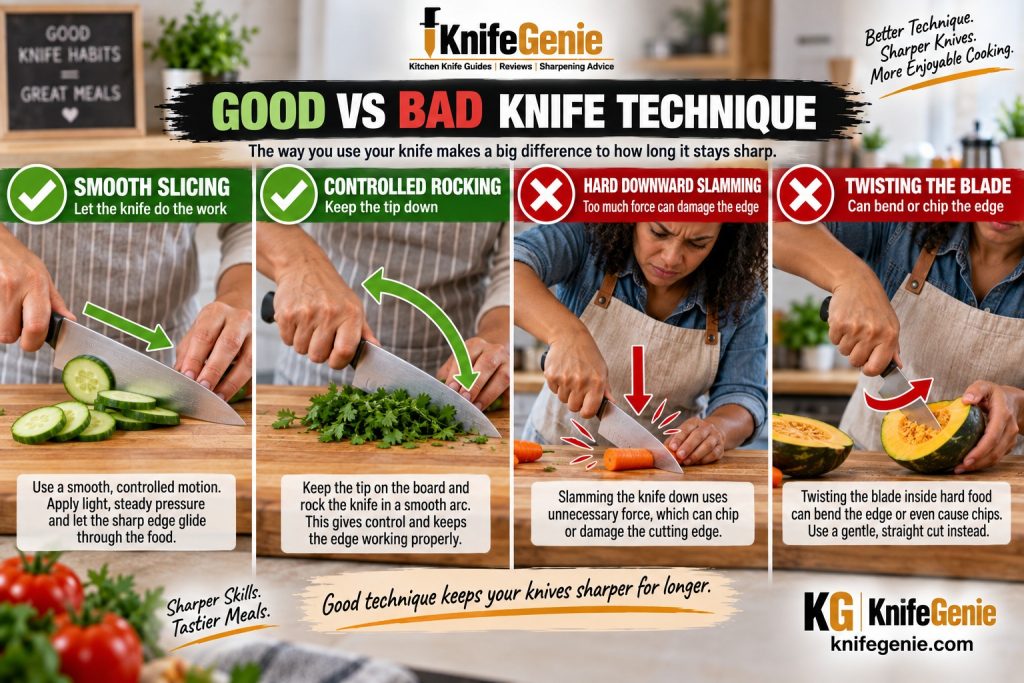
🔪 6. Your Cutting Technique Is Hard on the Edge

How you use the knife matters too.

You don’t need to baby a good kitchen knife.

It is a tool.

But repeatedly twisting the edge while it is embedded in food, slamming it into the board or using excessive force can accelerate wear or damage.

Watch Out for:

❌ Aggressive chopping into the board

❌ Twisting the blade while cutting hard food

❌ Using the knife as a pry bar

❌ Using the tip like a screwdriver

❌ Striking bones with a thin chef’s knife

A sharp kitchen knife should do much of the work for you.

If you regularly need excessive force, either the knife is already dull or you may be using the wrong tool or technique.


Good and bad kitchen knife cutting techniques compared

Twisting, prying and aggressive impacts can put unnecessary stress on a fine cutting edge.


🔩 7. The Steel and Edge Geometry Affect Edge Retention

Not every knife dulls at exactly the same rate.

Two chef’s knives can be used in the same kitchen and behave quite differently.

That’s because edge retention depends partly on factors such as:

🧪 Steel composition

🌡️ Heat treatment

💎 Steel hardness

📐 Edge angle

🔪 Blade geometry

🧱 Edge thickness

A relatively hard steel may support a fine edge and offer excellent edge retention.

But hardness isn’t everything.

Harder steels can sometimes be less tolerant of impacts or twisting, while somewhat softer steels may be tougher and easier to maintain.

⚠️ Important

Don’t judge a kitchen knife by hardness numbers alone.

A knife is a complete system.

Steel, heat treatment, geometry, sharpening and intended use all matter.


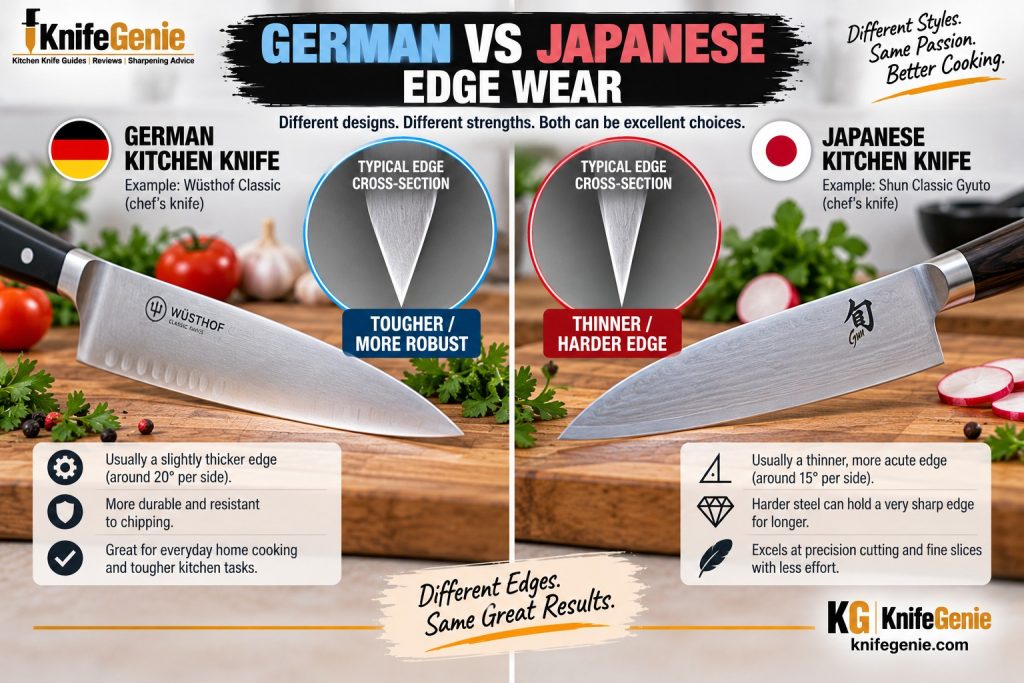
🇩🇪🇯🇵 8. German and Japanese Knives Can Dull Differently

This is where the difference between edge wear and edge damage becomes important.

Traditional German-style kitchen knives commonly use relatively tough steels and robust edge geometries.

Many Japanese knives use harder steels and thinner, more acute edges.

That can create different maintenance characteristics.

🇩🇪 German-Style Knife

Often:

✔️ Tough

✔️ Relatively forgiving

✔️ Suited to regular honing when appropriate

✔️ More likely to tolerate everyday Western-style kitchen use

🇯🇵 Japanese-Style Knife

Often:

✔️ Harder steel

✔️ Thinner blade geometry

✔️ Fine cutting performance

✔️ Excellent potential edge retention

But that thinner, harder edge may be less tolerant of twisting, bones and other abuse.

Neither approach is automatically better.

They simply represent different design priorities.

👉 See: German vs Japanese Kitchen Knives


German and Japanese kitchen knife edge geometry comparison

Different steels and edge geometries can produce different edge-retention and maintenance characteristics.


⏱️ 9. You Use the Knife a Lot

Sometimes there is nothing wrong with your knife.

You simply use it frequently.

Imagine two people buying identical chef’s knives.

Cook A

Prepares dinner two or three times per week.

Cook B

Prepares breakfast, lunch and dinner almost every day.

Cook B’s knife might make thousands more cuts over the same period.

Naturally, its edge experiences more wear.

That’s why there is no universal sharpening schedule that works for everyone.

How often you sharpen should depend more on actual cutting performance than an arbitrary date on the calendar.

👉 See more on: How Often Should You Sharpen Kitchen Knives?


📊 What Makes a Kitchen Knife Dull Faster?

Factor Effect on Edge Better Choice
Glass cutting board Very hard on edge Wood or suitable plastic
Ceramic/stone surface Accelerates wear Proper cutting board
Scraping with edge Adds sideways stress Use spine or scraper
Dishwasher Heat, detergent and contact Hand wash
Loose drawer storage Edge can contact utensils Block, guard or strip
Bones/frozen food Can roll or chip edge Correct specialized tool
Twisting blade Lateral stress Straight controlled cuts
Heavy use Normal accelerated wear Maintain as needed
No honing/maintenance Performance gradually declines Appropriate maintenance

Common reasons kitchen knives become dull quickly

Cutting surfaces, cleaning, storage, technique and heavy use can all influence edge life.


🧐 How Can You Tell When a Kitchen Knife Is Dull?

You don’t need laboratory equipment.

Usually, your food tells you.

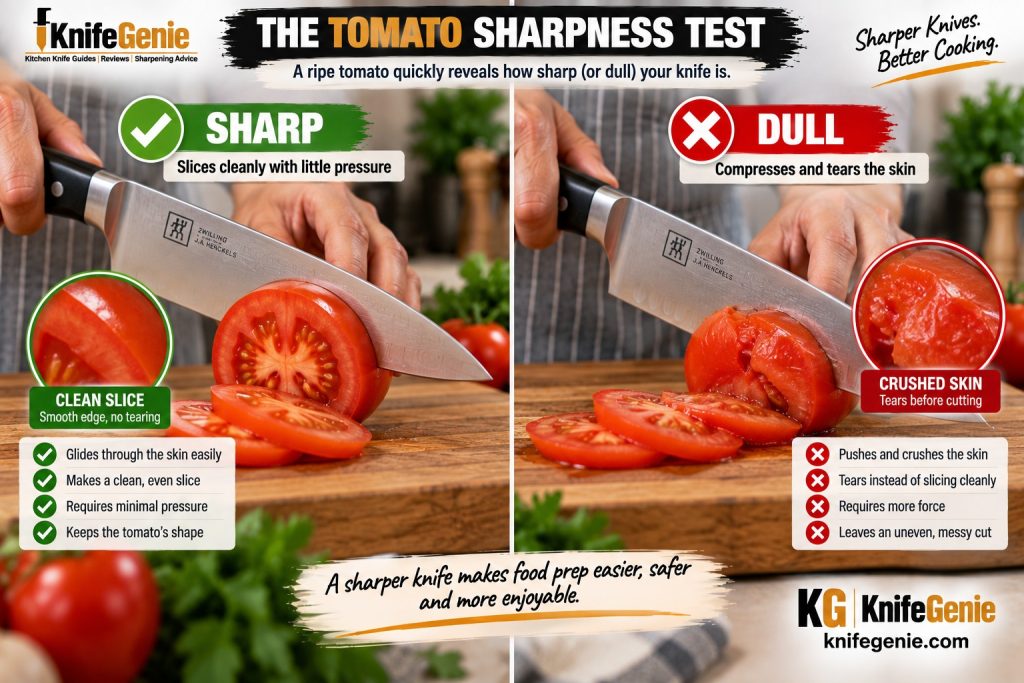
🍅 The Tomato Test

Place a ripe tomato on your cutting board.

Using normal safe cutting technique, try to begin a slice.

A properly sharp chef’s knife should bite into the skin without requiring excessive downward pressure.

If the blade slides across the skin or squashes the tomato before cutting, the edge needs attention.

🧅 Pay Attention During Normal Cooking

Other warning signs include:

❌ Onions becoming harder to slice

❌ Herbs bruising instead of cutting cleanly

❌ Meat requiring more sawing

❌ Carrots requiring noticeably more force

❌ The knife slipping rather than biting into food

❌ Cutting feeling less controlled

The change can happen gradually enough that you don’t notice it immediately.

Then you sharpen the knife and suddenly think:

“I forgot it was supposed to cut like this.”


Sharp and dull kitchen knives cutting a ripe tomato

Difficulty biting cleanly into tomato skin is a practical sign that a knife edge needs attention.


🔧 Is Your Knife Dull—or Does It Just Need Honing?

This distinction can save you from sharpening unnecessarily.

Honing and sharpening are not the same thing.

🔧 Honing

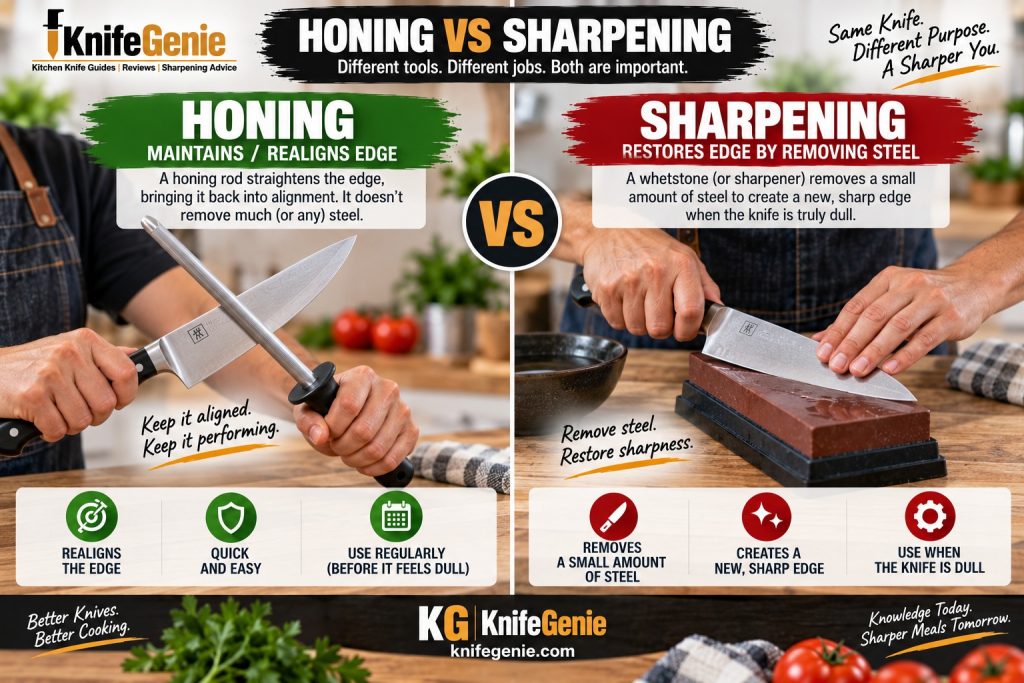
Honing primarily helps maintain or realign an existing edge.

Think:

Honing = edge maintenance

When using a compatible honing rod, light, controlled honing strokes help you maintain the edge without relying on excessive pressure.

🪨 Sharpening

Sharpening uses an abrasive to remove blade material and restore the cutting edge.

Think:

Sharpening = edge restoration

If an appropriate honing method restores the knife’s performance, you probably don’t need to sharpen it yet.

If honing no longer helps, the edge may need actual sharpening.

👉 Learn about: Honing vs Sharpening: 7 Critical Mistakes to Avoid


Honing rod compared with whetstone sharpening for kitchen knives

Honing maintains or realigns an edge; sharpening removes material to restore it.


🛡️ How to Keep Kitchen Knives Sharp Longer

Fortunately, preventing premature dulling isn’t complicated. See how to restore a dull chef knife’s edge.

🏆 KnifeGenie Edge-Saving Routine

1. Use the right cutting board.

Choose wood or suitable plastic rather than glass, stone or ceramic.

2. Stop scraping with the cutting edge.

Flip the knife and use its spine, or use a bench scraper.

3. Hand wash your knives.

Clean them promptly and dry them thoroughly.

4. Store the edge safely.

Use a knife block, suitable magnetic strip, drawer insert or blade guard.

5. Match the knife to the task.

Don’t expect a thin chef’s knife to function like a meat cleaver.

6. Avoid twisting the edge.

Cut cleanly through food rather than applying unnecessary lateral force.

7. Hone when appropriate.

Regular maintenance can help certain knife edges continue performing between sharpenings.

8. Sharpen when necessary.

Once honing no longer restores satisfactory performance, it may be time to sharpen.

9. Don’t over-sharpen.

Sharpening removes steel. There’s no benefit in grinding away blade material when the knife doesn’t need it.


⚠️ A Dull Knife Isn’t Just Annoying

A dull knife makes food preparation slower and more frustrating.

It can also encourage you to compensate by pushing harder.

That’s not ideal.

A sharp knife generally requires less force to perform the same cutting task.

The goal isn’t to keep your kitchen knives razor-sharp simply for bragging rights.

The goal is to maintain a controlled, predictable cutting tool.

If you notice yourself forcing the knife through foods it once cut easily, investigate why.

It may need honing.

It may need sharpening.

Or your cutting board and maintenance habits may be wearing the edge prematurely.


🧠 The Biggest Mistake: Blaming the Knife

If your knife becomes dull quickly, it is tempting to assume:

“This must be bad steel.”

Sometimes poor steel or poor heat treatment can certainly contribute to disappointing edge retention.

But don’t jump to that conclusion immediately.

First check:

🪵 What are you cutting on?

🧼 How are you washing it?

🗄️ How are you storing it?

🔪 What are you cutting?

↔️ Are you scraping the board with the edge?

🔧 Are you maintaining the edge appropriately?

🍳 How frequently are you using it?

A reasonably good knife can perform poorly when treated badly.

Likewise, good maintenance can help a modest kitchen knife perform reliably for a long time.


🔗 Related KnifeGenie Guides

If you’re working on keeping your kitchen knives sharper and in better condition, continue with:

👉 How Often Should You Sharpen Kitchen Knives? — Learn when a knife actually needs sharpening.

👉 Honing vs Sharpening: 7 Critical Mistakes to Avoid — Understand when to hone and when to remove steel.

👉 Best Knife Sharpeners for Beginners — Compare beginner-friendly ways to restore an edge.

👉 Can Kitchen Knives Go in the Dishwasher? — Learn why hand washing is usually the better choice.

👉 How to Store Kitchen Knives Safely — Protect your knives between uses.

👉 German vs Japanese Kitchen Knives — Understand how steel, hardness and blade geometry affect performance and maintenance.


❓ Frequently Asked Questions

Why does my kitchen knife get dull so fast?

Common causes include cutting on hard surfaces, scraping the cutting edge across the board, dishwasher cleaning, poor storage, cutting hard or frozen foods, heavy use and inappropriate maintenance. The knife’s steel, heat treatment and edge geometry also affect edge retention.

Do cutting boards dull knives?

All cutting involves some edge wear, but extremely hard surfaces can accelerate it. Wood and suitable plastic cutting boards are generally more forgiving than glass, ceramic, stone and metal.

Does cutting meat dull a knife?

Normal slicing of boneless meat is an appropriate job for many kitchen knives. Problems are more likely when the knife contacts bones, hard joints or other materials its edge wasn’t designed to cut.

Does cutting vegetables make knives dull?

Yes, eventually. Every time the edge passes through food and contacts the cutting board, it experiences wear. That’s normal. The goal isn’t to prevent all dulling but to avoid premature dulling.

Why shouldn’t I scrape food with my knife?

Dragging the cutting edge sideways across a board places lateral stress on the fine edge. Use the knife’s spine or a bench scraper instead.

Can a dishwasher make kitchen knives dull?

Dishwasher conditions can be unfriendly to knife edges because of strong detergents, heat, long wash cycles and potential contact with other items. Hand washing and prompt drying are generally safer for quality kitchen knives.

How often should kitchen knives be sharpened?

There isn’t one schedule that works for everyone. For many home cooks, sharpening roughly once or twice per year can be a useful starting point, but actual cutting performance is more important than the calendar. Heavy users may need sharpening sooner, while occasional users may go considerably longer.

Should I hone or sharpen my knife?

If the knife’s edge is simply slightly misaligned and appropriate honing restores cutting performance, sharpening isn’t necessary yet. If honing no longer restores the edge, actual sharpening may be required.

Do expensive knives stay sharp forever?

No. Every kitchen knife eventually requires maintenance. Better steel, heat treatment and geometry may improve edge retention, but price does not eliminate normal edge wear.

Do Japanese knives stay sharp longer?

Many Japanese kitchen knives use relatively hard steels and thin edge geometries that can provide excellent edge retention. However, those fine edges may also be less tolerant of twisting, bones or other misuse. Individual knife design matters more than country of origin alone.


🏁 Final Cut: Why Kitchen Knives Get Dull So Quickly

So why do kitchen knives get dull so quickly?

Because a knife edge is incredibly thin—and every cut puts that edge under stress.

Some dulling is unavoidable.

That’s simply what happens when you use a cutting tool.

But premature dulling is often preventable.

🏆 KnifeGenie Takeaway

If you want your knives to stay sharp longer:

🪵 Use a knife-friendly cutting board.

↔️ Don’t scrape the cutting edge across it.

🧼 Hand wash and dry your knives.

🗄️ Protect the edge during storage.

🦴 Don’t force chef’s knives through bones or frozen foods.

🔧 Hone appropriately.

🪨 Sharpen when the edge genuinely needs restoring.

And remember:

A knife that gets dull doesn’t automatically mean you bought a bad knife.

Sometimes the biggest improvement isn’t buying a more expensive blade.

It’s changing how you use the one you already have.

Sharp knives. Smart choices.

— KnifeGenie