

Finding orange-brown spots on a favorite kitchen knife is frustrating, especially when you’ve been careful with it. But a little rust doesn’t automatically mean the knife is ruined.
Learning how to remove rust from kitchen knives safely begins with identifying the corrosion, understanding the blade’s steel, and choosing the least aggressive cleaning method that will do the job.
A few small surface spots may come away with gentle cleaning. Deep pitting, damaged cutting edges, or corrosion near the handle are different matters.
And there’s an important distinction: removing visible rust is not the same as restoring damaged steel.
In this KnifeGenie guide, we’ll look at what causes rust, how stainless and carbon steel knives differ, how to approach light corrosion, which cleaning methods can damage a blade, and when to leave the work to a professional.
Our aim is simple: remove as little material as possible while keeping the knife clean, safe, and useful.
🏆 How to Remove Rust From Kitchen Knives: Quick Answer
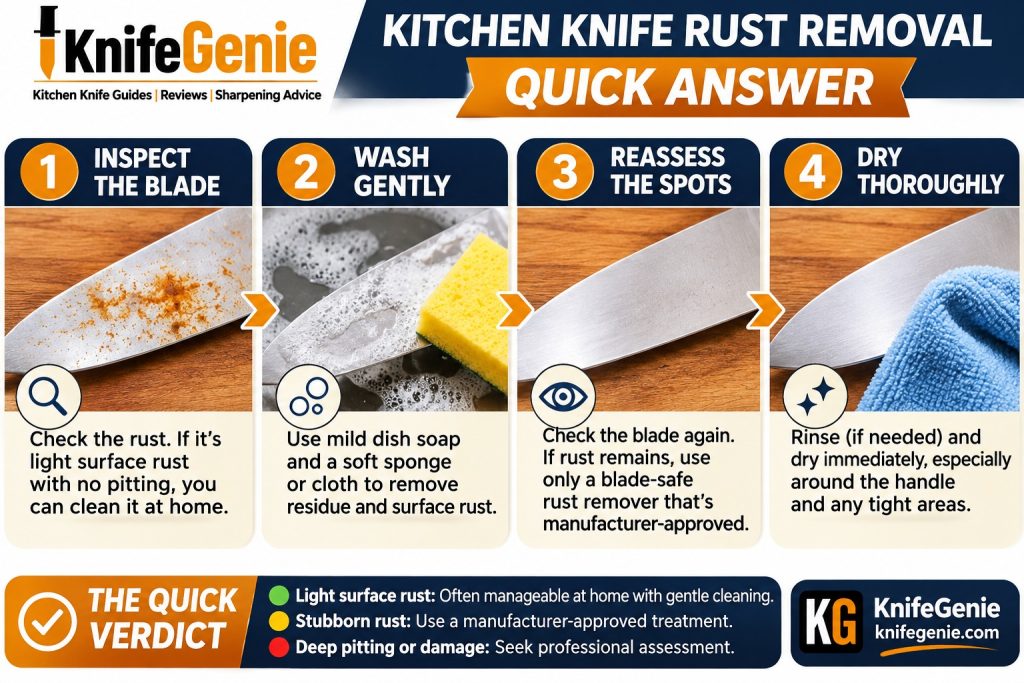
For a kitchen knife with a few light surface rust spots, start with mild dish soap, water, and a soft, non-abrasive cloth or sponge.
Here’s the safest general approach:
✔ Inspect the blade. Check whether the rust is superficial or accompanied by pitting.
✔ Check manufacturer instructions. Some blade finishes require special care.
✔ Wash gently. Use mild dish soap and a soft sponge or cloth.
✔ Reassess the spots. If corrosion remains, use only a rust-removal method specifically approved for the blade.
✔ Rinse when appropriate. Remove cleaning residue according to the product instructions.
✔ Dry immediately. Pay attention to the heel, handle junction, and other moisture-trapping areas.
✔ Inspect again. Don’t return a badly pitted or structurally damaged knife to food preparation.
🧙 KnifeGenie Quick Verdict
🟢 Light surface rust: Often manageable at home with gentle, compatible cleaning.
🟡 Stubborn rust: Use manufacturer-approved treatment rather than experimenting with aggressive abrasives.
🔴 Deep pitting or damaged steel: Seek professional assessment; replacement may be safer.
Remember: A shiny blade isn’t necessarily an undamaged blade. Don’t remove excessive metal simply to make every discoloration disappear.
🔽 Jump to What You Need
📊 Kitchen Knife Rust: Quick Assessment
| Blade Condition | What You May Notice | Recommended Action |
|---|---|---|
| 🟢 Light surface rust | Small orange-brown spots with no obvious cavities | Gentle cleaning and inspection |
| 🟡 Stubborn staining | Discoloration remaining after washing | Check finish and approved cleaning methods |
| 🟠 Surface pitting | Small visible depressions in the metal | Professional assessment, especially near the edge |
| 🔴 Severe corrosion | Deep cavities, flaking, edge damage, or corrosion at the handle junction | Stop using; assess repair or replacement |
Not every dark mark is rust. Carbon steel can develop a gray, blue, or dark patina through normal use. Some stainless knives also develop staining that resembles corrosion.
If you’re unsure what you’re seeing, identify the blade material before trying to polish the marks away.
🔍 Why Kitchen Knives Rust
Rust develops when iron in steel reacts with oxygen and moisture. Salt and certain other environmental conditions can accelerate corrosion.
Kitchen knives encounter plenty of opportunities for this to happen.
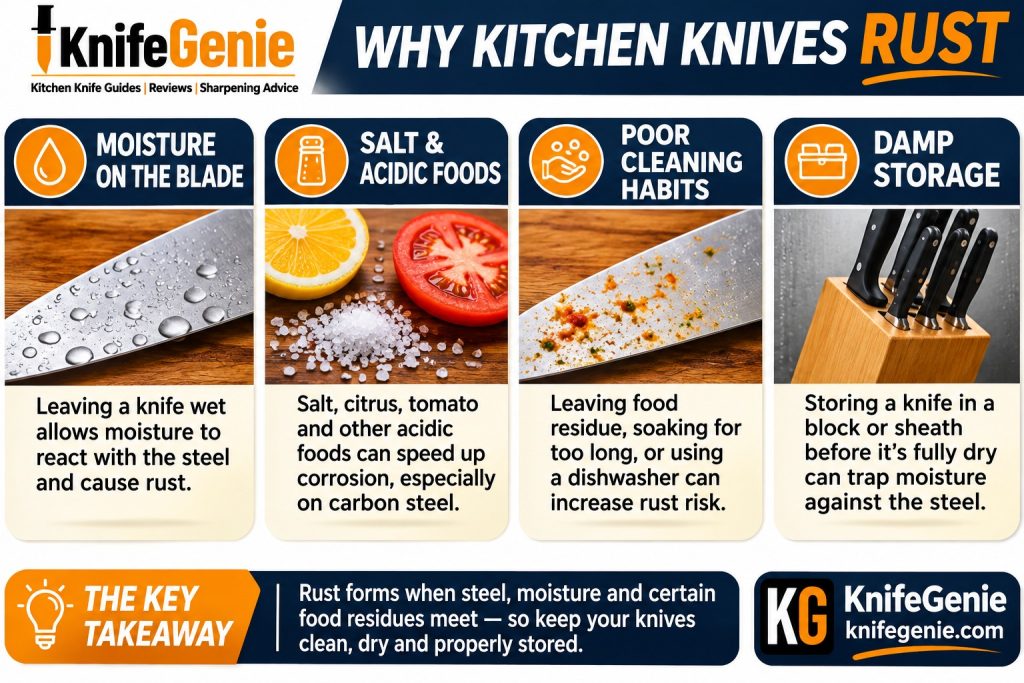
💧 Moisture Left on the Blade
One of the most common problems is leaving a knife wet after washing.
Water can remain around the handle, bolster, rivets, or other areas that are difficult to dry.
Even a knife that looks dry across its broad blade surface may still have moisture trapped near the handle.
🧂 Salt and Acidic Food Residue
Salt, citrus juice, tomato residue, and other food substances can contribute to staining or corrosion when left on susceptible steels.
This is particularly important with carbon steel knives, which generally require more attentive cleaning and drying.
🧽 Poor Cleaning Habits
Leaving knives in a wet sink, soaking them for extended periods, or allowing food residue to remain on the blade can increase corrosion risk.
Dishwashers introduce additional concerns, including prolonged moisture, detergent exposure, and possible contact with other utensils.
👉 Related guide: Can Kitchen Knives Go in the Dishwasher?
🗄️ Damp Storage
Putting a knife into a block or sheath before it is fully dry can trap moisture against the steel.
A dry storage environment matters just as much as a clean blade.
⚔️ Stainless Steel vs Carbon Steel: Which Rusts More Easily?
One of the biggest misconceptions about kitchen knives is that stainless steel cannot rust.
It can.
Stainless steel contains enough chromium to develop a thin protective surface layer that improves corrosion resistance. But that protection is not unlimited.
Different stainless knife steels have different corrosion resistance, and prolonged exposure to moisture, salt, or unsuitable cleaning products can still cause problems.
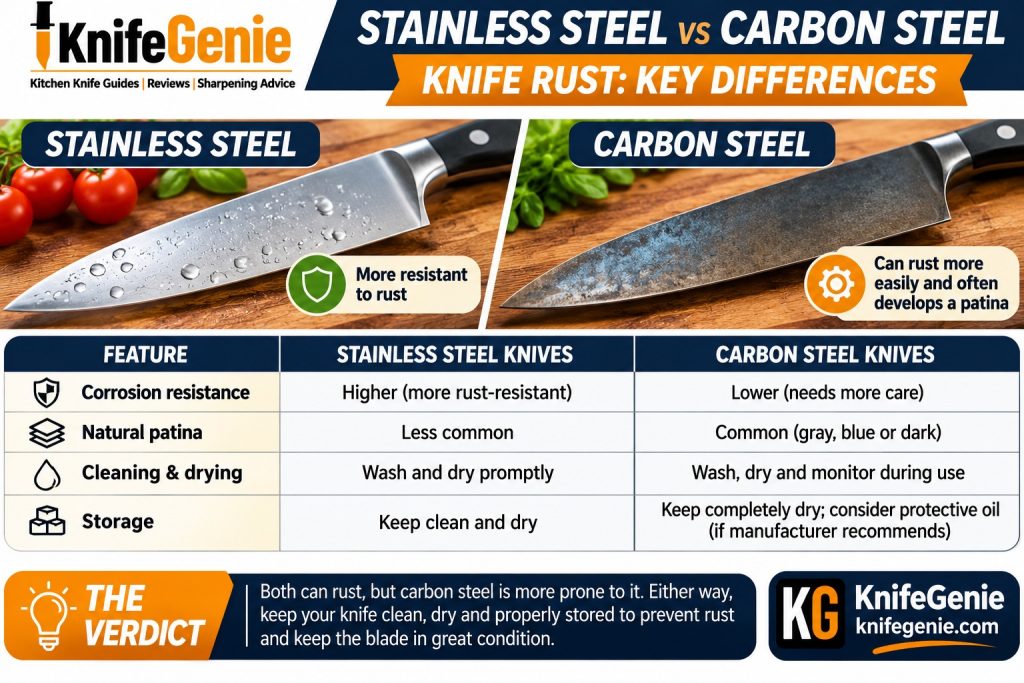
✨ Stainless Steel Kitchen Knives
Stainless knives are generally easier to maintain because their steels are formulated to resist corrosion better than ordinary non-stainless carbon steels.
However, you should still:
✔ Wash after use
✔ Remove food residue
✔ Dry thoroughly
✔ Avoid prolonged soaking
✔ Store in a clean, dry location
Don’t assume an orange spot on a stainless blade means the entire knife is defective. It may be a localized corrosion problem, staining, or contamination from another metal.
⚫ Carbon Steel Kitchen Knives
Carbon steel knives are valued by many cooks for their sharpening characteristics and cutting performance, but they typically need more careful corrosion prevention.
Unlike stainless steel, traditional carbon steel can react visibly with foods and moisture.
Over time, it may develop a natural patina.
A stable patina is not necessarily rust.
Patina is often gray, blue-gray, or dark in appearance. Active red-orange rust is a different concern and should be addressed.
📊 Stainless vs Carbon Steel Care Comparison
| Feature | Stainless Steel | Carbon Steel |
|---|---|---|
| Corrosion resistance | Generally higher | Generally lower |
| Natural patina | Less typical | Common with use |
| Drying requirements | Dry promptly | Dry promptly and during extended prep as needed |
| Routine care | Wash, dry, store | Wash, dry, monitor, protect when appropriate |
| Rust-removal caution | Protect polished or coated finishes | Protect patina and avoid unnecessary abrasion |
🧙 KnifeGenie Tip: Don’t scrub away a carbon steel patina simply because the blade no longer looks new. A normal patina and active rust are not the same thing.
🧰 What You Need for Safe Kitchen Knife Rust Removal
Before reaching for a rust remover, gather a few basic cleaning supplies.
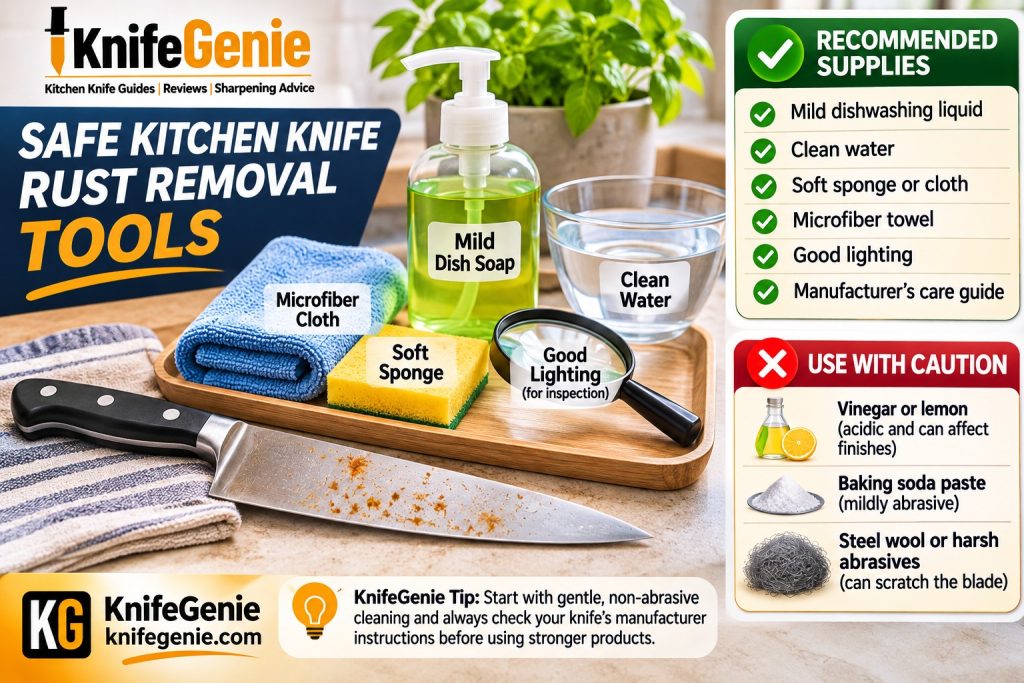
✅ Recommended Starting Supplies
🧼 Mild dishwashing liquid
💧 Clean water
🧽 Soft, non-abrasive sponge
🧺 Clean microfiber cloth or soft towel
💡 Good lighting for inspection
🪵 Stable, non-slip work surface
📋 Manufacturer’s knife-care instructions
Depending on the knife, you may also need a blade-compatible rust-removal product recommended by the manufacturer.
For carbon steel knives, a small amount of food-safe protective oil may be appropriate for storage if the manufacturer recommends it.
⚠️ Products to Approach Carefully
Some people recommend baking soda paste, vinegar, lemon juice, metal polish, abrasive erasers, or rust-removal compounds.
These products are not automatically suitable for every kitchen knife.
Acidic treatments can alter a carbon steel patina or affect certain finishes. Abrasive compounds can leave visible scratches or remove surface material.
Even products marketed for stainless steel may not be suitable for coated, etched, laminated, or decorative knife blades.
Our recommendation: Don’t make an untested household remedy your first choice on an expensive knife. Check the manufacturer’s guidance before applying chemicals or abrasives.
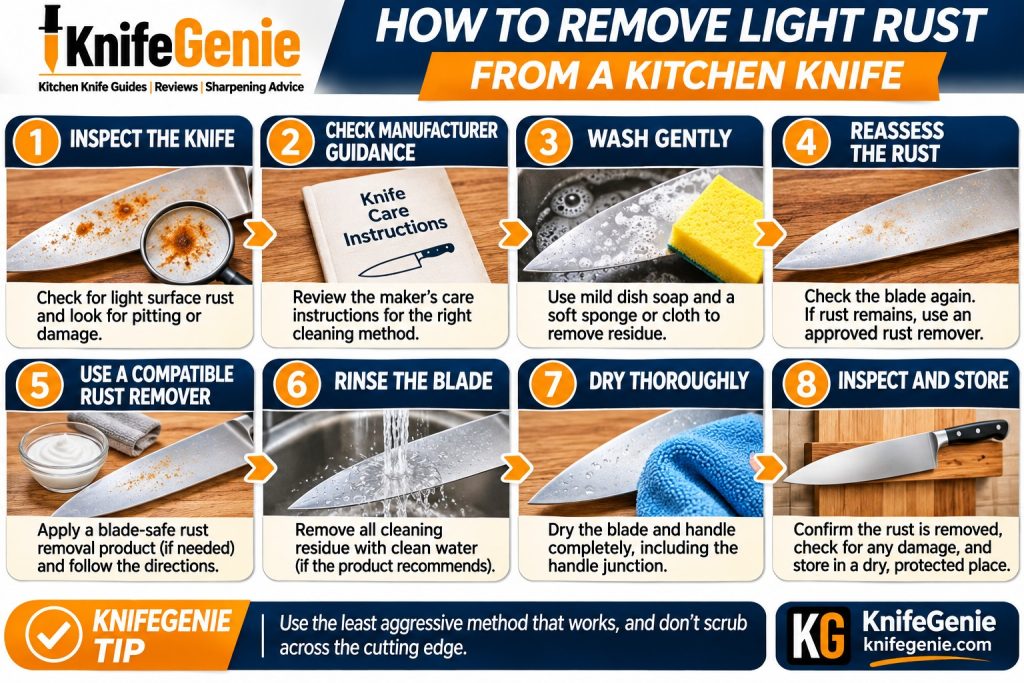
🧽 How to Remove Light Rust From Kitchen Knives: Step by Step
If the knife has only a few superficial spots and no obvious pitting or damage, the following process provides a conservative starting point.
1. 🔍 Inspect the Knife Before Cleaning
Look carefully at the blade under good lighting.
Check the flat sides, heel, spine, cutting edge, and handle junction.
You’re looking for the difference between light surface discoloration and physical damage to the metal.
If you can see cavities, cracks, flaking metal, or corrosion extending into the handle, stop and seek advice before continuing.
2. 📖 Check the Manufacturer’s Care Instructions
Identify the knife’s brand, steel type, and finish where possible.
A conventional polished stainless chef knife may tolerate cleaning methods that are unsuitable for a black-coated carbon steel knife or a decorative etched blade.
For example, MIYABI provides care guidance for its knives, including gentle hand washing and careful drying.
When the manufacturer gives a specific rust-removal procedure, follow that procedure rather than generic internet advice.
3. 🧼 Wash With Mild Soap and Water
Place the knife on a stable work surface where it cannot slip.
Use a soft sponge or cloth with mild dishwashing liquid and water to remove ordinary food residue and loose surface contamination.
Work carefully along the broad blade surface, keeping your fingers away from the cutting edge. Never wipe toward the sharp edge.
Avoid soaking the knife or leaving it submerged in the sink.
4. 🔎 Reassess the Remaining Rust
After gentle washing, inspect the affected areas again.
Some marks may have been surface contamination rather than established corrosion.
If the orange-brown spots remain, don’t immediately increase pressure or switch to a coarse abrasive.
Determine whether the blade has a finish that could be scratched or stripped.
5. ✨ Use Only a Compatible Rust-Removal Method
If the manufacturer approves a specific cleaning compound, rust eraser, or other treatment for that blade, follow its instructions carefully.
Keep the treatment localized and use the least aggressive approved method.
Do not scrub across the cutting edge, apply excessive pressure, or attempt to grind away deeper pits.
If no suitable treatment is confirmed, a professional knife-care service is a better option than experimenting on a valuable blade.
6. 🚿 Remove Cleaning Residue
Follow the cleaner’s instructions for rinsing or wiping away residue.
Any product used on a food-contact blade must be appropriate for that application, and cleaning residues should be completely removed before food preparation.
Do not mix cleaning chemicals.
7. 💨 Dry the Knife Thoroughly
Use a clean, dry cloth to remove moisture from the blade and handle.
Pay particular attention to the area where the blade enters the handle.
Allow any remaining surface moisture to evaporate before storing the knife.
8. 🛡️ Inspect and Store Properly
Look for remaining corrosion, pits, rough spots, or cutting-edge damage.
Do not use the knife for food preparation if corrosion or cleaning residue remains in an area that cannot be properly cleaned, or if its structural condition is uncertain.
If the knife is clean and sound, return it to suitable dry storage.
👉 Learn more: How to Store Kitchen Knives Safely.
🚫 7 Kitchen Knife Rust Removal Mistakes to Avoid
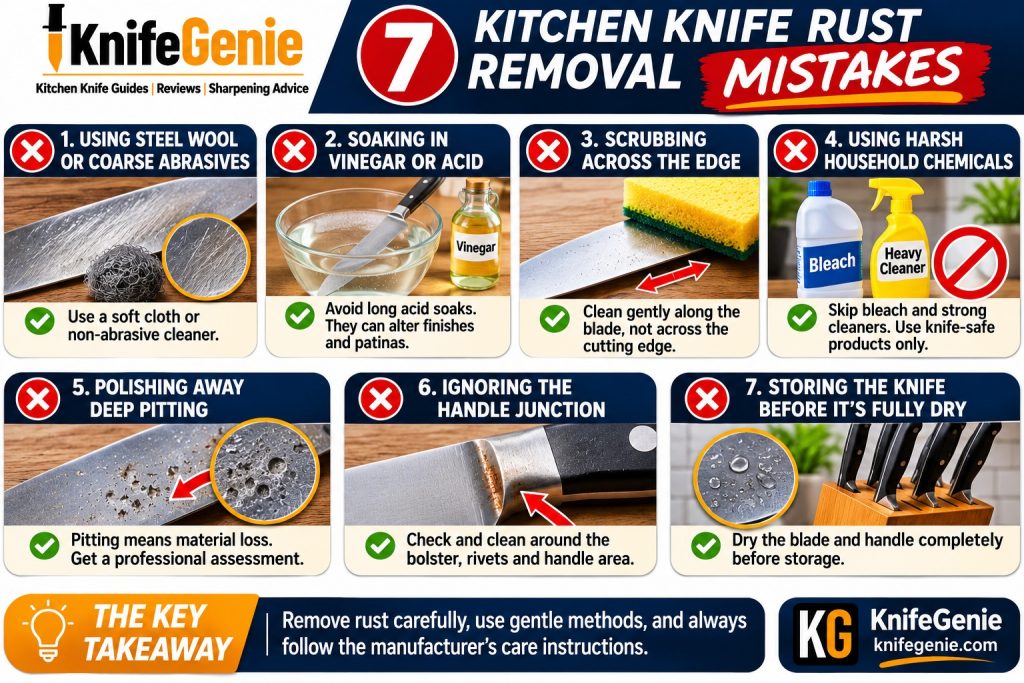
Sometimes the biggest damage comes not from the rust itself, but from an overly aggressive attempt to remove it.
❌ 1. Using Steel Wool or Coarse Sandpaper
These abrasives can scratch polished blades, alter surface finishes, and remove more metal than necessary.
Ordinary steel wool can also leave behind particles that may later corrode.
❌ 2. Soaking the Knife in Vinegar
Vinegar is frequently recommended as a household rust remover, but prolonged acid exposure can discolor steel, alter a carbon steel patina, or affect certain finishes.
Don’t soak a valuable kitchen knife in vinegar without specific manufacturer approval.
❌ 3. Scrubbing Across the Cutting Edge
Cleaning around the cutting edge requires care.
Abrasive contact can alter the edge geometry, dull the blade, or create unnecessary safety risks.
👉 Related reading: Why Kitchen Knives Get Dull So Quickly.
❌ 4. Using Strong Household Chemicals
Bleach, harsh cleaners, and general-purpose rust-removal chemicals are not automatically appropriate for kitchen knives.
Some can damage metal or finishes, while others may leave residues unsuitable for food-contact surfaces.
❌ 5. Trying to Polish Away Deep Pitting
Pitting means the corrosion has created depressions in the metal.
Removing enough surrounding steel to eliminate those depressions can change the blade’s shape and thickness.
This is not a sensible routine cleaning job.
❌ 6. Ignoring the Handle Junction
Rust near the bolster, rivets, or handle junction deserves particular attention.
Corrosion hidden beneath handle materials may be difficult to inspect or clean.
❌ 7. Storing the Knife Before It’s Completely Dry
Even successful rust removal won’t solve the problem if the knife goes straight back into a damp sheath or block.
Clean and dry the storage equipment as well.
👨🔧 When Does Kitchen Knife Rust Need Professional Help?
Light surface corrosion and serious rust damage are not interchangeable.
Some knives need more than a cleaning cloth and a little patience.
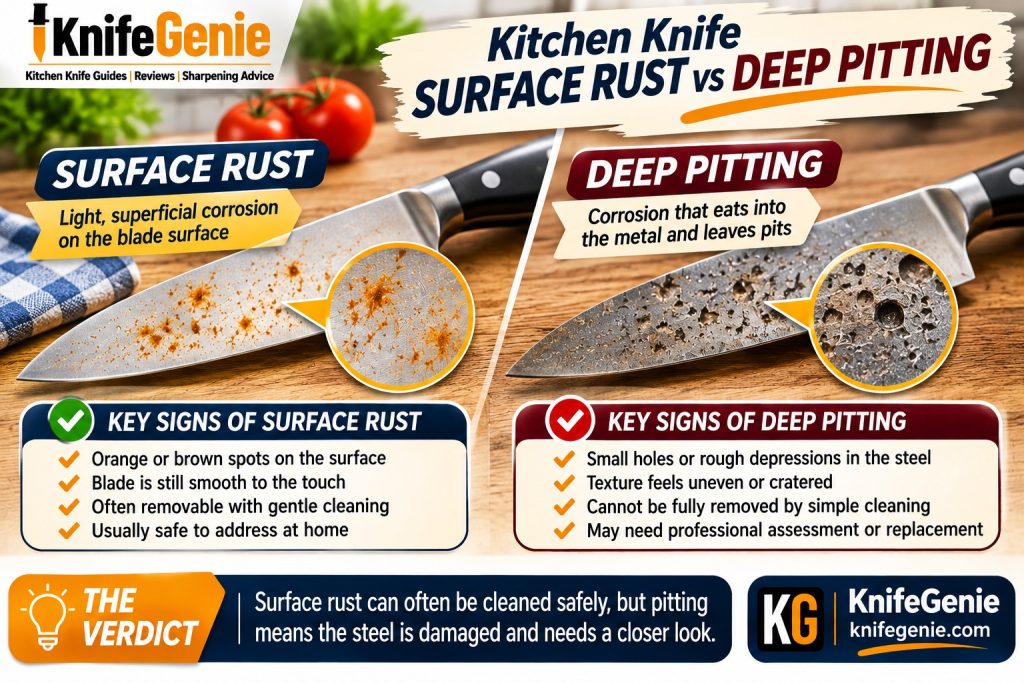
🔍 What Does Rust Pitting Look Like?
Pitting creates small cavities or depressions in the metal.
Unlike a flat stain, a pit represents actual material loss.
Cleaning may remove corrosion products from the surface, but it cannot put the missing steel back.
Be especially cautious when pitting is close to the cutting edge, along the blade’s spine, or near the handle.
⚠️ Signs You Should Stop Cleaning
🚩 Deep or widespread pitting
🚩 Cracks or flaking metal
🚩 Significant thinning near the edge
🚩 Rust spreading beneath handle components
🚩 A loose or damaged handle
🚩 Corrosion that repeatedly returns from inaccessible areas
🚩 An expensive or specialty blade with an uncertain finish
🔧 Can a Rusted Kitchen Knife Be Restored?
Sometimes.
A knowledgeable knife-restoration specialist may be able to assess the extent of corrosion, clean affected surfaces, and determine whether repair is practical.
However, restoration may change the original appearance, finish, or blade geometry.
Severe corrosion can make replacement the better decision, particularly when structural integrity or cleanability is in doubt.
🧙 KnifeGenie Verdict: If you cannot tell whether the blade is merely stained or physically damaged, don’t keep grinding or polishing until the marks disappear. Have it assessed.
🛡️ How to Prevent Rust From Returning
Once you’ve addressed light corrosion, the next step is preventing it from returning.
Fortunately, good knife care doesn’t need to be complicated.
🧼 Wash Your Knife Promptly
After preparing food, wash the blade by hand using mild dish soap and water.
Don’t leave acidic or salty food residue on susceptible steel for extended periods.
💨 Dry Immediately After Washing
Dry both sides of the blade and the handle carefully.
Carbon steel knives may also benefit from being wiped dry during lengthy food-preparation sessions.
🚫 Avoid Unnecessary Dishwasher Exposure
For quality kitchen knives, hand washing is generally the better maintenance choice.
Some manufacturers describe specific knife models as dishwasher-safe, but that does not mean dishwasher cleaning is always the best treatment for their appearance or long-term condition.
Follow the instructions for your particular knife.
🗄️ Choose Dry, Protective Storage
A knife block, magnetic strip, in-drawer organizer, or suitable blade guard can all work well.
The important thing is to keep the knife clean, completely dry, and protected from contact with other utensils.
Don’t put a damp blade into a sheath or enclosed holder.
🛢️ Consider Protective Oil for Carbon Steel
Some carbon steel knife manufacturers recommend a thin protective layer of food-grade mineral oil or another approved product when the knife will be stored for an extended period.
Use only an appropriate product, apply it according to the manufacturer’s directions, and follow the recommended cleaning procedure before food use.
Don’t assume that every stainless, coated, or decorative blade needs oiling.
🔪 Maintain the Cutting Edge
Rust prevention and edge maintenance are related parts of good knife care, but they are not the same process.
Sharpening restores worn cutting edges. It isn’t a substitute for appropriate corrosion removal.
For more maintenance guidance, visit the KnifeGenie Sharpen & Care hub.
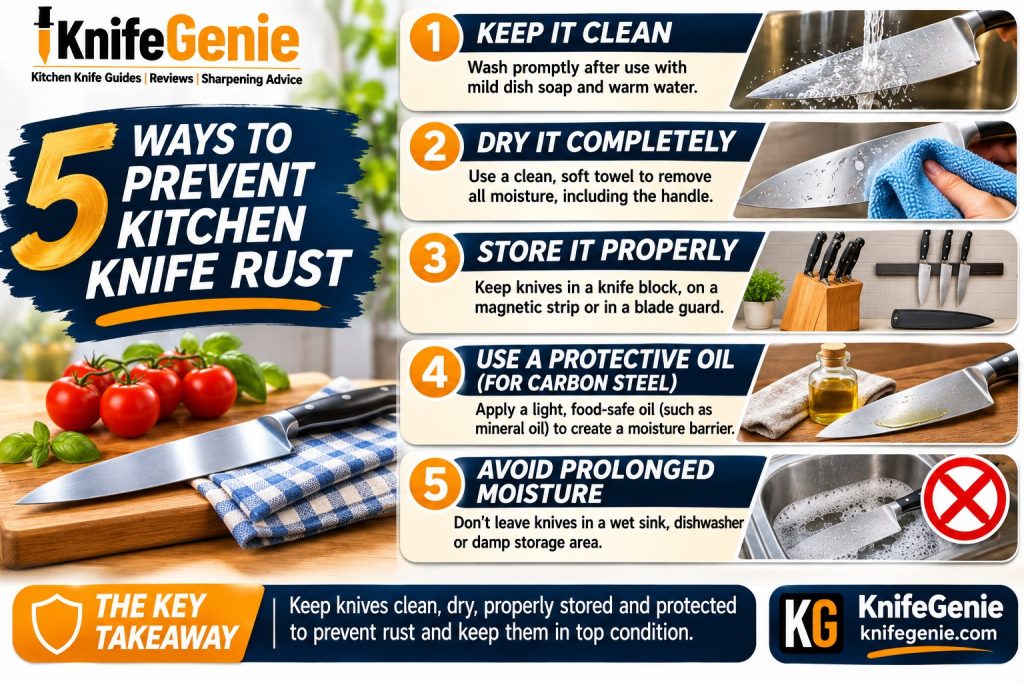
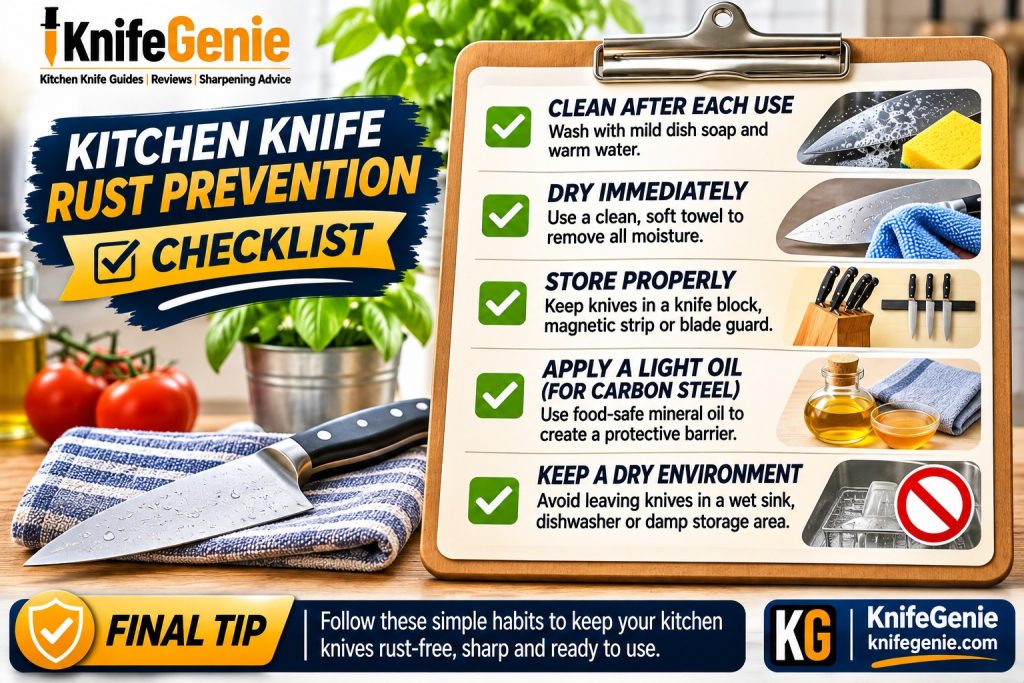
📋 Kitchen Knife Rust Prevention Checklist
✔ Clean the blade after food preparation.
✔ Avoid leaving knives soaking in the sink.
✔ Remove salty and acidic residues promptly.
✔ Dry the blade and handle completely.
✔ Keep knife blocks, guards, and sheaths dry.
✔ Inspect carbon steel blades regularly.
✔ Use only manufacturer-approved protective treatments.
✔ Seek professional advice when corrosion causes pitting or structural damage.
❓ Frequently Asked Questions
Can you remove rust from a stainless steel kitchen knife?
Often, yes, if the rust is limited to light surface corrosion. Start with gentle washing and use only a cleaning or rust-removal method compatible with the knife’s steel and finish. Deep pitting requires a different assessment.
What is the safest way to remove light rust from a kitchen knife?
Begin with mild dish soap, water, and a soft cloth or sponge. If visible rust remains, check the manufacturer’s approved treatment rather than immediately using acids or aggressive abrasives.
Can I use baking soda to remove rust from a knife?
Baking soda paste is a common household suggestion, but it can act as a mild abrasive. It may change delicate finishes or patinas. Use it only when appropriate for the specific blade and permitted by its manufacturer.
Does vinegar remove rust from kitchen knives?
Vinegar can react with rust, but it can also affect blade surfaces, patinas, and finishes. We don’t recommend prolonged vinegar soaking as a universal kitchen knife rust-removal method.
Is a rusty kitchen knife safe to use?
Don’t use a knife for food preparation while active corrosion or cleaning residue remains on its food-contact surfaces. If the blade is pitted, difficult to clean, or structurally damaged, seek professional assessment. A knife that has been properly cleaned and confirmed sound may be returned to use.
Is black discoloration on carbon steel a sign of rust?
Not necessarily. Carbon steel commonly develops a dark patina through normal use. A stable patina differs from active orange-brown corrosion, although appearance alone may not always be enough to identify a mark confidently.
Will removing rust make my knife dull?
Gentle cleaning should not significantly change a sound cutting edge. Aggressive scrubbing, grinding, or abrasive contact with the edge can dull or damage it. Rust that has already affected the cutting edge may require professional repair or sharpening.
Should I throw away a knife with rust pits?
Not every visible pit automatically requires disposal. The decision depends on the depth, location, cleanability, and overall condition of the blade. Deep or widespread pitting, particularly near the edge or handle, may make replacement more sensible than repair.
How do I stop carbon steel kitchen knives from rusting?
Wash and dry them promptly, wipe them during prolonged preparation when necessary, avoid damp storage, and follow the manufacturer’s recommendations for protective oil or other maintenance. A normal patina does not need to be removed simply for appearance.
🏆 Overall Recommendation: Remove Rust Gently and Protect the Blade
For most home cooks, the safest approach to kitchen knife rust removal is also the simplest: identify the problem, begin with gentle cleaning, and avoid removing more steel than necessary.
A few superficial rust spots may be manageable at home.
But don’t treat every knife the same way.
A polished stainless chef knife, a carbon steel gyuto, and a decorative laminated blade can have very different care requirements.
🧙 KnifeGenie Final Verdict
🥇 Best first step: Mild soap, water, gentle cleaning, and careful inspection.
🛡️ Best long-term protection: Prompt drying and clean, dry storage.
⚠️ Biggest mistake: Using harsh abrasives or acids without checking blade compatibility.
👨🔧 Best choice for deep pitting: Professional assessment before further use.
The goal isn’t to make every blade look brand-new at any cost. It’s to preserve the knife’s useful steel, maintain its cutting performance, and keep it suitable for food preparation.
Clean it carefully. Dry it completely. Store it properly.
Those three habits can prevent many rust problems before they start.
👉 Continue learning with the KnifeGenie Sharpen & Care Guide.