

A sharp kitchen knife deserves a better home than the bottom of a crowded utensil drawer.
Proper knife storage isn’t only about keeping your kitchen organized. It helps protect the cutting edge, reduce accidental contact with sharp blades, keep knives dry and make the knife you need easier to reach safely.
For most home kitchens, the best options are a knife block, magnetic strip, in-drawer knife organizer or individual blade guard/sheath. The right choice depends on your available space, knife collection and whether you want your knives displayed or stored out of sight.
One method should generally be avoided:
Never leave good kitchen knives loose and unprotected in a drawer.
The blades can strike utensils and other knives, potentially damaging their edges, while exposed cutting edges create an unnecessary risk whenever someone reaches into the drawer.
This KnifeGenie guide is based on research into knife-care recommendations, storage designs and manufacturer guidance rather than personal testing of every storage product mentioned. The goal is to explain what makes a storage method safe and blade-friendly so you can choose the solution that makes sense in your kitchen.
🔽 Jump to What You Need
👉 Quick Answer
👉 Knife Storage Comparison
👉 Why Knife Storage Matters
👉 Knife Blocks
👉 Magnetic Knife Strips
👉 In-Drawer Knife Organizers
👉 Blade Guards & Sheaths
👉 Why Loose Drawers Are a Bad Idea
👉 Does Storage Affect Sharpness?
👉 Moisture & Knife Storage
👉 Knife Safety & Accessibility
👉 Which Storage Method Should You Choose?
👉 KnifeGenie Pro Tips
👉 Frequently Asked Questions
👉 Overall Recommendation
🏆 How Should You Store Kitchen Knives? The Quick Answer
For most home cooks, there isn’t one storage method that beats every other option.
🧲 Choose a Magnetic Strip If You Want:
✔ Easy access
✔ More counter space
✔ Flexible storage for different knife sizes
✔ Knives visible at a glance
✔ Good airflow around clean, dry blades
🗄️ Choose an In-Drawer Organizer If You Want:
✔ Knives kept out of sight
✔ Clear countertops and walls
✔ Individual protection for each blade
✔ A good solution for homes with limited counter space
🪵 Choose a Knife Block If You Want:
✔ Traditional countertop storage
✔ Fast, convenient access
✔ Dedicated slots for your everyday knives
✔ A self-contained storage system
🛡️ Choose Blade Guards or Sheaths If You Want:
✔ An inexpensive solution
✔ Protection for individual knives
✔ Safe drawer storage without a large organizer
✔ Protection while transporting knives
❌ Avoid:
Loose, uncovered knives mixed with utensils in a kitchen drawer.
🧙 KnifeGenie Tip: Good knife storage should accomplish four things: protect you, protect the cutting edge, keep the knife clean and dry, and make it easy to retrieve without grabbing near the blade.
KNIFE STORAGE METHODS COMPARED
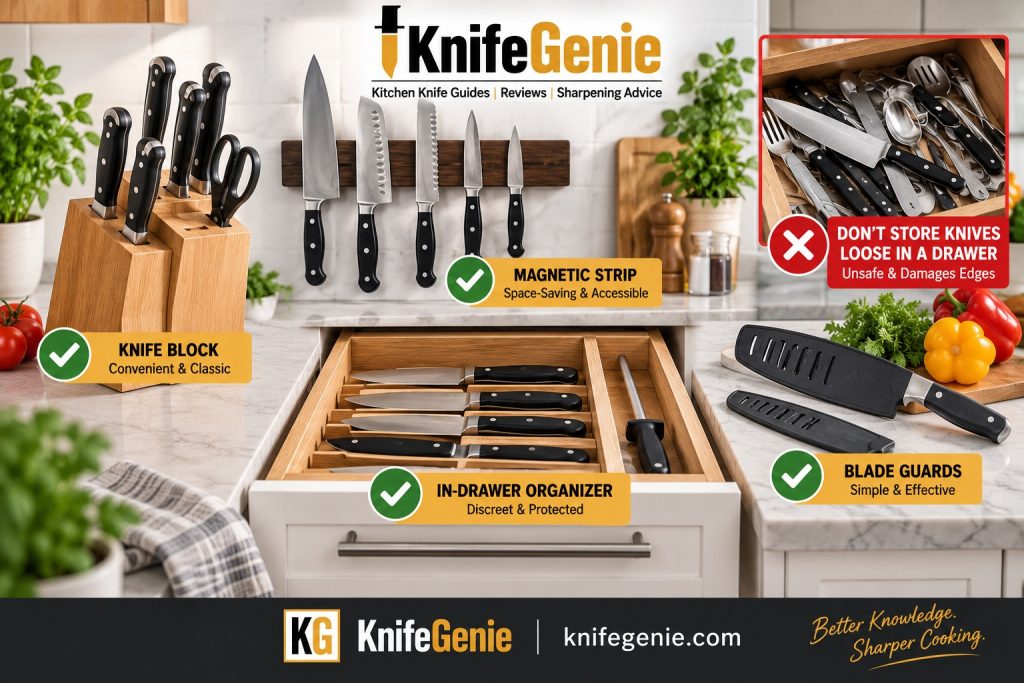
⚔️ Kitchen Knife Storage Methods Compared
| Storage Method | Blade Protection | Accessibility | Space Use | Main Consideration |
|---|---|---|---|---|
| 🪵 Knife block | Very good | Excellent | Uses counter space | Slots should stay clean and dry |
| 🧲 Magnetic strip | Excellent when used carefully | Excellent | Saves counter space | Requires secure installation and careful removal |
| 🗄️ In-drawer organizer | Excellent | Very good | Uses drawer space | Drawer must have adequate clearance |
| 🛡️ Blade guard/sheath | Very good | Good | Minimal | Guard must fit the blade properly |
| ❌ Loose drawer | Poor | Poor | Appears convenient | Exposed blades can contact utensils and hands |
For many households, in-drawer organizers and properly installed magnetic strips provide an excellent balance of safety, edge protection and efficient use of space.
Traditional blocks remain perfectly practical when kept clean and dry, while blade guards are particularly useful if you already have drawer space and don’t want to install a complete storage system.
🔪 Why Proper Knife Storage Matters
A kitchen knife’s cutting edge is surprisingly small.
When you sharpen a knife, you’re creating two surfaces that meet at a very fine apex. That fine edge is what allows the blade to pass easily through food.
Now imagine throwing that carefully maintained edge into a drawer containing:
🍴 Forks
🥄 Spoons
✂️ Kitchen shears
🔧 Metal utensils
🔪 Other knives
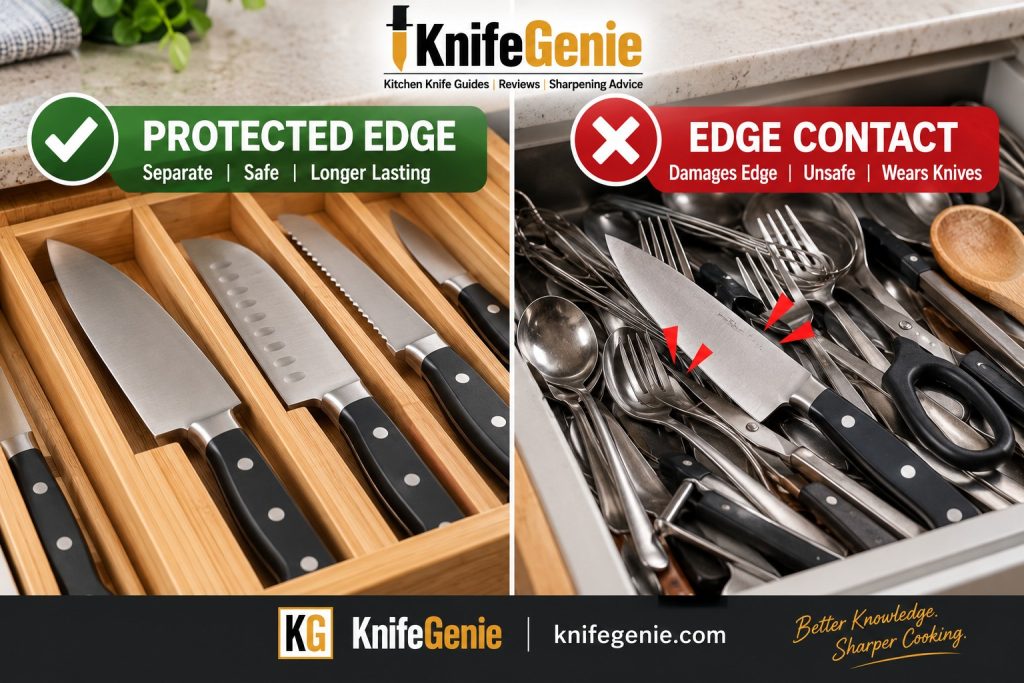
Every time the drawer opens and closes, the knife can shift and make contact with harder objects.
That is exactly what you don’t want.
Victorinox specifically advises against storing knives loosely in a drawer because unprotected blades can rub against one another, reducing sharpness and potentially damaging their cutting edges.
Proper storage therefore contributes to three important goals:
Safety → Edge protection → Knife longevity
Storage won’t eliminate the need for honing or sharpening, but it can help prevent unnecessary edge damage between uses.
PROTECT THE EDGE
🪵 Knife Blocks: Traditional and Convenient
The classic wooden knife block remains popular for a reason.
It keeps several knives together, places them within easy reach and prevents their cutting edges from bouncing around against other utensils.
✅ Advantages
✔ Convenient countertop access
✔ Individual slots protect blades
✔ Easy to organize
✔ Available for complete knife sets
✔ No wall installation required
✔ Can also accommodate shears and honing tools
❌ Disadvantages
✘ Takes up counter space
✘ Fixed slots may not fit unusual knives
✘ Slots can collect debris
✘ Moisture can become a problem if damp knives are inserted
✘ Interior slots can be difficult to inspect and clean
One important habit makes a major difference:
Never put a wet knife into a knife block.
Wash the knife, dry the blade and handle thoroughly, and only then return it to storage.
Knife blocks should also be cleaned periodically, especially if crumbs or debris collect inside the slots.
🧙 KnifeGenie Tip
If your block uses horizontal slots, store the knife with its edge facing upward where the design allows it. That reduces unnecessary contact between the cutting edge and the slot as the knife slides in and out.
With vertical slots, avoid dragging the cutting edge heavily against the wood. Insert and remove the knife with control.
CORRECT KNIFE BLOCK STORAGE

🧲 Magnetic Knife Strips: Excellent for Accessibility
A good magnetic strip solves several storage problems at once.
It frees counter and drawer space, accommodates knives of different shapes and keeps your collection visible.
Instead of searching for the right knife, you can immediately see your chef knife, Santoku, bread knife and paring knife.
A magnetic strip can therefore be particularly useful in a small kitchen.
✅ Advantages
✔ Saves counter space
✔ Excellent accessibility
✔ Fits many knife shapes and sizes
✔ Easy to see which knife you’re selecting
✔ Allows air circulation around the blade
✔ Doesn’t require fixed slots
❌ Disadvantages
✘ Must be mounted securely
✘ Exposed knives may not suit every household
✘ Poor removal technique can cause the blade to strike the strip
✘ Placement matters where children are present
✘ Some strips may hold more aggressively than others
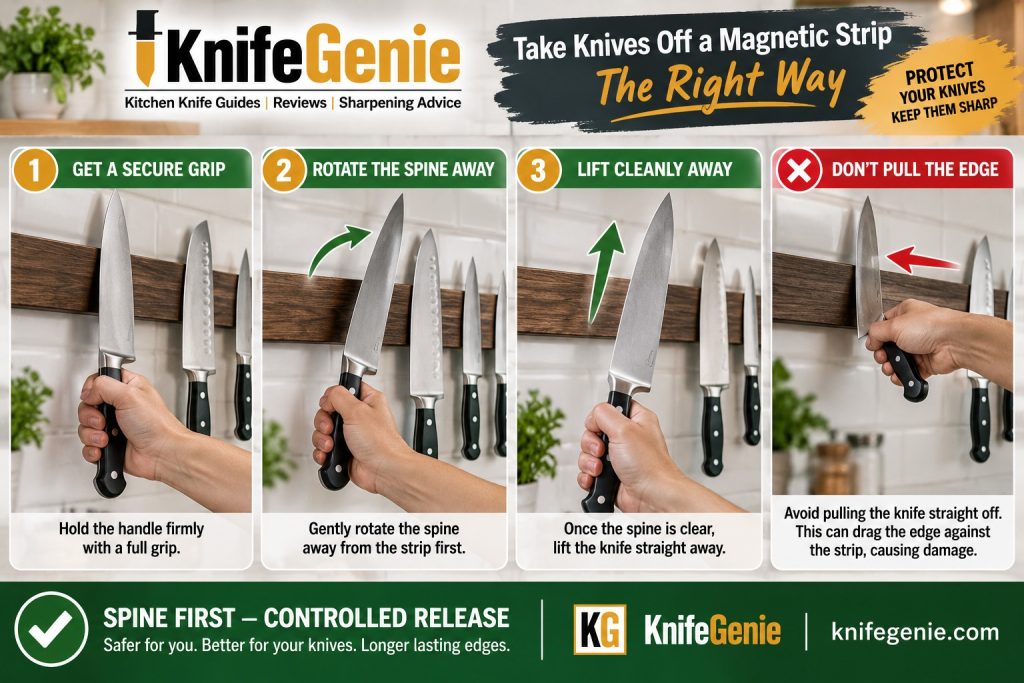
The important detail is how you remove the knife.
Don’t simply yank the blade straight toward yourself.
Grip the handle securely and gently rotate or roll the knife away so the spine releases before the cutting edge.
This gives you more control and reduces unnecessary edge contact.
⚠️ Think About Who Uses the Kitchen
A wall full of exposed knives may look fantastic.
That doesn’t automatically make it appropriate for every household.
If young children can reach the strip—or can climb onto nearby furniture or countertops—an enclosed or inaccessible storage solution may be more appropriate.
The strip should also be firmly anchored according to its installation instructions. A magnetic strip is only a safe storage system if the strip itself is securely attached.
MAGNETIC STRIP TECHNIQUE – How to Remove Knife From Magnetic Strip
🗄️ In-Drawer Knife Organizers: Safe and Discreet
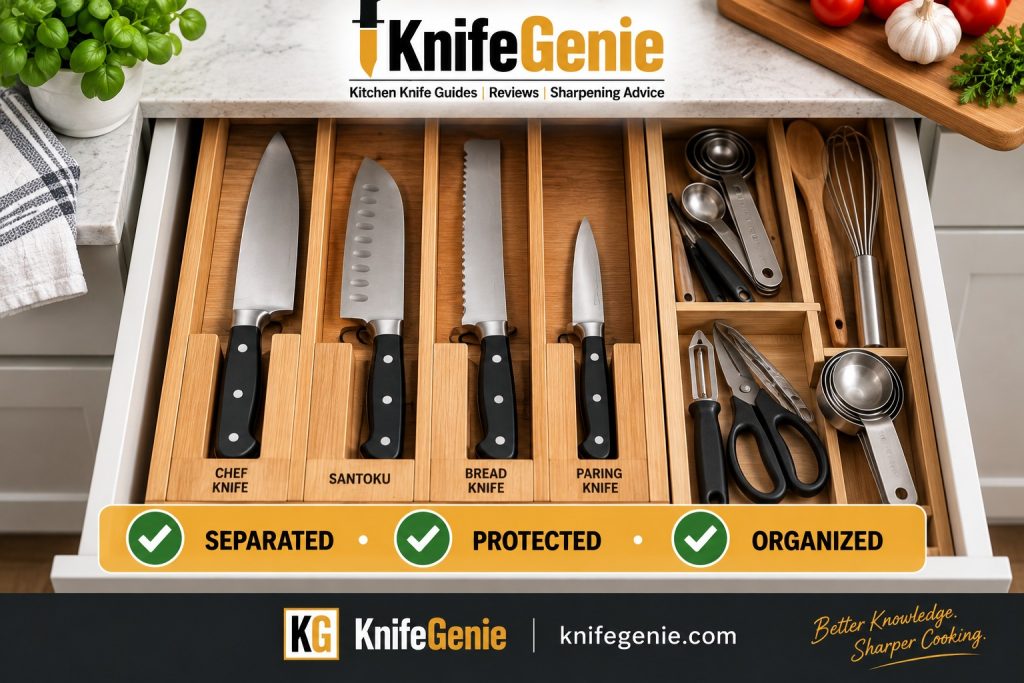
An in-drawer organizer gives you the clean appearance of ordinary drawer storage without the disadvantages of leaving blades loose.
Instead of knives sliding around, individual slots or dividers separate them.
Manufacturers such as ZWILLING specifically design in-drawer organizers so individual slots hold knives securely while protecting blades from dulling. Because you need to protect your knife edge from premature dulling.
✅ Advantages
✔ Keeps blades covered and separated
✔ Clears countertop space
✔ Keeps knives out of immediate view
✔ Protects edges from other utensils
✔ Organized and easy to understand
✔ No wall installation required
❌ Disadvantages
✘ Uses valuable drawer space
✘ Organizer must fit the drawer
✘ Deep handles may interfere with drawer clearance
✘ Very large knives may not fit standard organizers
Before buying one, measure:
Drawer width × depth × internal height
Don’t forget the height.
A tall knife handle sitting in an organizer can prevent a shallow drawer from closing even when the organizer itself fits perfectly.
🧙 KnifeGenie Tip
Don’t turn an organized knife drawer into another junk drawer.
If forks, peelers, scissors and miscellaneous utensils are piled on top of your knife organizer, you’ve defeated much of its purpose.
Give the knives their own protected area.
IN-DRAWER STORAGE – Safe In-Drawer Knife Organizer
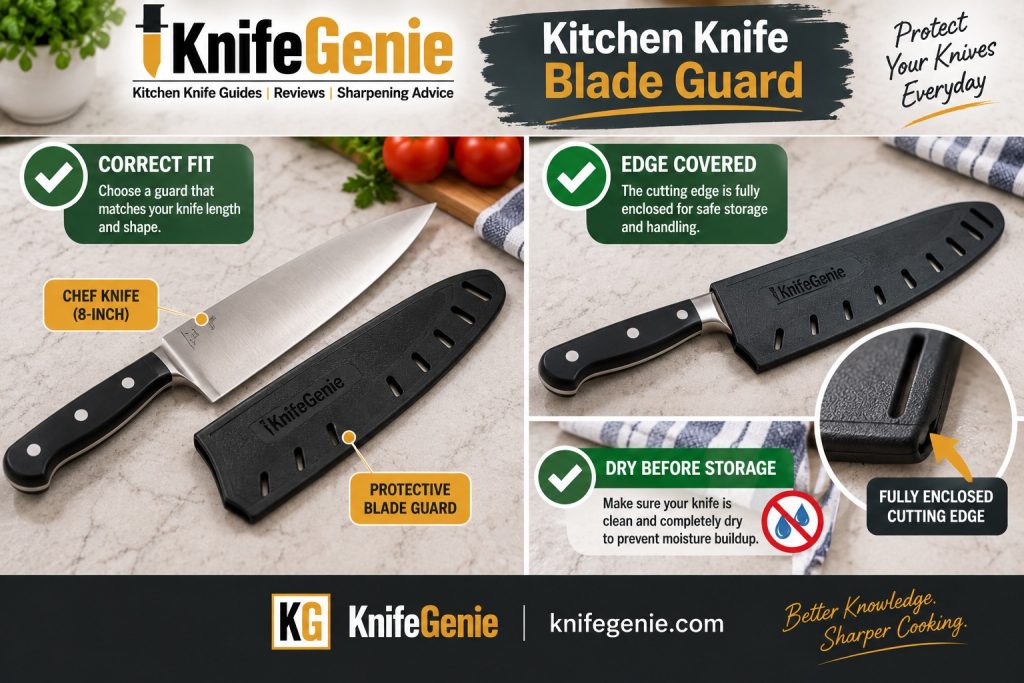
🛡️ Blade Guards & Sheaths: Simple Individual Protection
You don’t necessarily need a large storage system.
If you own only a few good knives, individual blade guards can be a practical solution.
A properly fitted guard covers the cutting edge and allows the protected knife to be stored in a drawer without exposing the edge to your hands or nearby utensils.
Victorinox describes blade guards as providing both safety and cutting-edge protection, while ZWILLING offers sheaths specifically for protected drawer storage.
Blade Guards Work Well For:
🔪 Individual chef knives
🔪 Santokus
🔪 Utility knives
🔪 Specialty knives
🔪 Knives transported in cases or rolls
🔪 Small collections without a dedicated block
Choose the correct guard for the length and height of the blade.
A chef knife shouldn’t be squeezed into a guard designed for a narrow utility knife.
And don’t treat the guard as a substitute for drying.
⚠️ Dry Before Covering
A sheath encloses part of the blade.
If you put the knife away wet, you’re potentially trapping moisture against the metal.
Clean → dry thoroughly → cover → store.
That’s the safer sequence.
BLADE GUARD
❌ Why Loose-Drawer Knife Storage Is a Bad Idea
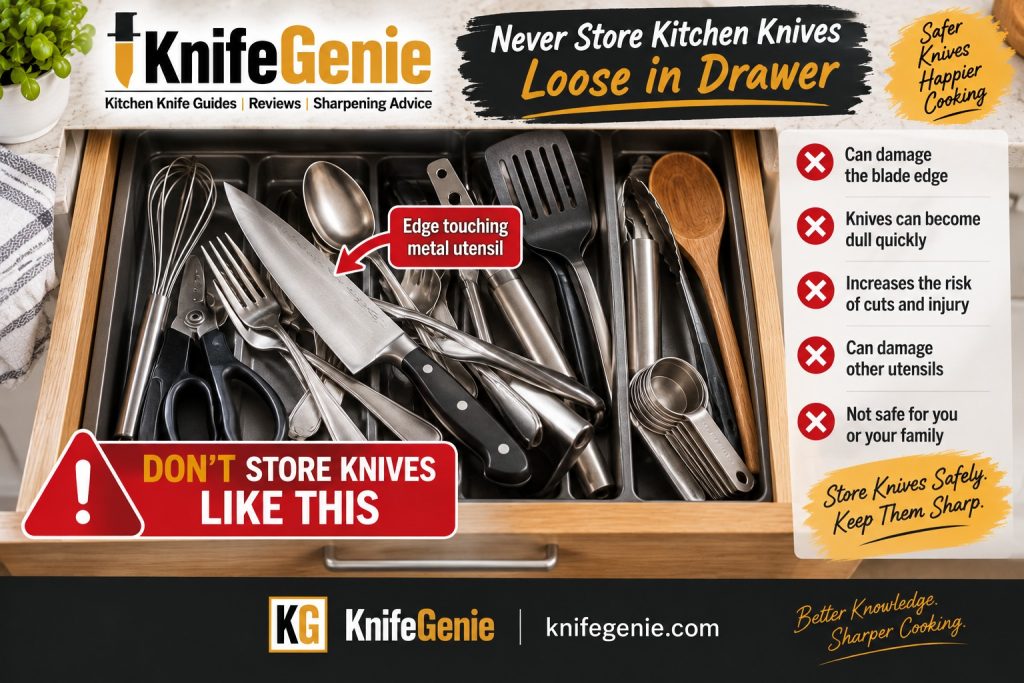
A loose utensil drawer creates two obvious problems: exposed blades are harder to retrieve safely, and the cutting edge can repeatedly strike other utensils as the drawer opens and closes.
🩹 Problem #1: Safety
Someone reaching into the drawer may contact an exposed cutting edge before realizing where the knife is.
This becomes particularly concerning in a shared kitchen where another person may not know a sharp knife has been placed underneath other utensils.
🔪 Problem #2: Edge Damage
The knife edge can strike:
Metal utensils → other knives → scissors → hard drawer components.
Those repeated contacts are completely unnecessary.
Victorinox explicitly warns that loose drawer storage allows unprotected blades to rub against one another and can damage their cutting edges. Shun likewise advises that knives should not be stored unsheathed in a drawer.
If drawer storage is your only practical option, that’s fine.
Protect the blade first.
Use an organizer, sheath or blade guard.
UNSAFE STORAGE
⚔️ Does Knife Storage Affect Sharpness?
Yes—but indirectly.
Simply placing a knife in a block or drawer organizer doesn’t make it sharper.
Good storage instead helps prevent avoidable damage to an already sharpened edge.
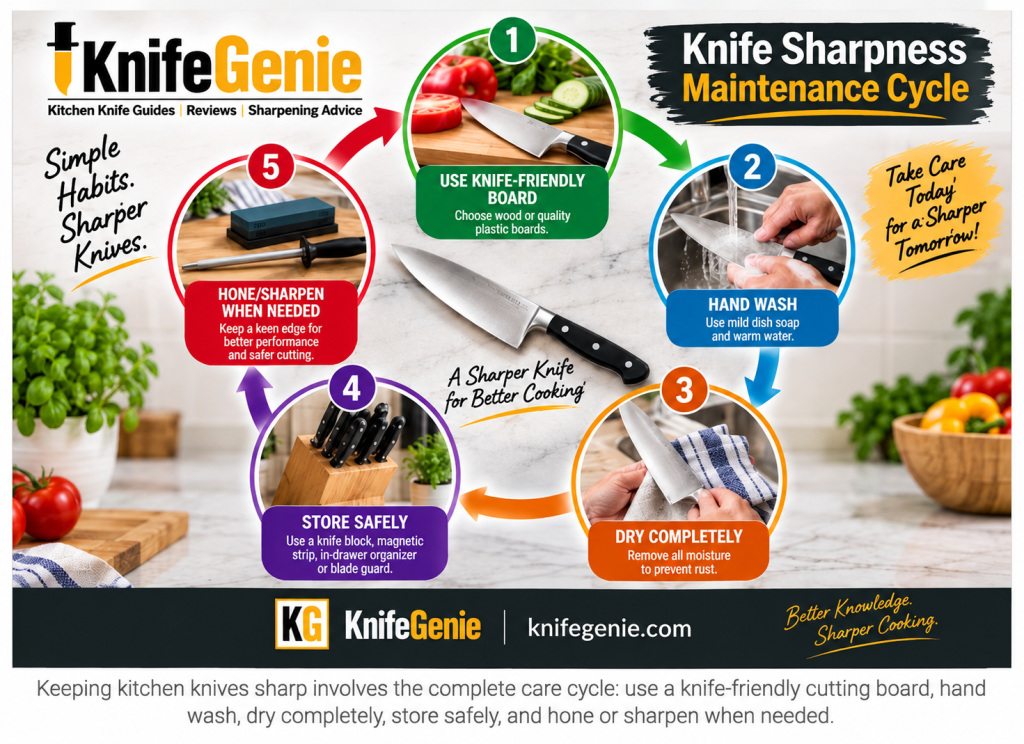
Think of edge retention as a chain:
Sharpen properly → use a knife-friendly cutting board → avoid abusive cutting → clean carefully → dry completely → store safely.
Break enough links in that chain and even a very good knife can seem to become dull surprisingly quickly.
Poor storage can introduce unnecessary metal-to-metal or edge-to-hard-surface contact between cooking sessions.
Good storage minimizes that contact.
That means your sharpening work isn’t being undermined while the knife isn’t even being used.
👉 KnifeGenie related guide: How Often Should You Sharpen Kitchen Knives?
👉 Also see: Honing vs Sharpening: What’s the Difference?
EDGE RETENTION
💧 Moisture & Knife Storage: Dry First, Store Second
Storage isn’t only about physical contact.
Moisture matters too.
Even stainless steel is better described as stain resistant, not completely immune to corrosion under every condition.
Carbon-steel knives require even more attention.
After washing:
- Rinse the knife.
- Dry the blade thoroughly.
- Dry around the handle and bolster.
- Check that no water remains on the edge.
- Only then return it to storage.
Shun’s current care guidance similarly recommends towel-drying knives immediately and removing moisture completely before storage.
This is especially important with:
🪵 Enclosed wooden blocks
🛡️ Blade guards
🗡️ Wooden sayas
🧳 Knife cases and rolls
Don’t deliberately trap moisture against the blade.
And if you’re already taking care to dry your knives properly, don’t undo that work by storing them in a damp or dirty holder.
👉 Read next: Can Kitchen Knives Go in the Dishwasher?
✋ Knife Safety & Accessibility
There’s a useful balance to find here.
You want a knife to be easy to retrieve when cooking.
But you don’t want the blade exposed where someone can accidentally touch it.
Ask yourself:
Who uses this kitchen?
A magnetic strip might provide superb access for an experienced adult cook.
A drawer organizer might make more sense in another household because the knives are less visually exposed.
Likewise, a countertop block near your prep area may be extremely convenient—but it shouldn’t sit somewhere it can easily be knocked over or reached by a small child.
A good storage position should be:
✔ Stable
✔ Dry
✔ Away from accidental bumps
✔ Convenient for the cook
✔ Appropriate for other household members
✔ Positioned so you can grip the handle without touching the blade
Safety isn’t just about what stores the knife.
It’s also about where you put it.
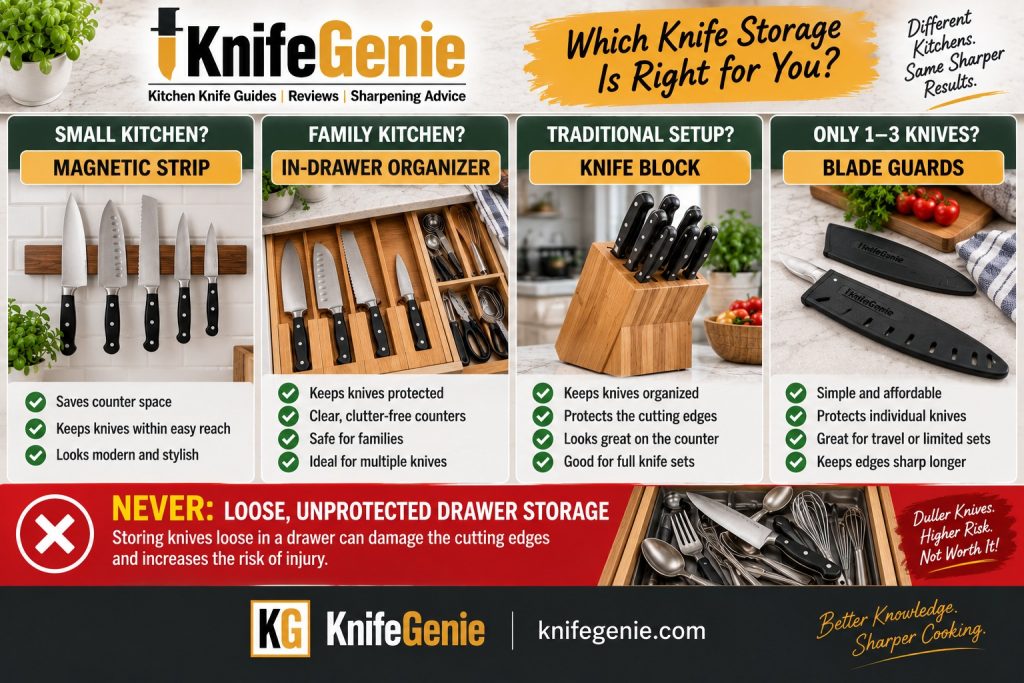
🛒 Which Knife Storage Method Should You Choose?
Here’s a simple way to decide.
| Your Situation | Storage Method to Consider |
|---|---|
| Small kitchen with little counter space | 🧲 Magnetic strip |
| Want knives hidden from view | 🗄️ In-drawer organizer |
| Traditional kitchen setup | 🪵 Knife block |
| Only own 1–3 quality knives | 🛡️ Blade guards |
| Mixed collection of unusual knife sizes | 🧲 Magnetic strip |
| Can’t drill into the wall | 🪵 Block or 🗄️ drawer organizer |
| Need to transport knives | 🛡️ Guards + suitable knife case/roll |
| Family/shared kitchen | 🗄️ Protected in-drawer storage can be particularly practical |
| Knives currently loose in a drawer | 🛡️ Add guards or an organizer |
🧙 KnifeGenie Recommendation
For many home cooks, an in-drawer organizer is an excellent all-around solution because it keeps blades separated, protected and off the countertop.
If easy visibility and quick access are priorities, a properly installed magnetic strip is equally compelling.
A knife block remains a perfectly good traditional choice when it fits your collection and is kept clean and dry.
And if you only own a few quality knives?
Individual blade guards may be all you need.
STORAGE DECISION — Best Knife Storage Method Decision Guide
🧙 KnifeGenie Pro Tips
🔪 Never store good knives loose. Separate the cutting edge from other utensils.
💧 Dry before storing. Don’t place a damp knife into a block, sheath, organizer or case.
🧲 Use magnetic strips carefully. Secure mounting and controlled knife removal matter.
🪵 Clean knife blocks periodically. Storage equipment needs maintenance too.
🛡️ Match blade guards to the knife. The entire cutting edge should be properly protected.
🗄️ Measure drawers before buying organizers. Check width, depth and height.
⚔️ Don’t confuse storage with sharpening. Proper storage protects an edge; it doesn’t restore a dull one.
🧼 Store only clean knives. Food residue and enclosed storage are a poor combination.
👨👩👧 Consider the household. The most convenient storage system isn’t necessarily the most appropriate if young children can reach it.
🔪 Build a complete maintenance routine. Cutting surface, washing, drying, storage, honing and sharpening all contribute to long-term knife performance.
❓ Frequently Asked Questions
What is the safest way to store kitchen knives?
A knife block, securely installed magnetic strip, in-drawer knife organizer or correctly fitted blade guard can all provide safe storage when used properly.
The important principle is that the sharp cutting edge should be protected from accidental contact and from other utensils.
Is it bad to store kitchen knives in a drawer?
Not if they’re properly protected.
An in-drawer knife organizer or individual blade guards can make drawer storage very practical.
The problem is storing uncovered knives loose among other utensils.
Do knife blocks dull knives?
A properly used knife block shouldn’t automatically dull a knife. However, repeatedly dragging the cutting edge against a hard slot can contribute to unnecessary contact.
Insert and remove knives carefully and keep the block clean and dry.
Are magnetic knife strips bad for knives?
A suitable magnetic strip can be an excellent storage system.
The important considerations are secure mounting, sufficient holding strength and careful removal so you aren’t repeatedly striking or dragging the cutting edge against the holder.
Should knives be stored blade up or blade down in a block?
Follow the design of your particular block.
With horizontal slots, positioning the cutting edge so it isn’t bearing against the slot can reduce unnecessary edge contact. With conventional vertical blocks, simply insert and remove the knife carefully rather than dragging the edge heavily against the slot.
Can I put a wet knife into a knife block?
You shouldn’t.
Dry the knife completely before storage. Moisture trapped inside a block or against a blade can encourage staining, corrosion or unwanted moisture inside the holder.
Are blade guards good for kitchen knives?
Yes. A correctly sized blade guard is a simple way to protect the cutting edge and make drawer storage safer.
The knife should be clean and completely dry before the guard is fitted.
What is the best knife storage method for a small kitchen?
A wall-mounted magnetic strip can be particularly space-efficient because it uses neither countertop nor drawer space.
If wall mounting isn’t possible, an in-drawer organizer is another excellent space-saving solution.
How should expensive Japanese knives be stored?
The same core principles apply: keep the blade clean, dry, separated and protected.
A suitable block, magnetic holder, in-drawer organizer, sheath or traditional wooden saya can work depending on the particular knife.
Hard, thin Japanese edges especially benefit from avoiding unnecessary impacts with other objects.
👉 See KnifeGenie’s German vs Japanese Kitchen Knives guide for more about differences in edge geometry and maintenance.
Does proper storage keep knives sharp longer?
Proper storage can help preserve an edge by preventing unnecessary contact with other knives, utensils and hard surfaces.
It doesn’t replace sharpening, but it helps ensure you’re not damaging the edge between uses.
Read: How Often Should You Sharpen Kitchen Knives?
🏆 Overall Recommendation: Store the Edge, Not Just the Knife
The best kitchen knife storage system isn’t necessarily the most expensive or attractive one.
It’s the one you’ll use correctly every day.
For most home kitchens, KnifeGenie recommends choosing among:
🗄️ In-drawer organizer — excellent all-around protected storage
🧲 Magnetic strip — excellent for space efficiency and accessibility
🪵 Knife block — excellent traditional countertop storage
🛡️ Blade guard/sheath — excellent simple protection for individual knives
The one method we would avoid is:
❌ Loose, uncovered knives mixed with other utensils in a drawer.
Your knife spends far more time stored than it does cutting food.
Protecting the blade during those hours is one of the simplest habits you can adopt to support safety and preserve the cutting edge.
A good knife-care routine is straightforward:
Use it properly → wash it carefully → dry it completely → store it safely → maintain the edge when needed.
Do those things consistently and you’re giving your kitchen knives a much better chance of performing properly for years.
SAFE KNIFE STORAGE — How to Store Kitchen Knives Safely: Final Recommendation