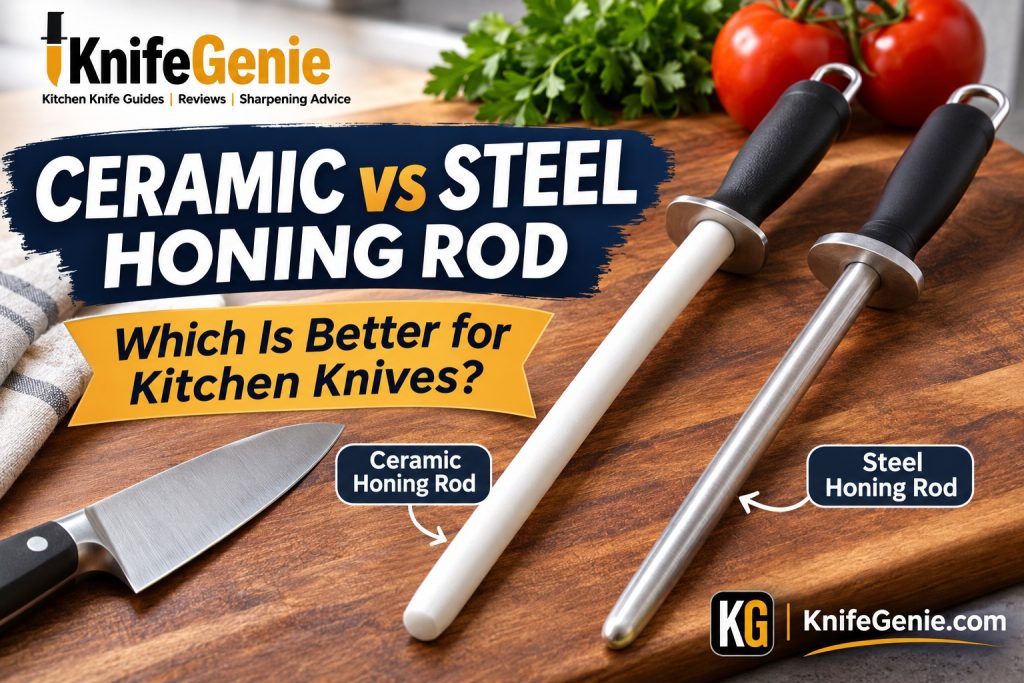
Ceramic and steel honing rods perform different knife maintenance tasks.A good kitchen knife doesn’t suddenly become useless when it loses a little of its sharpness. Often, it just needs some careful edge maintenance. But when you reach for a honing rod, should you choose ceramic or steel?
The ceramic vs steel honing rod question matters because these tools work differently. A traditional steel rod primarily maintains an existing edge, while a ceramic rod uses an abrasive surface to refine it and remove a small amount of metal.
Neither is automatically better for every knife. The right choice depends on your blade’s steel, edge geometry, condition, and the manufacturer’s recommendations.
Let’s look at what each rod actually does, where it works best, and when it’s time to put the rod away and sharpen your knife instead.
🏆 Ceramic vs Steel Honing Rod: Quick Answer
For many everyday Western-style kitchen knives, a compatible smooth or finely textured steel honing rod is a sensible choice for regular edge maintenance.
A fine ceramic rod is useful when you want light abrasive edge refinement. Unlike a traditional steel honing rod, it removes a small amount of metal, so it should be used deliberately rather than automatically.
Here’s the simplest way to choose:
🔧 Smooth steel rod: Best for gentle maintenance of compatible knife edges.
⚙️ Grooved steel rod: A more assertive maintenance surface, suitable for some tough kitchen knives but not every delicate edge.
🪨 Fine ceramic rod: Best for controlled, light abrasive touch-ups on compatible steel knives.
🔪 Whetstone or suitable sharpener: Best when the cutting edge is genuinely worn, blunt, or needs rebuilding.
🧙 KnifeGenie Rule
Choose the rod for the knife you own, not simply for the country where the knife was made.
For a practical introduction to technique, read our How to Hone a Kitchen Knife guide.
🔽 In This Honing Rod Comparison
📊 Ceramic vs Steel Honing Rod: Comparison Chart
Although both tools look similar, their surfaces interact with a knife edge in different ways.
| Feature | Steel Honing Rod | Ceramic Honing Rod |
|---|---|---|
| Main purpose | Routine edge maintenance | Light abrasive edge refinement |
| Surface | Smooth, polished, or grooved steel | Hard abrasive ceramic |
| Metal removal | Generally low; varies with texture and technique | Yes, depending on grit and pressure |
| Typical use | Maintaining a usable edge | Refreshing a slightly worn edge |
| Hard knife steels | Compatibility must be checked | May suit some, but not all |
| Durability | Generally impact-resistant | Brittle; may chip or break if dropped |
| Cleaning | Wipe clean and dry as instructed | Remove metal residue using maker-approved methods |
| Best overall role | Regular maintenance when compatible | Occasional fine abrasive touch-ups |
Important: The surface finish matters. A smooth steel and a heavily grooved steel do not behave identically, and a coarse ceramic rod is more aggressive than a fine ceramic rod.
Neither tool should be treated as a universal solution for every kitchen knife.
🔧 What Is a Steel Honing Rod?
A steel honing rod is a hardened metal rod designed primarily to maintain a knife’s cutting edge.
When a suitable knife loses a little of its crisp cutting performance, controlled contact with a honing steel may help correct minor edge deformation and improve how the knife cuts.
However, the familiar explanation that a steel rod only straightens the edge is an oversimplification. Depending on its texture, hardness, pressure, and the blade itself, a steel rod can also cause small amounts of abrasion.
🔹 Smooth Steel Honing Rods
A smooth steel rod has a polished or nearly polished working surface.
It is generally less aggressive than a deeply grooved rod and can be a good option for maintaining compatible knives without deliberately grinding away much steel.
Advantages
✔ Gentle maintenance when used correctly
✔ Minimal abrasion compared with dedicated sharpening abrasives
✔ Durable construction
✔ Useful for many compatible everyday kitchen knives
Disadvantages
✘ Cannot rebuild a heavily worn edge
✘ May have little effect on some very hard knife steels
✘ Still requires correct angle and pressure
🔹 Grooved Steel Honing Rods
Grooved honing rods have fine ridges running along their working surfaces.
These ridges create more concentrated contact with the knife edge. Depending on the design and technique, this can produce a more assertive maintenance action than a polished steel rod.
Grooved steels are common in kitchen knife sets, particularly those intended for conventional Western-style knives.
Advantages
✔ Can provide effective maintenance for suitable tough blades
✔ Commonly available
✔ Durable and convenient
Disadvantages
✘ Can be unnecessarily aggressive on delicate edges
✘ Heavy pressure may damage or deform the edge
✘ Not automatically appropriate for hard, thin-edged knives
🧙 KnifeGenie Verdict: Steel Rods
For routine maintenance of a compatible Western-style chef knife, a quality smooth or finely textured steel rod is often a practical choice.
But don’t assume the grooved steel supplied with a knife block is suitable for every other knife in your kitchen.
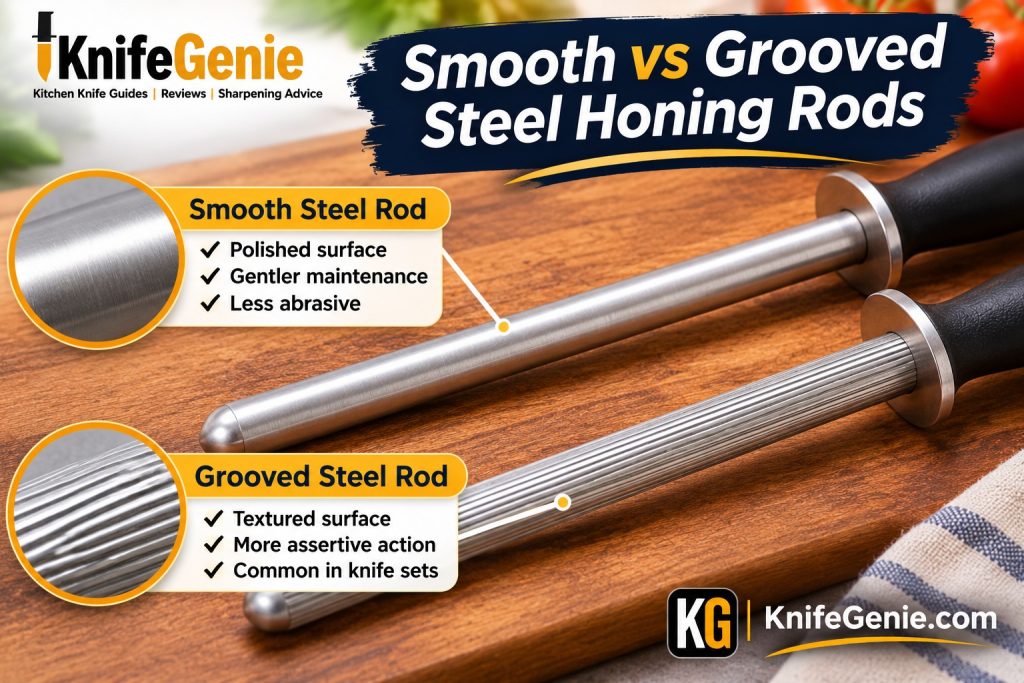
Smooth and grooved honing steels interact differently with knife edges.
🪨 What Is a Ceramic Honing Rod?
A ceramic honing rod uses a hard abrasive surface to refine a knife’s cutting edge.
Unlike a traditional smooth steel, ceramic removes a small amount of metal as the blade passes across it. That means ceramic rods perform a form of light sharpening as well as edge maintenance.
How aggressively they work depends on the ceramic’s grit, surface condition, pressure, and number of strokes.
🔬 Fine vs Coarse Ceramic Rods
Not all ceramic rods have the same abrasive finish.
A fine ceramic rod is generally intended for controlled edge refinement, while a coarser rod removes metal more quickly and may be better described as a sharpening tool.
For example, WÜSTHOF offers ceramic sharpening rods with different stated grit ratings for different levels of edge maintenance.
Do not assume grit numbers from different manufacturers are directly comparable unless they use the same grading standard.
✅ Advantages of Ceramic Rods
✔ Can refine a slightly worn cutting edge
✔ Useful for fine abrasive touch-ups
✔ Available in different abrasive finishes
✔ May suit certain harder knife steels when approved by the manufacturer
✔ Can improve edge performance without a full sharpening session
❌ Disadvantages of Ceramic Rods
✘ Removes metal, even during light touch-ups
✘ Can chip or break if dropped
✘ Collects dark metal residue
✘ Excessive pressure or repeated passes can alter a delicate edge
✘ Not suitable for every knife design
🧙 KnifeGenie Verdict: Ceramic Rods
A fine ceramic rod can be an excellent maintenance tool when your knife and its manufacturer permit abrasive rod use.
Use it with light pressure and stop once the edge performs well. Don’t turn a small touch-up into an unnecessary sharpening session.
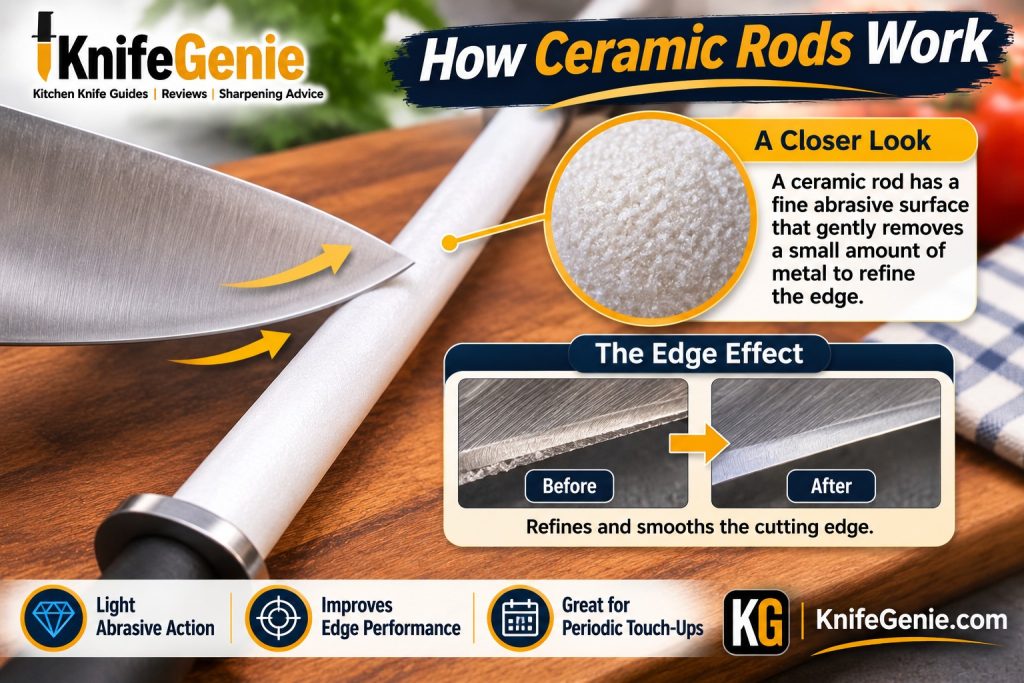
🔄 Honing vs Sharpening: Why the Difference Matters
The words honing and sharpening are often used interchangeably, but they describe different maintenance goals.
🔧 Honing: Maintain an Existing Edge
Honing is primarily about keeping a usable cutting edge performing well.
A suitable steel rod can help with minor edge deformation, while an abrasive ceramic rod may refine the edge through small amounts of metal removal.
🪨 Sharpening: Restore a Worn Edge
Sharpening removes material from the blade’s bevels to recreate an effective cutting edge.
When the edge becomes rounded, heavily worn, or damaged, ordinary honing will not restore it adequately.
That’s when a whetstone, compatible guided sharpener, or qualified professional becomes the better choice.
For a fuller explanation, read Honing vs Sharpening: What’s the Difference?
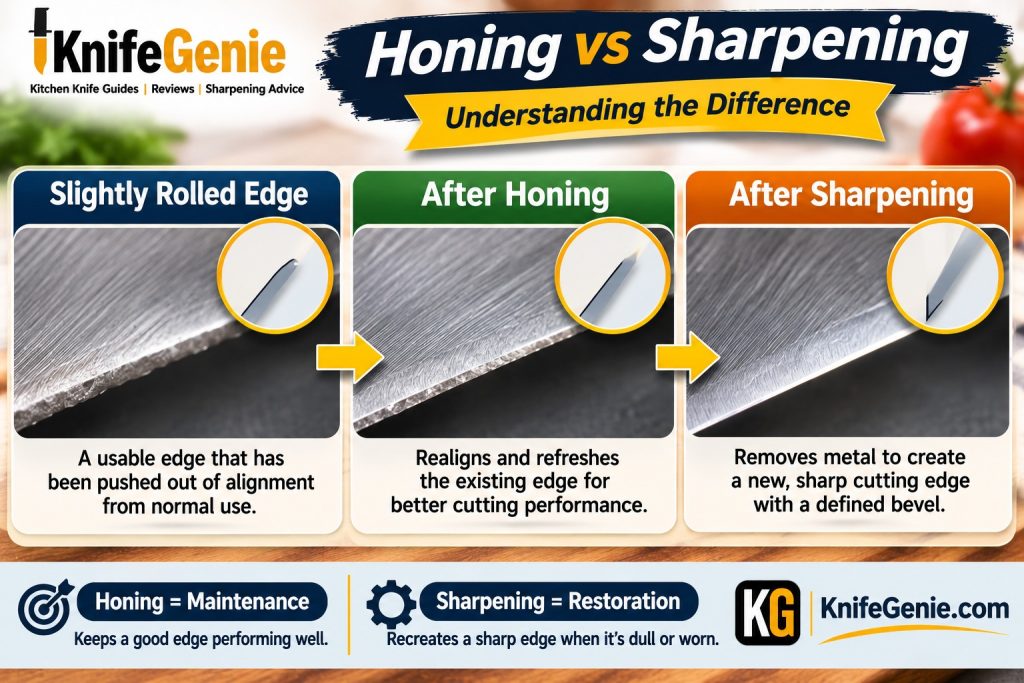
Honing maintains an existing edge, while sharpening restores worn cutting geometry.
🔪 Which Honing Rod Is Best for Your Kitchen Knife?
This is where the decision becomes more interesting.
Knife construction, steel hardness, bevel geometry, and manufacturer instructions matter more than whether a knife is labelled German or Japanese.
🇩🇪 Western-Style Chef Knives
Many traditional Western-style chef knives have relatively tough cutting edges designed to tolerate everyday kitchen use.
For these knives, a manufacturer-approved steel honing rod is often an effective maintenance tool.
A fine ceramic rod may also be useful when the edge needs a small abrasive touch-up.
Verdict: Start with the manufacturer’s recommended honing steel for regular maintenance. Consider fine ceramic for occasional edge refinement if compatible.
🇯🇵 Japanese-Style Kitchen Knives
Japanese kitchen knives vary enormously.
Some use hard steels and thin, acute cutting edges. Others use tougher steels or more conventional double-bevel geometry.
A hard Japanese gyuto, a softer stainless-steel santoku, and a traditional single-bevel yanagiba should not automatically receive identical honing treatment.
For example, Shun approves its own honing steel for compatible Shun knives and also offers a ceramic sharpening rod. That doesn’t mean every Japanese knife maker recommends either tool.
Some makers favor whetstones for maintaining particular blades, especially those with delicate or specialized edge geometries.
Verdict: Check the exact knife model. Use a steel or ceramic rod only when the maker approves the tool and technique.
🍞 Serrated Bread Knives
Ordinary smooth or grooved honing techniques are not appropriate for the scalloped edge of a serrated bread knife.
These knives require maintenance suited to their individual serrations and bevel geometry.
Verdict: Use a suitable serration-specific sharpening method or a professional service when necessary.
⚪ Ceramic Kitchen Knives
A ceramic honing rod is not intended to be used automatically on a ceramic-bladed kitchen knife.
Ceramic blades have different material properties and generally require specialized sharpening equipment and techniques.
Verdict: Follow the ceramic knife manufacturer’s care and sharpening instructions.
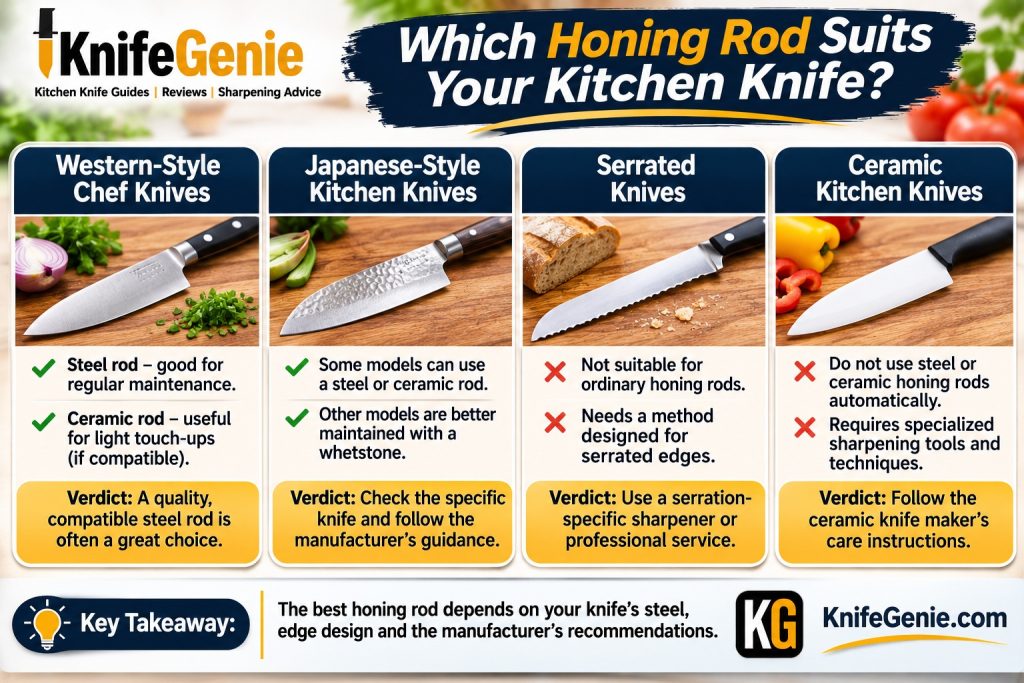
Knife steel, edge geometry and manufacturer guidance determine rod compatibility.
📐 How to Use a Honing Rod: Angle and Pressure
Even the right honing rod can produce poor results when used at the wrong angle or with excessive force.
For compatible straight-edged, double-bevel steel knives, the following supported method is a practical starting point.
Step 1: Stabilize the Rod
Rest the rod’s tip on a secure wooden or plastic cutting board. Hold the handle firmly and keep your fingers behind the protective guard.
Step 2: Match the Knife’s Edge Angle
Position the blade at the angle recommended for your specific knife.
Do not assume every Western knife uses 20 degrees or every Japanese knife uses 15 degrees.
The angle is measured between the side of the blade and the rod’s working surface, on each side of the edge.
Step 3: Use Light, Controlled Pressure
Place the heel of the knife against the upper working section of the rod and draw the edge downward, moving contact gradually toward the tip.
Use light pressure. With a ceramic rod, particularly a fine one, avoid pushing aggressively into the abrasive surface.
Step 4: Alternate Sides
Repeat the movement on the opposite side, maintaining the same appropriate angle.
For an ordinary compatible double-bevel knife, a few gentle alternating strokes are a reasonable starting point unless the manufacturer specifies another method.
Step 5: Clean and Test
Clean and dry the knife after maintenance, then check its cutting performance on a familiar food such as a ripe tomato.
If the knife cuts cleanly again, stop.
If it remains dull after a brief, correct session, don’t keep increasing the pressure or stroke count.
Our detailed How to Hone a Kitchen Knife tutorial explains the full supported technique.
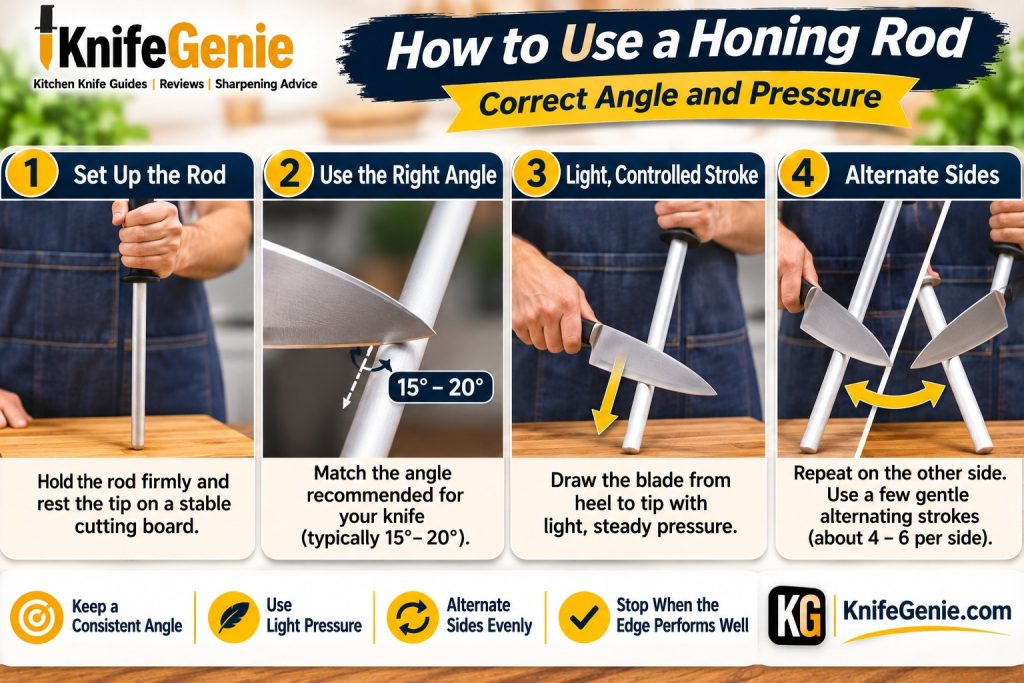
Use the manufacturer’s recommended angle and light, controlled pressure.
🧼 How to Clean and Maintain Your Honing Rod
Honing rods also need care. Dirt, metal residue, and surface damage can affect their performance.
🔧 Cleaning a Steel Honing Rod
Wipe the rod using a soft, slightly damp cloth when necessary, then dry it immediately.
Follow the manufacturer’s instructions before using detergents or immersing the rod, particularly if the handle contains wood or other moisture-sensitive materials.
Inspect the working surface for rust, damage, or contamination.
🪨 Cleaning a Ceramic Honing Rod
Ceramic rods often develop grey or dark marks from metal particles deposited during sharpening.
These marks are normal, but excessive buildup can reduce the effectiveness of the abrasive surface.
Use the cleaning method recommended by the rod manufacturer. Depending on the product, this may involve warm water and a gentle cleaning pad or an approved ceramic cleaning product.
Dry the rod thoroughly before storage and inspect it for cracks or chips.
⚠️ Important Storage Tip
Don’t leave a ceramic rod loose in a drawer where heavy utensils can strike it.
Use a protective sleeve, secure knife-block compartment, or other suitable storage arrangement.
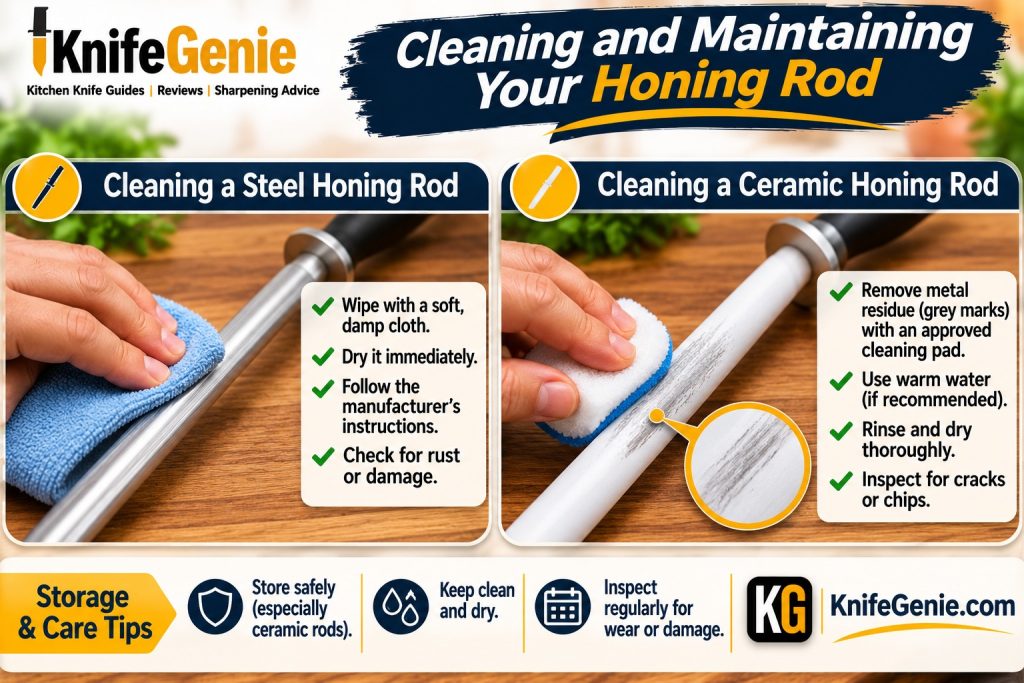
Keep honing rod surfaces clean and inspect ceramic rods for damage.
⚠️ When Honing Is Not Enough: Signs Your Knife Needs Sharpening
A honing rod can help maintain an edge, but it cannot keep the same knife sharp forever.
Look for these signs that actual sharpening may be necessary:
❌ The knife slides across a tomato instead of beginning the slice.
❌ You need noticeably more pressure to cut vegetables.
❌ The edge remains dull after appropriate honing.
❌ The cutting edge has become visibly rounded or worn.
❌ You can see chips or other edge damage.
❌ Any improvement from honing disappears unusually quickly.
A fine ceramic rod may improve a mildly worn edge, but it isn’t the best tool for substantial sharpening or edge repair.
🪨 What Should You Use Instead?
A whetstone offers precise control over the sharpening angle and the amount of material removed.
A compatible guided sharpening system can make angle consistency easier for beginners.
For damaged, valuable, or unusual blades, professional sharpening may be the safest practical choice.
Read How Often Should You Sharpen Kitchen Knives? to learn when maintenance is enough and when edge restoration is necessary.
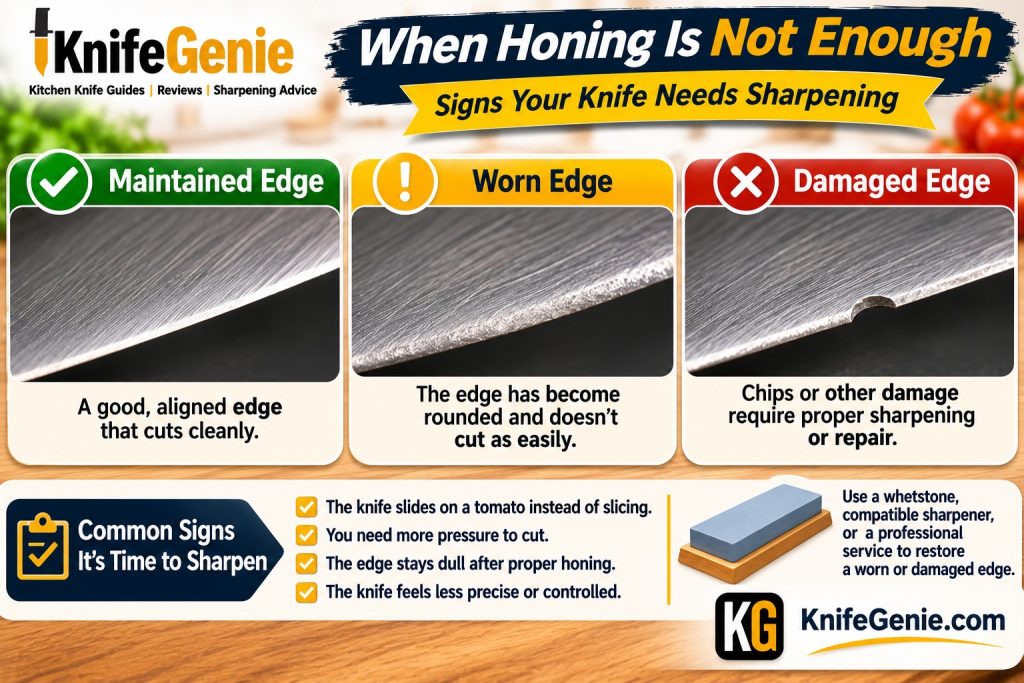
Worn or damaged edges require sharpening or appropriate repair.
🚫 Seven Common Honing Rod Mistakes to Avoid
1. Using a Grooved Steel on Every Knife
A heavily textured steel may be unsuitable for some delicate or hard edges. Check compatibility first.
2. Assuming Ceramic Never Removes Metal
Ceramic is abrasive. Even a fine rod removes some material during use.
3. Applying Too Much Pressure
Excessive force can deform or damage an edge. Light, controlled strokes are more useful than aggressive movements.
4. Using the Wrong Angle
An unsuitable angle can miss the cutting edge or change its geometry unnecessarily.
5. Honing a Damaged Knife
Chipped or heavily worn edges need suitable sharpening or repair, not forceful honing.
6. Ignoring Rod Maintenance
Metal residue, corrosion, and damaged surfaces can interfere with effective maintenance.
7. Treating Every Japanese Knife the Same
Knife steel, geometry, and manufacturer guidance matter more than a broad country-of-origin label.
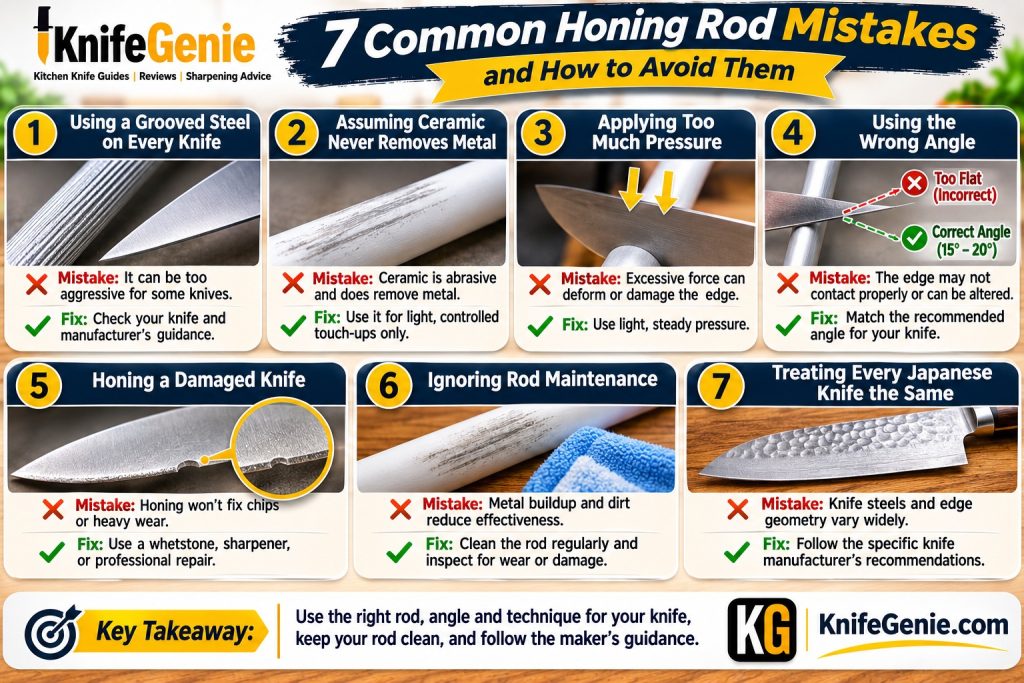
Avoid excessive pressure, unsuitable rods and incorrect honing angles.
📚 Manufacturer Guidance and Further Reading
Manufacturer recommendations are particularly useful because honing compatibility depends on the exact knife and maintenance tool.
🇩🇪 WÜSTHOF: Its official sharpening guidance explains supported rod technique and knife-specific sharpening angles. See WÜSTHOF’s knife sharpening instructions.
🇯🇵 Shun: Its official FAQ explains the distinction between its honing steel and abrasive ceramic sharpening rod. See Shun’s knife maintenance FAQ.
These are examples of manufacturer-specific guidance, not universal rules for every knife brand.
❓ Frequently Asked Questions
Is a ceramic honing rod better than a steel rod?
Not universally. Steel rods are often useful for regular maintenance of compatible knives, while ceramic rods provide light abrasive refinement. The better choice depends on your knife and the condition of its edge.
Does a ceramic honing rod sharpen a knife?
Yes, to a degree. Ceramic is abrasive and removes a small amount of steel. A fine ceramic rod can refine an edge, although it is not a substitute for full sharpening when significant material removal is needed.
Can a steel honing rod damage a Japanese knife?
It can if the rod, pressure, or technique is inappropriate. However, some Japanese knife manufacturers approve specific honing steels. Always check the exact model’s care instructions.
Is a smooth honing steel better than a grooved one?
A smooth rod is generally less aggressive and may be preferable for gentle maintenance of compatible edges. A grooved rod can provide more assertive contact, but it is not necessarily better for every knife.
How often should I use a ceramic honing rod?
Use it when a compatible knife needs light abrasive refinement, rather than automatically before every meal. Follow the rod and knife manufacturers’ guidance.
Can I use a ceramic honing rod on a ceramic knife?
Do not assume so. Ceramic kitchen knives generally require specialized sharpening equipment. Follow the blade manufacturer’s instructions.
What honing rod should I use for a German chef knife?
A quality steel honing rod is often suitable for traditional German-style chef knives, provided the manufacturer approves it. A fine ceramic rod may also be useful for occasional abrasive touch-ups.
When should I sharpen instead of hone?
Sharpen when the knife remains dull after appropriate honing, the edge is substantially worn, or damage requires restoration. Don’t try to compensate for a worn edge by pressing harder against the rod.
🏆 Final Verdict: Ceramic or Steel Honing Rod?
For most home cooks with compatible everyday Western-style knives, a quality smooth or finely textured steel honing rod is a sensible starting point for regular edge maintenance.
A fine ceramic rod is a useful addition when you need occasional abrasive refinement without undertaking a complete sharpening session.
🧙 KnifeGenie Final Recommendation
🥇 Best for regular maintenance: Manufacturer-approved smooth or finely textured steel honing rod.
🪨 Best for light abrasive touch-ups: Fine ceramic rod, when compatible with the knife.
🇯🇵 Best for specialized Japanese knives: The maintenance method specified by the knife maker, which may be a particular rod, whetstone, or professional service.
🔪 Best for a genuinely dull or damaged edge: Suitable sharpening equipment or professional sharpening.
The important thing isn’t owning the most expensive honing rod. It’s understanding what your knife needs and using the least aggressive appropriate method to maintain a reliable cutting edge.
For more practical guides, visit the KnifeGenie Sharpen & Care hub.
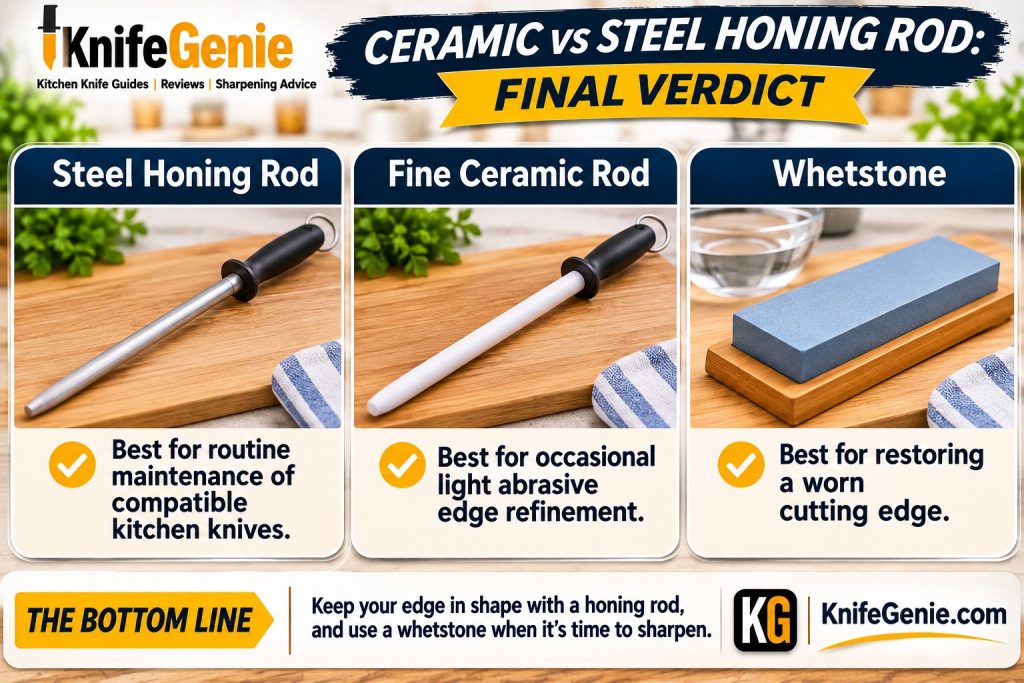
Choose steel for compatible routine maintenance, ceramic for light abrasive refinement, and sharpening when the edge needs restoration.