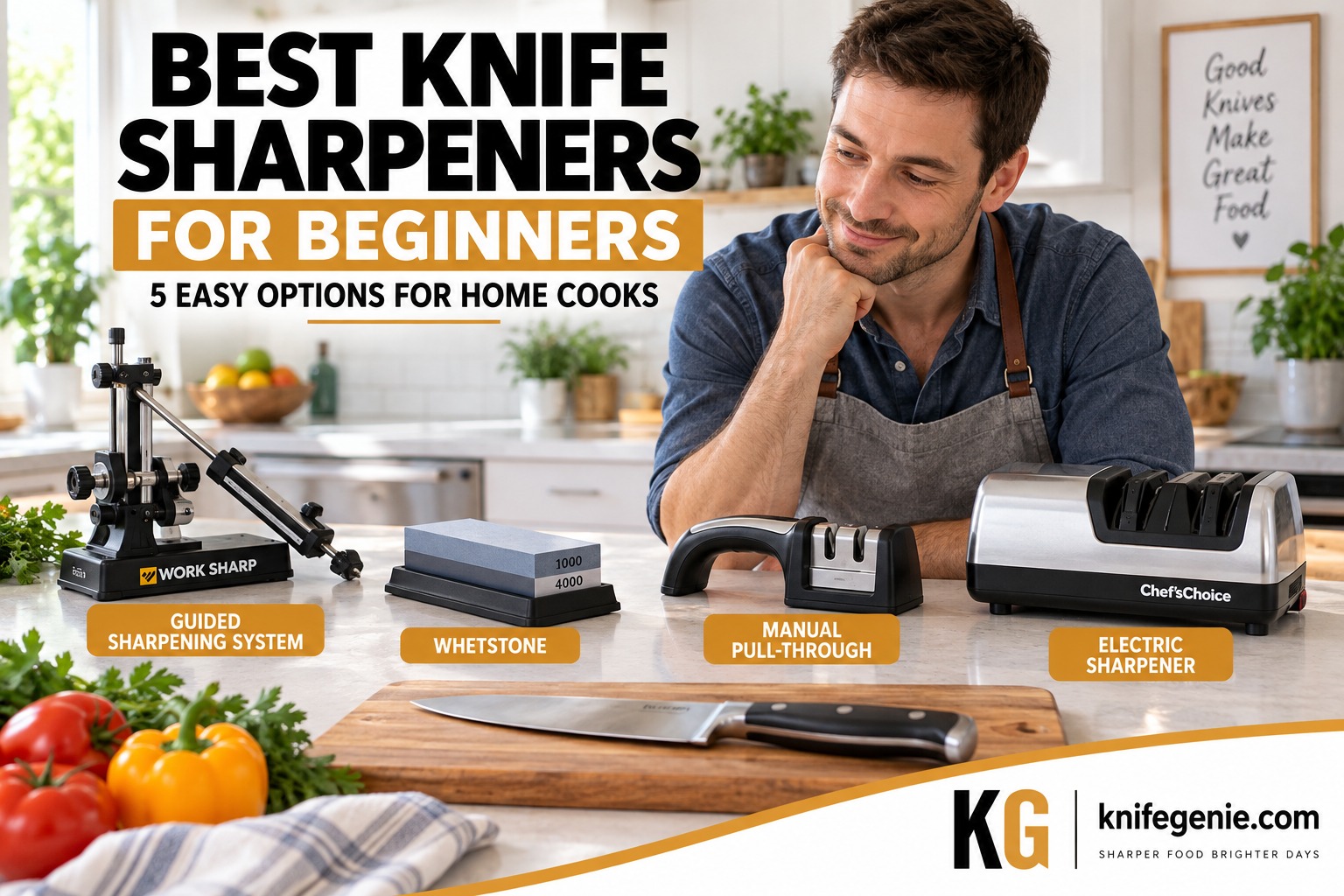
The best beginner knife sharpener combines ease of use, consistent angles, and enough control to sharpen without unnecessarily removing steel.
The best knife sharpeners for beginners make it easier to restore a dull kitchen knife without requiring years of sharpening experience. See what causes a knife edge to become dull.
A good kitchen knife doesn’t stay sharp forever. Eventually, even a quality chef’s knife will start sliding across tomato skins, crushing herbs, or requiring more pressure to cut vegetables.
That’s when many beginners run into the same problem:
What knife sharpener should I actually buy?
Walk into a kitchen store or search online and you’ll find whetstones, electric sharpeners, pull-through sharpeners, guided systems, ceramic rods and more.
They all promise sharp knives—but they don’t all work the same way.
For most beginners, the best knife sharpener isn’t necessarily the one capable of producing the absolute sharpest edge. It’s the one that gives you a good combination of ease of use, angle consistency, control and compatibility with the knives you actually own.
It’s the sharpener that gives you a good combination of:
✔ Ease of use
✔ Angle consistency
✔ Reasonable control
✔ Suitable abrasives
✔ Compatibility with your knives
✔ Low risk of unnecessary steel removal
Let’s make the choice much easier.
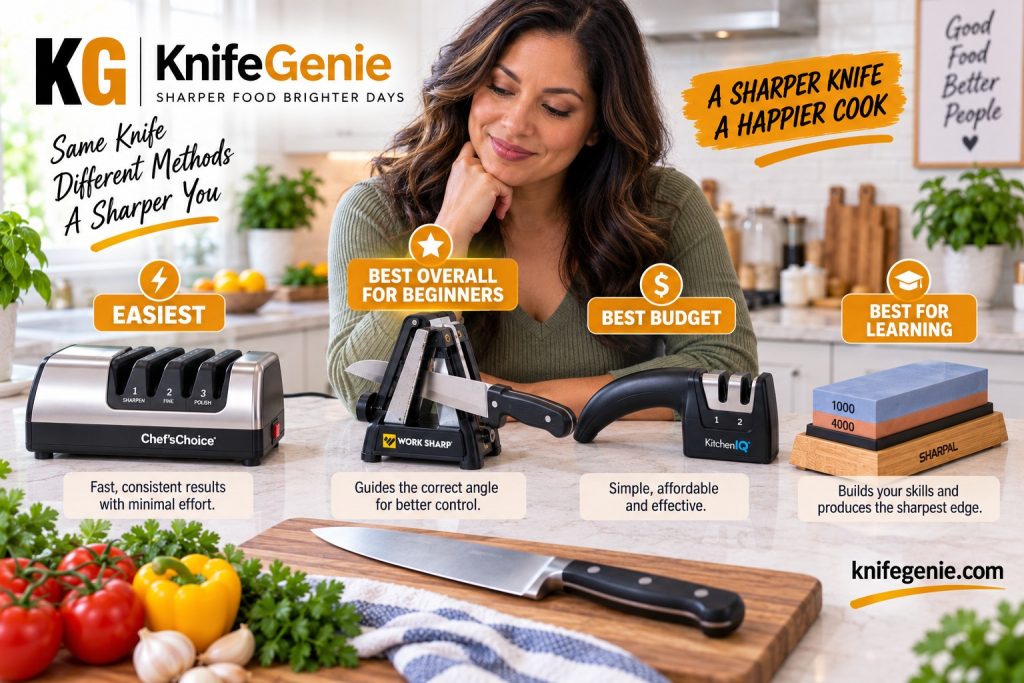
🏆 Best Knife Sharpener for Beginners: Quick Answer
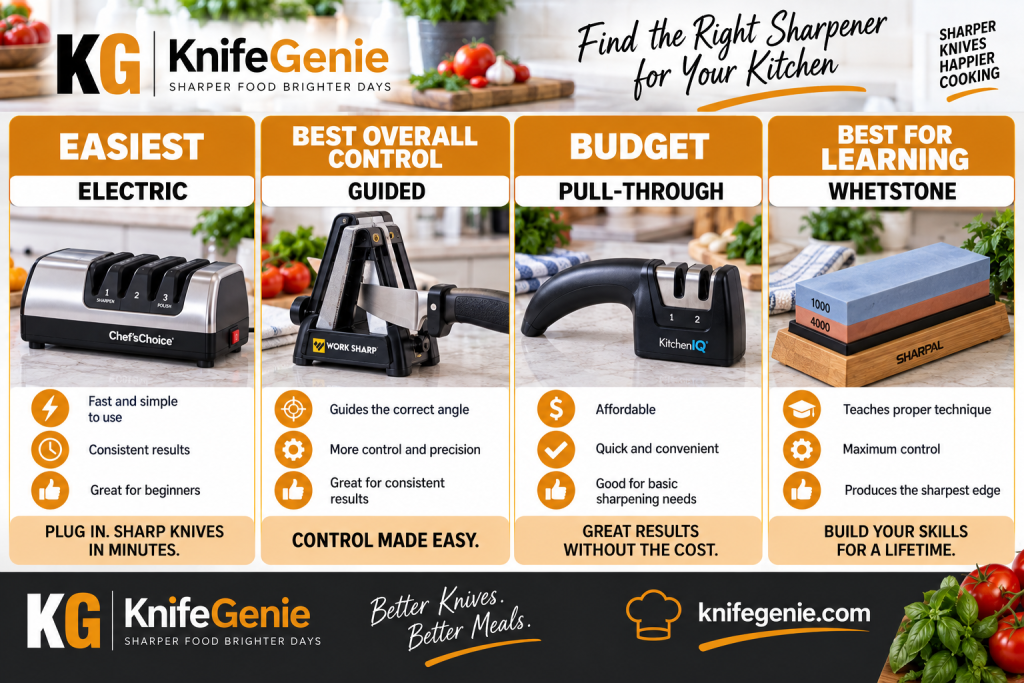
If you’re completely new to sharpening, our overall recommendation for most beginners is a guided sharpening system because it removes one of the hardest parts of learning to sharpen a knife: holding a consistent angle.
🥇 Best Overall for Beginners — Guided Sharpening System
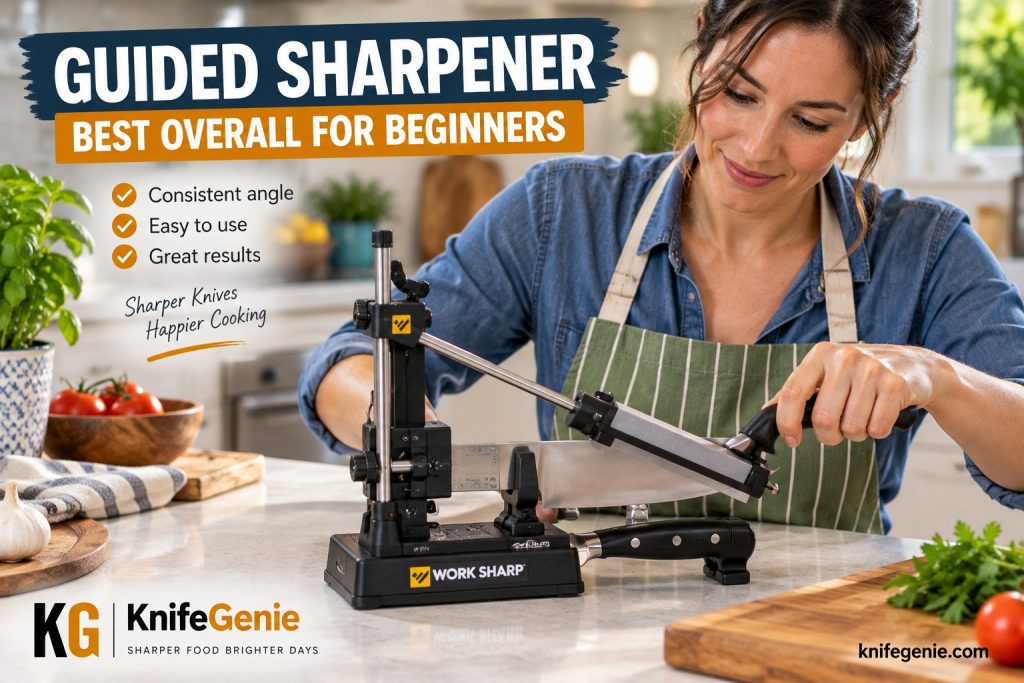
A guided system holds or controls the sharpening angle while you move the abrasive across the edge.
Best for: Beginners who want control and repeatable results.
⚡ Easiest — Quality Electric Sharpener
Insert the blade into the appropriate sharpening stage and follow the manufacturer’s instructions.
Best for: Home cooks who prioritize speed and simplicity.
👍 Simplest Budget Choice — Manual Pull-Through Sharpener
Compact, inexpensive and extremely easy to understand.
Best for: Ordinary inexpensive kitchen knives and occasional sharpening.
🪨 Best for Learning the Skill — Combination Whetstone
Takes considerably more practice but gives you excellent control once you learn the technique.
Best for: Beginners willing to learn proper freehand sharpening.
👨🔧 Best for Expensive or Difficult Knives — Professional Sharpening
Sometimes the smartest sharpener is no sharpener at all.
Best for: Premium knives, damaged edges, unusual grinds and anyone uncomfortable sharpening an expensive blade.
🧙 KnifeGenie Recommendation
For most beginners who want to learn to maintain their own knives, start with a guided sharpening system.
It provides a useful middle ground between the simplicity of a pull-through sharpener and the control of a whetstone.
🔽 In This Beginner Knife Sharpener Guide
👉 Quick Comparison
👉 What Does a Knife Sharpener Actually Do?
👉 Sharpening vs Honing
👉 1. Guided Sharpening Systems
👉 2. Electric Knife Sharpeners
👉 3. Manual Pull-Through Sharpeners
👉 4. Whetstones
👉 5. Professional Sharpening
👉 Which Sharpener Is Easiest for Beginners?
👉 What Sharpening Angle Should You Use?
👉 What to Look for Before Buying
👉 Sharpeners to Be Careful With
👉 Common Beginner Mistakes
👉 Frequently Asked Questions
👉 Overall Recommendation
📊 Beginner Knife Sharpeners: Quick Comparison
| Sharpener Type | Ease of Use | Control | Learning Curve | Speed | Best For |
|---|---|---|---|---|---|
| 🥇 Guided system | ⭐⭐⭐⭐ | ⭐⭐⭐⭐⭐ | Low–Medium | Medium | Best overall balance |
| ⚡ Electric | ⭐⭐⭐⭐⭐ | ⭐⭐ | Very Low | Very Fast | Maximum convenience |
| 👍 Pull-through | ⭐⭐⭐⭐⭐ | ⭐⭐ | Very Low | Fast | Budget/simple knives |
| 🪨 Whetstone | ⭐⭐ | ⭐⭐⭐⭐⭐ | High | Slow | Learning + maximum control |
| 👨🔧 Professional | ⭐⭐⭐⭐⭐ | N/A | None | N/A | Premium/damaged knives |
🧙 KnifeGenie Tip
Don’t choose solely on which sharpener promises the sharpest possible knife.
For a beginner, repeatability and control are often more valuable than theoretical maximum sharpness.
🔍 How We Evaluated These Beginner Sharpening Methods
This guide is based on research into the main sharpening methods available to home cooks, including manufacturer specifications, sharpening principles, and the practical advantages and limitations of each method.
We evaluated each approach based on ease of use, angle control, learning curve, speed, knife compatibility, and the risk of removing unnecessary steel.
Our recommendations focus on helping home cooks compare the best knife sharpeners for beginners based on ease of use, angle control, learning curve, knife compatibility, and the risk of removing unnecessary steel.
We also explain which sharpening method likely makes the most sense for a beginner—not that we personally tested every sharpener mentioned in this guide.
🔪 What Does a Knife Sharpener Actually Do?
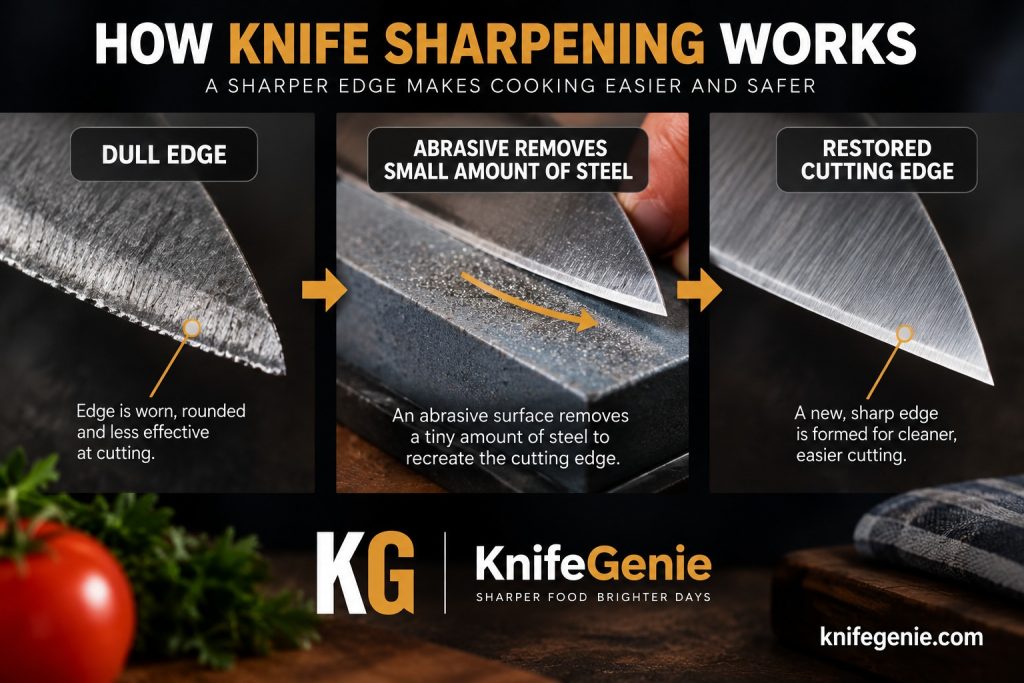
A knife becomes dull as its very thin cutting edge wears, deforms or suffers microscopic damage through normal use.
Actual sharpening uses an abrasive to remove a small amount of metal and recreate the cutting edge.
Different sharpeners control this process differently.
A whetstone gives your hands almost complete control.
A guided system helps control the angle mechanically.
A pull-through sharpener largely determines the angle for you.
An electric sharpener uses powered abrasive wheels or discs and guides to make the process faster.
That distinction matters because you don’t want to remove more steel than necessary.
Your goal isn’t to grind the knife aggressively.
Your goal is to restore an effective cutting edge while preserving as much of the blade as practical.
HOW KNIFE SHARPENING WORKS
🔄 Sharpening vs Honing: Don’t Confuse Them
Before buying anything, understand this distinction.
🔪 Sharpening
Sharpening uses abrasive material to remove metal and restore the cutting edge.
🔁 Honing
Honing is primarily an edge-maintenance process. It can help keep a usable edge performing well between actual sharpenings.
That means you shouldn’t automatically sharpen your chef’s knife every time it feels slightly less sharp.
👉 How Often Should You Sharpen Kitchen Knives?
🧙 KnifeGenie Rule
Maintain the edge when appropriate. Sharpen when the knife actually needs sharpening.
🥇 1. Guided Sharpening Systems — Best Overall for Beginners
A guided sharpener solves one of the biggest problems beginners face:
Maintaining a consistent sharpening angle.
Instead of trying to hold the knife at exactly the same angle during dozens of freehand strokes, the system uses a guide, clamp, rod or similar mechanism to make the process more repeatable.
For example, the Work Sharp Precision Adjust uses a clamp and an adjustable 15°–30° sharpening chassis together with diamond and ceramic abrasives.
The Work Sharp Precision Adjust is designed to make angle control easier by securing the knife and guiding the abrasive at a selected angle.
That type of design makes guided systems particularly attractive to people who want to understand sharpening without immediately learning freehand stone technique.
✅ Pros
✔ Consistent sharpening angles
✔ More control than most pull-through systems
✔ Easier learning curve than freehand stones
✔ Multiple abrasives may be included
✔ Repeatable results
✔ Good way to understand sharpening progression
❌ Cons
✘ Slower than an electric sharpener
✘ More setup required
✘ Some systems struggle with very long, very small or unusually shaped blades
✘ More expensive than basic pull-through sharpeners
✘ You still need to understand which angle is appropriate
⭐ Best For
Beginners who want good results now while learning more about sharpening along the way.
🧙 KnifeGenie Verdict
BEST OVERALL SHARPENER TYPE FOR BEGINNERS
If you want more control than a pull-through sharpener without jumping directly into freehand whetstones, this is the category we’d look at first.
GUIDED KNIFE SHARPENER
⚡ 2. Electric Knife Sharpeners — Easiest for Convenience
Electric sharpeners are difficult to beat for simplicity.
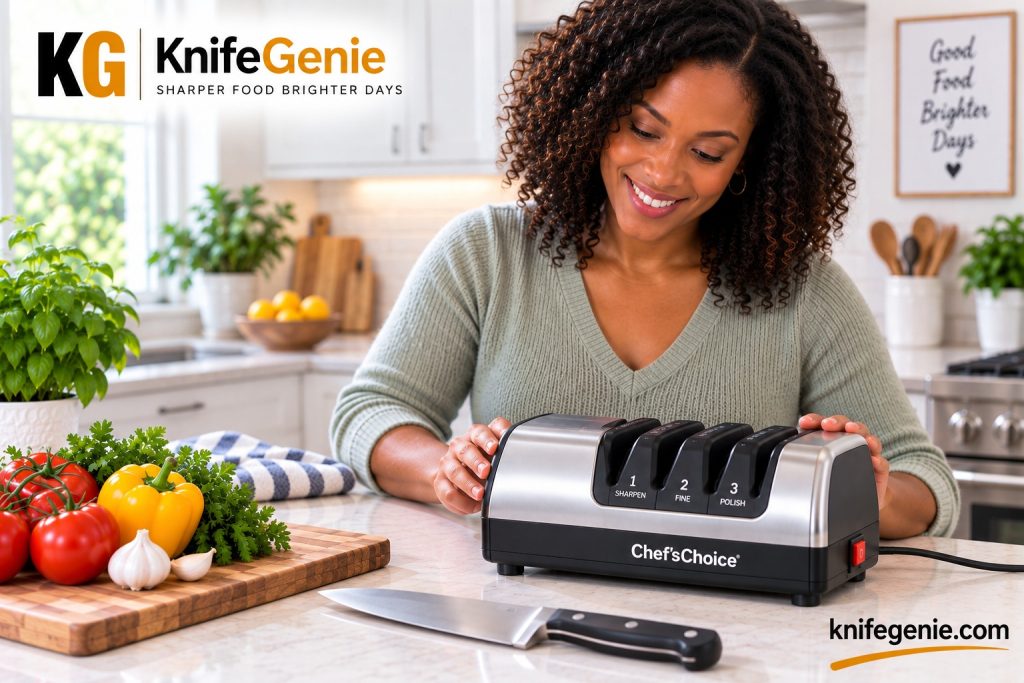
Most use guides to position the knife while powered abrasives do the sharpening.
Higher-quality models may provide separate stages for shaping, sharpening and polishing.
The Chef’sChoice 15XV, for example, uses a three-stage system with diamond abrasives and angle guides.
✅ Pros
✔ Extremely easy to learn
✔ Very fast
✔ Guided sharpening
✔ Consistent process
✔ Little manual technique required
✔ Convenient for households with several knives
❌ Cons
✘ Less control than careful manual sharpening
✘ Quality models can be relatively expensive
✘ Powered abrasives can remove steel quickly
✘ Preset geometry may not suit every knife
✘ Not our first choice for every premium Japanese knife
⚠️ Important
Read the manufacturer’s instructions before putting a knife into an electric sharpener.
Don’t assume every kitchen knife should be converted to whatever angle the machine produces.
⭐ Best For
Home cooks who care more about speed, simplicity and convenience than learning sharpening technique.
🧙 KnifeGenie Verdict
EASIEST BEGINNER OPTION
A good electric sharpener can take much of the guesswork out of routine sharpening—but compatibility matters.
ELECTRIC SHARPENER
👍 3. Manual Pull-Through Sharpeners — Best Simple Budget Option
You’ve probably seen these in kitchen stores.
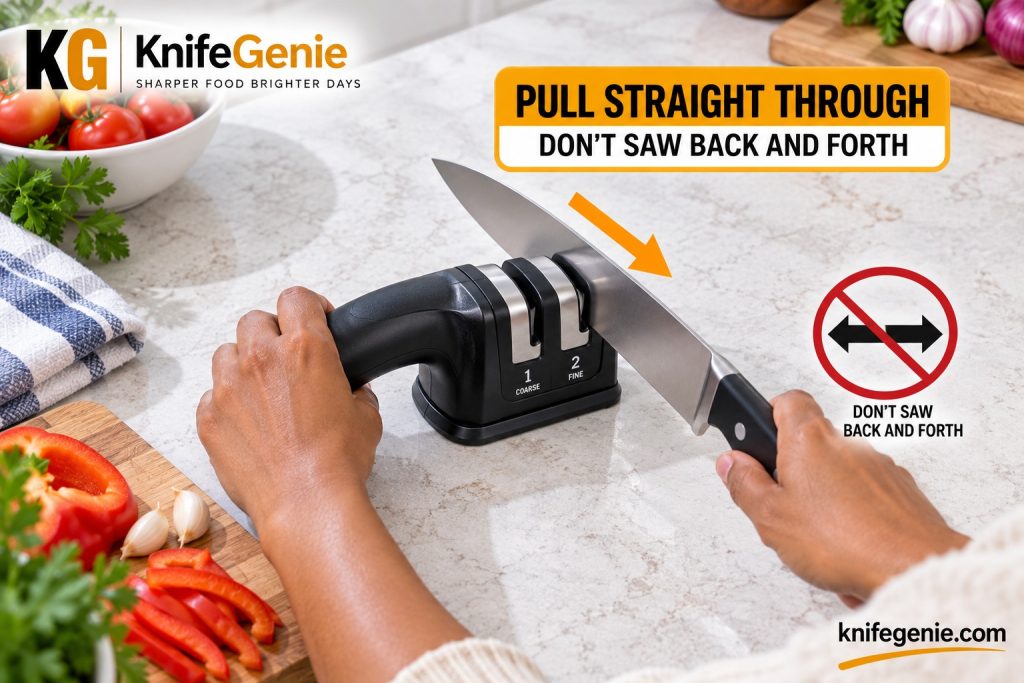
A manual pull-through sharpener typically has one or more V-shaped sharpening slots.
Place it securely on the counter, insert the knife as directed and draw the blade through the appropriate slot.
Simple.
And that simplicity is exactly why they’re popular.
✅ Pros
✔ Very easy to use
✔ Affordable
✔ Compact
✔ Fast
✔ Little technique required
✔ Useful for ordinary household knives
❌ Cons
✘ Limited angle control
✘ Fixed geometry may not suit your knife
✘ Cheap carbide models can be aggressive
✘ Less precise than guided systems or stones
✘ Not ideal for every premium blade
⚠️ Don’t Buy Solely on Price
There’s a significant difference between a well-designed guided manual sharpener and an extremely aggressive bargain sharpener.
For a good kitchen knife, we’d rather see a beginner sharpen conservatively than repeatedly strip away unnecessary steel.
⭐ Best For
Budget-conscious home cooks with ordinary Western-style kitchen knives who want something quick and uncomplicated.
PULL-THROUGH SHARPENER
🪨 4. Whetstones — Best for Learning Proper Sharpening
Whetstones remain one of the most versatile ways to sharpen kitchen knives.
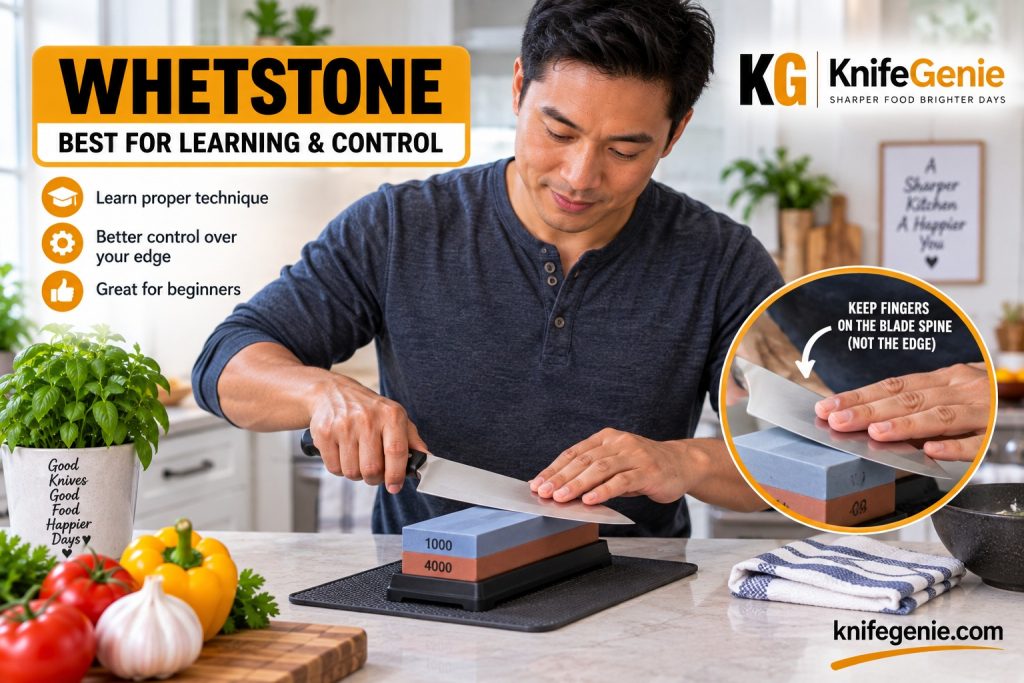
Instead of putting your knife into a preset guide, you move the blade across an abrasive stone while maintaining the desired angle yourself.
That’s both their greatest strength and their biggest weakness.
You control:
👉 Sharpening angle
👉 Pressure
👉 Abrasive grit
👉 Number of passes
👉 Edge progression
👉 How much material you remove
But you also have to develop the skill to control those things consistently.
✅ Pros
✔ Excellent control
✔ Works with many kitchen knives
✔ Wide range of grits available
✔ Can produce excellent edges
✔ Teaches you how sharpening actually works
✔ No powered mechanism
❌ Cons
✘ Steeper learning curve
✘ Angle consistency takes practice
✘ Slower for beginners
✘ Different stones require different care
✘ Easy to become obsessed with buying more stones than you need!
🧙 KnifeGenie Tip
Beginners don’t need a drawer full of sharpening stones.
A sensible combination stone or simple stone setup is enough to start learning.
Practice on an inexpensive kitchen knife before sharpening your most expensive blade.
⭐ Best For
People who enjoy learning practical skills and want maximum long-term sharpening control.
WHETSTONE SHARPENING
👨🔧 5. Professional Sharpening — Sometimes the Smartest Choice
You don’t have to sharpen every knife yourself.
Professional sharpening makes particular sense when you have:
💎 An expensive knife you’re afraid of damaging
🔨 A chipped or damaged edge
🇯🇵 A specialty Japanese blade
📐 An unusual grind or bevel
🔪 A knife requiring significant edge repair
😬 No interest in learning sharpening
A skilled professional can also evaluate problems that aren’t obvious to a beginner.
✅ Pros
✔ No learning curve
✔ Useful for edge repair
✔ Good option for valuable knives
✔ Appropriate for unusual blade geometries when the sharpener has the necessary expertise
❌ Cons
✘ Ongoing cost
✘ Quality varies
✘ You may need to leave or ship the knife
✘ Less convenient than sharpening at home
🧙 KnifeGenie Verdict
There’s nothing wrong with maintaining ordinary kitchen knives yourself while sending your expensive or difficult knives to a knowledgeable professional.
🏆 Which Knife Sharpener Is Easiest for Beginners?
If ease alone is the priority:
🥇 Electric Sharpener
The machine and guides do most of the work.
If you want ease plus better manual control:
🥇 Guided Sharpening System
This is our preferred compromise.
If you want cheap and simple:
👍 Manual Pull-Through
If you want to learn sharpening as a skill:
🪨 Whetstone
There isn’t one correct answer because these users have different priorities.
BEGINNER SHARPENER DECISION
📐 What Sharpening Angle Should a Beginner Use?
This is where beginners should resist overly simple advice.
There is no single correct sharpening angle for every kitchen knife.
Different manufacturers and knife designs use different edge geometries.
A traditional Western-style chef’s knife may have a different edge from a thin Japanese gyuto.
Some specialty Japanese knives can even have asymmetrical or single-bevel edges.
🧙 KnifeGenie Recommendation
Preserve the manufacturer’s intended edge geometry unless you have a good reason and enough experience to change it.
If you don’t know the factory angle, check the manufacturer’s specifications or sharpening instructions before choosing a fixed-angle sharpener.
🛍️ 7 Things Beginners Should Check Before Buying a Knife Sharpener
1. 🔪 What Knives Do You Own?
Start with the knives—not the sharpener.
Ask:
👉 Western chef’s knives?
👉 Japanese kitchen knives?
👉 Serrated knives?
👉 Single-bevel knives?
👉 Pocket knives as well as kitchen knives?
A sharpener that works beautifully for one collection may be unsuitable for another.
2. 📐 Can You Control the Angle?
Angle control is one of the biggest advantages of guided systems.
If your sharpener uses a fixed angle, make sure that geometry makes sense for your knives.
3. 🪨 What Abrasives Does It Use?
Common sharpening abrasives include:
• Diamond
• Ceramic
• Aluminum oxide
• Silicon carbide
• Natural and synthetic stones
Don’t assume one material automatically makes a sharpener superior.
The abrasive, grit, pressure and sharpening technique all work together.
4. 🔄 Does It Have Multiple Stages or Grits?
A badly dulled knife may need more abrasive work than a knife receiving a routine touch-up.
Multiple abrasives or stages can allow you to move from sharpening toward refinement.
But don’t automatically start with the coarsest abrasive every time.
⚠️ Remember
Coarse abrasives remove metal faster.
Use them when they’re actually needed.
5. 🧲 Is the Knife Held Securely?
With guided systems, check how securely the knife can be clamped.
With pull-through and electric systems, check whether the base remains stable.
With whetstones, use a secure stone holder or non-slip base.
Stability improves both consistency and safety.
6. 🧼 Is It Easy to Maintain?
Sharpening creates metal and abrasive debris.
Look for equipment that’s straightforward to clean according to the manufacturer’s instructions.
7. 💰 Are You Paying for Features You’ll Actually Use?
A beginner doesn’t necessarily need the most sophisticated sharpening system available.
Start with your knives and your needs.
You can always upgrade later.
⚠️ Knife Sharpeners Beginners Should Be Careful With
Not every inexpensive sharpener is a bargain.
Be cautious with extremely aggressive carbide pull-through sharpeners, particularly on expensive knives.
They can remove material quickly.
That doesn’t mean every carbide sharpener is automatically bad.
It means beginners should understand that fast metal removal isn’t necessarily desirable.
Also avoid:
❌ Sharpeners with no clear angle information
❌ Poorly secured sharpening equipment
❌ Using damaged or contaminated stones
❌ Systems incompatible with your blade geometry
❌ Assuming one sharpener works properly on every knife
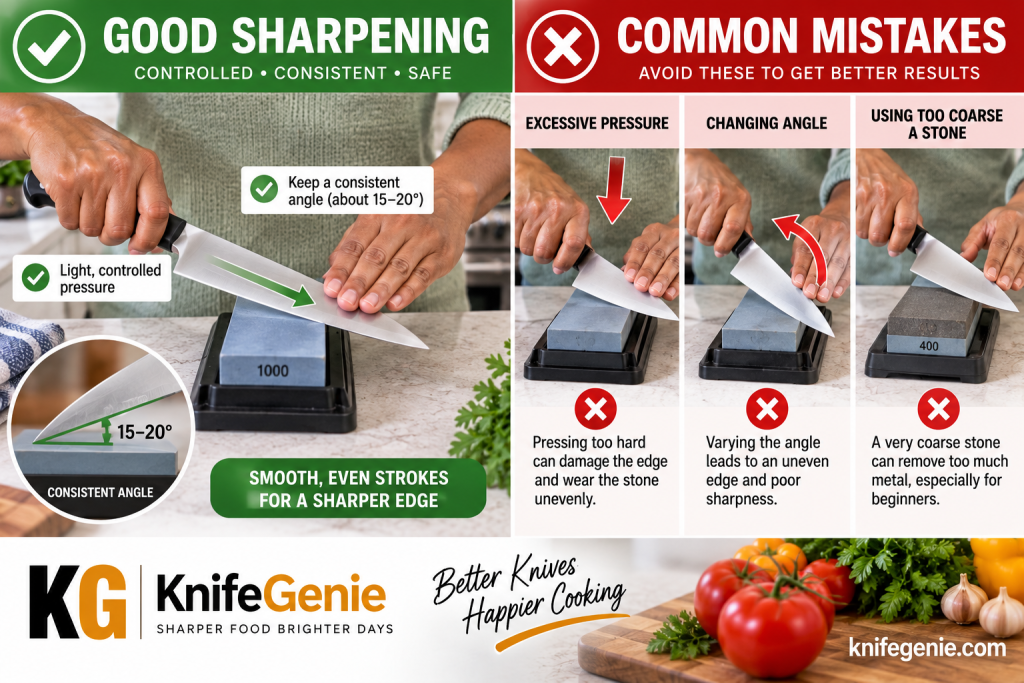
🚫 7 Common Knife Sharpening Mistakes Beginners Make
1. Sharpening a Knife That Only Needs Maintenance
Don’t grind away steel unnecessarily.
👉 Read: How Often Should You Sharpen Kitchen Knives?
2. Using the Wrong Angle
Check your knife manufacturer’s recommendation.
3. Starting Too Coarse
Use coarse abrasives for edges that actually require substantial correction.
4. Applying Excessive Pressure
More pressure doesn’t automatically create a better edge.
5. Changing Angles During Sharpening
Consistency matters.
This is one reason guided systems are so useful for beginners.
6. Practicing on Your Most Expensive Knife
Learn on an inexpensive knife first.
Your premium Japanese chef’s knife doesn’t need to become your sharpening experiment.
7. Expecting the Sharpener to Fix Bad Knife Habits
A freshly sharpened knife won’t stay sharp for long if you:
❌ Cut on glass
❌ Cut on granite
❌ Throw knives loose into drawers
❌ Abuse the edge on bones or frozen foods
❌ Use the knife for tasks it wasn’t designed to perform
Sharpening and knife care work together.
SHARPENING MISTAKES
🔪 What About Japanese Kitchen Knives?
Be more cautious.
Many Japanese-style kitchen knives use relatively hard steels and thin edge geometries.
Some specialty Japanese knives also use single-bevel or asymmetrical edges.
That doesn’t mean beginners can’t sharpen Japanese knives.
It means you shouldn’t automatically put an expensive Japanese knife into an aggressive fixed-angle sharpener without checking compatibility.
German vs Japanese Kitchen Knives
For an expensive specialty knife, a suitable whetstone, compatible guided system or knowledgeable professional may make more sense.
🍞 What About Serrated Knives?
Serrations require a different approach because the cutting edge isn’t simply one continuous straight bevel.
Some sharpeners specifically support serrated edges, while others don’t.
Always check the manufacturer’s instructions.
Serrated vs Plain Edge Kitchen Knives
Don’t repeatedly force a serrated bread knife through an ordinary sharpener unless the sharpener is specifically designed for that blade.
🍖 What About Boning Knives?
Boning knives create another challenge because the blade can be narrow, curved and sometimes flexible. These differences are especially important when comparing a boning knife vs fillet knife.
That makes secure positioning and angle consistency especially important.
If you regularly butcher meat at home, choose a system capable of accommodating the shape of your boning knife.
Best Boning Knife for Home Butchers
❓ Frequently Asked Questions
What is the best knife sharpener for a complete beginner?
For someone who wants a balance between ease of use and control, we suggest a guided-angle sharpening system.
If maximum convenience matters more than learning the sharpening process, a quality electric sharpener may be easier.
Are pull-through knife sharpeners bad for knives?
Not automatically.
Quality varies considerably.
The main concerns are whether the preset geometry suits your knife and how aggressively the sharpener removes steel.
We would be more cautious using an inexpensive aggressive pull-through system on a premium kitchen knife.
Is a whetstone too difficult for a beginner?
No.
But expect a learning curve.
Maintaining a consistent freehand angle takes practice.
Start with an inexpensive knife rather than your best chef’s knife.
Are electric knife sharpeners good for beginners?
Yes, particularly when convenience is the priority.
Good models use guides to make angle control easier.
However, always check that the sharpener is appropriate for your knife’s edge geometry.
Do I need to sharpen a new knife?
Usually not.
A quality new kitchen knife should arrive with a usable factory edge.
Use it before deciding that it needs sharpening.
How often should beginners sharpen their kitchen knives?
Don’t sharpen solely according to the calendar.
For many home cooks, sharpening once or twice a year may be a reasonable starting point, but actual frequency depends on usage, knife steel, edge geometry, cutting surface and maintenance habits.
Can the same sharpener sharpen German and Japanese knives?
Sometimes—but don’t assume so.
Check the angles, edge geometry and the sharpener manufacturer’s compatibility information.
👉 Read: German vs Japanese Kitchen Knives
Should I buy a honing rod or a knife sharpener?
They perform different jobs.
A honing rod is primarily an edge-maintenance tool.
A sharpener uses abrasive material to recreate the cutting edge.
Many kitchens benefit from having an appropriate method for both maintenance and eventual sharpening.
How do I know when my knife is sharp enough?
A sharp kitchen knife should cut food cleanly without excessive pressure.
A ripe tomato is a useful practical test: the edge should bite into the skin rather than simply pushing or sliding across it.
You don’t need to chase a razor-like edge just to prepare dinner.
🏆 Overall Recommendation: Which Knife Sharpener Should a Beginner Buy?
For most beginners who want to sharpen their own kitchen knives, our first choice is:
🥇 A Good Guided Sharpening System
It gives you something extremely valuable when you’re learning:
consistency.
You still learn about angles, abrasives and edge progression, but the system helps remove much of the difficulty of maintaining the angle freehand.
Choose an electric sharpener if speed and convenience are your priorities.
Choose a manual pull-through sharpener if you have ordinary inexpensive kitchen knives and want something simple and affordable.
Choose a whetstone if you’re willing to practice and want maximum control over your sharpening.
And choose professional sharpening when the knife is expensive, damaged, unusually ground or simply beyond your comfort level.
🧙 KnifeGenie Final Verdict
BEST OVERALL FOR BEGINNERS: Guided sharpening system
EASIEST: Electric sharpener
BEST BUDGET OPTION: Manual pull-through
BEST FOR LEARNING: Whetstone
BEST FOR EXPENSIVE OR DAMAGED KNIVES: Professional sharpener
The best beginner sharpener isn’t necessarily the fastest or most expensive.
It’s the one that lets you restore your knife’s edge consistently without removing more steel than necessary.
Learn that principle first, and choosing—and using—a knife sharpener becomes much easier.
OVERALL RECOMMENDATION