Choosing between German vs Japanese kitchen knives isn’t really about deciding which country makes the “better” knife.
It’s about deciding which knife-making philosophy fits the way you cook.
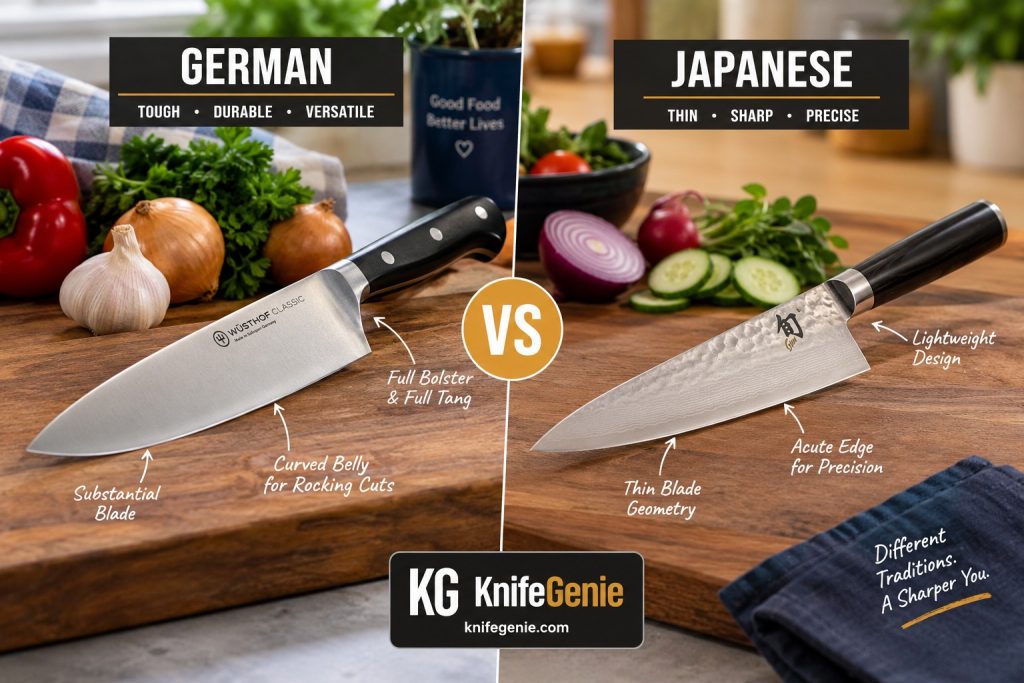
Traditional German-style kitchen knives tend to be sturdy, substantial and forgiving. They’re excellent all-purpose workhorses for home cooks who want a knife capable of handling a wide variety of everyday prep.
Japanese-style knives generally take a different approach. They’re often thinner, lighter and made from harder steel, allowing them to take very keen edges and make exceptionally clean, precise cuts.
So which should you buy?
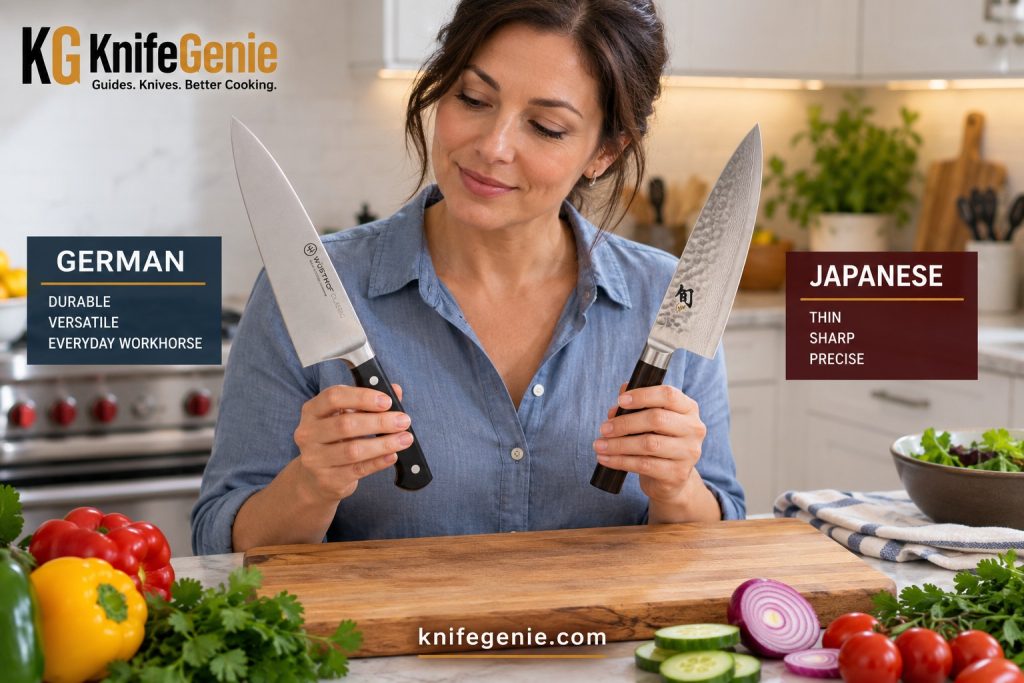
For most home cooks who prioritize durability and versatility, KnifeGenie gives the advantage to a good German chef’s knife.
For cooks who prioritize sharpness, lightweight handling and precision, a Japanese knife may be the more satisfying choice.
And if you’re serious about cooking?
There is a strong argument for eventually owning both.
🔽 Jump to What You Need
👉 Quick Answer
👉 German vs Japanese Comparison
👉 What Is a German Kitchen Knife?
👉 What Is a Japanese Kitchen Knife?
👉 Steel & Hardness
👉 Sharpness & Edge Retention
👉 Weight & Balance
👉 Cutting Style
👉 Durability
👉 Sharpening & Maintenance
👉 German Knife Pros & Cons
👉 Japanese Knife Pros & Cons
👉 Which Should You Buy?
👉 Recommended Brands
👉 KnifeGenie Pro Tips
👉 Frequently Asked Questions
👉 Final Verdict
🏆 German vs Japanese Kitchen Knives: The Quick Answer
If you simply want to know which style suits you:
🇩🇪 Choose a German Knife If You Want:
✔ A durable everyday workhorse
✔ A substantial, balanced feel
✔ A curved blade suited to rocking cuts
✔ A somewhat more forgiving edge
✔ Straightforward maintenance
✔ One general-purpose knife for lots of different kitchen jobs
🇯🇵 Choose a Japanese Knife If You Want:
✔ Exceptional sharpness
✔ A thinner blade
✔ Lightweight, agile handling
✔ Precise slicing and chopping
✔ Excellent edge retention
✔ A knife optimized for controlled, accurate cuts
🧙 KnifeGenie Quick Verdict
Best for most first-time premium-knife buyers: 🇩🇪 German
Best for precision and sharpness: 🇯🇵 Japanese
Best solution for serious home cooks: 🔪 Own one of each.
KNIVES COMPARISON
⚔️ German vs Japanese Kitchen Knives — Comparison
| Feature | 🇩🇪 German-Style Knife | 🇯🇵 Japanese-Style Knife |
|---|---|---|
| Typical feel | Substantial and sturdy | Light and agile |
| Blade | Generally thicker | Generally thinner |
| Steel | Usually somewhat softer/tougher | Often harder |
| Typical hardness | Around 55–58 HRC | Often around 60–66+ HRC |
| Edge geometry | Generally less acute | Generally more acute |
| Edge retention | Good | Often excellent |
| Chipping resistance | Generally higher | Greater care often required |
| Cutting motion | Excellent for rocking | Excellent for slicing/push cutting |
| Maintenance | Generally easier | Can require more care |
| Best for | Versatile everyday use | Precision cutting |
| Beginner friendly? | ⭐⭐⭐⭐⭐ | ⭐⭐⭐⭐ |
| KnifeGenie choice | Best all-purpose workhorse | Best precision cutter |
🧙 KnifeGenie Tip: These are general characteristics—not absolute rules. Modern German and Japanese manufacturers increasingly borrow ideas from each other.
German and Japanese knives aren’t your only choices. Home cooks who prefer domestic manufacturing can also explore our guide to American-made kitchen knives.
🇩🇪 What Is a German-Style Kitchen Knife?
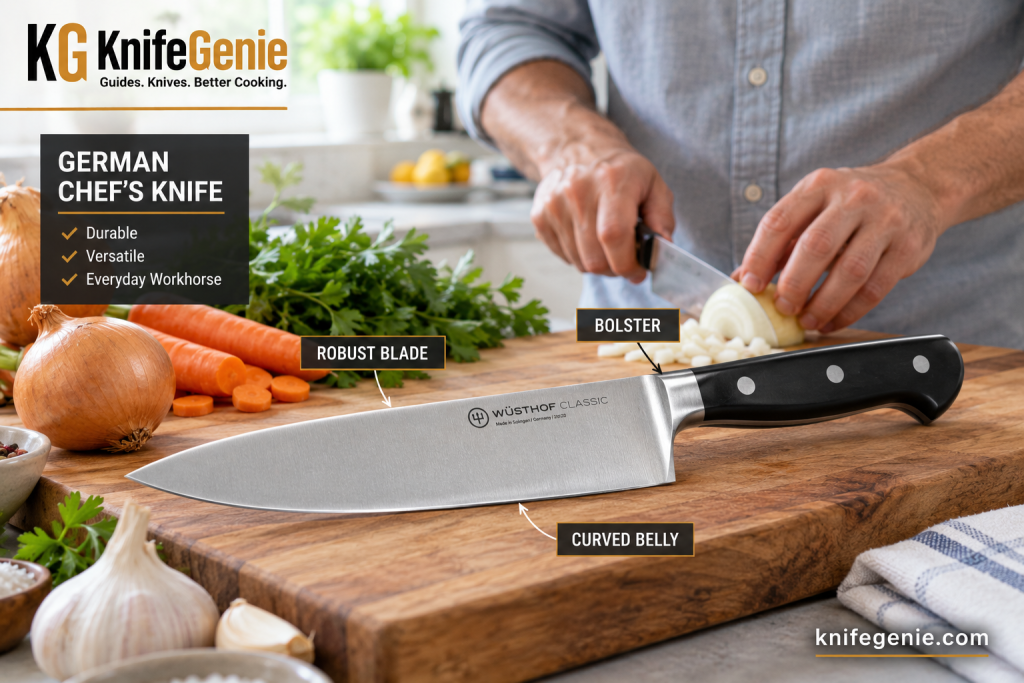
Think of the traditional German chef’s knife as the pickup truck of the kitchen-knife world.
It isn’t designed solely to make the thinnest possible cut.
It’s designed to do lots of jobs reliably.
Classic German chef’s knives typically have relatively substantial blades, curved cutting edges and enough weight to make repetitive chopping feel controlled.
The curved belly is particularly useful if you like the familiar rock-chopping motion used for onions, herbs and vegetables.
Many traditional forged German chef’s knives also feature a bolster where the blade meets the handle and a full-tang construction extending through the handle.
Well-known examples come from manufacturers such as Wüsthof and ZWILLING.
💪 What German Knives Do Well
✔ Everyday chopping
✔ Rocking cuts
✔ Meat preparation
✔ Larger vegetables
✔ General-purpose kitchen work
✔ Busy family kitchens
✔ Cooks who prefer a substantial knife
German knives are particularly attractive when you want one dependable chef’s knife rather than a highly specialized cutting tool.
GERMAN CHEF’S KNIFE
🇯🇵 What Is a Japanese-Style Kitchen Knife?
Japanese kitchen knives cover an enormous range of designs.
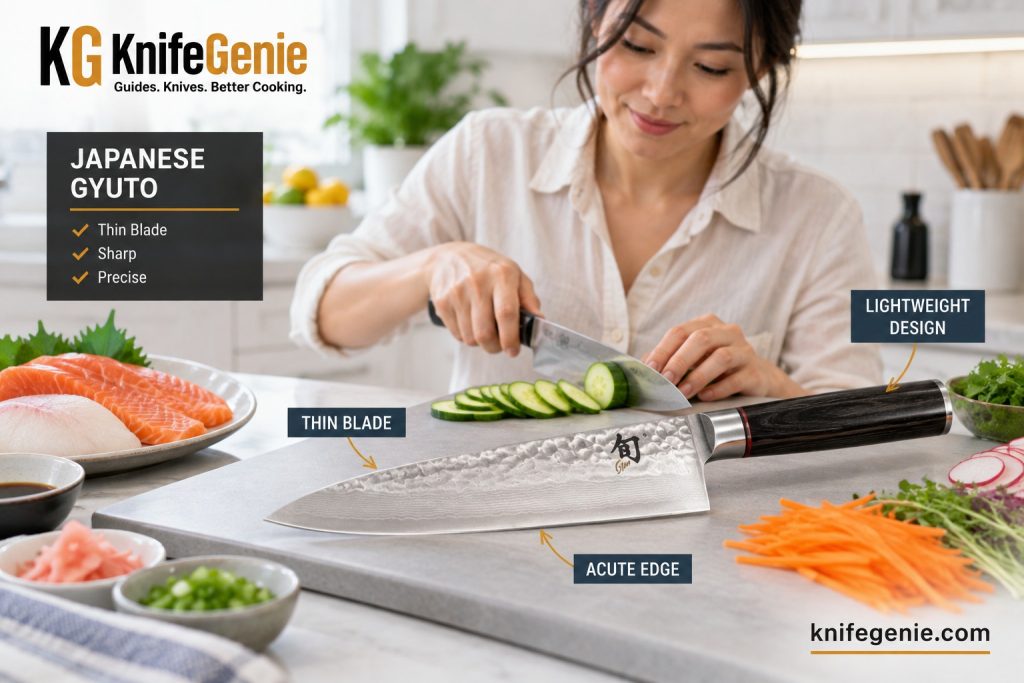
You’ll find gyutos, Santokus, nakiris, petty knives, yanagibas, deba knives and many other specialized patterns.
So it would be misleading to describe every Japanese knife as though it were constructed the same way.
For Western home cooks comparing alternatives to an ordinary German chef’s knife, however, the gyuto is probably the most useful comparison. Also, you can have a look at these American-made kitchen knives from popular manufacturers.
A gyuto performs many of the same everyday jobs as a Western chef’s knife but commonly uses thinner blade geometry, harder steel and a lighter overall construction.
That can make cutting feel almost effortless.
Instead of forcing your way through a carrot or onion, a good Japanese blade can feel as though it simply passes through it.
Premium Japanese manufacturers such as Shun Cutlery and Miyabi offer modern examples designed for cooks who want Japanese cutting characteristics without moving completely into traditional specialist knives.
🎯 What Japanese Knives Do Well
✔ Fine vegetable preparation
✔ Thin slicing
✔ Precise cuts
✔ Boneless proteins
✔ Herbs
✔ Fish preparation
✔ Long prep sessions where low weight helps
JAPANESE GYUTO
🧱 German vs Japanese Knife Steel & Hardness
This is one of the biggest differences between the two traditions.
German-style kitchen knives commonly use stainless steels hardened to roughly the mid-to-upper 50s on the Rockwell C scale.
Japanese knives frequently push hardness considerably higher.
Some premium Japanese knives reach approximately 60–63 HRC or beyond, depending on the steel and heat treatment.
Why does that matter?
🇩🇪 Softer Doesn’t Mean Worse
A slightly softer German blade can be:
✔ Tough
✔ Forgiving
✔ Relatively easy to sharpen
✔ Less susceptible to edge chipping
The trade-off is that the edge may roll or dull sooner and require more frequent maintenance.
🇯🇵 Harder Doesn’t Automatically Mean Better
Harder Japanese steel can support:
✔ Thinner geometry
✔ Very fine edges
✔ Excellent edge retention
✔ Extremely precise cutting
But there is a trade-off.
Very hard, thin edges can be less tolerant of lateral stress, twisting, bones, frozen food and rough technique.
That’s why comparing knives purely by HRC is a mistake.
🧙 KnifeGenie Tip: Don’t buy the knife with the highest Rockwell number simply because the specification looks impressive. Heat treatment, blade geometry, steel composition and intended use matter just as much.
Read our guide on how a kitchen knife loses its edge.
🔬 Sharpness: Japanese Knives Take the Advantage
If you’re looking for the category where Japanese knives have their clearest traditional advantage, this is it.
Japanese manufacturers can combine harder steel with thin blade geometry and relatively acute edge angles.
The result can be exceptionally low cutting resistance.
For example, Miyabi describes many of its Japanese knives as using approximately 9.5°–12° edges, while ZWILLING gives approximately 15° per side as typical for its German knives.
But be careful with universal claims about exact angles.
Different manufacturers—and even different knife lines from the same manufacturer—use different geometry.
🏆 Sharpness Winner: 🇯🇵 Japanese
Not because every Japanese knife is sharper than every German knife, but because the Japanese tradition generally places greater emphasis on thin geometry and acute cutting edges.
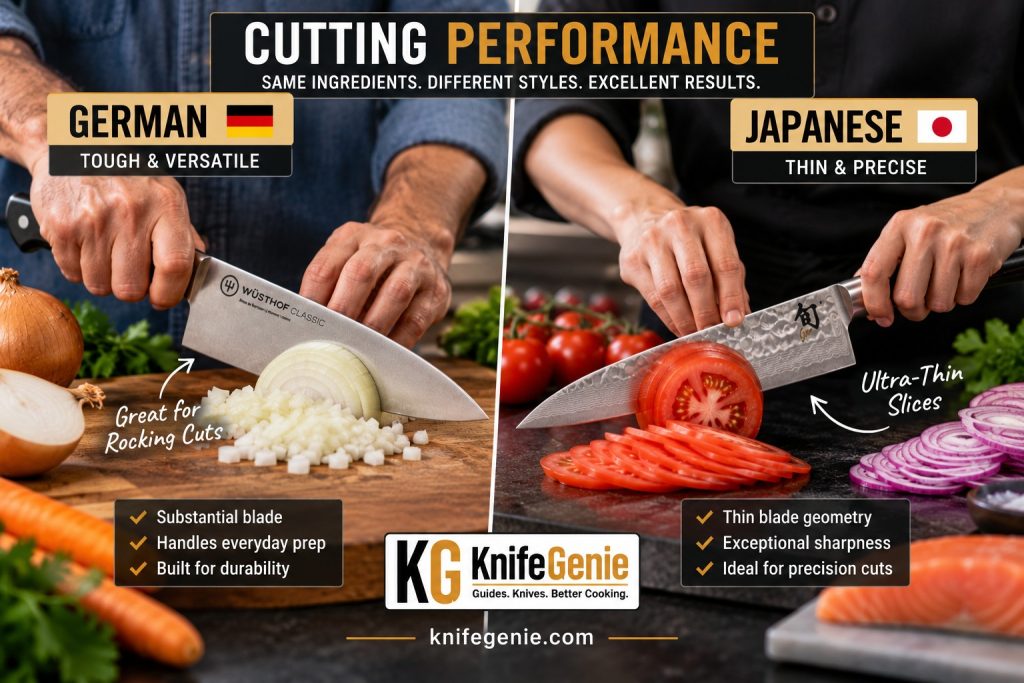
CUTTING PERFORMANCE
⚖️ Weight & Balance: Completely Different Personalities
Pick up a traditional German chef’s knife and then a lightweight Japanese gyuto.
The difference can be immediate.
🇩🇪 German
A traditional German knife often feels:
Solid → substantial → balanced → powerful
That additional mass can help when working through dense ingredients.
Some cooks love that reassuring weight.
Others find it tiring.
🇯🇵 Japanese
A Japanese knife often feels:
Light → quick → nimble → precise
Instead of relying on mass, it relies more heavily on sharpness and blade geometry.
That makes Japanese knives particularly enjoyable during extended vegetable preparation.
🏆 Weight Winner?
Neither.
This comes entirely down to preference.
If possible, hold both before buying.
🥕 Cutting Style: Rocking vs Push Cutting
Your cutting technique can tell you which knife you’ll probably prefer.
🇩🇪 Rock Choppers
German chef’s knives commonly have a pronounced curved belly.
That makes them excellent for rocking the blade repeatedly through:
🥕 Vegetables
🌿 Herbs
🧅 Onions
🧄 Garlic
If you learned to cook using a traditional Western chef’s knife, the motion will probably feel natural.
🇯🇵 Push Cutters
Many Japanese-style knives have flatter sections along their cutting edge.
They work beautifully with controlled:
⬇ Push cuts
↘ Forward slicing
⬇ Straight chopping
A Japanese knife rewards clean technique rather than aggressive rocking and twisting.
🛡️ Durability: German Knives Fight Back
This is where German-style knives regain the advantage.
Hardness and toughness aren’t the same thing.
A relatively tough German blade is generally better suited to cooks who occasionally treat their knives less delicately than they should.
That doesn’t mean you can abuse one.
Neither style should be used to cut bones, pry things open or hack through frozen food unless the particular knife is designed for that task.
But German chef’s knives are generally more forgiving of everyday mistakes.
🏆 Durability Winner: 🇩🇪 German
For a busy household, shared kitchen or beginner cook, that extra forgiveness can be genuinely useful.
🪨 Sharpening & Maintenance
This category deserves more attention than it usually gets.
Buying a knife is easy.
Keeping it performing properly for ten years is the real test.
🇩🇪 German Knives
German knives generally respond well to routine honing and conventional sharpening.
Because the steel tends to be somewhat softer than many premium Japanese steels, restoring an edge is usually relatively straightforward.
🇯🇵 Japanese Knives
Hard Japanese steels can retain a fine edge for a long time, but sharpening them properly may require more care.
A whetstone is an excellent option if you’re willing to learn the technique.
Also remember that traditional high-carbon Japanese knives can require considerably more attention to moisture and corrosion than modern stainless Japanese knives.
🧙 KnifeGenie Tip
Whatever you buy:
Hand wash it. Dry it promptly. Store it properly. Use a knife-friendly cutting board.
Those four habits will do more for the life of your knife than obsessing over tiny differences in specifications.
🇩🇪 German Kitchen Knives — Pros & Cons
✅ Strengths
✔ Durable and forgiving
✔ Excellent all-purpose performance
✔ Comfortable for rocking cuts
✔ Relatively easy edge maintenance
✔ Familiar Western handle designs
✔ Good choice for beginners
✔ Excellent for shared kitchens
✔ Substantial feel many cooks enjoy
❌ Weak Points
✘ Usually heavier
✘ Generally thicker behind the edge
✘ May require more frequent honing
✘ Less nimble for very fine cutting
✘ Full bolsters on some traditional designs can complicate sharpening
🧙 KnifeGenie Verdict
BEST FOR DURABILITY & EVERYDAY VERSATILITY
If you want one dependable chef’s knife and don’t want to worry excessively about delicate edge geometry, German is difficult to beat.
🇯🇵 Japanese Kitchen Knives — Pros & Cons
✅ Strengths
✔ Exceptional cutting performance
✔ Thin blade geometry
✔ Excellent edge retention with many steels
✔ Lightweight and agile
✔ Excellent for precision preparation
✔ Huge range of specialized knife shapes
✔ Often beautiful craftsmanship
✔ Premium steels widely available
❌ Weak Points
✘ Hard thin edges can chip if abused
✘ Some knives require more careful sharpening
✘ Carbon-steel versions require additional maintenance
✘ Premium handmade models can become extremely expensive
✘ Specialized Japanese profiles aren’t always beginner friendly
🧙 KnifeGenie Verdict
BEST FOR SHARPNESS & PRECISION
If cutting feel matters more to you than ruggedness, Japanese knives are extremely compelling.
🛒 Which Should You Buy?
Here’s the easiest way to decide.
| Your Priority | KnifeGenie Recommendation |
|---|---|
| First premium chef’s knife | 🇩🇪 German |
| Maximum durability | 🇩🇪 German |
| Shared family kitchen | 🇩🇪 German |
| Rock chopping | 🇩🇪 German |
| Prefer heavier knives | 🇩🇪 German |
| Maximum precision | 🇯🇵 Japanese |
| Lightweight handling | 🇯🇵 Japanese |
| Thin vegetable slicing | 🇯🇵 Japanese |
| Edge retention | 🇯🇵 Japanese |
| Knife enthusiast | 🇯🇵 Japanese |
| Want maximum versatility | 🔪 Consider owning both |
BUYING DECISION
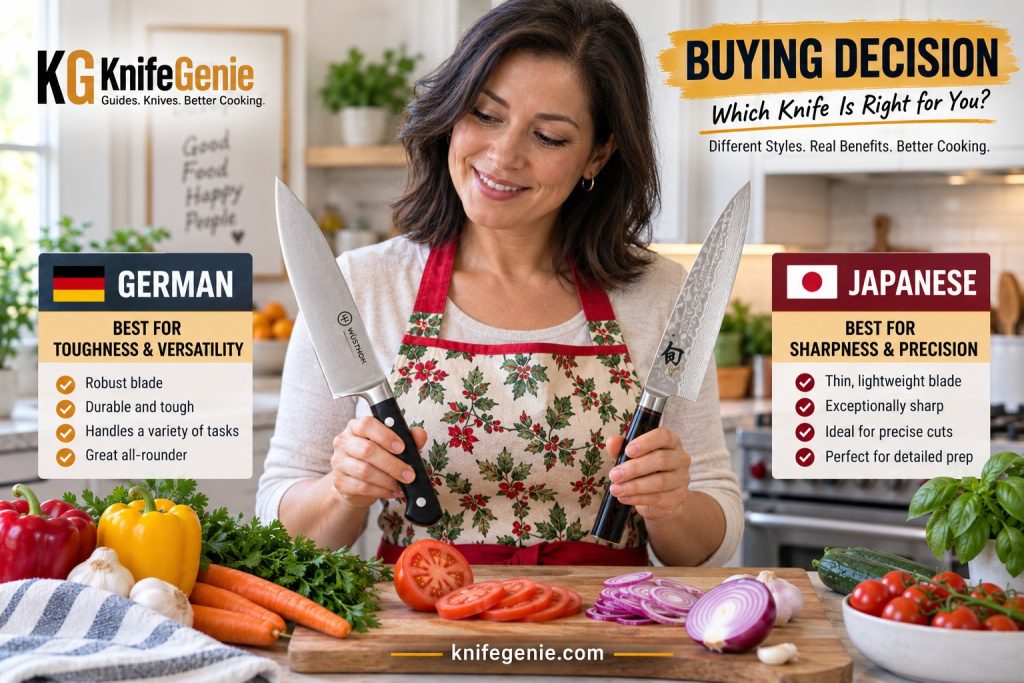
Before buying either knife checkout this guide…
🏭 German & Japanese Knife Brands Worth Knowing
You don’t have to buy the most expensive knife available.
But established manufacturers give you useful reference points when comparing construction, steel and design.
🇩🇪 German
Wüsthof — A benchmark traditional German knife manufacturer from Solingen.
ZWILLING J.A. Henckels — One of Germany’s best-known knife makers, with everything from mainstream Western knives to premium collections.
🇯🇵 Japanese
Shun — Premium Japanese knives combining traditional influences with designs accessible to Western home cooks.
Miyabi — Japanese-made premium knives combining Japanese manufacturing with ZWILLING’s international distribution.
MAC — Particularly interesting if you want Japanese cutting performance in a familiar Western-style chef’s knife format.
GLOBAL — Known for lightweight, distinctive all-stainless Japanese knives.
👉 KnifeGenie related guide: See our 5 Best Imported Kitchen Knives of 2026 for specific Japanese and German models worth considering.
🧙 KnifeGenie Pro Tips
🔪 Don’t obsess over country of origin. Buy according to geometry, steel, construction and how the knife feels in your hand.
🪨 Think about sharpening before buying. A spectacular knife isn’t much use if you can’t maintain its edge.
🪵 Use a knife-friendly board. Avoid glass, stone and other extremely hard cutting surfaces.
🧼 Keep good knives out of the dishwasher. Hand washing takes seconds and is kinder to the blade and handle.
🦴 Don’t use your chef’s knife as a cleaver. Bones and frozen foods require the appropriate tool.
✋ Try the grip. Weight and handle geometry can matter more than impressive specifications.
💰 Spend for performance—not decoration. Damascus patterns and exotic handles can be beautiful, but they don’t automatically make a knife cut better.
❓ Frequently Asked Questions
Are Japanese knives better than German knives?
Not universally.
Japanese knives generally have an advantage in thinness, precision and edge retention, while German knives traditionally offer greater toughness, weight and forgiveness.
The better knife depends on your cooking style.
Are Japanese knives sharper?
Japanese knives are often designed with harder steel, thinner blades and more acute edges, which can produce exceptional cutting performance.
However, a properly sharpened high-quality German knife is also extremely sharp.
Do Japanese knives chip easily?
Some hard, thin Japanese edges are more susceptible to chipping than tougher German-style blades if they’re twisted, dropped or used against bones, frozen food or very hard surfaces.
Used correctly, a quality Japanese knife should not simply chip during normal food preparation.
Do German knives get dull faster?
Their relatively softer steel can mean more frequent edge maintenance compared with many hard Japanese steels.
The upside is toughness and generally straightforward sharpening.
Which knife is better for beginners?
For many beginners, German.
The additional toughness and familiar curved chef’s-knife profile make a quality German knife very forgiving.
A Japanese knife is still perfectly suitable for a beginner who’s willing to use careful technique.
Which is better for vegetables?
For thin, precise vegetable preparation, Japanese knives are excellent.
A gyuto or Santoku makes a superb general-purpose choice, while a nakiri is specifically designed around vegetable preparation.
Can I use a honing steel on a Japanese knife?
Don’t automatically treat every Japanese knife the way you would a softer Western blade.
Follow the manufacturer’s maintenance recommendations for your specific steel and knife.
Should I own both?
If you cook frequently, yes—that can be an excellent combination.
A robust German chef’s knife can handle general everyday work while a Japanese gyuto or Santoku provides lightweight precision when you want exceptionally clean cuts.
🏆 Final Verdict: German or Japanese?
There’s no universal winner in German vs Japanese kitchen knives.
They solve slightly different problems.
🇩🇪 German Wins For:
💪 Toughness
🔄 Everyday versatility
🥕 Rock chopping
👨🍳 Beginner friendliness
🛡️ Forgiveness
🇯🇵 Japanese Wins For:
⚔️ Precision
🔪 Thin cutting geometry
🪶 Lightweight handling
🎯 Fine slicing
⏳ Edge retention
🧙 KnifeGenie Overall Recommendation
Choose German if you want a dependable workhorse.
Choose Japanese if you want a precision cutting instrument.
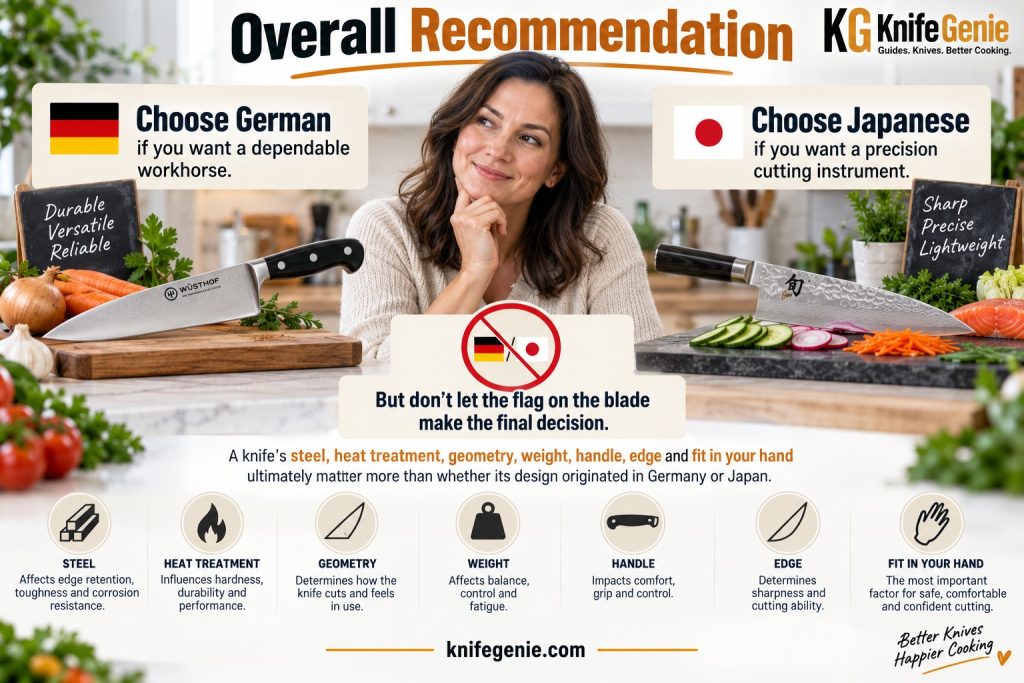
But don’t let the flag on the blade make the final decision.
A knife’s steel, heat treatment, geometry, weight, handle, edge and fit in your hand ultimately matter more than whether its design originated in Germany or Japan.
For many serious home cooks, the best answer isn’t German or Japanese.
It’s German and Japanese.
See our Best Imported Kitchen Knives recommendations…