
Choosing between an 8-inch and 10-inch chef knife might seem like a simple matter of blade length.
After all, it’s only a two-inch difference.
But those extra two inches can noticeably change how a knife feels, how much cutting-board space it needs, how quickly you can work through large ingredients, and how easy it is to control.
So, which should you buy?
For most home cooks, the answer is straightforward:
🏆 An 8-inch chef knife is the better all-around choice.
It gives you enough blade for onions, vegetables, herbs, chicken, boneless meats and most everyday prep without feeling unnecessarily large.
A 10-inch chef knife, however, can be the better tool if you regularly prepare large ingredients, cook in big batches, have a spacious cutting board and already feel comfortable controlling a longer blade. And if you want USA-made chef’s knives are good choices.
This KnifeGenie buying guide compares the two sizes side by side so you can decide which one belongs in your kitchen.
🧙 KnifeGenie Quick Take:
Buy the 8-inch chef knife if you’re unsure. Choose the 10-inch primarily when you know you need the additional cutting length and have enough workspace to use it comfortably.
🔽 Jump to What You Need
👉 Quick Answer
👉 8-Inch vs 10-Inch Comparison
👉 Why Choose an 8-Inch Chef Knife?
👉 Why Choose a 10-Inch Chef Knife?
👉 Control & Maneuverability
👉 Cutting Speed & Efficiency
👉 Cutting Board Size
👉 Knife Weight & Fatigue
👉 Rock Chopping & Slicing
👉 Beginners
👉 Small vs Large Hands
👉 Japanese vs German Knives
👉 Which Size Should You Buy?
👉 Frequently Asked Questions
👉 Final Verdict
🏆 8-Inch vs 10-Inch Chef Knife: The Quick Answer
If you simply want our recommendation:
🥇 Best Overall — 8-Inch Chef Knife
For most home cooks, 8 inches is the sweet spot.
It provides enough cutting length for almost everything you are likely to prepare while remaining relatively maneuverable.
💪 Best for Large Prep — 10-Inch Chef Knife
Choose a 10-inch chef knife if you regularly work with:
🥬 Large cabbages
🍉 Melons
🎃 Large squash
🥩 Large boneless cuts of meat
🥕 Big batches of vegetables
🍲 High-volume meal prep
The longer cutting edge can make these jobs faster and more efficient.
But bigger isn’t automatically better.
If you spend most of your time chopping an onion, slicing a tomato and preparing dinner for two or four people, you may rarely benefit from those additional two inches.
⚔️ 8-Inch vs 10-Inch Chef Knife — Side-by-Side Comparison
| Feature | 🔪 8-Inch Chef Knife | 💪 10-Inch Chef Knife |
|---|---|---|
| Overall versatility | ⭐⭐⭐⭐⭐ | ⭐⭐⭐⭐ |
| Control | ⭐⭐⭐⭐⭐ | ⭐⭐⭐½ |
| Large ingredients | ⭐⭐⭐⭐ | ⭐⭐⭐⭐⭐ |
| Bulk preparation | ⭐⭐⭐⭐ | ⭐⭐⭐⭐⭐ |
| Small kitchens | ⭐⭐⭐⭐⭐ | ⭐⭐½ |
| Beginner friendly | ⭐⭐⭐⭐⭐ | ⭐⭐⭐ |
| Maneuverability | ⭐⭐⭐⭐⭐ | ⭐⭐⭐½ |
| Cutting-board space needed | Moderate | Large |
| Typical weight | Lower | Higher |
| Best for | Most home cooks | Large-volume prep |
| KnifeGenie choice | 🏆 Winner | 💪 Specialist choice |
🧙 KnifeGenie Tip
Don’t look at blade length in isolation.
Weight, balance, blade height, thickness, handle design and overall construction can make two chef knives of the same length feel completely different.
MAIN COMPARISON

🥇 Why Choose an 8-Inch Chef Knife?
There is a reason the 8-inch chef knife has become one of the most popular all-purpose sizes.
It occupies an extremely useful middle ground.
An 8-inch blade is long enough to handle most foods found in a home kitchen but short enough that most cooks can comfortably maneuver it on a normal cutting board.
Think about a typical evening meal.
You might need to:
🧅 Dice an onion
🧄 Mince garlic
🥕 Chop carrots
🥔 Cube potatoes
🌿 Mince herbs
🍗 Prepare boneless chicken
🍅 Slice tomatoes
An 8-inch chef knife can comfortably perform all of these jobs.
⚙️ Where the 8-Inch Excels
✔ Everyday vegetable preparation
✔ Chopping onions
✔ Mincing herbs
✔ Slicing fruit
✔ Preparing boneless meat
✔ General family meals
✔ Medium-sized cutting boards
✔ Precision work requiring good tip control
✅ Advantages
✔ Excellent balance of length and control
✔ Easier to maneuver than a 10-inch knife
✔ Fits most home cutting boards
✔ Comfortable for longer prep sessions
✔ Suitable for beginners
✔ Large enough for most ingredients
✔ Available in an enormous range of styles and prices
✔ Easy to store in most knife blocks and drawers
❌ Weak Points
✘ Less efficient than a 10-inch blade for very large ingredients
✘ Shorter cutting edge for bulk prep
✘ Large melons and oversized squash may require additional strokes
✘ Professional cooks doing high-volume prep may prefer more blade
🧙 KnifeGenie Verdict
BEST OVERALL FOR HOME COOKING
If you want one chef knife that can perform almost every normal kitchen preparation task, buy the 8-inch.
For most home cooks, the advantages of moving up to 10 inches simply aren’t large enough to outweigh the 8-inch knife’s easier handling.
See our Chef Knife vs Santoku guide
8-INCH KNIFE

💪 Why Choose a 10-Inch Chef Knife?
A 10-inch chef knife isn’t simply a stretched 8-inch knife.
The additional blade length changes how you interact with the knife.
You gain a longer cutting edge and additional reach, which can be particularly useful when dealing with large foods.
Imagine slicing through a large cabbage.
With a shorter knife, you may need to reposition the blade or make multiple cuts.
A longer knife can potentially span more of the ingredient in a single motion.
The same principle applies when processing large quantities of food.
⚙️ Where the 10-Inch Excels
✔ Large vegetables
✔ Large fruit
✔ Cabbage
✔ Squash
✔ Melons
✔ Large boneless cuts
✔ Big batches of herbs and vegetables
✔ Meal preparation for large families
✔ High-volume kitchen work
✅ Advantages
✔ More cutting edge
✔ Greater reach
✔ Excellent for large ingredients
✔ Efficient for bulk food preparation
✔ Fewer strokes may be required for some jobs
✔ Useful for long slicing motions
✔ Experienced cooks may appreciate the additional working length
❌ Weak Points
✘ Requires more cutting-board space
✘ Usually heavier than the equivalent 8-inch knife
✘ More blade to control
✘ Can feel cumbersome in small kitchens
✘ Less beginner-friendly
✘ Takes more storage space
✘ Additional length provides little benefit during many small prep jobs
🧙 KnifeGenie Verdict
BEST FOR LARGE-SCALE PREP
A 10-inch chef knife makes sense when your cooking habits actually justify it.
If you frequently prepare large meals or oversized ingredients, the additional reach can be genuinely useful.
Otherwise, an 8-inch knife will usually be more convenient.
10-INCH KNIFE

✋ Which Gives You Better Control?
🏆 Winner: 8-Inch
For most home cooks, the 8-inch knife wins on maneuverability.
With two fewer inches extending beyond your hand, controlling the tip generally feels easier.
This becomes particularly noticeable when making smaller or more precise cuts.
An 8-inch knife can feel more natural when you’re:
🧄 Mincing garlic
🍓 Preparing small fruit
🧅 Dicing onions
🌿 Chopping herbs
🥕 Making smaller vegetable cuts
A 10-inch knife can perform these jobs too.
The question is whether the additional blade length provides any advantage.
Usually, it doesn’t.
🧙 KnifeGenie Tip
A chef knife should feel like an extension of your hand.
If you’re constantly thinking about where the tip of your knife is, the knife may be larger than you need.
⚡ Which Is Faster for Food Prep?
🏆 Winner for Large Batches: 10-Inch
This is where the 10-inch knife begins fighting back.
A longer cutting edge allows you to cover more food during each stroke.
Imagine preparing:
🥕 20 carrots
🧅 10 onions
🥬 Several heads of cabbage
🥔 A large batch of potatoes
A confident cook may find a 10-inch knife more efficient.
But there’s an important distinction:
Bigger batches don’t automatically require a bigger knife.
If you aren’t comfortable controlling the additional length, any theoretical speed advantage disappears.
For ordinary home dinners, the difference is unlikely to matter much.
For large meal-prep sessions, catering-style cooking or very large families, it can.
Read: Boning Knife vs Fillet Knife: Which One Do You Need?
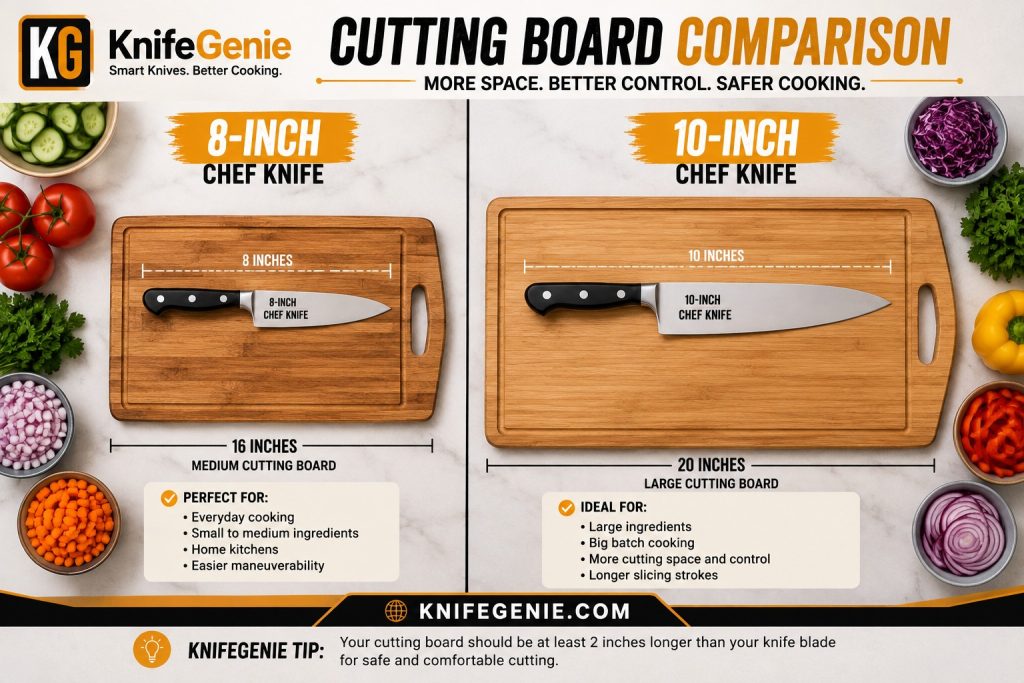
📏 Cutting Board Size Could Decide This for You
Your knife and cutting board need to work together.
This is one of the most overlooked factors when choosing between an 8-inch and 10-inch chef knife.
Put a 10-inch knife on a cramped cutting board and you’ll immediately understand the problem.
You need space not only for the blade, but also for:
🥕 Your ingredients
✋ Your guiding hand
🔪 Your cutting motion
🥗 Your prepared food
Small Cutting Board
Choose: 8-inch
A 10-inch knife is likely to feel unnecessarily cumbersome.
Medium Everyday Cutting Board
Choose: 8-inch
This is the natural pairing for most home kitchens.
Large Cutting Board
Choose: 8-inch or 10-inch
Now the choice can be based more on ingredients and personal preference.
CUTTING BOARD COMPARISON
⚖️ Weight & Fatigue: Two Inches Can Make a Difference
Blade length isn’t the only difference.
Within the same knife series, moving from 8 inches to 10 inches generally means more blade material and therefore additional overall size and often weight.
How noticeable that feels depends heavily on the knife.
A thin Japanese 10-inch gyuto may still feel surprisingly agile.
A substantial 10-inch forged German chef knife can feel considerably more imposing.
That extra mass isn’t necessarily bad.
Some cooks like letting the knife’s weight contribute to the cutting action.
Others prefer a lighter, quicker feeling.
Choose the 8-inch if you prefer:
⚡ Agility
🎯 Precise control
✋ Less knife to manage
🏠 Normal home preparation
Consider the 10-inch if you prefer:
💪 More substantial tools
📏 Additional reach
🥬 Large-ingredient preparation
🍲 High-volume cooking
🔄 Which Is Better for Rock Chopping?
There isn’t an automatic winner here because blade profile matters as much as blade length.
Traditional Western chef knives often have a curved belly that facilitates rocking cuts.
A longer blade can give you a substantial rocking surface, which experienced cooks may enjoy when working through herbs and vegetables.
But don’t assume every 10-inch knife rocks better than every 8-inch knife.
A flatter Japanese-style gyuto behaves differently from a deeply curved German chef knife regardless of length.
🧙 KnifeGenie Tip
Choose your cutting technique first.
Then look at blade profile + length, rather than length alone.
🥩 Which Is Better for Slicing Meat?
Slight Advantage: 10-Inch
Longer blades can be useful for slicing because they allow longer, smoother strokes.
That makes a 10-inch chef knife attractive when working with larger boneless cuts.
However, a chef knife isn’t always the ideal specialist slicing tool.
If carving roasts or slicing large proteins is a regular part of your cooking, a dedicated slicing or carving knife may ultimately perform that job better.
For normal chicken, steaks and smaller boneless cuts, an 8-inch chef knife remains perfectly capable.
👶 8-Inch vs 10-Inch Chef Knife for Beginners
🏆 Winner: 8-Inch
We recommend that most beginners start with an 8-inch chef knife.
Why?
Because you’re learning:
✋ Grip
🎯 Tip control
🔄 Cutting motions
👆 Guiding-hand position
⚖️ Balance
📏 Spatial awareness
There is little reason to make that process more difficult by adding blade length you don’t need.
An 8-inch chef knife gives beginners plenty of room to develop proper technique while still being capable enough to remain useful long after their skills improve.
What if 8 inches still feels too big?
Try a 7-inch chef knife.
Or even a 6-inch model.
Comfort and control matter more than following an arbitrary rule.
✋ Does Hand Size Matter?
Yes—but don’t make your decision based solely on hand size.
Someone with large hands isn’t automatically better suited to a 10-inch knife.
Likewise, someone with small hands doesn’t necessarily need a tiny blade.
Consider the entire knife:
🔹 Handle circumference
🔹 Handle length
🔹 Balance point
🔹 Blade height
🔹 Weight
🔹 Bolster design
🔹 Grip style
🔹 Overall construction
A well-balanced 10-inch knife can sometimes feel more comfortable than a poorly balanced 8-inch knife.
And a thin 8-inch Japanese chef knife can feel dramatically lighter than a thick 8-inch German model.
HANDLING TEST

🇯🇵 Japanese vs 🇩🇪 German: Size Doesn’t Tell the Whole Story
This is particularly important when comparing chef knives.
🇯🇵 Japanese-Style Knives
Japanese gyutos often emphasize:
⚡ Lower weight
🔪 Thin blade geometry
🎯 Precise cutting
✨ Harder steels
🥕 Efficient slicing
Common metric sizes include:
210 mm ≈ 8.3 inches
240 mm ≈ 9.4 inches
A 240 mm gyuto therefore sits close to the 10-inch category, although it is technically a little shorter.
Because Japanese knives can be relatively thin and light, a 240 mm gyuto may feel much more maneuverable than you expect from looking at its length.
🇩🇪 German-Style Chef Knives
Traditional German knives commonly emphasize:
💪 Robust construction
⚖️ More substantial weight
🔄 Curved blade profiles
🔨 Toughness
🥩 General-purpose versatility
A substantial forged 10-inch German chef knife can therefore feel considerably larger than a thin Japanese knife of similar length.
🧙 KnifeGenie Tip
Never compare chef knives by length alone.
Length tells you how long the blade is—not how large the knife will feel in your hand.
🔍 Real-World Example: What Do Popular Chef Knives Tell Us?
Many highly regarded all-purpose chef knives cluster around the 8-inch range.
For example, KnifeGenie’s Best Imported Kitchen Knives comparison includes the MAC Professional MTH-80 at approximately 8.5 inches alongside 8-inch-class models from Miyabi, Wüsthof, Shun and GLOBAL.
That doesn’t prove 8 inches is universally superior.
But it does illustrate how practical the roughly 8-inch format is for an all-purpose chef knife.
If you want to compare several Japanese and German examples, see:
👉 KnifeGenie: 5 Best Imported Kitchen Knives of 2026
🧪 How to Test 8-Inch vs 10-Inch Before Buying
If you can handle both sizes before purchasing, do it.
Don’t simply pick up the knife and hold it in the air.
Try to approximate your normal cooking position.
Ask yourself:
1️⃣ Can I comfortably control the tip?
The knife shouldn’t feel as though it’s pulling your hand around.
2️⃣ Can I use a proper pinch grip?
Your normal grip should feel comfortable and secure.
3️⃣ Do I have enough knuckle clearance?
Blade height matters here—not just length.
4️⃣ Does the knife feel balanced?
You shouldn’t feel as though you’re fighting the front or rear of the knife.
5️⃣ Is the 10-inch actually helping me?
This is perhaps the most important question.
If the longer knife doesn’t improve how you cut, why carry the additional blade?
6️⃣ Will it fit my cutting board?
Imagine the knife in your actual kitchen rather than on a large store counter.
7️⃣ Could I comfortably use it for 20 minutes?
A knife that feels impressive for 30 seconds can become tiring during a long prep session.
🛒 Which Size Should You Buy?
Here’s the easiest way to decide.
🥇 Buy an 8-Inch Chef Knife If…
✔ You want one all-purpose chef knife
✔ You prepare normal family meals
✔ You’re a beginner
✔ You use a medium-sized cutting board
✔ Control matters more than maximum reach
✔ You have limited counter space
✔ You want good maneuverability
✔ You’re uncertain which size to choose
🧙 KnifeGenie Verdict
For most readers, this is the right choice.
💪 Buy a 10-Inch Chef Knife If…
✔ You regularly prepare large quantities of food
✔ You cut large vegetables and fruit
✔ You have a spacious cutting board
✔ You prefer long slicing strokes
✔ You’re already comfortable using chef knives
✔ You like longer blades
✔ You want more cutting edge per stroke
✔ Your kitchen has sufficient working space
🧙 KnifeGenie Verdict
Buy it because your cooking requires it—not simply because bigger sounds better.
🎯 KnifeGenie Buying Decision
Still undecided?
Use this simple guide:
| Your Situation | KnifeGenie Recommendation |
|---|---|
| First chef knife | 🥇 8-inch |
| Beginner | 🥇 8-inch |
| Average home cook | 🥇 8-inch |
| Small kitchen | 🥇 8-inch |
| Medium cutting board | 🥇 8-inch |
| One chef knife for almost everything | 🥇 8-inch |
| Large cutting board | Either |
| Large family | 8-inch or 10-inch |
| Frequent meal prep | 💪 10-inch |
| Large vegetables and fruit | 💪 10-inch |
| Experienced cook who likes long blades | 💪 10-inch |
| High-volume preparation | 💪 10-inch |
BUYING DECISION

🚫 5 Mistakes to Avoid When Choosing Chef Knife Size
❌ Mistake #1: Assuming Bigger Means Better
A 10-inch knife isn’t an upgrade from an 8-inch knife.
It’s a different size designed to suit different preferences and jobs.
❌ Mistake #2: Ignoring Your Cutting Board
Your beautiful new 10-inch chef knife won’t be much fun if your cutting board barely accommodates it.
❌ Mistake #3: Choosing Based Only on Hand Size
Handle design, blade height, balance and weight matter too.
❌ Mistake #4: Copying Professional Chefs
A professional cook processing large quantities of ingredients has different needs from someone preparing dinner at home.
Buy for your kitchen.
❌ Mistake #5: Ignoring Weight
Two additional inches can also mean more material.
Compare the actual weight and balance of the knives you’re considering whenever possible.
🧙 KnifeGenie Pro Tips
🔪 Start With 8 Inches
If this is your first serious chef knife, an 8-inch model gives you an excellent baseline.
You can always add a longer knife later.
📏 Measure Your Cutting Board
Don’t guess.
Put a ruler on your board and visualize a 10-inch blade before ordering one.
✋ Test Your Grip
Use a proper pinch grip when comparing knives. Holding a knife by the very end of its handle doesn’t tell you much about how it will feel during actual prep.
⚖️ Compare Weight, Not Just Length
A light 10-inch knife may suit you better than a heavy 8-inch model.
🍉 Buy According to What You Cook
If the largest thing you regularly cut is an onion, the extra length probably won’t transform your cooking.
If you’re constantly breaking down cabbages, melons and large piles of vegetables, that’s different.
🔗 Related KnifeGenie Guides
Continue with these KnifeGenie guides:
👉 What Size Chef Knife Is Best for Home Cooking?
Learn how 6-inch, 8-inch and 10-inch chef knives compare for everyday home use.
👉 5 Best Imported Kitchen Knives of 2026
Compare popular Japanese and German chef knives.
👉 How to Hold a Chef Knife
Learn the pinch grip and basic handling techniques before moving to a larger blade.
👉 Forged vs Stamped Knives: What’s the Difference?
See how knife construction affects weight, feel, balance and price.
❓ Frequently Asked Questions
Is an 8-inch or 10-inch chef knife better?
For most home cooks, an 8-inch chef knife is better because it offers an excellent balance between cutting length, maneuverability and control. A 10-inch knife becomes more attractive when preparing large ingredients or large quantities of food.
Is a 10-inch chef knife too big for home cooking?
Not necessarily. A 10-inch chef knife can work extremely well at home if you have enough cutting-board space and feel comfortable controlling the longer blade. Most home cooks, however, don’t need the extra length.
Is an 8-inch chef knife big enough?
Yes. An 8-inch chef knife is large enough for the vast majority of everyday kitchen preparation, including vegetables, herbs, fruit, chicken and boneless meats.
Should a beginner buy an 8-inch or 10-inch chef knife?
Most beginners should start with an 8-inch chef knife. It provides excellent versatility without introducing unnecessary blade length.
Is a 10-inch chef knife better for large hands?
Not automatically. Hand size is only one factor. Handle dimensions, knife weight, blade height and balance may have a greater effect on comfort.
Does a 10-inch chef knife cut faster?
It can during large-volume preparation because the longer cutting edge covers more food per stroke. For normal home cooking, the speed difference may be insignificant.
Is a 10-inch chef knife heavier?
Within the same knife line, a longer version will commonly contain more blade material and may weigh more. However, construction varies significantly, so check the specifications of the individual knife.
Is an 8-inch chef knife easier to control?
Generally, yes. The shorter blade gives you less length extending beyond your hand, which is one reason 8-inch chef knives are so popular for everyday cooking.
What is the Japanese equivalent of an 8-inch chef knife?
A 210 mm gyuto measures approximately 8.3 inches and is a very common general-purpose Japanese chef-knife size.
What is the Japanese equivalent of a 10-inch chef knife?
A 240 mm gyuto measures approximately 9.4 inches and provides a similar step up in working length, although it isn’t a full 10 inches.
Do I need both an 8-inch and 10-inch chef knife?
Probably not.
Most home cooks can perform nearly all everyday chef-knife tasks with a good 8-inch knife. Consider adding a longer chef knife only if your cooking habits show that you genuinely need more reach.
🏆 Final Verdict: 8-Inch vs 10-Inch Chef Knife
After comparing the two sizes, KnifeGenie’s recommendation is clear:
🥇 For most home cooks, buy the 8-inch chef knife.
It offers the strongest combination of:
✔ Control
✔ Versatility
✔ Maneuverability
✔ Cutting length
✔ Cutting-board compatibility
✔ Beginner friendliness
✔ Everyday usefulness
The 10-inch chef knife isn’t worse.
In the right kitchen, it may actually be better.
Its additional reach makes sense for large vegetables, large fruit, long slicing strokes and high-volume food preparation.
But that’s exactly the point.
A 10-inch knife is worth buying when you have a reason to need those additional two inches.
For everyday cooking, the 8-inch knife hits the sweet spot.
🧙 KnifeGenie Final Recommendation
🥇 8-INCH — BEST FOR MOST HOME COOKS
💪 10-INCH — BEST FOR LARGE INGREDIENTS & HIGH-VOLUME PREP
When in doubt, choose 8 inches.
“What Size Chef Knife Is Best for Home Cooking?”