
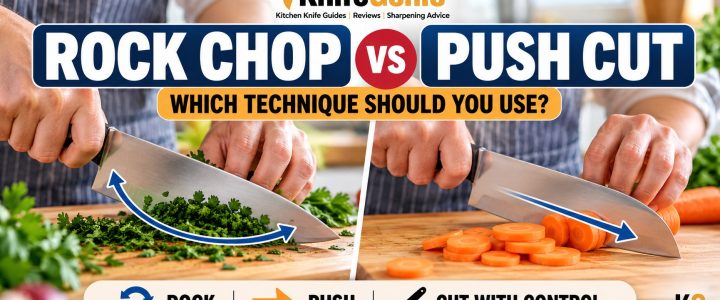
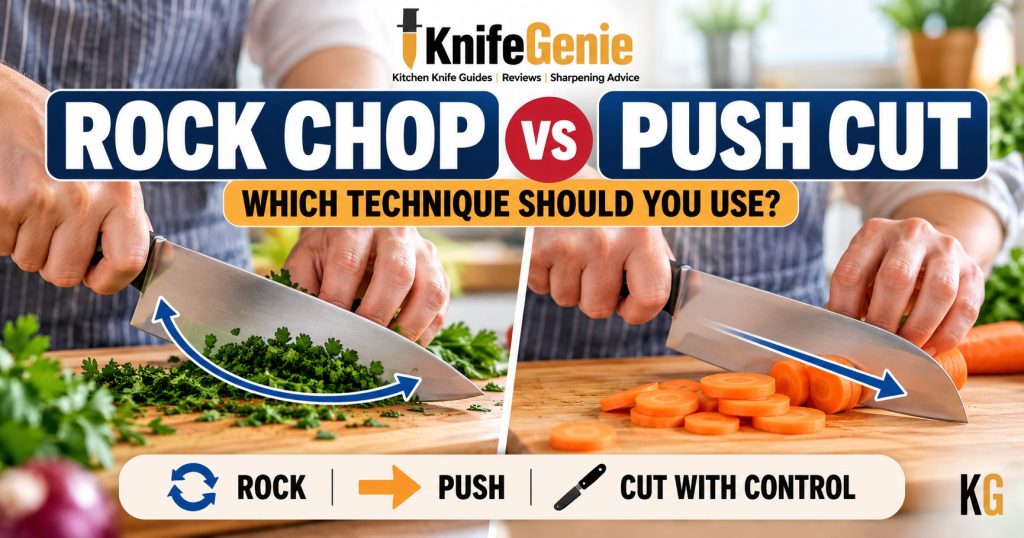
Rock chopping and push cutting use different blade movements; the right technique depends partly on knife profile and cutting task.
Watch experienced cooks prepare vegetables, and you may notice that their knives don’t all move the same way.
They either try rock chop vs push chop to find which technique is most suitable.
Some keep the tip of the knife close to the cutting board while the blade rises and falls in a smooth rocking motion.
Others lift more of the blade and move it forward and downward through the food, producing a cleaner, more linear cut.
These are commonly described as rock chopping and push cutting.
Neither technique is automatically better.
The right motion depends on your knife’s shape, the ingredient you’re cutting, and how much control you have over the blade. Western-style chef’s knives commonly have more curvature to facilitate rocking, while flatter blade profiles can lend themselves naturally to push cutting. WÜSTHOF, for example, specifically describes the curved profile of Western chef’s knives as facilitating rocking motions.
This guide is based on research into knife design, manufacturer guidance, and established cutting techniques rather than personal testing of any particular knife or product.
By the end, you’ll know when to:
🔄 Rock chop
➡️ Push cut
⬇️ Use a simple straight chop
—and why learning more than one cutting motion can make you much more comfortable with a chef knife.
NB: If you’re still learning the fundamentals, start with our How to Use a Chef Knife guide, which covers grip, guiding-hand position, cutting motions, and basic knife control.
▶️ Jump to a Section
👉 Quick Answer
👉 Rock Chop vs Push Cut Comparison
👉 What Is Rock Chopping?
👉 What Is Push Cutting?
👉 How Blade Shape Affects Cutting
👉 Common Cutting Mistakes
👉 Which Technique Should Beginners Use?
👉 Frequently Asked
👉 Final Takeaway
🏆 Rock Chop vs Push Cut: The Quick Answer
🔄 Use the Rock Chop When:
✔ Your chef knife has a noticeably curved belly
✔ You’re mincing herbs
✔ You’re making repeated cuts through relatively small ingredients
✔ You want to keep the knife tip near the board
✔ A rocking motion feels comfortable and controlled
➡️ Use the Push Cut When:
✔ Your knife has a flatter cutting edge
✔ You’re cutting vegetables into controlled, even pieces
✔ You’re using a chef knife vs Santoku, nakiri, or flatter-profile chef knife
✔ You want clean cuts with less repetitive rocking
✔ You’re comfortable moving the blade forward and down
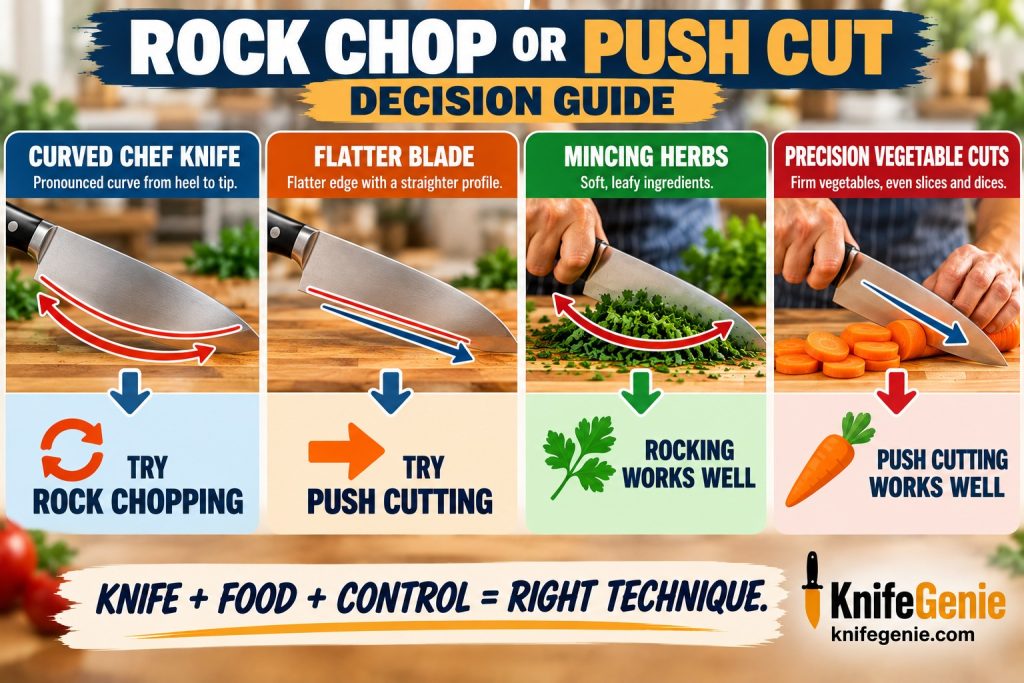
🧙 KnifeGenie Quick Rule
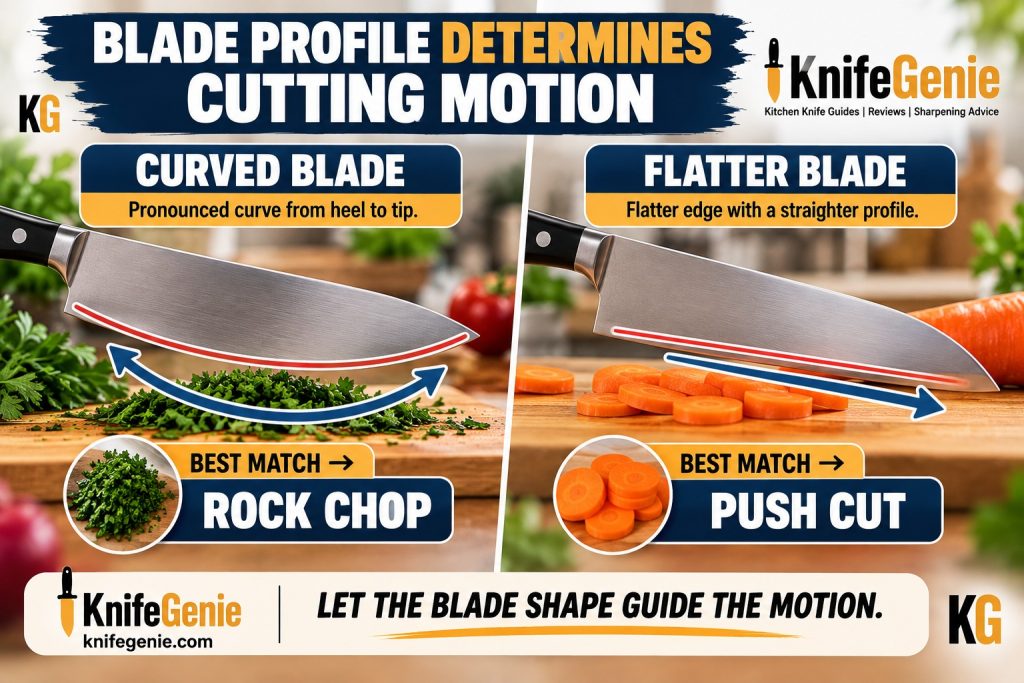
CURVED BLADE → ROCKING FEELS NATURAL
FLATTER BLADE → PUSH CUTTING FEELS NATURAL
But don’t treat that as an absolute rule. Many chef knives can perform both techniques, and the food you’re preparing matters just as much as the knife.
🧙 KnifeGenie Tip: Don’t force your knife into a cutting motion that doesn’t suit its blade profile. Let the shape of the edge help determine how the knife moves across the board.
Rock Chop vs Push Cut Overview
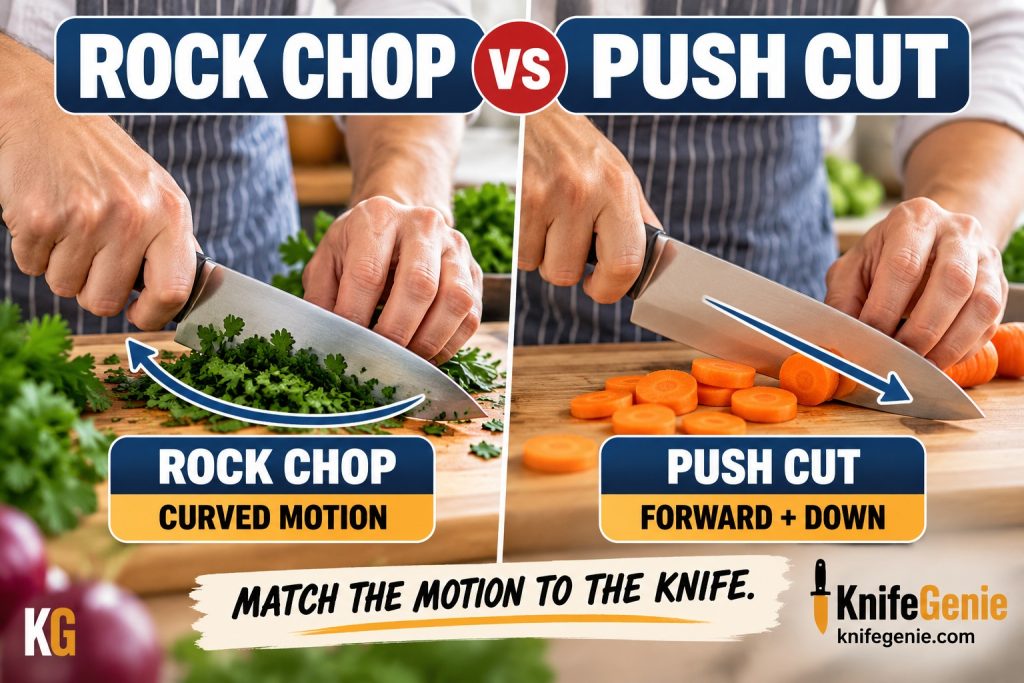
⚔️ Rock Chop vs Push Cut — Comparison
| Feature | 🔄 Rock Chop | ➡️ Push Cut |
|---|---|---|
| Main motion | Rocking/rolling | Forward and downward |
| Tip position | Often stays near board | Usually moves with blade |
| Best blade profile | Curved | Flatter |
| Common knife | Western chef knife | Santoku, gyuto, nakiri |
| Excellent for | Herbs, onions, repeated chopping | Vegetables, precise cuts |
| Guiding hand | Claw grip | Claw grip |
| Cutting feel | Flowing and rhythmic | Controlled and deliberate |
| Blade travel | Curved arc | Forward/down |
| Beginner difficulty | Relatively intuitive with curved chef knife | Requires learning blade path |
| Main mistake | Excessive rocking | Straight-down chopping |
| Key principle | Let curvature work | Slice through rather than crush |
The biggest difference isn’t simply whether the knife moves up and down.
It’s how the cutting edge travels through the ingredient.
ZWILLING’s knife guidance emphasizes that cutting involves movement through the food rather than simply pressing downward; greater slicing movement can reduce the amount of pressure required.
🔄 What Is Rock Chopping?
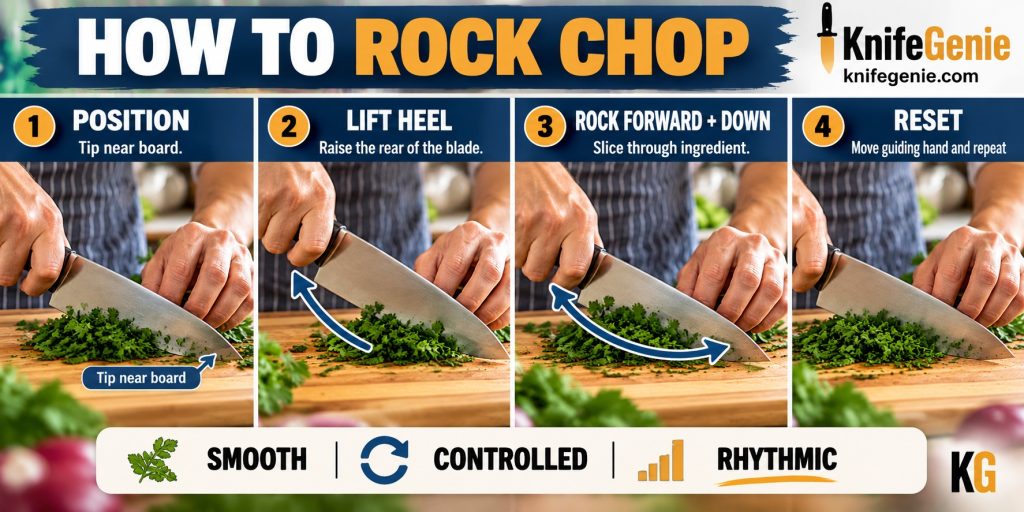
Rock chopping uses the curvature of a chef knife to create a smooth rocking motion across the cutting board.
Rather than repeatedly lifting the entire blade straight up and bringing it straight down, you allow the knife to travel through a controlled arc.
Think:
FORWARD → DOWN → ROCK → LIFT → REPEAT
The tip often remains on or close to the cutting board while the heel rises.
As the heel comes downward, the curved cutting edge progressively contacts the board.
This is why blade shape matters.
Traditional Western chef knives commonly have a noticeable curve—or belly—along the cutting edge. That curvature helps the blade move smoothly through a rocking cut, unlike WÜSTHOF German knives.
🌿 When Does Rock Chopping Work Well?
Rock chopping can be particularly useful when you’re working with:
🌿 Parsley
🌱 Cilantro
🧄 Garlic
🧅 Onions
🥬 Leafy herbs
🥕 Smaller vegetable pieces
It is particularly familiar for mincing herbs, because the knife can repeatedly travel across the ingredients while maintaining a flowing motion.
That doesn’t mean you should rock aggressively.
A controlled rock chop should feel smooth rather than violent.
If the knife is slamming against the cutting board, you’re probably using more force than necessary.
➡️ What Is Push Cutting?
Push cutting uses a noticeably different blade path.
Instead of pivoting primarily around the knife’s tip, the blade moves:
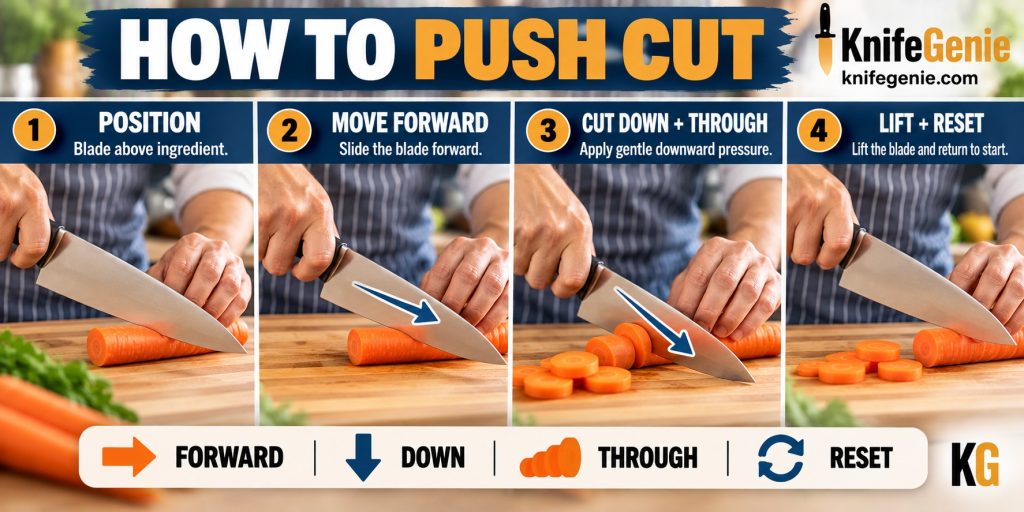
FORWARD + DOWN → THROUGH FOOD → LIFT → RESET
You’re allowing the sharp edge to slice through the ingredient as the knife moves forward.
That’s an important distinction.
A push cut isn’t simply:
UP → DOWN → UP → DOWN.
That’s closer to straight chopping.
The forward component helps the cutting edge travel through the ingredient instead of relying mainly on downward force.
Shun’s current use-and-care guidance similarly tells users to slice rather than simply chop, describing a forward-and-down cutting movement followed by a return stroke. See their PDF Shun Cutlery
🥕 When Does Push Cutting Work Well?
Push cutting is particularly useful for controlled vegetable preparation.
Examples include:
🥕 Carrots
🥒 Cucumbers
🧅 Onions
🥔 Potatoes
🫑 Peppers
🥬 Cabbage
🍠 Root vegetables
It can work especially naturally with knives that have relatively flat sections along their cutting edges.
For example, ZWILLING describes its nakiri as suitable for chopping, slicing and push cutting, while Shun notes that flatter-profile designs such as the kiritsuke naturally support push-cutting techniques.
🔪 Blade Shape Changes Everything
This is probably the most important lesson in the entire comparison.
Your knife isn’t just a sharpened piece of steel.
Its blade profile determines how the edge contacts the cutting board.
🔄 More Curved Blade
A pronounced belly allows the edge to roll progressively across the board.
That naturally supports:
ROCK → ROCK → ROCK
➡️ Flatter Blade
A flatter edge can contact more of the board simultaneously.
That naturally supports:
PUSH → LIFT → RESET
Trying to perform a large exaggerated rock with an extremely flat blade can feel awkward.
Likewise, trying to make perfectly flat vertical cuts with a highly curved chef knife can leave parts of the ingredient incompletely cut.
See our Cut an Onion With a Chef Knife guide.
🇩🇪 German vs Japanese Knives and Cutting Technique
This also helps explain something we discussed in our German vs Japanese Kitchen Knives guide.
Traditional German-style chef knives often have a relatively curved cutting edge.
That makes them particularly comfortable for:
🔄 Rock chopping
🌿 Mincing
🧅 Repetitive chopping
Many Japanese-inspired multipurpose knives have flatter portions of edge.
These can feel particularly natural for:
➡️ Push cutting
⬇️ Controlled chopping
🎯 Precision slicing
WÜSTHOF similarly distinguishes the curved profile common to Western chef knives from straighter Asian-style profiles.
But avoid turning this into:
GERMAN = ROCK
and
JAPANESE = PUSH
Modern knife designs overlap considerably.
Look at the actual blade profile, not simply the country printed on the packaging.
✋ Your Guiding Hand Doesn’t Change
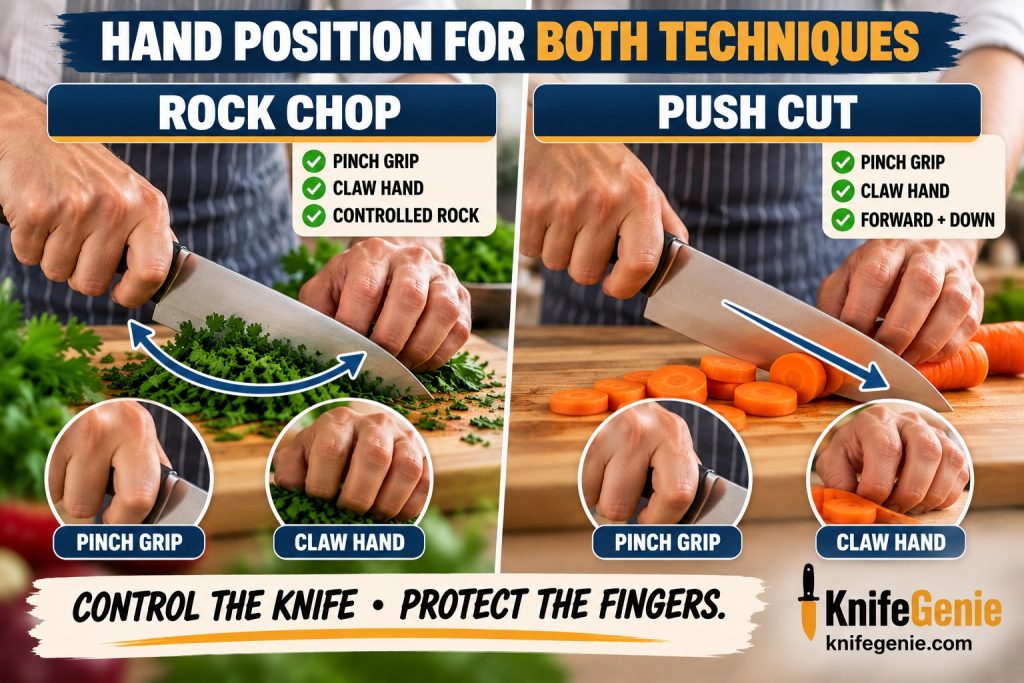
Whichever cutting motion you choose, your non-knife hand remains extremely important.
Use a proper claw grip.
Curl your fingertips backward and allow your knuckles to form a guide beside the blade.
Your fingertips should not be stretched toward the cutting line.
ZWILLING’s description of rocking technique similarly notes that the holding hand guides the blade along the curved fingers’ knuckles.
Combine that with a controlled pinch grip on the knife itself.
This gives you a simple system:
PINCH GRIP → CLAW HAND → CONTROLLED BLADE MOTION
🥬 Rock Chopping Herbs
Herbs are one of the classic uses for a rocking motion.
Place the herbs together, establish your claw grip and make controlled cuts through them.
For finer mincing, you can gather the herbs again and make additional controlled passes.
The mistake is turning this into a frantic display of speed.
Speed isn’t the objective.
Consistency is.
Your knife should remain controlled throughout the movement.
🥕 Push Cutting Vegetables
Carrots provide an excellent ingredient for practicing push cuts because their shape makes it easy to see whether your cuts are consistent.
Start slowly.
Position your claw hand.
Move the blade:
FORWARD ↘ DOWN
Then lift it enough to clear the ingredient.
Move your guiding hand slightly backward.
Repeat.
Your first goal isn’t speed.
Try to produce several pieces of approximately equal thickness.
That develops distance control, which is far more useful than trying to chop rapidly.
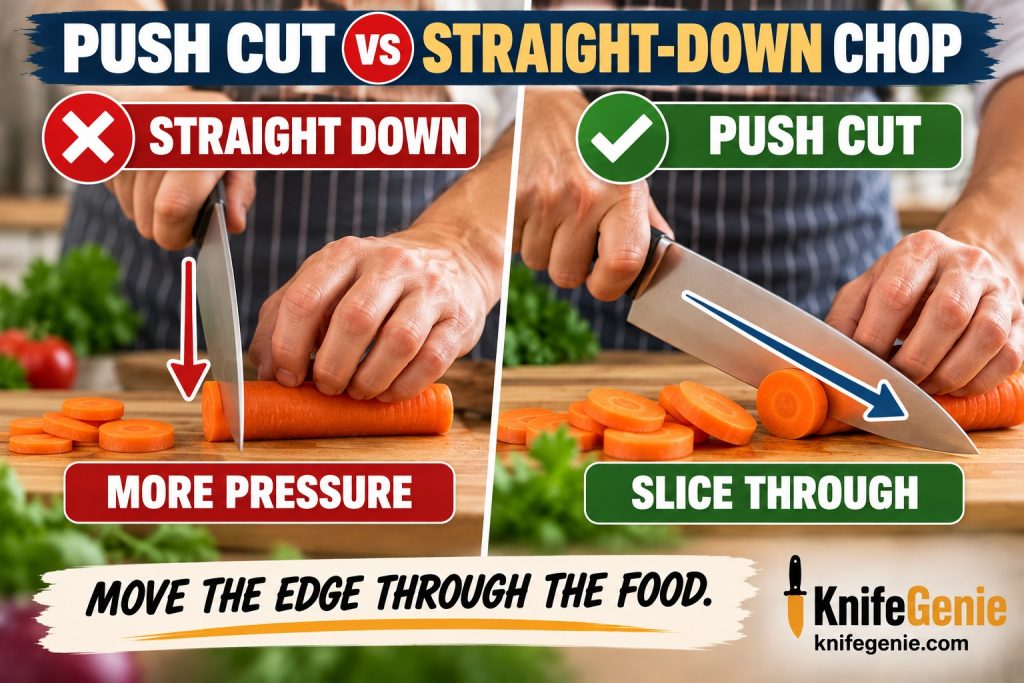
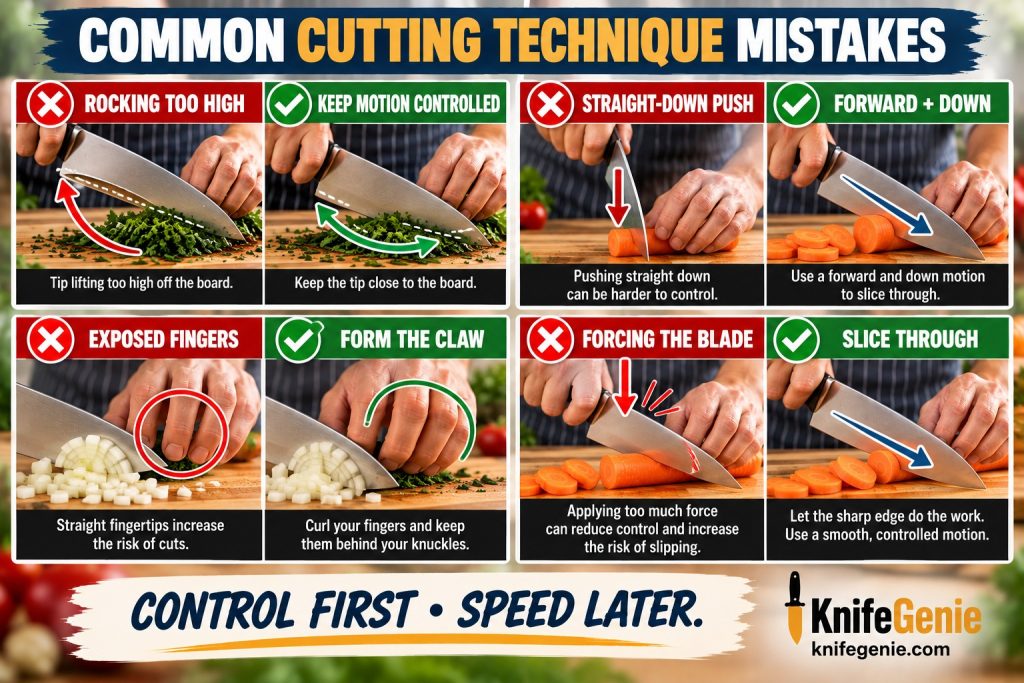
⚠️ Push Cutting Is NOT Straight-Down Chopping
This distinction deserves its own section because beginners frequently confuse the two.
❌ Straight Down
UP ↓ DOWN
The knife primarily presses through the food.
✔ Push Cut
FORWARD ↘ DOWN
The cutting edge travels through the ingredient.
A sharp knife combined with slicing movement generally requires less brute force than simply pressing downward. ZWILLING explicitly notes this relationship between cutting movement and the pressure needed.
Think:
SLICE THROUGH THE FOOD—DON’T PUNCH THROUGH IT.
⚠️ Common Rock-Chopping Mistakes
1. Rocking Too Aggressively
You don’t need huge movements.
Keep the motion controlled.
2. Raising the Knife Too High
Exaggerated movements increase unnecessary blade travel.
3. Chasing Speed
Fast knife work comes from repetition and control—not deliberately moving the blade as quickly as possible.
4. Forgetting the Claw
Never sacrifice guiding-hand position just because you’re concentrating on the knife.
5. Forcing a Flat Knife to Rock
Some knives simply aren’t designed for a pronounced rocking motion.
Use the blade profile you actually have.
Watch out and don’t force too much, or you may have issues. See Why Kitchen Knives Get Dull.
⚠️ Common Push-Cutting Mistakes
1. Chopping Straight Down
Remember:
FORWARD + DOWN
not simply:
DOWN
2. Pushing Too Far Forward
The motion doesn’t need to be enormous.
3. Twisting the Blade
Avoid lateral twisting while the edge is embedded in food, particularly with thin, hard edges.
4. Using Excessive Force
If ordinary vegetables require substantial force, investigate your knife’s sharpness and technique.
5. Cutting Too Quickly
Learn the path first.
Speed can develop naturally later.
🆚 Which Technique Should Beginners Learn First?
If you own a conventional curved Western chef knife, learning a gentle rock chop is useful.
But don’t stop there.
Push cutting teaches an important principle:
A knife cuts most effectively when the edge moves through the food.
For a beginner learning general chef-knife skills, a sensible progression is:
1️⃣ PINCH GRIP
↓
2️⃣ CLAW HAND
↓
3️⃣ CONTROLLED SLICING
↓
4️⃣ PUSH CUT
↓
5️⃣ ROCK CHOP
↓
6️⃣ PRACTICE CONSISTENCY
You don’t need to choose one technique permanently.
A capable home cook should eventually be comfortable using several cutting motions.
🧅 Can You Use Both Techniques on the Same Ingredient?
Absolutely.
Consider an onion.
You might use controlled slicing movements while making the initial cuts.
Then use push cuts when dicing.
Later, if you want a finer mince, you might use a gentle rocking motion.
The ingredient hasn’t changed.
The cutting objective has.
That’s why thinking in terms of techniques rather than one universal knife movement makes you a more adaptable cook.
🪵 Your Cutting Board Matters Too
Whichever technique you’re practicing, use a stable, knife-friendly cutting board.
Wood and appropriate plastic boards are common choices.
Avoid cutting directly on extremely hard surfaces such as:
❌ Glass
❌ Stone countertops
❌ Ceramic plates
❌ Metal surfaces
Hard surfaces can be unnecessarily harsh on the cutting edge. WÜSTHOF specifically advises avoiding surfaces including metal and glass, while Shun likewise warns against glass, marble, granite, ceramic and similar hard surfaces.
Your board also shouldn’t slide.
If necessary, stabilize it before beginning.
👉 Related KnifeGenie guide: Best Cutting Board for Kitchen Knives: Wood vs Plastic
🧙 KnifeGenie Technique Tips
🔪 Match the motion to your blade. A curved chef knife invites rocking; flatter edges often favor push cutting.
✋ Master your hands before chasing speed. Build a reliable pinch grip and claw hand first.
🥕 Practice on predictable vegetables. Carrots, cucumbers and similar produce make it easy to judge cut consistency.
🪵 Stabilize the board. A moving cutting board undermines otherwise good technique.
⚔️ Let the edge cut. Excessive pressure is usually a warning that something needs attention.
🐢 Practice slowly. Deliberate repetitions build control better than trying to imitate a professional cook’s speed.
🔄 Learn both techniques. The goal isn’t to become a “rock chopper” or “push cutter.” It’s to select an appropriate motion for the knife and task.
❓ Frequently Asked Questions
Is rock chopping better than push cutting?
Neither is universally better.
Rock chopping works naturally with curved chef knives and is particularly useful for repetitive chopping and mincing. Push cutting works especially well with flatter blade profiles and controlled vegetable preparation.
Learning both gives you more flexibility.
What is the difference between rock chopping and push cutting?
Rock chopping moves a curved knife through an arc, often keeping the tip close to the cutting board.
Push cutting moves the blade forward and downward through the ingredient before lifting and resetting it.
Is push cutting the same as chopping straight down?
No.
A proper push cut includes forward movement so the edge slices through the ingredient.
Straight-down chopping relies much more heavily on vertical movement.
What knife is best for rock chopping?
A chef knife with a curved belly is particularly well suited to rocking.
Traditional Western chef knives commonly use this type of profile.
What knife is best for push cutting?
Knives with relatively flat cutting edges—including many Santoku, nakiri and Japanese-inspired chef-knife designs—can work particularly well for push cutting.
Blade design varies, however, so examine the actual knife rather than relying entirely on its name or country of origin.
Can you rock chop with a Japanese knife?
Sometimes.
“Japanese knife” describes a huge range of blade shapes and constructions.
Some have enough curvature to accommodate gentle rocking; others are much flatter.
Follow the manufacturer’s guidance for the particular knife and avoid aggressive rocking or lateral twisting with thin, hard edges.
Should the knife leave the cutting board when rock chopping?
The tip commonly remains on or close to the board while the heel rises and falls.
The exact movement depends on the knife’s profile and the food you’re preparing.
Is rock chopping safe for beginners?
It can be when performed slowly with a stable cutting board, controlled knife grip and proper claw hand.
Beginners should prioritize control and consistent hand position rather than speed.
🏆 Rock Chop vs Push Cut: Final Takeaway
Rock chopping and push cutting aren’t competing techniques.
They’re different tools in your knife-skills toolbox.
🔄 ROCK CHOP
Works naturally with:
✔ Curved chef knives
✔ Herbs
✔ Repetitive chopping
✔ Mincing
✔ Flowing cutting motions
➡️ PUSH CUT
Works naturally with:
✔ Flatter blade profiles
✔ Vegetable preparation
✔ Precision cuts
✔ Santoku and nakiri-style knives
✔ Controlled forward slicing
The most useful lesson is simple:
🧙 KnifeGenie Rule: Let the knife, ingredient and cut determine the technique—not habit alone.
Once you can comfortably use a pinch grip, protect your guiding hand with the claw, and switch between rocking, push cutting and controlled slicing, you’re developing the foundation of genuinely useful chef-knife technique.
Now see our guides to take you a step further: How to Use a Chef Knife: Beginner’s Guide to Cutting Safely and How to Use a Pinch Grip.