
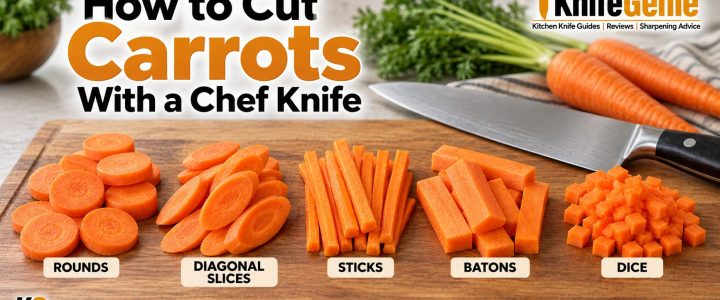
This guide teaches how to cut carrots with a chef knife. Carrots are among the most useful vegetables for practising chef knife cuts. They’re affordable, widely available, and suitable for learning everything from simple rounds to evenly sized dice.
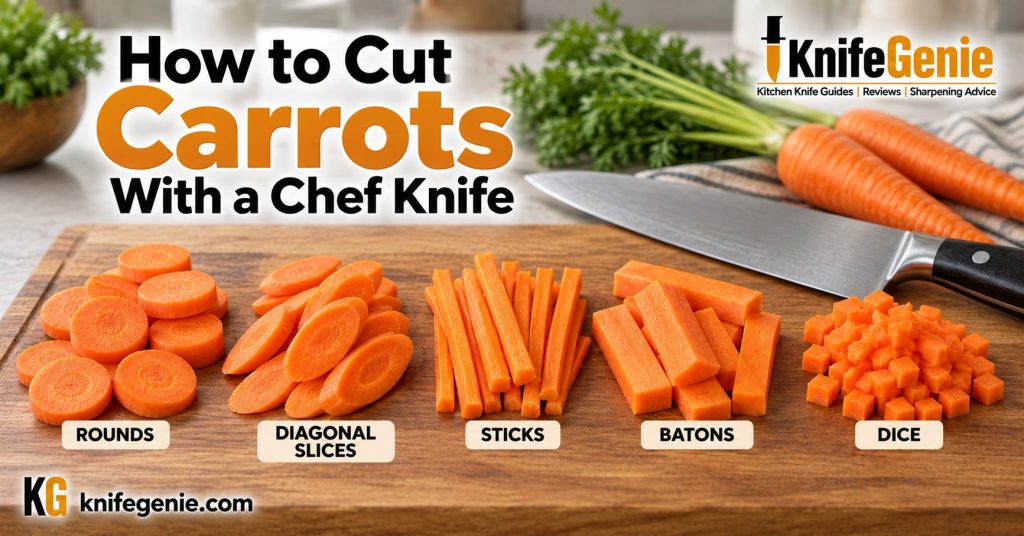
However, their firm texture and rounded shape can make them surprisingly difficult to control, particularly when you’re still learning how to hold a knife correctly.
The good news is that cutting carrots becomes much easier once you understand three basic principles: keep the carrot stable, protect your guiding hand, and use a controlled cutting motion.
In this guide, you’ll learn how to prepare carrots, make five useful cuts, and improve your accuracy with a chef knife. We’ll also explain the claw grip for beginners and show how to practise consistent push cuts.
Whether you’re preparing carrots for soup, stir-fry, salads, or roasted vegetables, these techniques will help you work more safely and confidently.
 Jump to
👉 Set Up a Safe Cutting Surface
👉 Practise Consistent Push Cuts
👉 Common Mistakes and Safety Tips
🥕 Quick Answer: How Do You Cut Carrots With a Chef Knife?
To cut carrots safely with a chef knife, wash them thoroughly, trim the ends, and peel them if desired. Place the carrot on a stable cutting board and, where necessary, cut a small flat surface along one side to prevent rolling.
Hold the knife using a comfortable, controlled grip, keep your guiding fingertips tucked into a claw grip, and cut using smooth, deliberate strokes.
The five most useful carrot cuts are:
-
Rounds: Circular slices for soups, steaming, and everyday cooking.
-
Diagonal slices: Angled pieces with a larger surface area, useful for roasting and stir-frying.
-
Sticks: Narrow strips for snacks, salads, and vegetable platters.
-
Batons: Thicker, regularly shaped pieces for roasting and other cooked dishes.
-
Dice: Small cubes or cube-like pieces for soups, stews, and mixed vegetables.
For beginners, start with rounds made from short, stable carrot sections. Once you can control the knife comfortably, progress to sticks, batons, and dice.
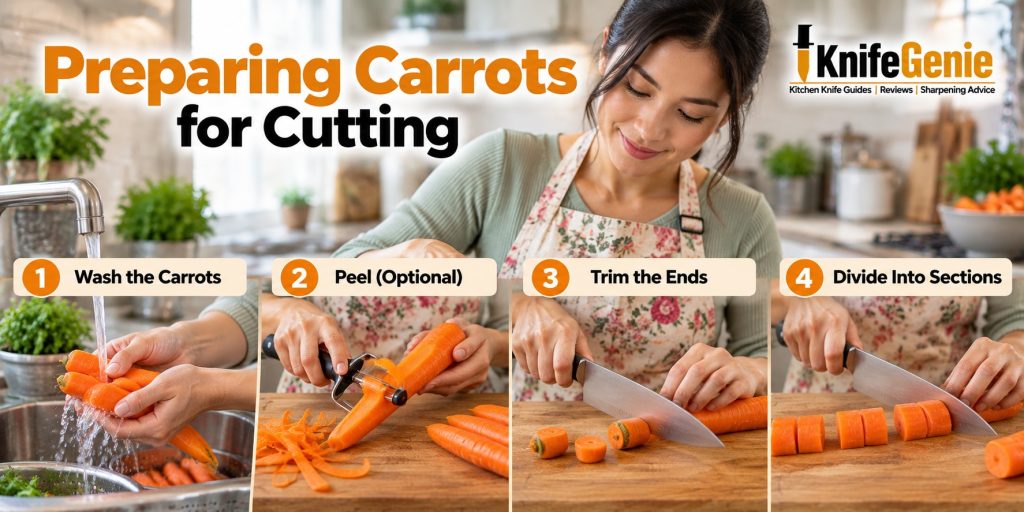
🥕 How to Wash and Prepare Carrots Before Cutting
Proper preparation makes carrots easier to handle and helps keep dirt away from your cutting board and knife.
Step 1: Wash the Carrots
Rinse whole carrots under cool running water. Rub the surface with your hands or use a clean vegetable brush to remove visible dirt.
Pay particular attention to grooves and irregular areas where soil can collect.
You do not need soap or detergent. Running water and gentle scrubbing are sufficient for routine cleaning.
Step 2: Peel if Necessary
Peeling carrots is optional.
Young carrots with thin, clean skins can usually be cooked with the peel intact. Older carrots may have tougher or slightly bitter skin, so peeling can improve their texture and appearance.
If peeling, use a vegetable peeler rather than trying to remove the skin with a large chef knife.
Step 3: Trim the Ends
Place the carrot on your cutting board and remove the stem end with a controlled cut. Trim the narrow tip if needed.
For long carrots, cut them crosswise into shorter sections before attempting more detailed cuts.
Sections around 2–3 inches long are often easier for beginners to control, particularly when making sticks or dice.
Step 4: Check the Carrot’s Shape
Carrots vary in thickness, taper, and curvature.
A straight carrot is generally easier to cut into uniform pieces than a heavily curved one. If the carrot has an awkward bend, divide it into shorter sections before proceeding.
See FDA — Selecting and Serving Produce Safely for washing fresh carrots and safe produce handling.
🔪 How to Create a Stable Cutting Surface
One of the biggest challenges when cutting carrots is their tendency to roll.
Unlike vegetables with naturally flat sides, a whole carrot can move unexpectedly as the knife presses against it.
Keep Your Cutting Board Secure
Start with a clean, sturdy cutting board placed on a level countertop.
If the board slides, use a damp, flat kitchen towel or a nonslip mat underneath it. The board should remain firmly in place when you apply light pressure.
Avoid cutting carrots on plates, loose trays, or unstable surfaces.
Create a Flat Side on the Carrot
For a thick carrot, you can carefully remove a thin lengthwise slice from one side to create a flat base.
A safer method for beginners is to divide the carrot into short sections first, stand a section securely on a trimmed end if appropriate, and make a controlled lengthwise cut to create two halves.
Place each half cut-side down before continuing.
This helps prevent rolling and provides a stable surface for making sticks or batons.
For thin carrots, cutting crosswise into rounds while keeping the carrot securely controlled may be more practical than trying to shave off a narrow flat strip.
KnifeGenie tip: Never try to stop a rolling carrot by placing your fingertips in front of the blade. Reposition the carrot and establish a stable cutting surface before continuing.
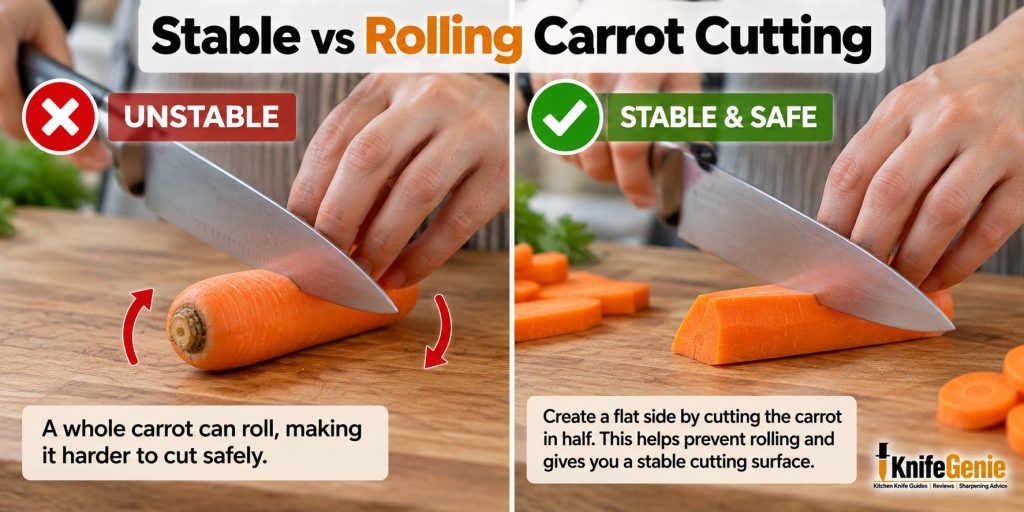
A flat surface helps prevent carrots from rolling.
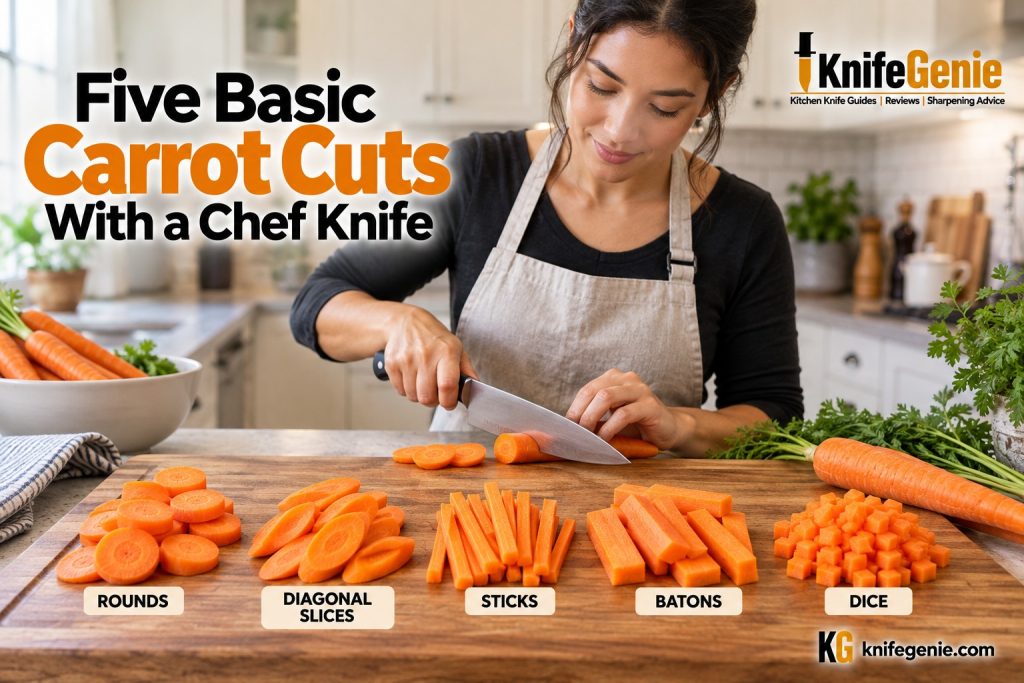
🥕 Five Ways to Cut Carrots With a Chef Knife
Different carrot cuts are useful for different recipes. The goal is not necessarily to produce professional restaurant-style shapes, but to make pieces that are easy to cook and reasonably consistent in size.
1. How to Cut Carrots Into Rounds
BEST FOR: SOUPS, STEAMING, BOILING, EVERYDAY COOKING
Rounds are one of the simplest carrot cuts and an excellent starting point for beginners.
-
Place a washed, trimmed carrot on a stable cutting board.
-
Hold the carrot securely with your guiding hand, keeping fingertips tucked away from the blade.
-
Position your chef knife across the carrot at a right angle to its length.
-
Cut downward and slightly forward in one controlled slicing motion.
-
Move along the carrot, maintaining approximately the same thickness.
For general cooking, rounds around ¼ inch (6 mm) thick are a practical starting point.
Thinner rounds cook faster, while thicker rounds generally take longer to soften.
As the carrot becomes shorter, stop and reposition it rather than forcing the final cuts close to your fingertips.
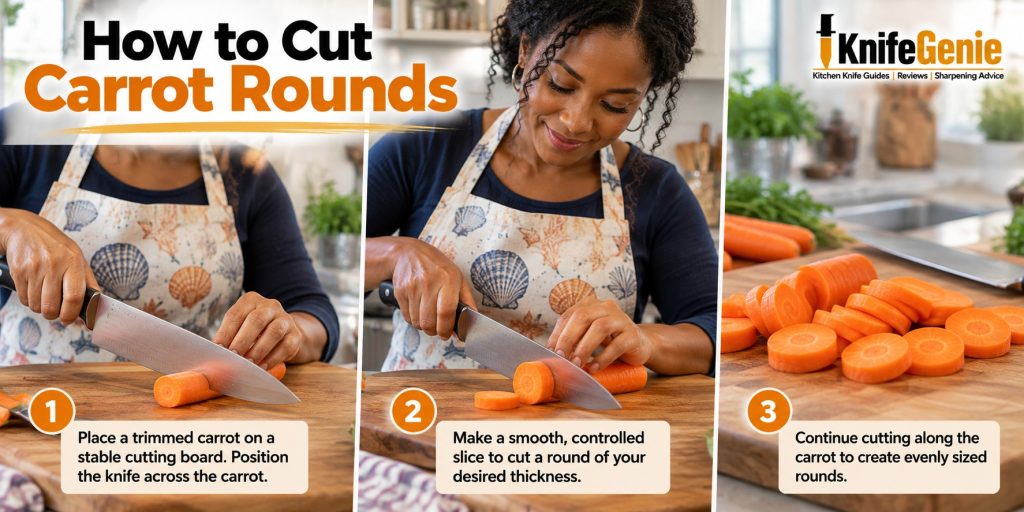
Cut across the carrot to produce rounds of similar thickness.
2. How to Cut Carrots Into Diagonal Slices
BEST FOR: STIR-FRIES, ROASTING, GLAZED CARROTS
Diagonal slices are made by cutting across the carrot at an angle instead of straight across.
They produce attractive oval-shaped pieces with a larger cut surface than similarly thick straight rounds.
-
Place the carrot securely on your cutting board.
-
Position the blade at approximately a 45-degree angle across the carrot.
-
Make a smooth, controlled slice.
-
Move along the carrot while keeping the cutting angle consistent.
-
Aim for similar thicknesses so the pieces cook at approximately the same rate.
You can adjust the angle to produce longer or shorter oval slices.
Avoid making some slices extremely thin and others very thick, especially when preparing carrots for a quick stir-fry.
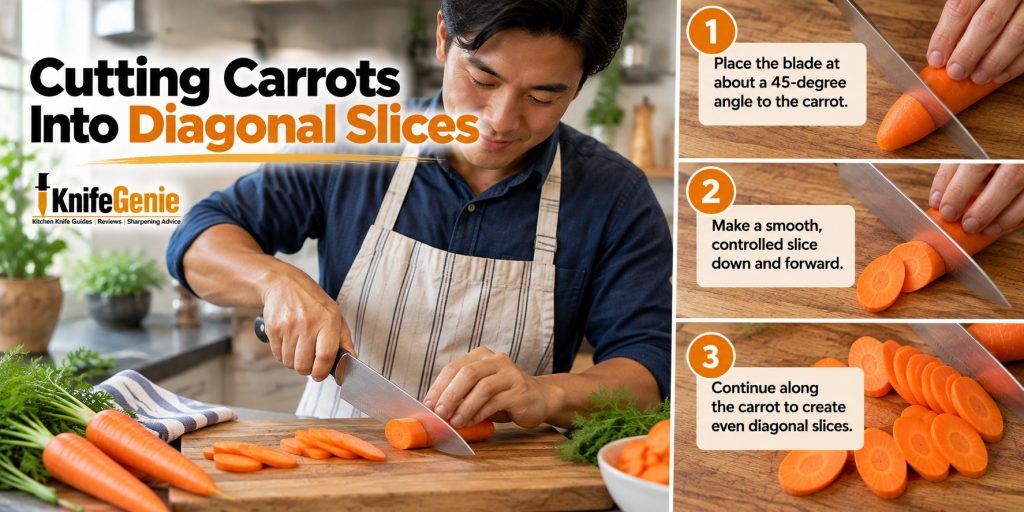
Angled cuts create attractive diagonal carrot slices.
3. How to Cut Carrots Into Sticks
BEST FOR: SNACKS, DIPS, SALADS, VEGETABLE PLATTERS
Carrot sticks are narrow, elongated pieces that are easy to serve raw or use in recipes.
-
Cut the carrot into sections approximately 2–3 inches long.
-
Carefully split each section lengthwise to create a flat surface.
-
Place the flat side against the cutting board.
-
Cut the section lengthwise into several flat slices.
-
Stack only a few stable slices at a time, then cut them lengthwise into sticks.
For snack-style carrot sticks, aim for a thickness around ¼ inch (6 mm), adjusting to your preference.
Do not stack so many slices that they slide or become difficult to control.
Carrot sticks do not need to be perfectly square, particularly when preparing them for dipping.
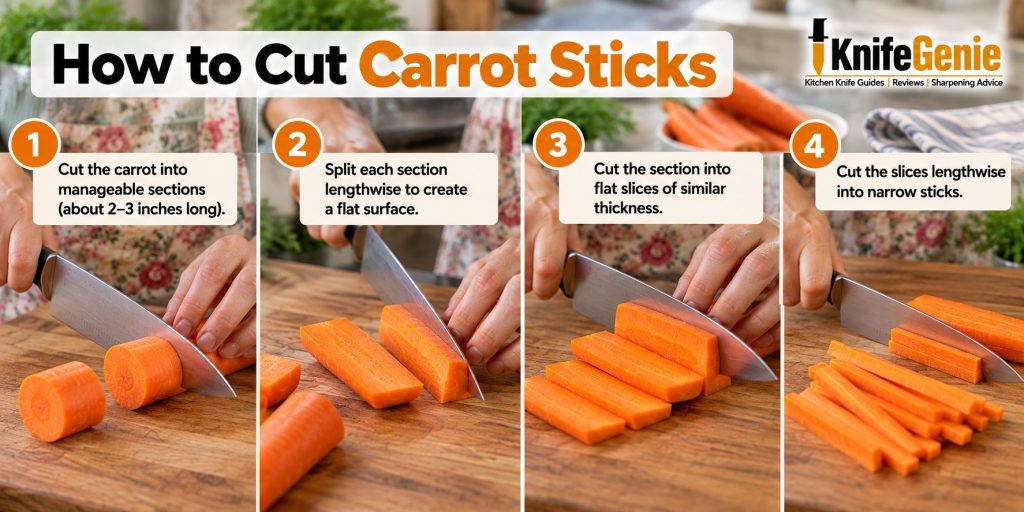
Cut stable carrot sections lengthwise to make sticks.
4. How to Cut Carrots Into Batons
BEST FOR: ROASTING, VEGETABLE SIDES, STEWS
Batons are thicker, more regularly shaped sticks. The term is sometimes used loosely in home cooking, although professional kitchens may use more precise dimensions.
-
Cut the carrot into manageable sections, around 2–3 inches long.
-
Create a stable flat surface on each section.
-
Cut lengthwise into relatively thick slabs.
-
Cut the slabs into rectangular sticks of similar thickness.
-
Arrange the pieces together and check that they are reasonably uniform.
For home cooking, batons around ⅜–½ inch (10–12 mm) thick are useful for many roasted vegetable dishes.
Thicker batons usually retain more texture during cooking than very thin carrot sticks.
The most important consideration is consistency rather than achieving an exact culinary-school measurement.
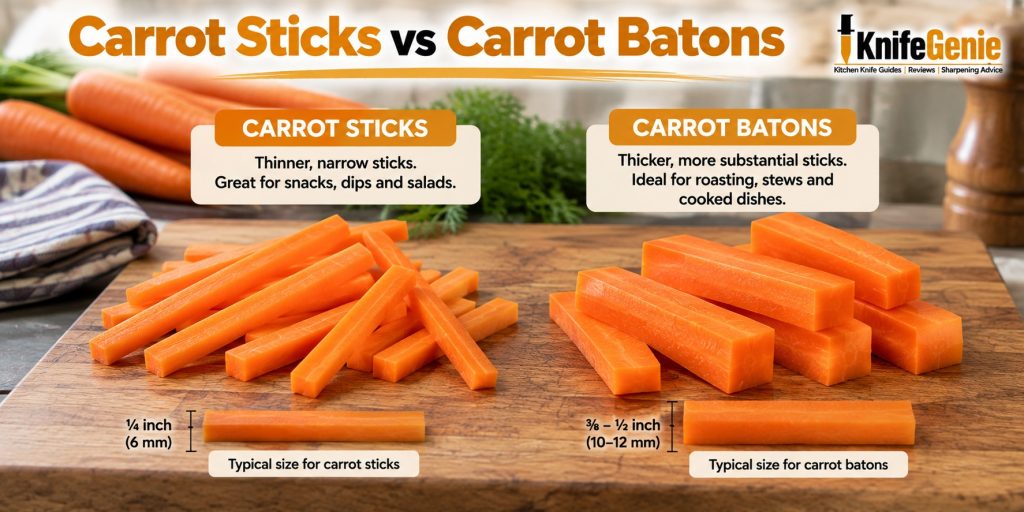
Batons are generally thicker than snack-style carrot sticks.
5. How to Dice Carrots Into Even Pieces
BEST FOR: SOUPS, STEWS, SAUCES, VEGETABLE MIXTURES
Dicing carrots means cutting them into small cube-like pieces.
The easiest approach is to begin with lengthwise sticks, then cut those sticks crosswise.
-
Wash, trim, and divide the carrot into shorter sections.
-
Create a stable flat side and place it against the board.
-
Cut the carrot lengthwise into slabs of approximately equal thickness.
-
Cut the slabs into sticks of similar width.
-
Gather a small number of sticks together, keeping them stable.
-
Cut crosswise at regular intervals to produce diced carrot pieces.
For many soups and stews, dice around ¼ inch (6 mm) are practical.
Larger dice work well in slow-cooked dishes, while smaller pieces are useful when you want carrots to soften quickly or blend into a vegetable mixture.
Because carrots naturally taper, some pieces will be slightly irregular. Aim for approximately even sizes rather than forcing every piece into a perfect cube.
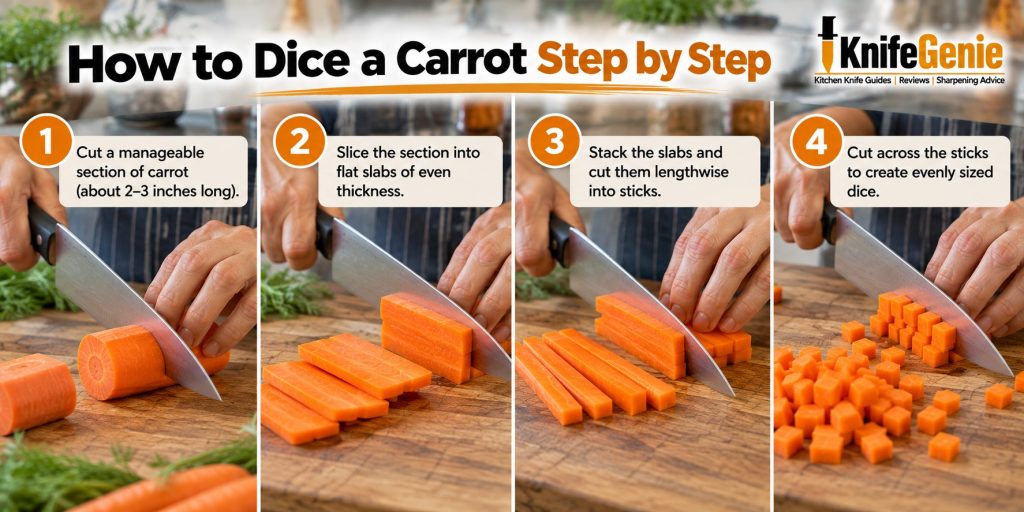
Create carrot dice by cutting evenly sized sticks crosswise.
✋ How Beginners Can Use the Claw Grip When Cutting Carrots
The claw grip is one of the most important knife skills to learn because it helps keep your fingertips away from the cutting edge.
It is particularly useful when cutting firm vegetables such as carrots, where maintaining control is essential.
Step 1: Curl Your Guiding Fingers
Place your non-knife hand on the carrot.
Curl your fingertips inward so they are tucked behind your knuckles, rather than pointing toward the blade.
Keep your thumb behind your fingers and away from the cutting path.
Step 2: Stabilize the Carrot
Use your curled fingers to hold the carrot gently but securely.
Your hand should be relaxed enough to move naturally without allowing the carrot to roll.
When possible, work with a carrot section that has already been placed on a flat side.
Step 3: Use Your Knuckles as a Guide
Position the side of the blade beside your leading knuckles, keeping the cutting edge away from your fingertips.
Your knuckles can help you judge where the next cut should fall, but they should not be used to push against the sharp edge.
Step 4: Move Your Guiding Hand Gradually
After each cut, reposition your guiding hand slightly farther back along the carrot.
Maintain the curled position throughout the process.
Do not straighten your fingers between cuts or reach toward the blade to reposition a small piece of carrot.
Step 5: Stop When the Carrot Gets Too Short
The claw grip becomes more difficult as the carrot gets smaller.
Rather than attempting a final cut with your fingertips close to the blade, stop, reposition the remaining piece safely, or leave it for another use.
For a more detailed explanation, see our How to Use the Claw Grip With a Chef Knife guide.
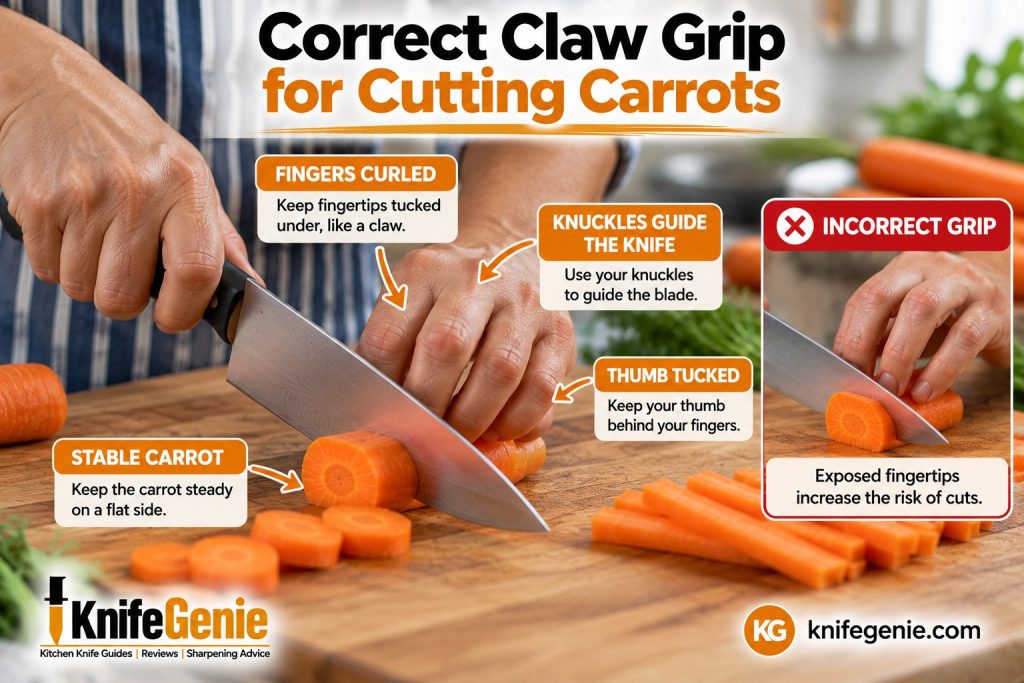
Keep your fingertips tucked behind your knuckles.
➡️ How to Practise Consistent Push Cuts With Carrots
Once you can maintain a safe guiding-hand position, carrots are a useful ingredient for practising push cuts.
A push cut combines forward and downward movement, allowing the cutting edge to travel through the vegetable rather than relying entirely on downward pressure.
Understand the Push-Cutting Motion
A push cut generally follows this movement:
PUSH CUT
Forward + downward slicing
STRAIGHT-DOWN CUT
Mostly downward pressure
A push cut does not require an exaggerated forward movement. A short, controlled slicing action is enough.
A Simple Push-Cutting Practice Exercise
-
Select a straight, medium-sized carrot and cut it into a manageable section.
-
Place the carrot securely on the cutting board, creating a flat side if necessary.
-
Establish your claw grip with the guiding hand.
-
Position the chef knife for a crosswise cut.
-
Move the blade slightly forward and downward through the carrot.
-
Lift the blade clear, reposition your guiding hand, and repeat.
Try to produce five slices of approximately the same thickness.
Examine the pieces before continuing.
Are some slices noticeably thicker than others? Are the cuts angled unintentionally? Is the carrot shifting as you cut?
These observations help you improve your technique.
Improve Consistency Before Speed
Once your first five slices look reasonably even, try another set.
Keep your movements deliberate and pay attention to the distance between each cut.
With practice, you can gradually make thinner or thicker slices while maintaining consistency.
The aim is not to imitate the speed of a professional chef. It is to develop a controlled, repeatable movement.
For a detailed comparison of blade movements, read Rock Chop vs Push Cut: Which Knife Technique Is Better?. The guide also explains why push cutting differs from simply pressing the knife straight down.
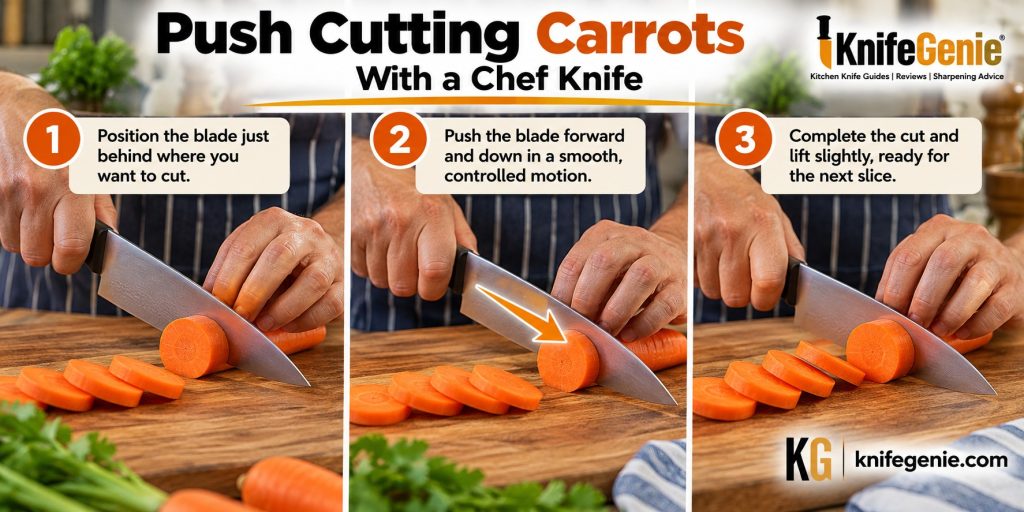
Push cuts combine forward and downward blade movement.
📏 How to Make Carrot Pieces More Uniform
Uniform cutting is useful for more than appearance.
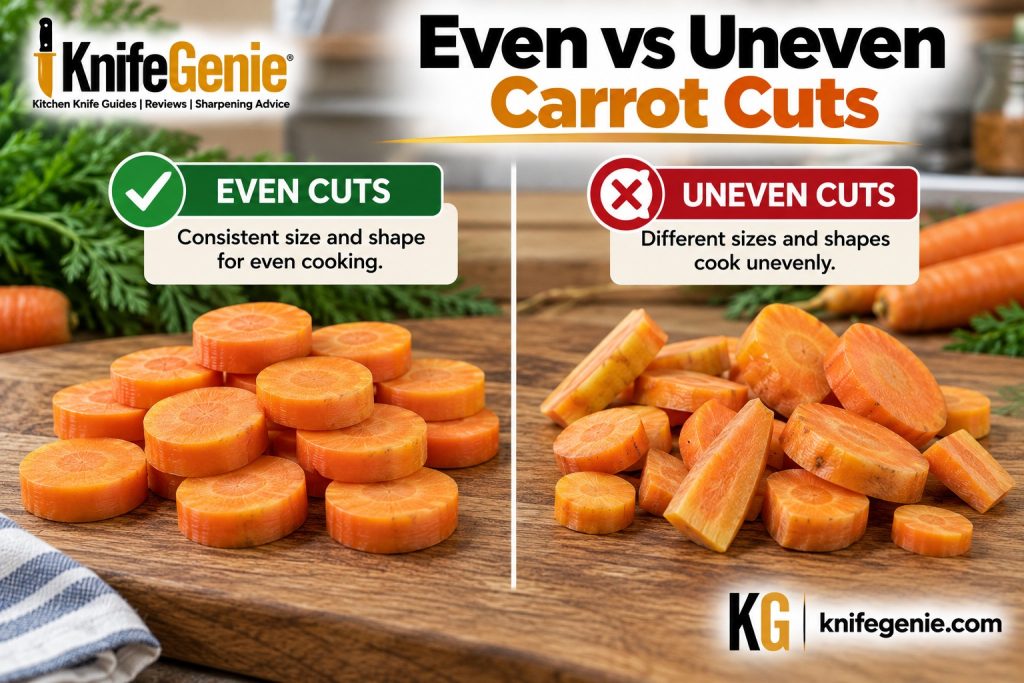
When carrot pieces have similar thicknesses and dimensions, they tend to cook at more similar rates.
For example, a thin carrot round may become soft while a much thicker piece remains firm.
You can improve consistency by following a few practical habits.
Choose a Target Thickness
Before cutting, decide approximately how thick you want the pieces.
For ordinary home cooking, the following dimensions provide useful starting points.
| Carrot cut | Approximate size | Common use |
|---|---|---|
| Rounds | ¼ inch thick | Soups, steaming |
| Diagonal slices | ¼ inch thick | Stir-frying |
| Sticks | ¼ inch wide | Dips, snacks |
| Batons | ⅜–½ inch thick | Roasting |
| Small dice | ¼ inch cubes | Soups, sauces |
These are practical home-cooking guidelines, not strict professional knife-cut standards.
Separate Thick and Thin Sections
A carrot is usually wider near the stem and narrower toward the tip.
If you want pieces of similar size, divide the carrot into thick and thin sections before cutting.
You can then adjust the cuts to account for the difference in diameter.
Avoid Cutting Too Many Pieces at Once
Stacking several carrot slabs may seem efficient, but unstable stacks can shift under the blade.
Start with one or two flat layers until you can control the cutting motion confidently.
Check Your Work Occasionally
After cutting several pieces, stop and compare them.
You do not need to measure every slice with a ruler. Visual consistency is sufficient for most home recipes.
Check ZWILLING for manufacturer knife-care and cutting guidance.
⚠️ Common Mistakes When Cutting Carrots
Even experienced home cooks can make mistakes when preparing firm vegetables. Most problems come from poor stability, inappropriate pressure, or rushing.
❌ 1. Cutting a Carrot That Keeps Rolling
Problem: The carrot shifts as the knife touches it.
Correction: Divide the carrot into manageable sections and create a flat surface when needed. Never continue cutting an ingredient that you cannot stabilize.
❌ 2. Using Too Much Force
Problem: The knife feels difficult to push through the carrot.
Correction: Use a sharp, appropriate knife and a controlled slicing movement. Avoid forcing the blade or twisting it while embedded in the carrot.
If cutting becomes noticeably difficult, check whether your knife needs maintenance. Our guide to why kitchen knives get dull so quickly explains common causes of poor cutting performance.
❌ 3. Leaving Fingertips Exposed
Problem: The guiding fingers extend toward the blade.
Correction: Curl your fingertips behind your knuckles and keep your thumb away from the cutting path.
❌ 4. Making Uneven Cuts
Problem: Some carrot pieces are much thicker than others.
Correction: Slow down and establish a consistent distance between cuts. Work with shorter carrot sections when necessary.
❌ 5. Trying to Cut Too Quickly
Problem: The knife moves faster than the guiding hand can safely reposition.
Correction: Practise deliberate cuts first. Speed should never come at the expense of control.
❌ 6. Trying to Cut the Very Last Piece
Problem: The remaining carrot is too short to hold securely.
Correction: Stop before your fingers approach the cutting edge. Reposition the piece safely or set it aside.
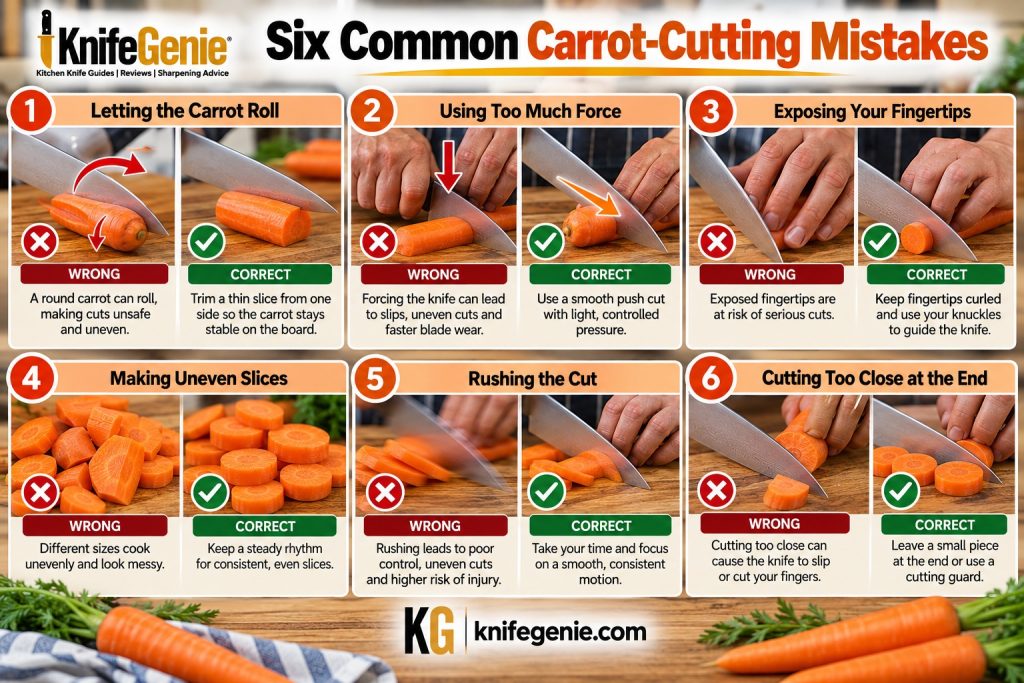
Avoid rolling carrots, exposed fingers, and excessive force.
🛡️ Carrot-Cutting Safety Checklist
Before you start cutting, check that your workspace and technique are suitable.
-
✔ Your cutting board is stable and does not slide.
-
✔ Your chef knife is sharp, clean, and comfortable to control.
-
✔ Your carrot has been washed and trimmed.
-
✔ Long or awkwardly shaped carrots have been divided into manageable sections.
-
✔ Your guiding fingertips and thumb are tucked away from the blade.
-
✔ You are using controlled slicing movements rather than excessive force.
-
✔ You stop cutting whenever the carrot becomes difficult to hold securely.
-
✔ You keep your work area clear of loose scraps.
A sharp knife is helpful, but good knife skills also depend on hand positioning, board stability, and controlled movements.
If you’re new to using a chef knife, our How to Use a Chef Knife guide covers the broader fundamentals of safe cutting.
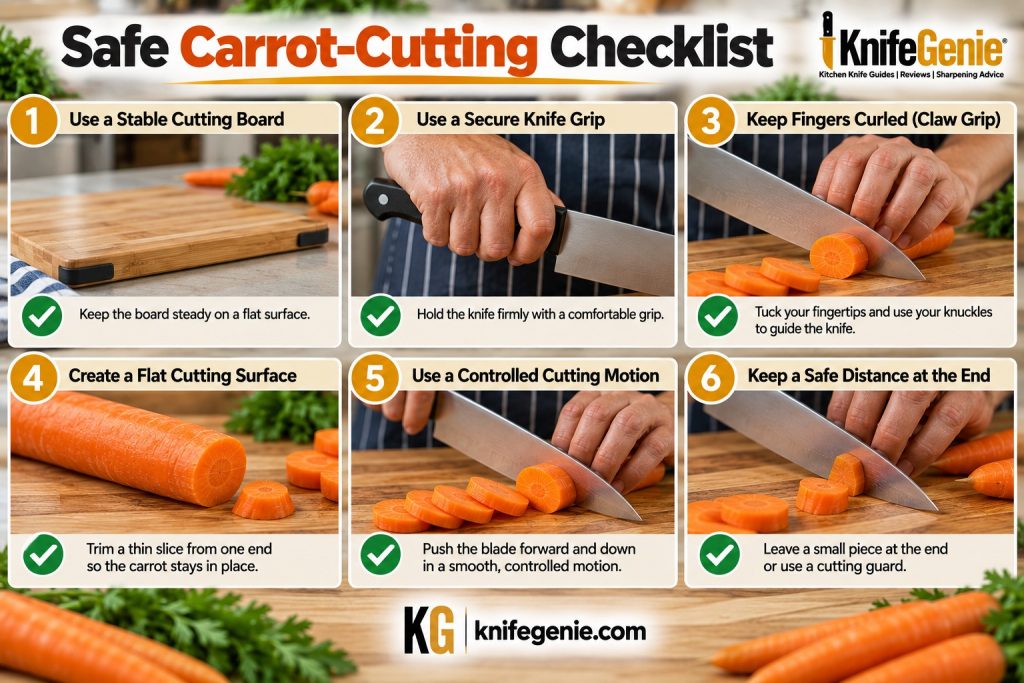
Check your board, grip, and carrot stability before cutting.
❓ Frequently Asked Questions
What Is the Easiest Way to Cut Carrots for Beginners?
Start by cutting a washed, trimmed carrot into rounds. Use a stable cutting board, keep your fingertips tucked, and make slow, controlled slices. Once you’re comfortable, move on to diagonal slices, sticks, and dice.
Should You Peel Carrots Before Cutting Them?
Not necessarily. Carrot skins are edible, and thoroughly washed carrots can often be prepared without peeling. Peeling is a matter of preference, appearance, and texture.
What Size Chef Knife Is Best for Cutting Carrots?
An 8-inch chef knife is a versatile choice for many home cooks, but a smaller knife may feel easier to control for some people. The most important factors are comfort, sharpness, and a secure grip.
Why Do Carrots Sometimes Crack or Split When Cutting?
Carrots can split because of their firm texture, the shape and thickness of the blade, or excessive downward pressure. A dull edge can make the problem worse. Use a sharp knife and controlled slicing movement rather than forcing the blade.
Is It Better to Rock Chop or Push Cut Carrots?
Both techniques can work, depending on the knife and the desired cut. Push cutting is particularly useful for practising deliberate, consistent vegetable slices, while a gentle rocking motion may feel natural with a curved Western chef knife.
How Do You Dice Carrots Without Making Uneven Pieces?
Cut the carrot into short sections, create stable flat surfaces, slice the sections into slabs, cut the slabs into sticks, and finally cut the sticks crosswise. Keeping the slabs and sticks similar in thickness makes the finished dice more uniform.
Can You Cut Carrots With a Santoku Knife?
Yes. A Santoku is suitable for many carrot-cutting tasks, including rounds, sticks, and dice. Its blade profile often works well with controlled slicing and push-cutting motions.
🧙 KnifeGenie Final Takeaway
Learning how to cut carrots with a chef knife is about more than preparing a vegetable. It is an opportunity to develop several useful kitchen skills at the same time.
Start with the basics: wash and trim the carrot, stabilize your cutting board, and make sure the vegetable cannot roll unexpectedly.
Practise rounds first, then progress to diagonal slices, sticks, batons, and dice.
As your confidence improves, concentrate on keeping your guiding hand in a safe claw position and developing a smooth, repeatable cutting motion.
Remember the KnifeGenie rule:
STABLE CARROT → SAFE HAND POSITION → CONTROLLED CUT → CONSISTENT PIECES
These habits will help you prepare carrots more confidently and transfer the same techniques to many other vegetables.
For your next knife-skills exercise, try our How to Cut an Onion With a Chef Knife guide.
Editorial note: This guide is based on established culinary knife-skills principles, food preparation guidance, and research into safe cutting techniques. It is not presented as a personal test or hands-on review of any particular knife or product.