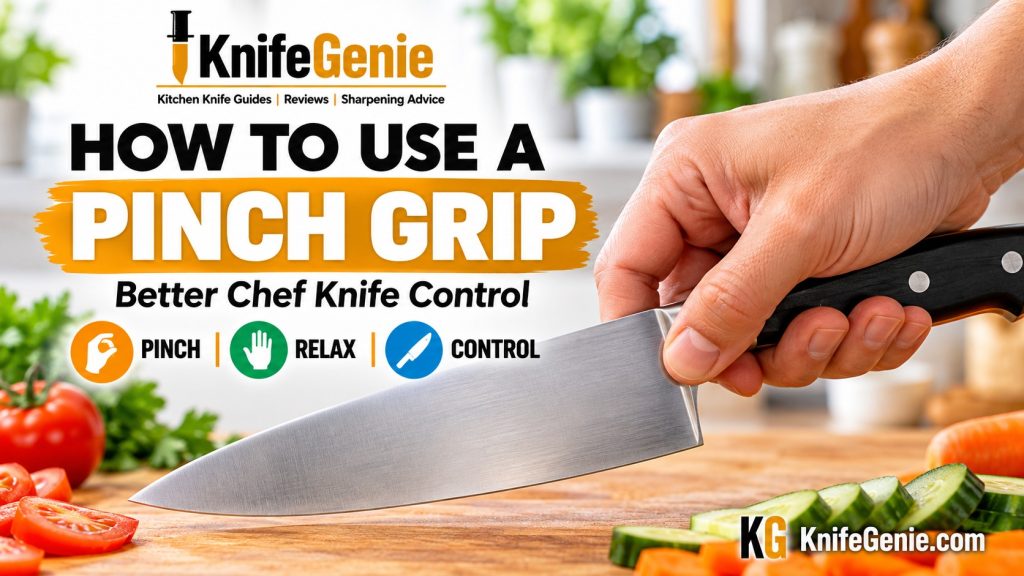
Learn how to position your thumb, index finger and remaining fingers for a controlled chef-knife pinch grip.Learning how to use a pinch grip with a chef knife is one of the simplest ways to improve your control in the kitchen.
Instead of holding the knife entirely by its handle, the pinch grip moves your thumb and index finger forward so they lightly grip the blade near the handle.
It may feel unusual at first.
But once the position becomes familiar, the knife can feel less like something you’re holding at the end of a handle and more like an extension of your hand.
The important part is that pinch doesn’t mean squeeze.
You want a secure, relaxed grip that helps you guide the blade—not a white-knuckle hold that makes your hand tense.
This guide explains exactly where your fingers should go, how tightly to hold the knife, the mistakes beginners commonly make, and how to practise the pinch grip safely.
🧙 KnifeGenie Note: This guide is based on research into commonly taught chef-knife handling techniques and published culinary guidance. It isn’t based on personal testing of a particular knife or product. Grip preferences can vary according to the knife, task, hand size and individual comfort. According to Doczz.net, Culinary guidance also recognizes that the most suitable grip can depend partly on the cutting task.
 Jump-to Anchor Links
❓ FAQs
🤏 Pinch Grip: The Quick Answer
To use a pinch grip with a chef knife:
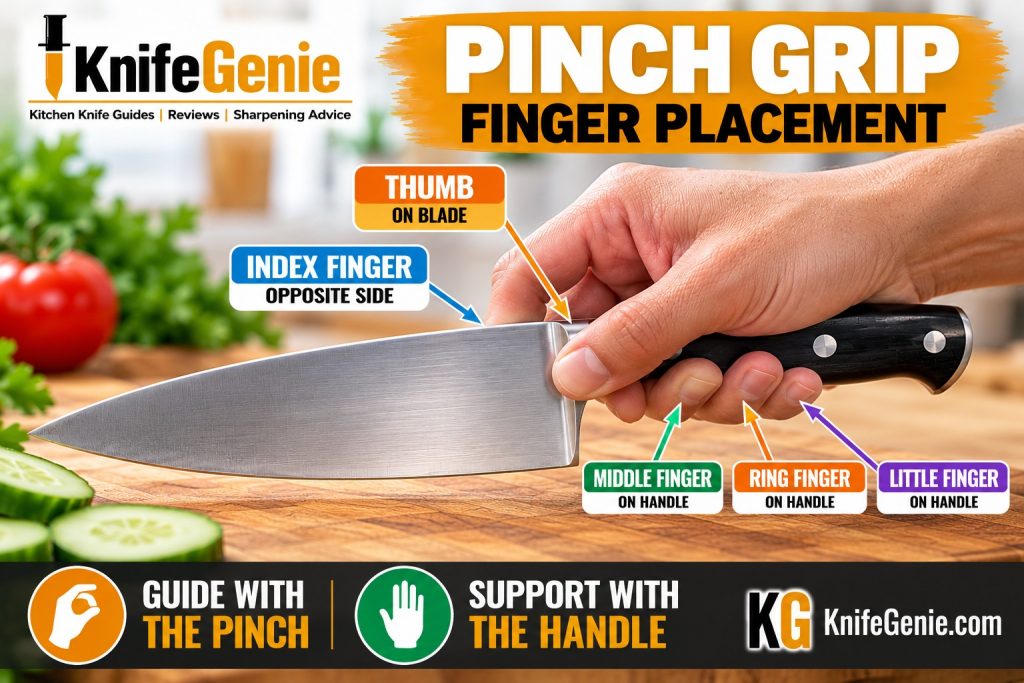
1. Place your hand near the point where the blade meets the handle.
2. Put your thumb against one flat side of the blade.
3. Rest the side of your bent index finger against the opposite side.
4. Wrap your remaining three fingers naturally around the handle.
5. Keep your wrist comfortable and your grip secure but relaxed.
Your thumb and index finger should control the knife near the blade while your other fingers stabilize the handle.
Think:
🤏 PINCH THE BLADE → ✋ SUPPORT THE HANDLE → 🔪 GUIDE THE KNIFE
You do not need to squeeze the blade hard.
The goal is control, balance and comfortable movement.
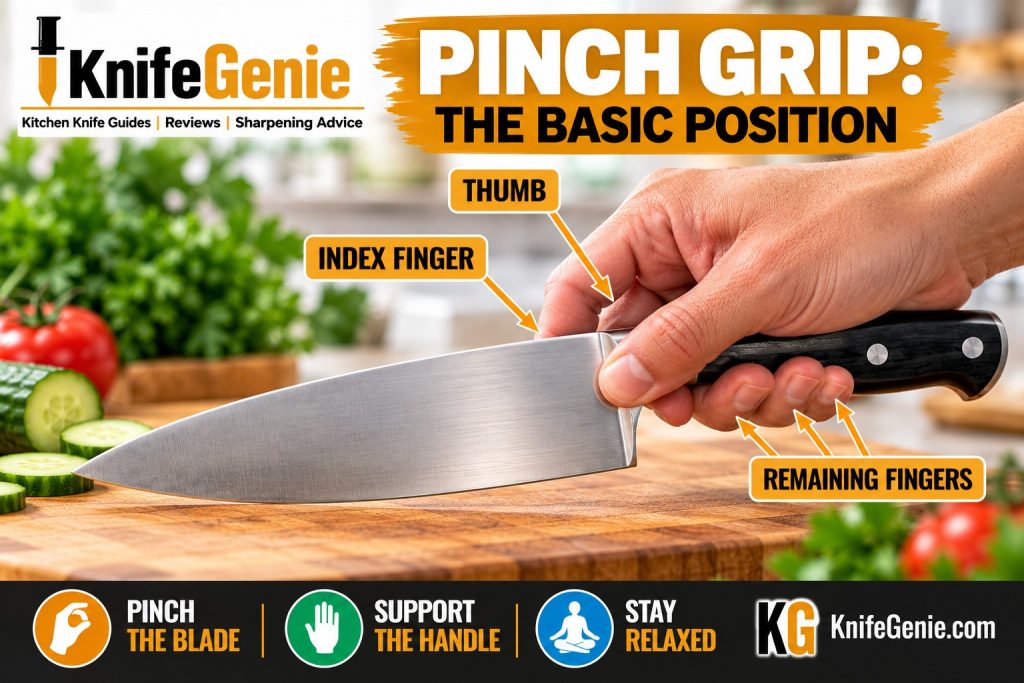
A basic pinch grip places the thumb and index finger on opposite sides of the blade while the remaining fingers support the handle.
🔪 What Is a Pinch Grip?
A pinch grip is a way of holding a chef knife in which your hand moves slightly forward from a conventional handle-only grip.
Instead of wrapping all four fingers around the handle, your thumb and index finger make contact with opposite sides of the blade near the handle.
The other three fingers remain around the handle.
This gives you:
✔ Direct contact with the blade
✔ A stable point from which to guide it
✔ Fine control over its direction
✔ A secure connection between hand and knife
✔ A natural transition into common cutting motions
The pinch grip is widely taught for chef knives, although it isn’t the only legitimate way to hold a kitchen knife. Professional cooks also use variations depending on the knife, task and personal preference. Serious Eats has an informative take on this.
🧙 KnifeGenie Tip: Think of the thumb and index finger as guiding the blade while your other three fingers provide support. Don’t try to do all the work by squeezing with your thumb and index finger.
⚖️ Why Use a Pinch Grip?
The main reason is control.
A chef knife has a relatively long blade. If your hand is positioned entirely behind the blade on the handle, you’re controlling that blade from farther away.
Moving your grip forward brings your hand closer to the knife’s working area.
For many cooks, this creates a more direct feeling of control.
It can be particularly useful when you’re:
🥕 Cutting vegetables
🧅 Dicing onions
🌿 Chopping herbs
🥔 Preparing potatoes
🥒 Slicing produce
🔪 Making repeated controlled cuts
But don’t turn the pinch grip into a rule that must be followed regardless of circumstances.
Different knives have different handles, bolsters, blade heights and balance points. Hands also differ considerably.
Control and comfort matter more than copying an exact finger position.
✋ How to Use a Pinch Grip Step by Step
Let’s build the grip from scratch.
1️⃣ Start With the Knife Safely Positioned
Place the chef knife flat on a stable cutting board with the handle toward your dominant hand.
Make sure your board cannot slide.
A damp kitchen towel, damp paper towel or nonslip mat underneath a slippery board can help stabilize it.
2️⃣ Pick Up the Knife Near the Blade
Pick up the knife normally.
Then allow your hand to move slightly forward toward the point where the blade and handle meet.
You’re not moving your entire hand onto the blade.
Only the thumb and index finger need to move forward.
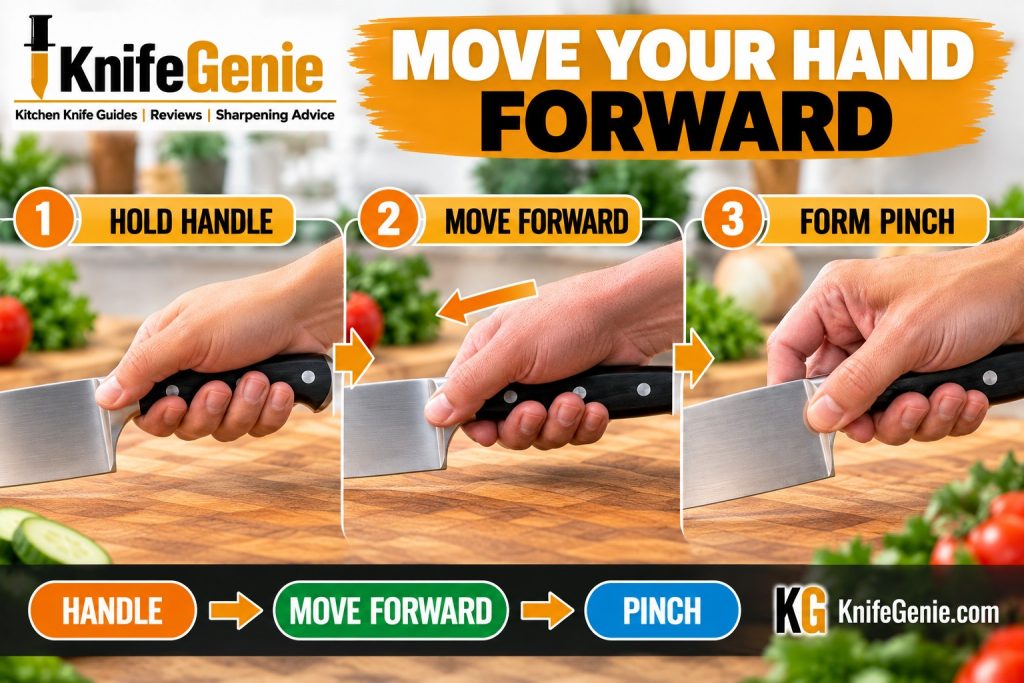
Move your hand slightly forward from the handle to form the pinch grip near the blade.
3️⃣ Place Your Thumb Against the Blade
Place the pad or side of your thumb against the flat side of the blade, close to where the blade enters the handle.
Your thumb should not be:
❌ On the cutting edge
❌ Underneath the blade
❌ Stretched far forward
❌ Pressing painfully into the steel
It should rest naturally against the flat face.
4️⃣ Bend Your Index Finger Around the Other Side
This is where beginners sometimes misunderstand the word pinch.
You generally don’t want to grab the blade between the tips of your thumb and index finger as though you were picking up a coin.
Instead, bend your index finger naturally.
The side of the bent index finger can rest against the opposite face of the blade.
Your thumb and index finger now oppose each other across the blade.
🤏 THUMB → | BLADE | ← INDEX FINGER
That creates the basic pinch.
5️⃣ Wrap Three Fingers Around the Handle
Your:
Middle finger
Ring finger
Little finger
remain around the handle.
They shouldn’t hang loose.
But they shouldn’t crush the handle either.
Think:
Thumb + index finger = guide
Other three fingers = support
Together, they create one controlled grip.
💪 How Tight Should a Pinch Grip Be?
This is one of the most important parts of the technique.
Don’t squeeze unnecessarily hard.
The knife needs to be secure enough that you control it, but excessive tension can make your hand and forearm work harder than necessary.
Try this simple progression:
TOO LOOSE → SECURE & RELAXED → TOO TIGHT
The middle position is what you’re looking for.
If your knuckles are whitening and your hand feels rigid, you’re probably gripping harder than necessary.
If the knife moves independently of your hand or feels insecure, your grip may be too loose.
🧙 KnifeGenie Tip: Start securely, then consciously relax unnecessary tension without allowing the knife to become unstable. You’re looking for control—not maximum gripping force.
⚠️ Don’t Put Your Index Finger Along the Spine
A very common beginner position is:
Index finger stretched straight along the top of the knife.
It can initially feel precise because you’re pointing in the same direction as the blade.
But it isn’t the same as a pinch grip.
For ordinary chef-knife work, bending the index finger and forming the pinch gives the hand a more secure relationship with the blade.
That doesn’t mean an extended index finger is never used with any knife or task. Grip variations exist, especially for specialized cutting techniques.
For learning basic chef-knife control, however, start with the conventional pinch.
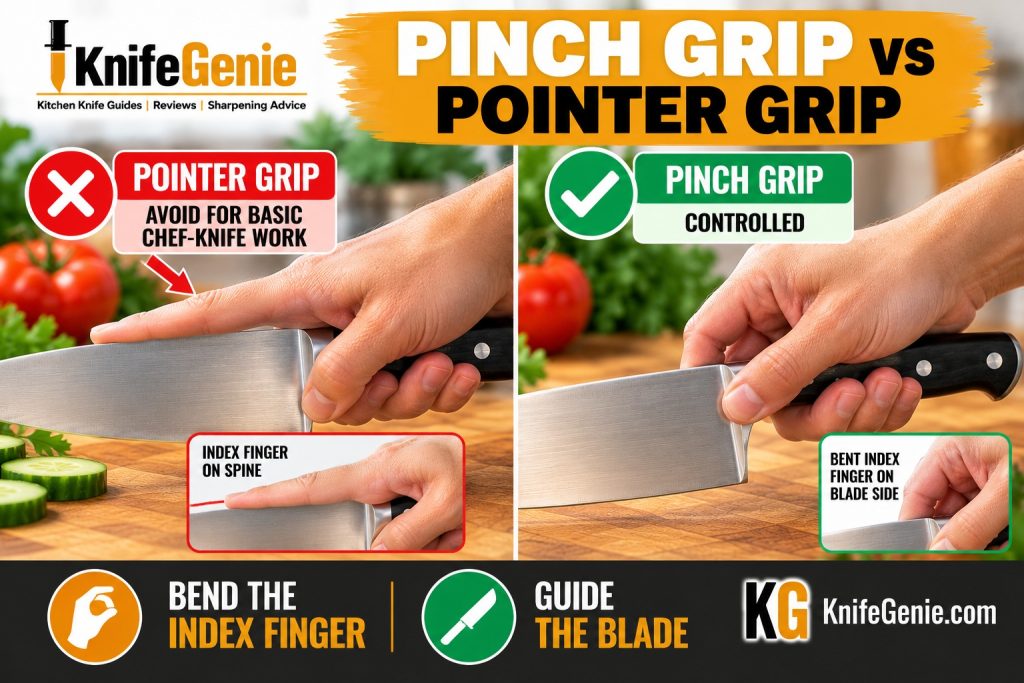
For basic chef-knife handling, bend the index finger into the pinch rather than extending it along the blade.
🧍 Your Wrist Position Matters Too
Correct finger placement won’t help much if your wrist is extremely bent or rigid.
Aim for a comfortable, relatively neutral wrist position.
Your hand, wrist and forearm should work together.
Avoid deliberately:
❌ Cocking the wrist sharply upward
❌ Bending it excessively sideways
❌ Locking the entire arm rigid
❌ Squeezing harder to compensate for poor positioning
You want controlled movement without unnecessary tension.
🦀 Combine the Pinch Grip With the Claw Hand
Learning the knife-hand grip is only half the technique.
Your other hand—the guiding hand—controls the food.
A commonly taught position is the claw grip.
Curl your fingertips back and use the front of your knuckles as a reference point while keeping your fingertips away from the cutting path.
So the two hands have different jobs:
| Knife Hand | Guiding Hand |
|---|---|
| 🤏 Pinch grip | 🦀 Claw position |
| Controls knife | Controls food |
| Guides blade | Keeps food stable |
| Creates cutting motion | Helps establish cut position |
Your pinch grip and claw hand should eventually work together rather than as two separate techniques.
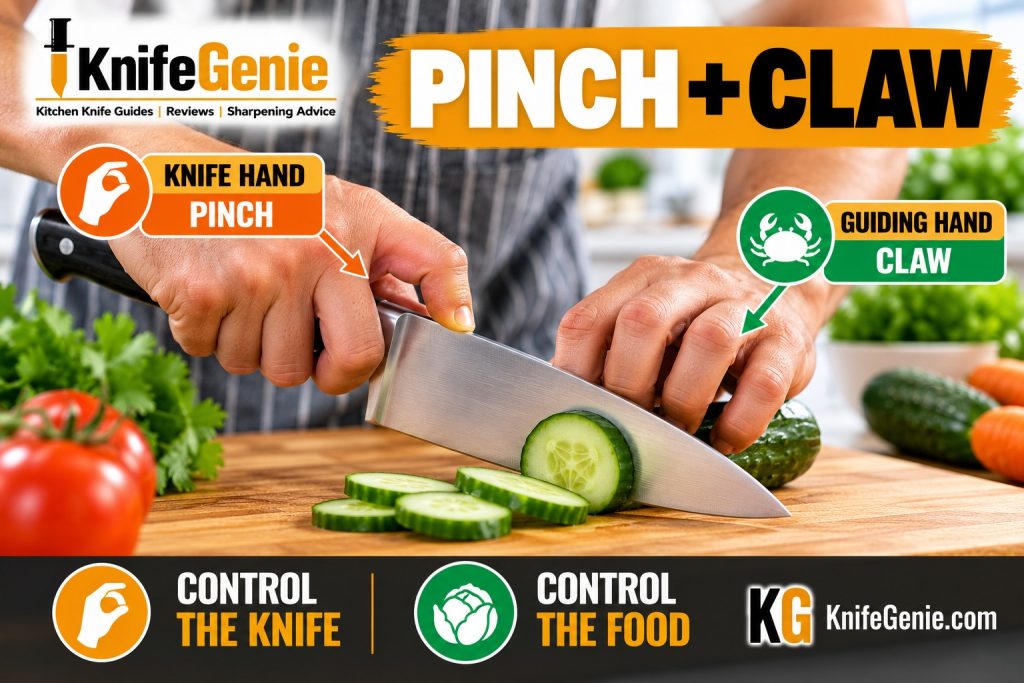
The pinch grip controls the chef knife while the claw hand helps control the food.
🥕 Practise the Pinch Grip Slowly
Don’t try to learn the grip while racing through dinner preparation.
Start slowly.
A good practice sequence is:
1️⃣ STABILIZE BOARD
↓
2️⃣ FORM PINCH GRIP
↓
3️⃣ FORM CLAW HAND
↓
4️⃣ MAKE SLOW CUTS
↓
5️⃣ RELAX EXCESS TENSION
↓
6️⃣ BUILD CONSISTENCY
Choose a stable ingredient that gives you enough room to practise controlled cuts.
Speed is irrelevant at this stage.
What you’re trying to develop is repeatability.
The grip should eventually stop being something you consciously assemble before every cut.
It should simply become how you pick up the knife.
🔄 Pinch Grip With Different Cutting Motions
The pinch grip isn’t limited to one cutting technique.
It can accompany several common chef-knife motions.
🔪 Rock Cutting
With a curved chef knife, the blade can rock through ingredients while your grip controls its movement.
⬇️ Push Cutting
The knife moves forward and down through the ingredient.
The pinch helps you guide the blade rather than simply pushing from the back of the handle.
↘️ Slicing
For longer slicing motions, maintain a relaxed grip and allow the blade to travel through the food.
The key principle remains:
Slice through food rather than simply forcing the blade downward.
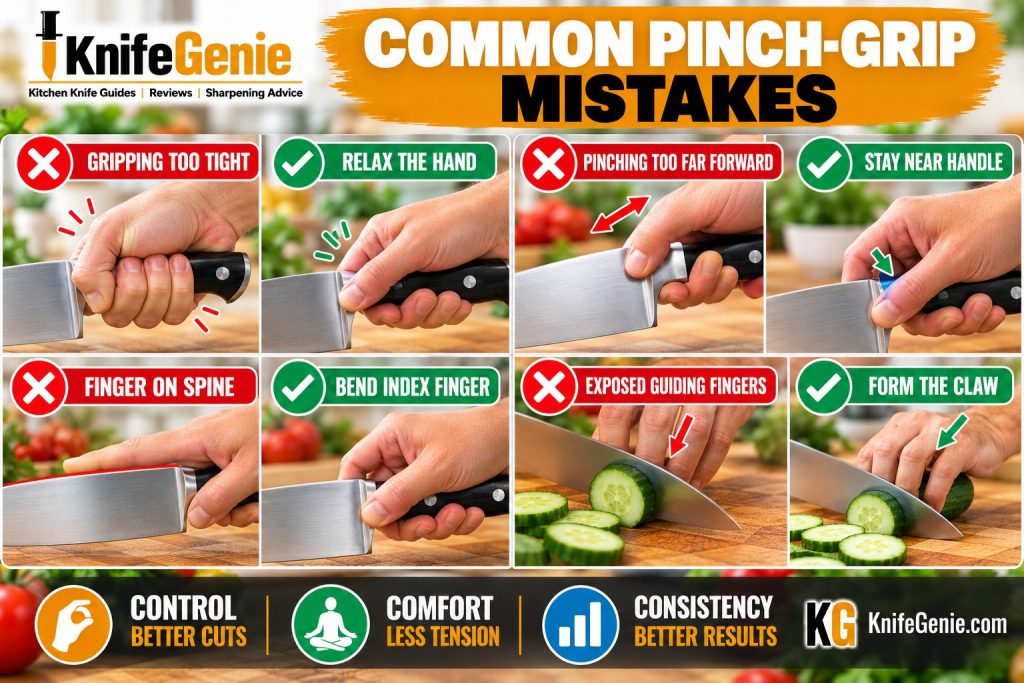
❌ 7 Common Pinch-Grip Mistakes
1. Squeezing Too Hard
More pressure doesn’t automatically create more control.
Use enough pressure to keep the knife secure.
2. Pinching Too Far Forward
Moving your fingers excessively far along the blade isn’t necessary.
Stay close to the blade-handle junction.
3. Pinching With Only Your Fingertips
The grip shouldn’t feel like you’re delicately picking up the knife between two fingertips.
Let the hand settle naturally around the blade and handle.
4. Forgetting the Other Three Fingers
The middle, ring and little fingers are important.
They stabilize the handle and complete the grip.
5. Extending the Index Finger Along the Spine
This is different from the conventional pinch grip and is generally unnecessary for ordinary chef-knife cutting.
6. Ignoring the Guiding Hand
A perfect knife-hand grip doesn’t protect fingertips that are sitting in the cutting path.
Learn the claw hand alongside the pinch grip.
7. Trying to Cut Fast
Speed should come from familiarity and consistency—not deliberately moving the knife faster than you can comfortably control.
🧙 KnifeGenie Tip: Practise for accuracy first. If the technique becomes natural, efficiency tends to improve without forcing it.
🖐️ What If the Pinch Grip Feels Uncomfortable?
Don’t assume discomfort means you simply need to tolerate it.
First check your technique.
You may be:
🔸 Squeezing too hard
🔸 Pinching too far forward
🔸 Holding your wrist awkwardly
🔸 Using an uncomfortable part of the index finger
🔸 Using a knife whose handle or bolster doesn’t suit your hand
Knife design matters.
Chef knives can have dramatically different:
Handle shapes • blade heights • bolsters • weights • balance points
Your grip may therefore look slightly different from someone else’s.
Professional cooks also use variations of the pinch grip rather than one perfectly standardized finger position. See Serious Eats.
Don’t force your hand into an uncomfortable position merely because a diagram shows it.
🔪 Does the Pinch Grip Work With Every Kitchen Knife?
Not necessarily.
This article is specifically about the chef knife.
A chef knife provides a broad blade and geometry that generally work well with a pinch grip.
Other knives can require different handling.
For example, the way you control a:
🔪 Paring knife
🐟 Fillet knife
🥩 Boning knife
🍞 Serrated bread knife
🔪 Cleaver
may differ because the blade shape, task and required movement are different.
Even among chef knives, German and Japanese knife designs can feel noticeably different because of variations in weight, blade geometry, balance and handle construction. Our comparison of German and Japanese knives explains those differences in more detail.
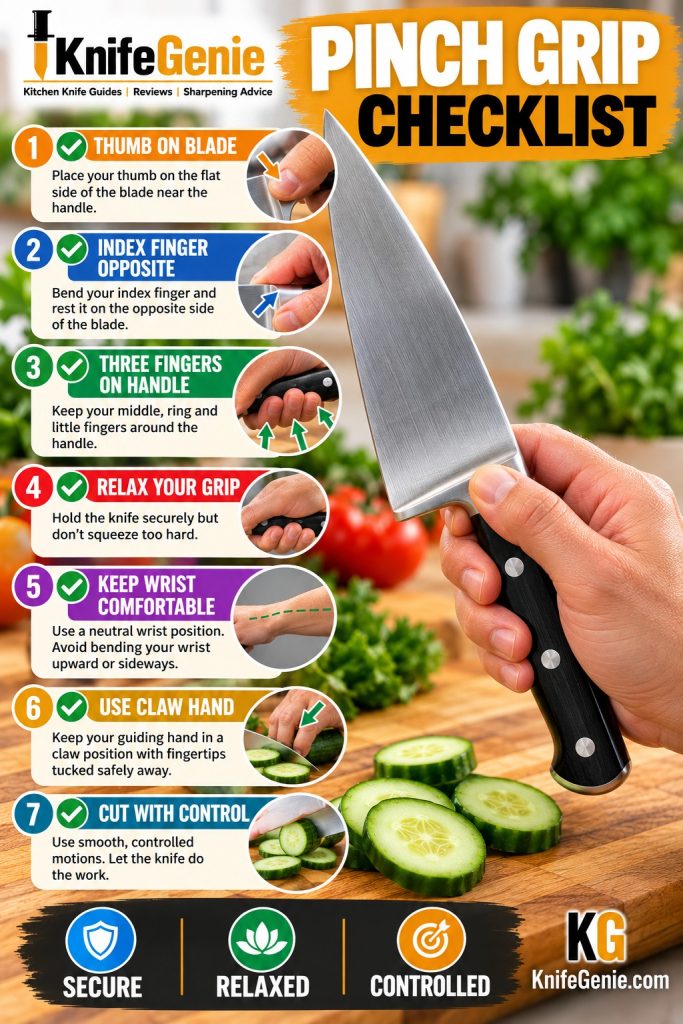
🧙 KnifeGenie Pinch-Grip Checklist
Before you start cutting, quickly check:
✔ Cutting board stable
✔ Knife appropriate for task
✔ Thumb against blade face
✔ Index finger bent on opposite side
✔ Three fingers supporting handle
✔ Grip secure but relaxed
✔ Wrist comfortable
✔ Guiding fingers away from cutting path
✔ Food stable
✔ Cutting motion controlled
If those fundamentals are in place, don’t obsess over making your hand look exactly like a photograph.
The purpose of the grip is to help you control the knife.
❓ Frequently Asked Questions
Is the pinch grip the correct way to hold a chef knife?
It is one of the most widely taught grips for general chef-knife use because it brings the hand close to the blade and can provide excellent control.
It isn’t the only possible grip, however. Knife design, cutting task, comfort and personal preference can influence how a cook holds a knife.
Where should my thumb go in a pinch grip?
Place your thumb against the flat side of the blade near the point where the blade and handle meet.
Keep it safely away from the cutting edge.
Where does the index finger go?
Bend the index finger naturally against the opposite side of the blade.
Avoid stretching it along the knife’s spine when you’re learning the conventional pinch grip.
How hard should I pinch a chef knife?
Firmly enough to maintain secure control, but not so hard that your hand becomes unnecessarily tense.
A good grip should feel stable rather than strained.
Why does my index finger hurt when using a pinch grip?
Check whether you’re squeezing excessively or pressing an uncomfortable part of your finger against a sharp or angular section of the knife.
Knife geometry can also affect comfort. If the grip repeatedly causes pain, don’t force it.
Should beginners use a pinch grip?
It’s a useful technique for beginners to learn because it develops direct control over a chef knife.
Learn it slowly alongside cutting-board stability, the claw hand and controlled cutting motions rather than focusing on speed.
Can I use a pinch grip with a Japanese chef knife?
Yes, many Japanese-style chef knives such as gyutos can be used with variations of the pinch grip.
The exact feel can differ from a heavier Western chef knife because blade shape, weight, balance and handle geometry vary.
🏁 Final Thoughts: Control Comes Before Speed
The pinch grip isn’t complicated.
Thumb on one side.
Bent index finger on the other.
Three fingers around the handle.
But good knife technique is about more than simply putting your fingers in the correct places.
Your grip should be:
🤏 SECURE
✋ RELAXED
🔪 CONTROLLED
Combine it with a stable cutting board, a properly positioned guiding hand, and deliberate cutting motions.
Most importantly, don’t chase speed.
Learn to make slow, predictable cuts first.
As the movement becomes familiar, the pinch grip should begin to feel less like a special technique and more like a natural way to control your chef knife.
👉 Next: Learn how to use the claw hand to protect your fingertips while cutting.
👉 Read How to Use a Chef Knife: Beginner’s Guide to Cutting Safely for the complete beginner technique.