
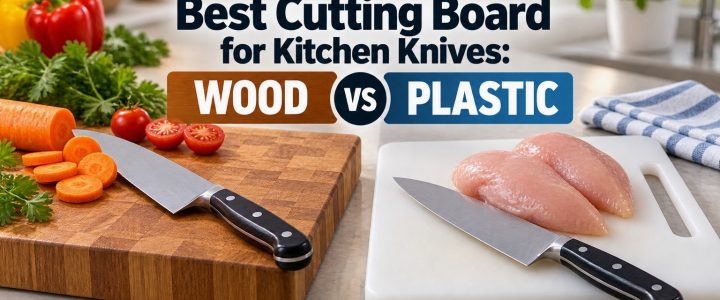
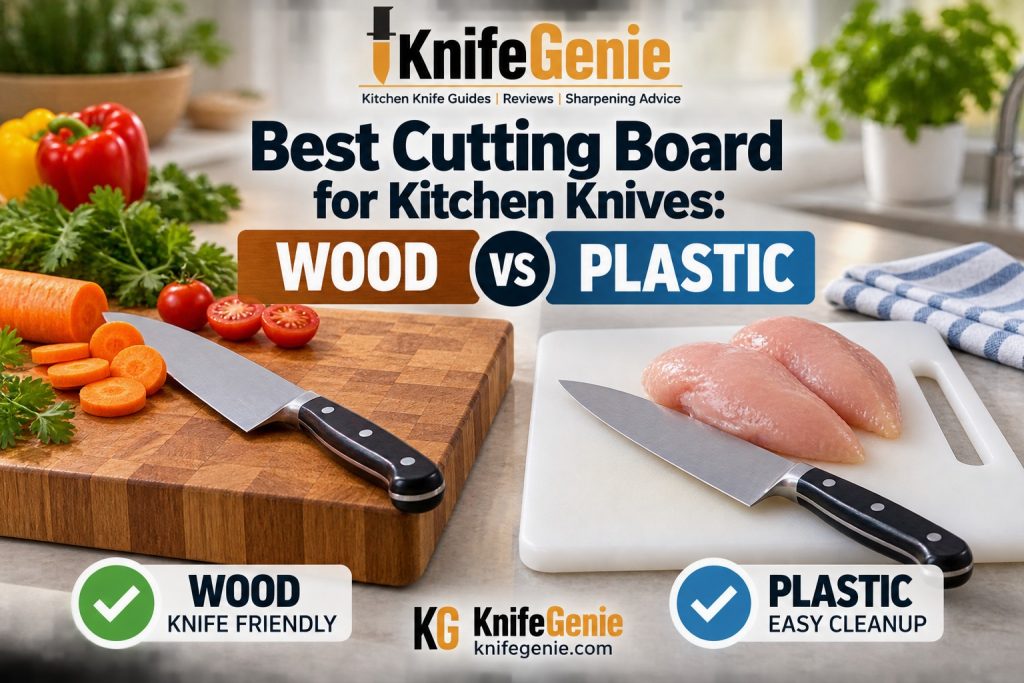
Wood vs plastic cutting boards: compare knife friendliness, cleanup, and everyday kitchen use.The cutting board underneath your knife may seem like a simple piece of kitchen equipment, but the best cutting board for kitchen knives is very important.
Every time you chop an onion, slice a tomato or dice vegetables, the knife edge eventually meets the board. A surface that is reasonably forgiving allows the edge to make contact without excessive stress. A very hard surface can accelerate dulling and may increase the risk of edge damage.
For most home cooks, a good wooden cutting board is the better everyday choice when protecting kitchen knife edges is the priority. Plastic boards, however, have an important advantage: they are inexpensive, easy to maintain and many can be cleaned in a dishwasher.
In practice, you don’t necessarily have to choose only one.
A sensible home-kitchen setup is often a wooden board for everyday vegetable, fruit, bread and general knife work, plus a separate dishwasher-safe plastic board for raw meat, poultry or seafood.
💡 Quick Answer: For everyday knife work, choose a quality wood cutting board such as maple or walnut. Wood provides a durable but relatively forgiving cutting surface. Keep a separate plastic board if you want something inexpensive and easy to sanitize after preparing raw meat, poultry or seafood.
🔬 Research Note: This guide is based on published food-safety guidance, cutting-board research and manufacturer information. It is not presented as personal testing or firsthand experience with the individual products or materials discussed.
Also read about proper chef knife grip when using a cutting board.
 Jump to
👉 Wood vs Plastic: Quick Comparison
👉 Why Your Cutting Board Matters
👉 Is Wood Better for Kitchen Knives?
👉 Are Plastic Cutting Boards Good for Knives?
👉 Wood vs Plastic for Food Safety
👉 End-Grain vs Edge-Grain Wood
👉 Best Woods for Cutting Boards
👉 What About Bamboo Cutting Boards?
👉 Cutting Board Materials to Avoid
👉 What Size Cutting Board Should You Buy?
👉 How Thick Should a Wooden Cutting Board Be?
👉 How to Keep a Cutting Board From Sliding
👉 How to Clean a Wooden Cutting Board
👉 How to Clean a Plastic Cutting Board
👉 Don’t Scrape Food With Your Knife Edge
👉 When Should You Replace a Cutting Board?
👉 Which Cutting Board Should You Choose?
👉 Final Recommendation
👉 Frequently Asked Questions
⚖️ Wood vs Plastic Cutting Boards: Quick Comparison
Both materials can work well in a home kitchen, but they have different strengths.
| Feature | 🪵 Wood | ◻️ Plastic |
|---|---|---|
| Knife-edge friendliness | Excellent with suitable woods | Good to moderate |
| Maintenance | Requires more care | Easy |
| Dishwasher compatible | Usually no | Often yes |
| Longevity | Potentially many years | Usually shorter |
| Deep groove resistance | Good on quality boards | Grooves develop with use |
| Cost | Usually higher | Usually lower |
| Raw-meat convenience | Good if cleaned correctly | Excellent |
| Appearance | Excellent | Functional |
| Best use | Everyday prep | Raw meat / easy cleanup |
✅ Bottom line: If preserving your knife edges is the main concern, quality wood is generally the stronger choice. If easy cleanup is the priority, plastic has a clear advantage.
WOOD VS PLASTIC QUICK COMPARISON

🔪 Why Your Cutting Board Matters to Your Knives
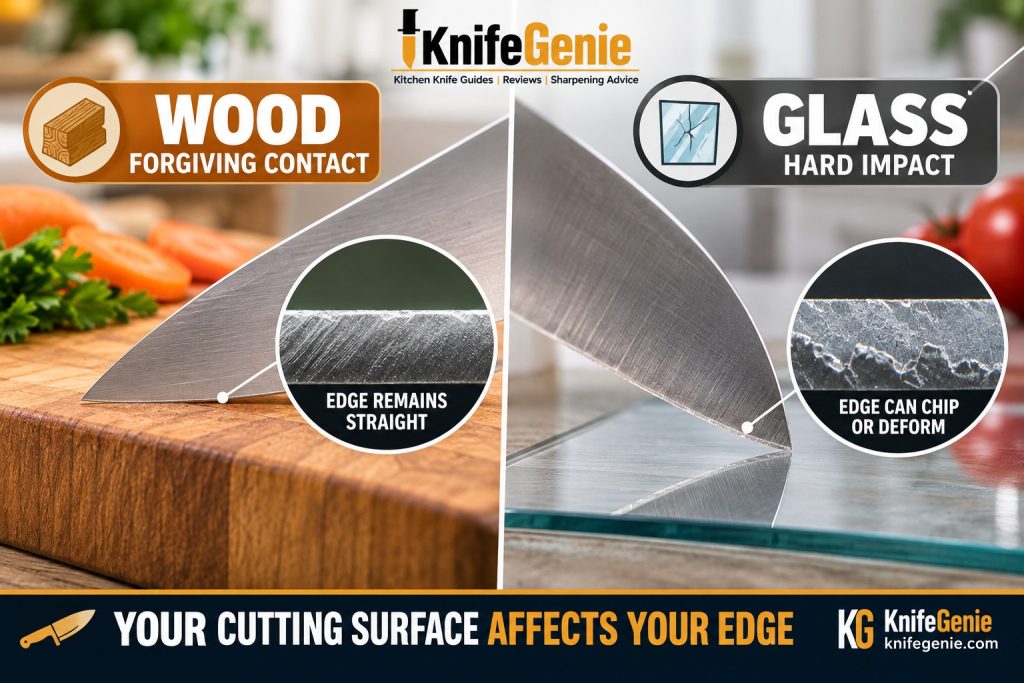
A sharp kitchen knife has a very thin cutting edge. During normal cutting, that edge repeatedly contacts the board beneath the food.
The harder and less forgiving that surface is, the greater the stress placed on the fine edge.
A knife-friendly cutting board protects the edge during prep, while correct honing technique helps maintain a compatible knife between sharpenings.
That is why chopping directly on glass, ceramic, stone, granite or a plate is a poor habit. These surfaces provide very little cushioning when the knife contacts them.
A suitable cutting board does something different: it provides a stable working surface while allowing the knife to finish the cut without repeatedly striking an extremely hard material.
This becomes particularly important with thin, finely sharpened knives.
See our How often to sharpen kitchen knives guide.
💡 KnifeGenie Tip: If your kitchen knives seem to lose their sharpness unusually quickly, the cutting surface is one of the first things worth checking. It is still important to keep kitchen knives sharp to prolong the life of your cutting board.
🔗 Related guide: Read Why Kitchen Knives Get Dull So Quickly for other common causes of premature dulling.
WHAT HAPPENS TO THE KNIFE EDGE
🪵 Is Wood Better for Kitchen Knives?
For most everyday kitchen cutting, wood is an excellent choice.
Suitable cutting-board woods provide a balance between durability and resilience. The surface is firm enough to support controlled cutting without feeling excessively hard underneath the blade.
Common choices include:
- Maple
- Walnut
- Cherry
- Beech
Hard maple is particularly well established as a cutting-board material. FDA food-service guidance specifically recognizes hard maple and equivalently hard, close-grained woods for cutting boards.
But simply being made from wood doesn’t automatically make a board ideal. Because it’s wood doesn’t make it the best cutting board for kitchen knives.
Very hard or abrasive materials can be less forgiving, and poorly constructed wooden boards can warp, split or develop rough surfaces.
✅ Advantages of Wood
A good wooden cutting board can:
- provide a forgiving cutting surface;
- offer excellent stability;
- last for years with proper maintenance;
- be resurfaced in some cases;
- develop fewer obvious knife scars than many plastic boards; and
- double as an attractive preparation or serving surface.
⚠️ The trade-off: Most traditional wooden boards should be washed by hand rather than repeatedly exposed to the heat and prolonged moisture of a dishwasher. Follow the board manufacturer’s instructions because construction methods vary.
◻️ Are Plastic Cutting Boards Good for Knives?
Yes. A quality plastic cutting board is still a perfectly practical cutting surface.
Plastic is considerably more knife-friendly than glass, ceramic or stone.
Its greatest advantage, however, is convenience.
Many plastic boards are:
- inexpensive;
- lightweight;
- nonporous;
- easy to wash;
- dishwasher safe; and
- easy to dedicate to a particular food category.
That makes them particularly useful when preparing raw chicken, meat or seafood.
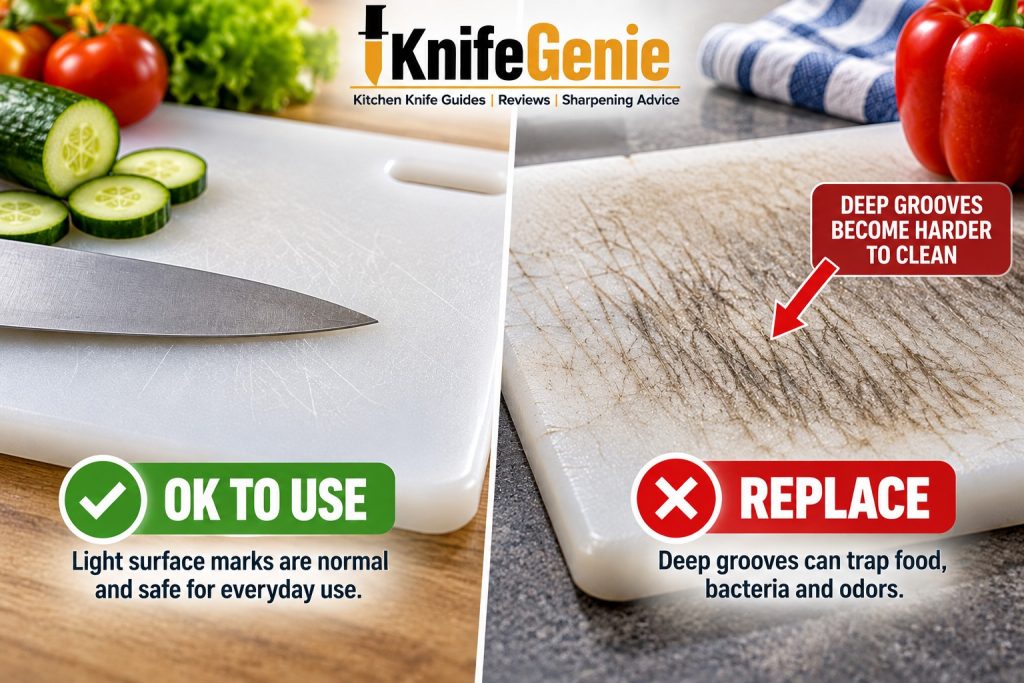
⚠️ Watch for wear: Repeated cutting creates scratches and eventually deeper grooves. Once those grooves become difficult to clean properly, the board should be replaced.
USDA on cutting boards specifically recommends replacing cutting boards that become excessively worn or develop hard-to-clean grooves.
WORN PLASTIC BOARD
🧼 Wood vs Plastic for Food Safety
This is where the comparison often becomes unnecessarily confusing.
You’ll sometimes hear that plastic is always more sanitary because it is nonporous. You’ll also encounter claims that wood is naturally safer.
For a home cook, the more useful conclusion is simpler:
✅ Either material can be used safely when it is properly cleaned, maintained and kept in good condition.
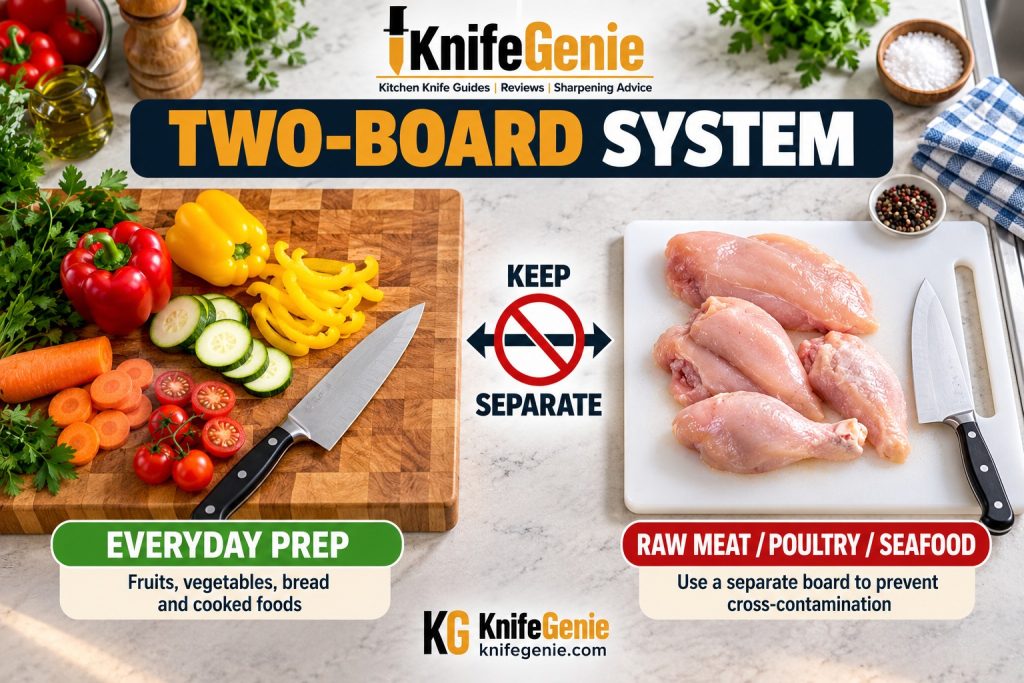
The USDA recommends using separate boards where possible: one for fresh produce and bread and another for raw meat, poultry and seafood.
That separation helps reduce cross-contamination.
After preparing raw animal products, cutting boards and utensils should be thoroughly cleaned before they are used for other foods.
🍎 A Practical Two-Board System
🪵 BOARD 1 — WOOD
Use for:
🥕 Vegetables → 🍎 Fruit → 🌿 Herbs → 🍞 Bread → 🔪 General preparation
◻️ BOARD 2 — PLASTIC
Use for:
🍗 Raw poultry → 🥩 Raw meat → 🐟 Raw seafood
💡 Why this works: This isn’t because wood cannot be cleaned safely. It simply makes the workflow easier and provides an additional barrier against accidental cross-contamination.
🌳 End-Grain vs Edge-Grain Cutting Boards
Once you’ve decided on wood, there is another choice to make.
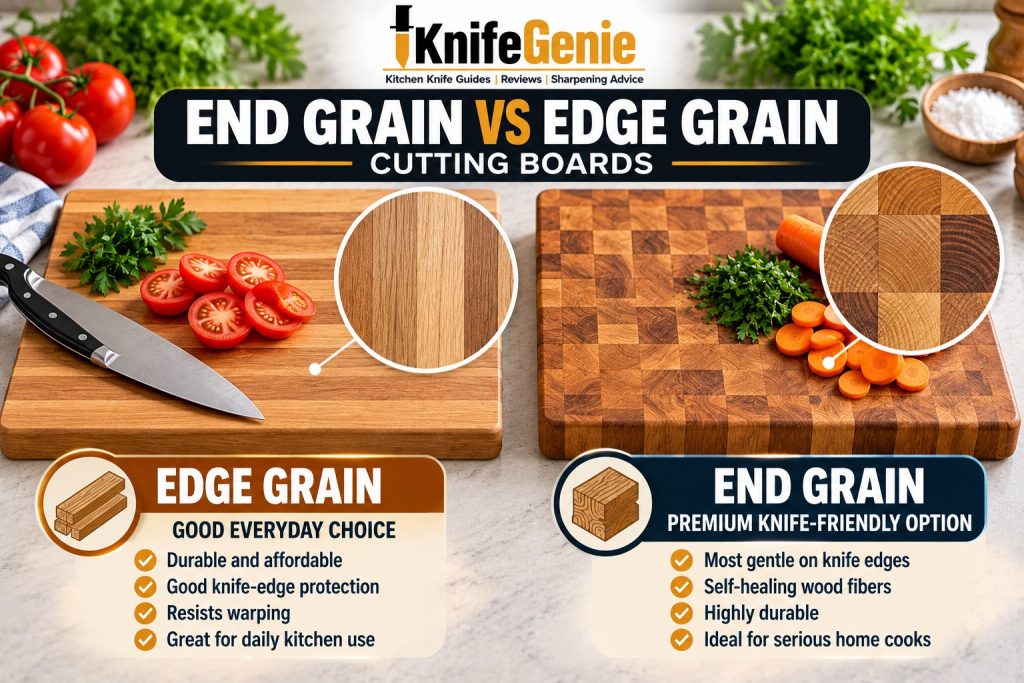
Edge-Grain Boards
On an edge-grain board, long strips of wood are arranged with their edges forming the cutting surface.
These boards are commonly available and usually less expensive than comparable end-grain boards.
💰 Best value: For most home cooks, a good edge-grain maple or walnut board offers an excellent balance of performance, durability and price.
End-Grain Boards
An end-grain board is constructed so that the ends of the wood fibers face upward.
Think of the surface as thousands of tightly packed fibers.
When a knife contacts the board, the edge meets those fibers rather than repeatedly cutting across long grain.
End-grain boards are often prized for their forgiving cutting feel and ability to hide light knife marks.
⭐ Main advantage: Excellent cutting feel and premium construction.
⚠️ Main drawbacks: Higher price, greater weight and additional maintenance.
🌲 What Is the Best Wood for a Cutting Board?
For a general-purpose kitchen board, look for a relatively close-grained hardwood that is durable without being excessively hard.
🍁 Maple
Hard maple is one of the classic choices.
It is durable, relatively light in color and widely used for butcher blocks and professional work surfaces.
Best for: Someone looking for a traditional all-purpose board.
🌰 Walnut
Walnut is somewhat darker and attractive enough to remain on the countertop.
It provides an excellent work surface but generally costs more than basic maple.
Best for: Knife care plus appearance.
🍒 Cherry
Cherry offers another relatively forgiving hardwood surface and develops a deeper color as it ages.
Best for: Someone wanting an attractive board that can also serve as a permanent countertop piece.
🌳 Beech
Beech is another traditional cutting-board hardwood.
It can provide good value, although—as with other wooden boards—it needs proper drying and occasional maintenance.
Best for: Practical everyday use.
🎋 What About Bamboo Cutting Boards?
Bamboo boards are inexpensive, widely available and often marketed as environmentally friendly alternatives to hardwood.
But bamboo is not actually wood; it is a grass.
Many bamboo boards are relatively hard, and their construction commonly involves laminated strips.
💡 KnifeGenie Takeaway: That doesn’t mean a bamboo board will immediately damage a kitchen knife. It simply means that if knife-edge preservation is your primary objective, maple, walnut or another suitable hardwood would generally be the first choice instead.
See our honing vs sharpening guide to a better knife edge.
⛔ Cutting Board Materials to Avoid for Kitchen Knives
Some kitchen surfaces may look attractive but make poor cutting boards.
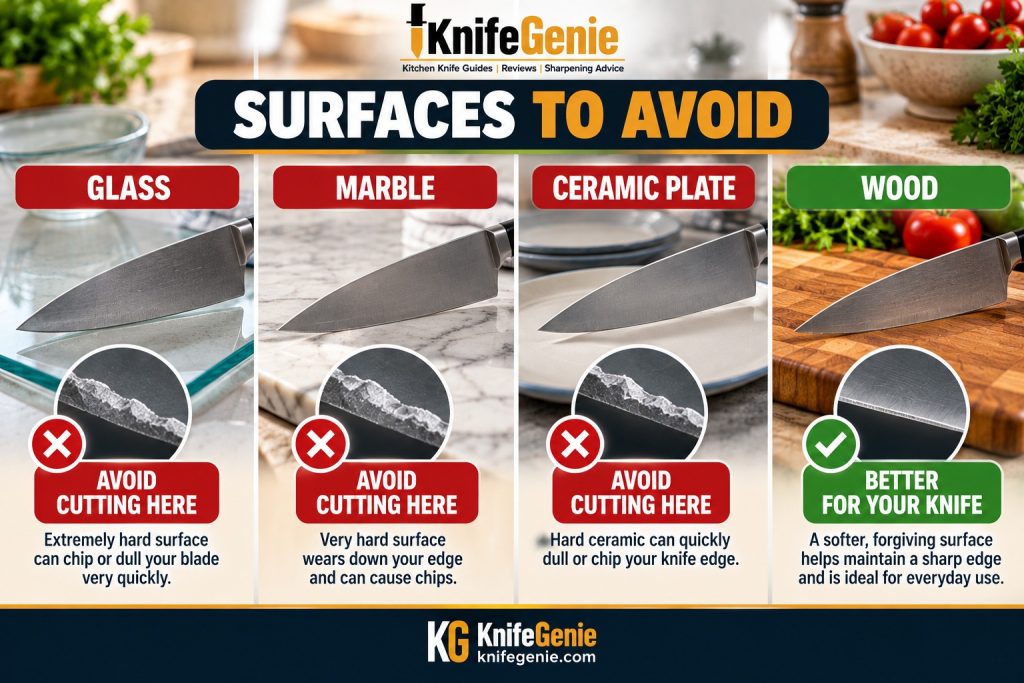
❌ Glass
Glass is easy to clean but extremely hard compared with a suitable cutting surface.
Use a glass board as a serving or decorative surface—not as the primary surface for chopping with a good knife.
❌ Marble and Granite
The same principle applies to stone.
Your countertop may seem convenient, but cutting directly on granite, marble or engineered stone repeatedly puts the edge against a very hard surface.
❌ Ceramic Plates
Avoid using a dinner plate as an improvised cutting board.
The glazed eating surface is not an appropriate chopping surface for a quality kitchen knife.
These are generally not the best cutting boards for kitchen knives to use.
The above advice applies to imported German and Japanese knives also.
📏 What Size Cutting Board Should You Buy?
A cutting board should give you enough room to work without food constantly falling off the edges.
For an 8-inch chef’s knife, a board around 12 × 18 inches is a useful general-purpose size for many kitchens.
Larger boards provide more working room, particularly when chopping several vegetables.
Choosing the right chef knife size for your cutting board is also very important to give you the right space to work with.
⚠️ Don’t forget the sink: A huge board that won’t fit comfortably in your sink may become frustrating very quickly.
Before buying, check:
- 📐 Available countertop space
- 🚰 Sink dimensions
- 🗄️ Storage space
- 🔪 Knife length
- 🥕 Amount of food you normally prepare
📐 How Thick Should a Wooden Cutting Board Be?
Thickness becomes particularly important with larger wooden boards.
Thin wood boards are lighter and easier to store, but substantial boards generally feel more stable.
For a board that will stay on the counter, a thicker butcher-block-style design can provide an excellent work surface.
For something you intend to lift, wash and store after every meal, however, moderate thickness may be more practical.
✅ Choose stability before appearance.
A beautiful cutting board isn’t much help if it moves every time you start chopping.
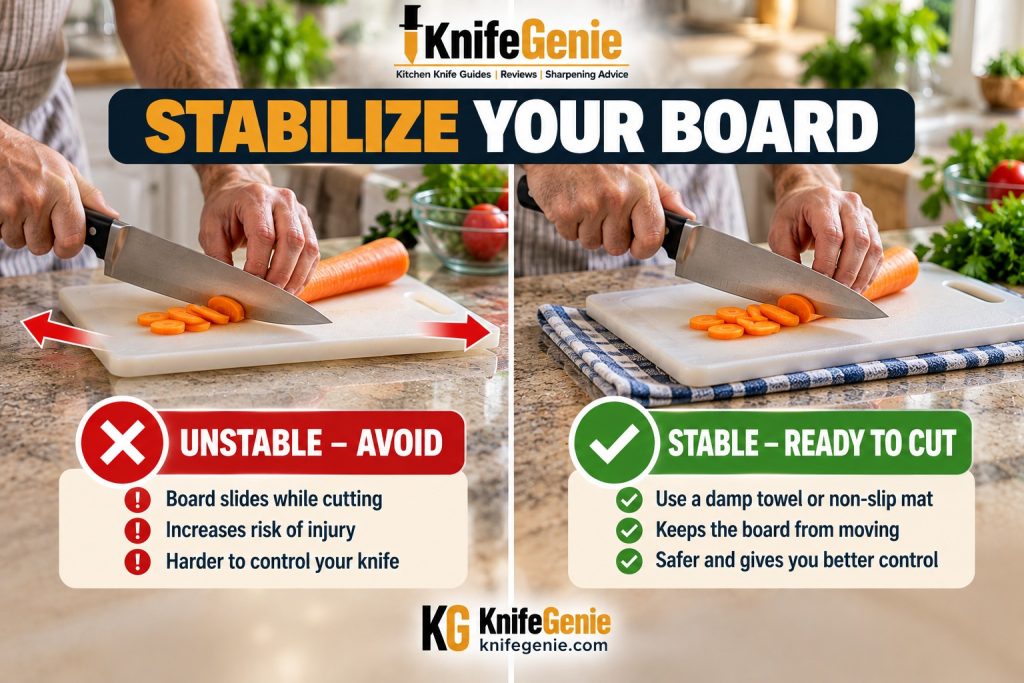
🛑 How to Keep a Cutting Board From Sliding
This is an important knife-safety habit.
Before cutting, place the board on a stable, dry counter and check whether it moves.
If it slides, place a slightly damp kitchen towel or nonslip mat underneath it.
Then press down on each corner.
The board should remain stable before the knife comes anywhere near the food.
💡 KnifeGenie Tip: This simple step is especially useful with lightweight plastic boards.
🔗 Related guide: See How to Use a Chef Knife: Beginner’s Guide to Cutting Safely for grip, claw-hand position, stance and controlled cutting technique.
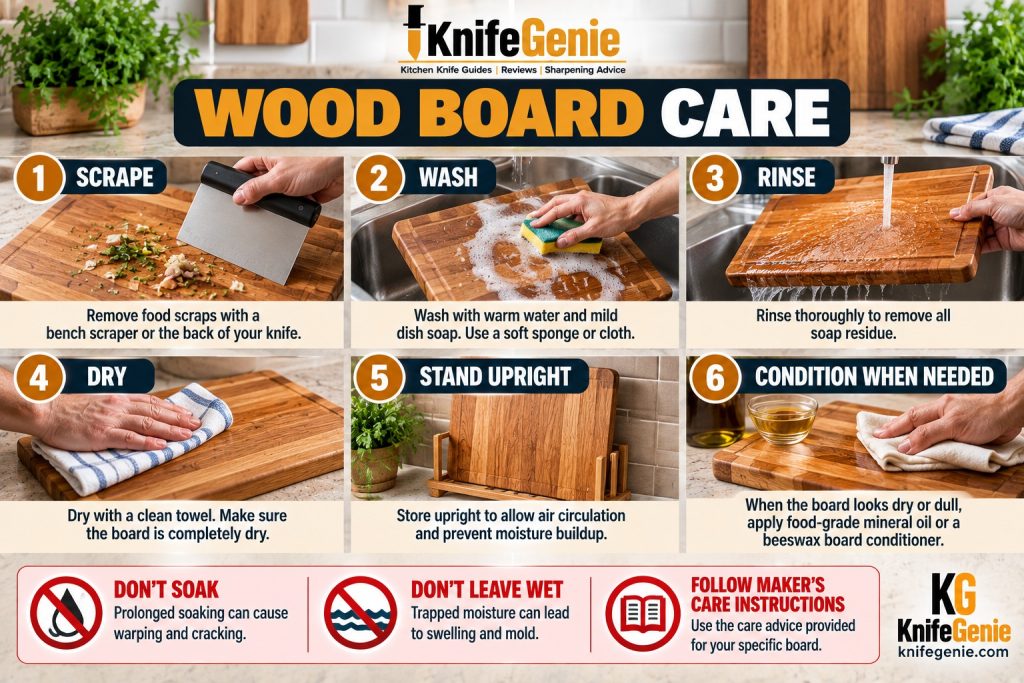
🧽 How to Clean a Wooden Cutting Board
For most traditional wooden boards:
1️⃣ Remove Food Debris
Scrape remaining food into the trash or compost.
Use a bench scraper rather than dragging the sharp edge of your knife sideways across the board.
2️⃣ Wash Promptly
Wash the surface with warm water and dish soap according to the manufacturer’s care instructions.
🚫 Avoid leaving a wooden board soaking in a sink.
3️⃣ Rinse
Remove soap and food residue thoroughly.
4️⃣ Dry Immediately
Wipe away excess water and allow air to circulate around the board.
Standing a board upright can help both sides dry more evenly.
5️⃣ Oil When Necessary
If the manufacturer recommends it, periodically apply food-grade mineral oil or an appropriate cutting-board conditioner.
⚠️ Avoid ordinary cooking oils that can become rancid.
🚿 How to Clean a Plastic Cutting Board
Plastic is simpler.
After use:
- 🧹 Remove food debris.
- 🧼 Wash thoroughly with hot, soapy water.
- 🚿 Rinse thoroughly.
- ✨ Sanitize when appropriate.
- 💨 Air-dry completely.
If the manufacturer identifies the board as dishwasher safe, the dishwasher provides a convenient cleaning option.
⚠️ Food-safety reminder: Wash cutting boards, utensils and work surfaces thoroughly between preparing raw meat, poultry or seafood and preparing foods that will not subsequently be cooked.
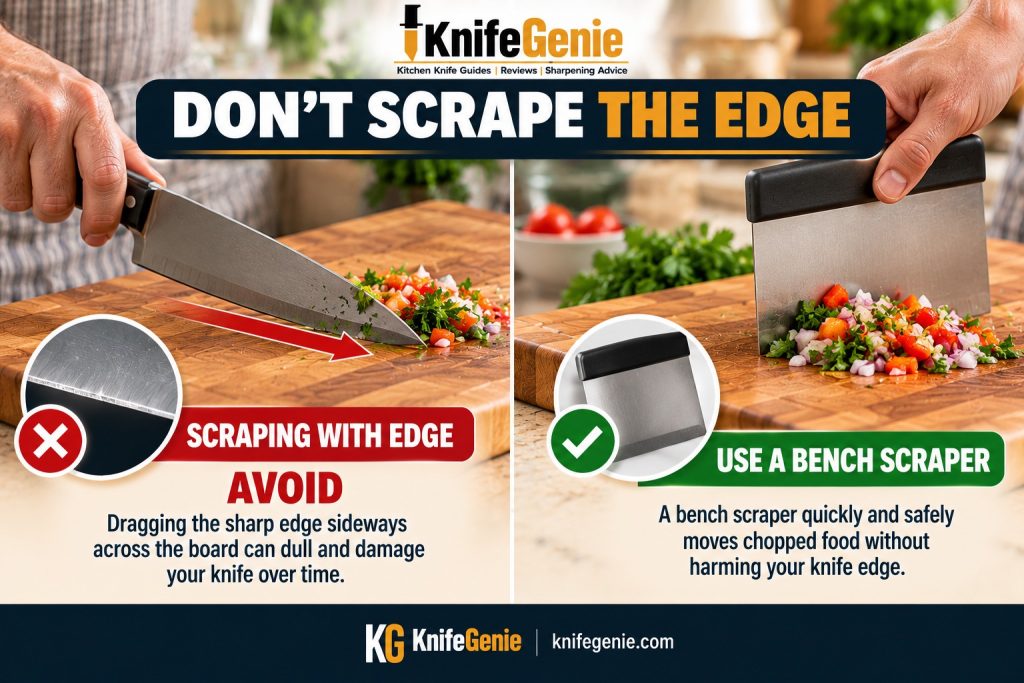
🚫 Don’t Scrape Food With Your Knife Edge
The cutting board isn’t the only part of this relationship that matters.
After chopping vegetables, many cooks turn the knife sideways and drag the sharpened edge across the board to gather the food.
Try not to do this.
Repeated sideways scraping can be unnecessarily hard on a fine cutting edge.
✅ Better method: Turn the knife over and use the spine, or use a bench scraper.
♻️ When Should You Replace a Cutting Board?
A wooden board can often remain useful for years if it is properly cared for.
Replace it—or have it professionally resurfaced where appropriate—if it develops:
- ❌ Major splits
- ❌ Deep cracks
- ❌ Loose sections
- ❌ Severe warping
- ❌ Persistent contamination or odors
- ❌ Damage that prevents thorough cleaning
Plastic boards usually have a shorter practical life.
Light scratches are normal. Deep, heavily scored grooves that are difficult to clean are a sign that replacement is due.
💡 Don’t judge a cutting board by age alone. Judge it by its condition.
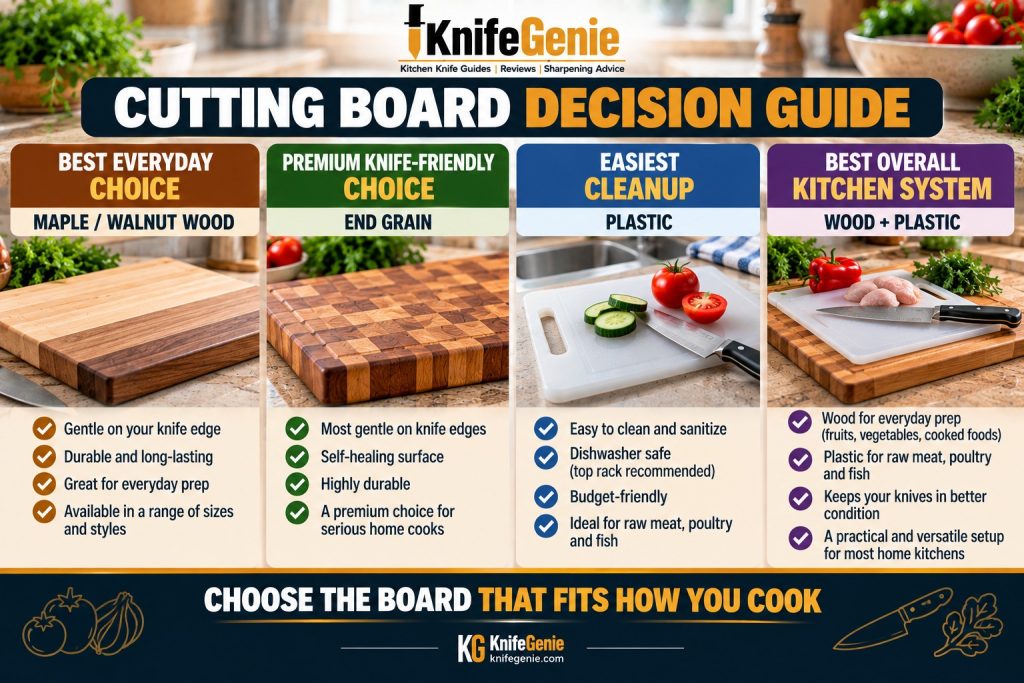
🎯 Which Cutting Board Should You Choose?
For most home cooks, the decision can be simplified.
🪵 Choose Maple or Walnut Wood If:
You want an excellent everyday surface for a chef’s knife and don’t mind hand washing and occasional maintenance.
⭐ Choose End-Grain Wood If:
You want a premium, substantial work surface and are comfortable paying more and maintaining it.
🧼 Choose Plastic If:
Easy cleaning, low cost, light weight and dishwasher compatibility are priorities.
🪵 + ◻️ Use Both If:
You want perhaps the most practical home-kitchen arrangement.
Use a quality wood board for most everyday cutting and keep a separate plastic board for raw meat, poultry and seafood.
🏆 Final Recommendation
If your main concern is keeping your kitchen knives sharp, start with a quality maple, walnut, cherry or similar close-grained hardwood cutting board.
It provides a durable everyday workspace without subjecting your knife edge to the harsh contact associated with glass, stone or ceramic.
But plastic shouldn’t be dismissed.
An inexpensive dishwasher-safe plastic board makes an excellent companion to a wooden board, particularly for handling raw meat, poultry and seafood.
For many home cooks, therefore, the best answer to wood vs plastic isn’t really one or the other.
🪵 Wood for everyday knife work + ◻️ plastic for easy-clean raw-protein preparation.
Whichever board you choose, keep it clean, keep it stable and replace it when damage makes it difficult to maintain properly.
Your cutting board is part of your knife-care system. Pairing a sharp knife with an appropriate cutting surface can help that edge perform as intended for longer.
❓ Frequently Asked Questions
🔪 What cutting board is best for keeping knives sharp?
A quality wooden cutting board made from a suitable hardwood such as maple or walnut is an excellent choice for protecting kitchen knife edges during everyday use.
🪵 Is wood or plastic better for kitchen knives?
Wood generally offers an excellent balance of durability and knife friendliness. Plastic is also suitable for knives and offers easier cleaning, particularly when dishwasher safe.
◻️ Are plastic cutting boards bad for knives?
No. Plastic boards are far more appropriate cutting surfaces than glass, ceramic or stone. However, plastic becomes scratched and grooved over time and should be replaced once those grooves become difficult to clean.
🚫 What cutting boards should you avoid?
Avoid using glass, marble, granite, ceramic plates and other very hard surfaces as regular cutting surfaces for quality kitchen knives.
🎋 Is bamboo good for kitchen knives?
Bamboo boards are usable, but many are relatively hard. If protecting a fine knife edge is the priority, a suitable hardwood such as maple or walnut is generally a stronger choice.
🥩 Can wooden cutting boards be used for raw meat?
Wooden cutting boards can be used safely when properly cleaned and maintained. For convenience and reducing cross-contamination risk, however, many home cooks may prefer keeping a separate dishwasher-safe plastic board specifically for raw meat, poultry and seafood.
🚿 Should I put a wooden cutting board in the dishwasher?
Usually not unless the manufacturer specifically states that the board is dishwasher safe. Heat and prolonged exposure to water can warp, split or damage many traditional wooden boards.