
A Swiss Army Knife can last for decades, but its blade is not indestructible, replacing the blade on a Swiss Army knife is not easy. Accidental drops, improper cutting, corrosion, or years of hard use can leave a blade chipped, bent, broken, or difficult to open.
Learn when a damaged Swiss Army Knife blade needs sharpening, repair, or replacement.
If that happens, you may wonder whether you can simply remove the damaged blade and fit a new one.
The answer depends on the model, the type of damage, and how the knife is constructed.
Most traditional Swiss Army Knives do not have user-replaceable main blades. Unlike some modern folding knives, their blades are normally held in place by permanent pivot pins rather than removable screws.
That doesn’t mean a damaged Swiss Army Knife is beyond repair. It means choosing the right repair method matters.
This guide explains how to assess a damaged blade, when replacement makes sense, how professional repairs work, and what to know before attempting a DIY blade replacement.
▶️ Jump to What You Need
👉 Quick Answer
👉 Can You Replace the Blade?
👉 Check the Damage
👉 How to Arrange a Replacement
👉 DIY Blade Replacement
👉 Repair or Replace the Knife?
👉 Care and Maintenance
👉 Frequently Asked Questions
🏆 Replacing a Swiss Army Knife Blade: The Quick Answer
Yes, a damaged Swiss Army Knife blade can often be replaced, but it is usually a professional repair rather than a simple DIY job.
For most owners, the best approach is to have the knife inspected by Victorinox or an authorized repair service.
Here’s the quick decision guide:
| Blade condition | Recommended action |
|---|---|
| Dull but otherwise undamaged | Sharpen the existing blade |
| Minor surface discoloration | Clean and inspect |
| Small chip in the cutting edge | Assess whether careful sharpening can correct it |
| Broken blade tip | Seek professional assessment |
| Bent or cracked blade | Stop using it and request repair |
| Loose or damaged pivot | Have the mechanism inspected |
| Blade difficult to open | Clean and lubricate first, if there is no structural damage |
🧙 KnifeGenie Quick Verdict
✔ Best for beginners: Use the manufacturer’s repair service.
✔ Best for a dull blade: Sharpen rather than replace.
✔ Best for a damaged pivot or spring: Professional repair.
✔ Best for experienced knife restorers: Model-specific disassembly and replacement may be possible, but require specialist tools and suitable parts.
KnifeGenie Tip: A blade that is merely dull is not necessarily damaged. Before considering replacement, make sure the problem cannot be corrected with ordinary sharpening or maintenance.
🔧 Can You Replace the Blade on a Swiss Army Knife?
In many cases, yes. But replacing the blade is more complicated than it first appears.
Traditional Swiss Army Knives are built as compact, layered tools. Depending on the model, a knife may contain a main blade, smaller blade, scissors, screwdrivers, openers, saws, and other accessories.
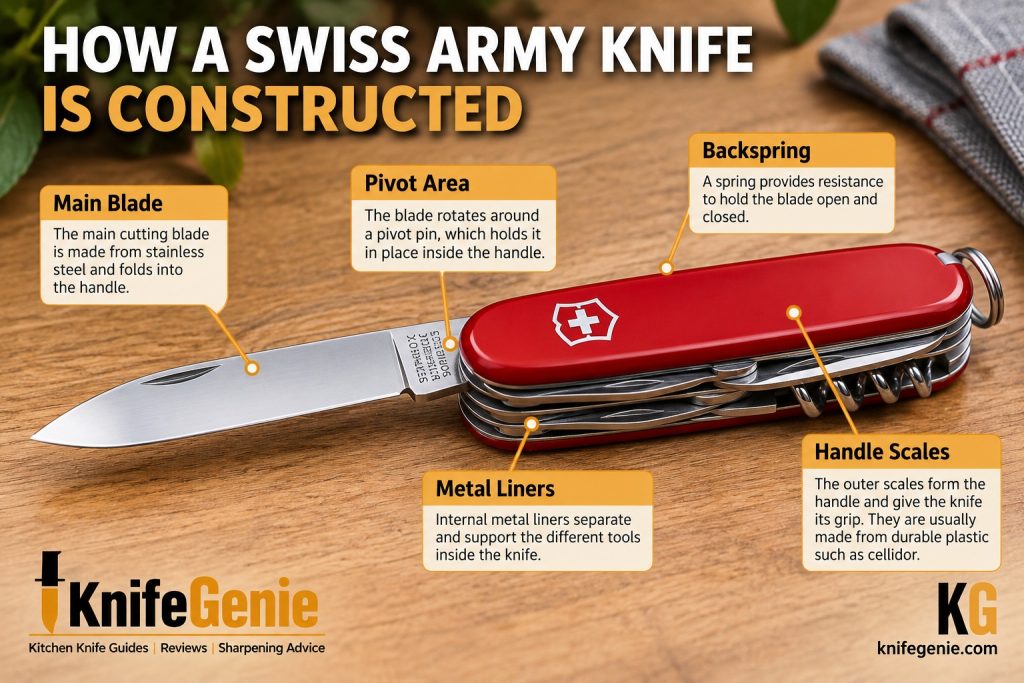
These tools share a carefully arranged system of pivot pins, backsprings, and metal liners.
The construction is designed to provide a compact, reliable tool rather than make individual blade replacement convenient for the owner.
How a Traditional Swiss Army Knife Is Assembled
A typical construction includes:
- Main blade: The primary cutting tool.
- Pivot pin: Holds the blade in its operating position.
- Backspring: Provides resistance and helps retain the blade in its open or closed position.
- Liners: Separate and support the internal tool layers.
- Handle scales: Form the outer grip.
- Other tools: Share the knife’s layered construction.
The pivot pins are commonly peened during assembly. Removing them can require drilling, filing, or other metalworking operations, followed by accurately fitting replacement hardware.
That is very different from loosening a screw on a folding knife.
Are All Swiss Army Knives Constructed the Same Way?
No.
Victorinox has produced many knife designs, including traditional officer-style pocket knives, larger locking-blade models, and specialized multi-tools.
The details of their construction and repair procedures vary.
A repair method suitable for one model may not work on another.
Before ordering parts or considering disassembly, identify the exact knife model.
🔍 Step 1: Check Whether the Blade Really Needs Replacing
The first step is determining what has actually gone wrong.
A blade that cuts poorly may need sharpening, while a blade that wobbles, bends, or has a damaged pivot may require more extensive work.
1. The Blade Is Dull
A dull blade is the easiest problem to address.
If the cutting edge has become rounded through ordinary use, sharpening may restore its performance without replacing any parts.
You can learn more about the difference between edge maintenance and sharpening in our Honing vs Sharpening guide.
2. The Blade Has a Small Chip
A minor chip may sometimes be removed through careful sharpening, depending on its size and location.
However, removing a chip means removing additional steel.
Large chips, damage near the pivot, or cracks should be assessed by a professional.
3. The Blade Tip Is Broken
Broken tips are a relatively common form of pocket-knife damage.
A small amount of tip damage may sometimes be corrected by reshaping the blade, but doing so changes its original profile.
For a valuable or collectible Swiss Army Knife, professional repair is generally preferable.
4. The Blade Is Bent or Cracked
This is more serious.
A bent blade may no longer align correctly inside the handle. A crack can weaken the steel and create a risk of sudden failure.
Do not attempt to straighten a cracked blade or continue using it.
5. The Blade Is Loose or Difficult to Open
Not every opening problem is caused by the blade itself.
Dirt, dried lubricant, corrosion, damaged springs, or worn pivot components can affect operation.
Cleaning may resolve an ordinary stiffness problem. A blade with excessive side-to-side movement, abnormal spring resistance, or damaged hardware needs professional inspection.
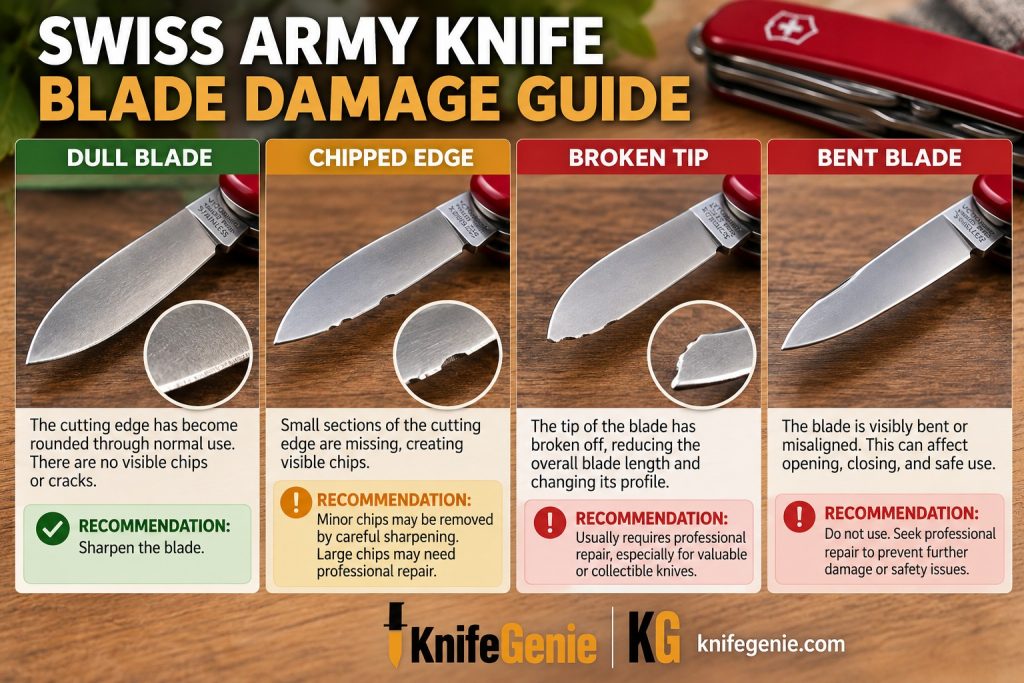
Different types of blade damage require different maintenance or repair solutions.
🛠️ Step 2: How to Arrange a Swiss Army Knife Blade Replacement
For most readers, professional repair is the most practical route.
Victorinox provides product support and repair services, although procedures, charges, and availability can vary by country and by the knife’s condition.
1. Identify Your Knife
Check the markings on the blade and the design of the handle.
Look for information such as:
- The Victorinox name or tang stamp.
- The approximate handle length.
- The number and arrangement of tools.
- Whether the blade locks.
- Any distinctive features that identify the model.
If you still have the original packaging, that may help.
2. Document the Damage
Take clear photographs of the affected blade and any other damaged components.
Describe what happened and whether the blade still opens and closes correctly.
If the knife has sentimental or collector value, mention that before authorizing repair. Ask whether original parts will be retained or replaced.
3. Contact Victorinox
Visit the official Victorinox Swiss Army Knife Product Support page.
Follow the instructions for your country or contact an appropriate authorized service representative.
Ask whether the damaged blade is repairable, whether a replacement part is available, and whether the work may be covered by warranty.
4. Review the Repair Conditions
Before sending the knife, check:
- Whether you need a repair authorization.
- Whether there are inspection or processing charges.
- Whether shipping is your responsibility.
- Whether the repair is covered by warranty.
- Whether replacement parts will match the original model.
- Whether the knife may be replaced rather than repaired.
Warranty coverage depends on the cause of damage and the manufacturer’s terms. Accidental damage or misuse should not be assumed to qualify for free service.
5. Package the Knife Safely
Close the blade if it can be done safely.
If the blade cannot close, protect the exposed edge securely and follow the repair center’s packing instructions.
Use a sturdy package that prevents movement during shipping. Follow applicable carrier rules for sending knives.
6. Inspect the Knife After Repair
When the repaired knife returns, check that:
- The blade opens and closes smoothly.
- The blade aligns correctly with the handle.
- The backspring operates normally.
- There is no unusual movement at the pivot.
- Other tools function as expected.
Do not test the blade by running your finger along its edge.
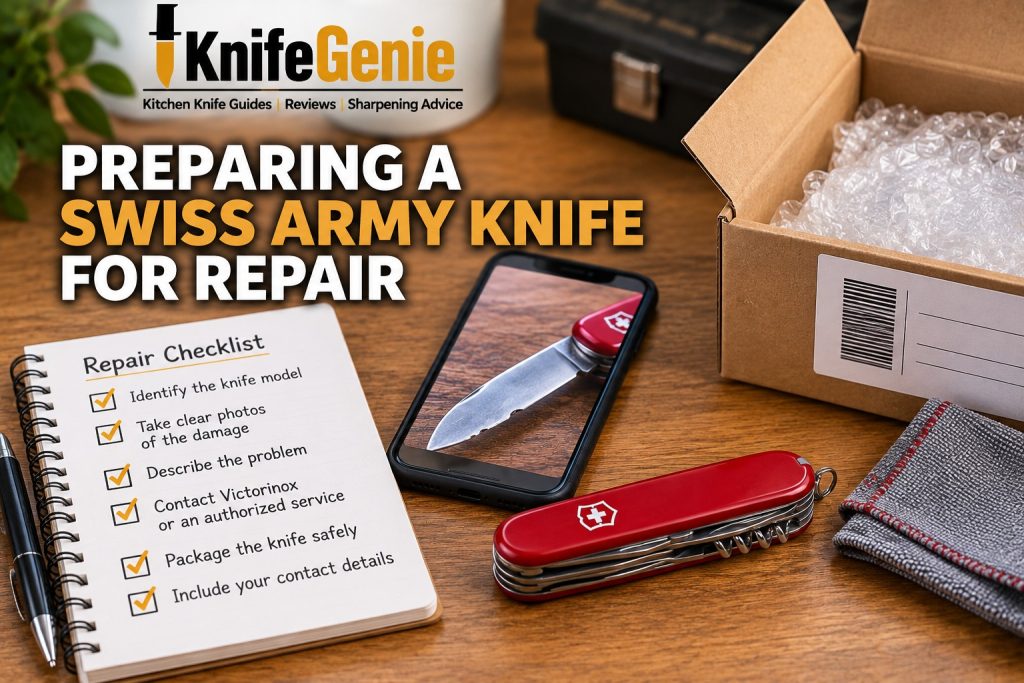
Identify the knife, document the damage, and follow the repair center’s shipping instructions.
⚙️ Step 3: Can You Replace a Swiss Army Knife Blade Yourself?
Technically, some experienced knife restorers can replace blades in traditional Swiss Army Knives.
However, the process is not beginner-friendly.
Unlike a folding knife with screw-fastened pivots, a traditional Swiss Army Knife generally requires more extensive disassembly.
What DIY Blade Replacement Involves
A specialist repair may involve the following stages:
1. Identify the exact model and compatible replacement blade.
The blade must match the knife’s construction, including pivot geometry, thickness, tang profile, and spring arrangement.
2. Document the original assembly.
The arrangement of tools, liners, washers where present, and backsprings must be understood before disassembly.
3. Remove the existing pivot hardware.
Peened pins generally cannot be removed in the same way as screws. Removing them can permanently damage the hardware and may damage nearby components.
4. Inspect the internal components.
The restorer checks the spring, liners, pivot holes, and neighboring tools for wear or damage.
5. Fit a compatible replacement blade.
A replacement must interact correctly with the backspring and adjacent components.
6. Reassemble and test the mechanism.
The pivot hardware must be properly fitted, and the blade must open, close, and remain correctly aligned.
These are the broad stages of a specialist repair, not a beginner disassembly tutorial. The precise procedure depends on the model, and incorrect assembly can create a dangerous folding mechanism.
Why We Don’t Recommend DIY Replacement for Beginners
Improper repairs can cause:
- Excessive blade movement.
- Weak or uneven spring tension.
- Poor blade alignment.
- Damage to the handle scales or liners.
- Binding against neighboring tools.
- Unexpected blade closure.
- Permanent damage to an otherwise repairable knife.
A replacement blade that looks similar is not necessarily mechanically compatible.
KnifeGenie Tip: If you cannot positively identify the knife model, obtain compatible parts, and verify the completed mechanism, professional repair is the safer option.
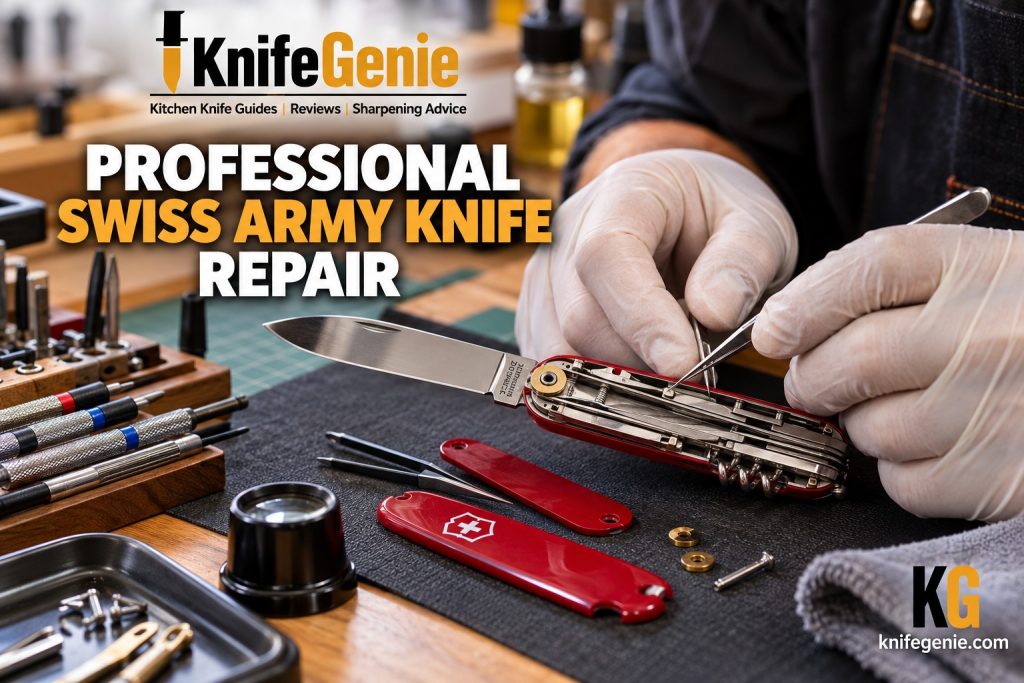
Replacing a traditional Swiss Army Knife blade requires compatible parts and careful reassembly.
⚖️ Should You Repair the Blade or Replace the Entire Knife?
Not every damaged knife is worth repairing.
Sometimes restoring a blade is the obvious choice. In other situations, replacing an inexpensive pocket knife may be more practical.
| Situation | Better option |
|---|---|
| Knife has sentimental value | Seek professional repair |
| Vintage or collectible model | Consult a specialist |
| Minor dullness | Sharpen |
| Broken blade covered by warranty | Contact Victorinox |
| Severe damage to several components | Compare repair and replacement costs |
| Inexpensive knife with expensive out-of-warranty repair | Consider replacing the knife |
| Rare discontinued model | Investigate parts availability before repair |
When Repair Makes More Sense
Repair is particularly attractive when the knife has personal history, collectible value, or features that are no longer available on current models.
An older Swiss Army Knife inherited from a family member may be worth preserving even if professional repair costs more than purchasing a modern equivalent.
When Buying a New Knife Makes More Sense
For an ordinary, inexpensive model with extensive damage, replacement may be more economical.
However, obtain an estimate before assuming repair will be too expensive.
If you’re considering a different style of folding knife, our Buying a Cool Pocket Knife guide explains blade styles, locking mechanisms, handle materials, and other features worth comparing.
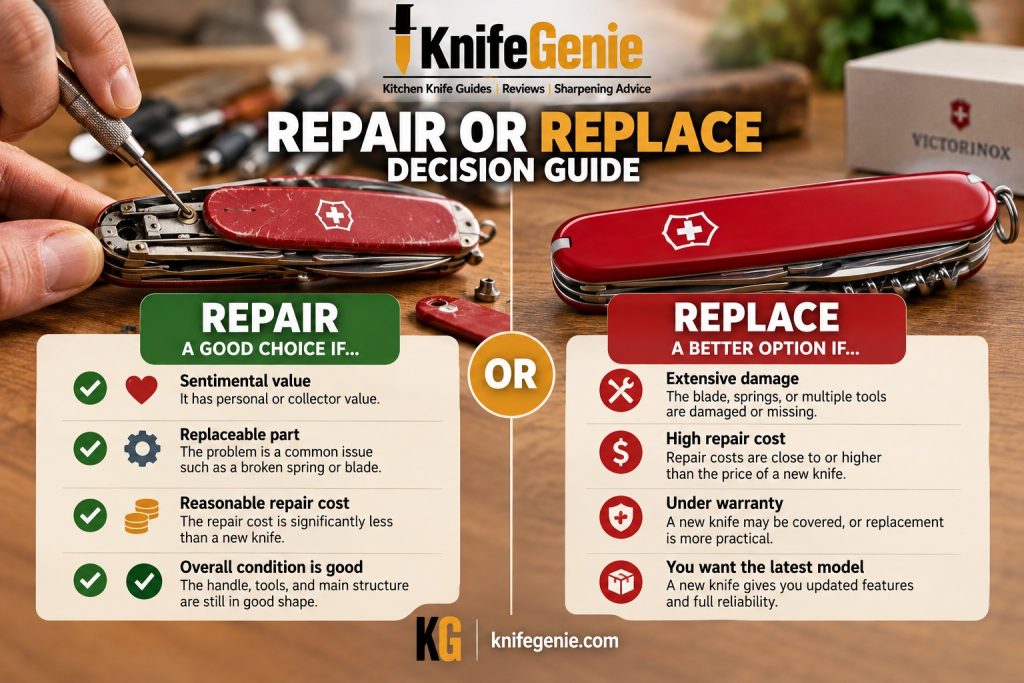
Repair may be worthwhile for sentimental or collectible knives, while replacement may suit extensively damaged models.
🧼 How to Maintain a Swiss Army Knife and Avoid Blade Damage
Good maintenance can reduce the likelihood of blade problems.
Although Swiss Army Knives are designed for everyday use, their compact blades and internal mechanisms still need reasonable care.
Keep the Knife Clean
Remove dirt, food residue, and other debris after use.
Follow the manufacturer’s cleaning instructions and avoid leaving the knife wet.
Dry it thoroughly, paying attention to the joints and spaces between tools.
Lubricate the Moving Parts
A small amount of manufacturer-recommended lubricant can help keep the joints operating smoothly.
Avoid excessive oil, which may attract dirt.
If the knife is used around food, choose a lubricant suitable for that application and follow its instructions.
Sharpen Before the Blade Becomes Severely Dull
A properly maintained edge requires less cutting force.
For an undamaged plain-edge blade, sharpening is usually preferable to replacement.
If you want to learn the fundamentals of controlled sharpening, see our How to Sharpen a Chef Knife With a Whetstone guide. The principles of abrasion and edge formation are useful, but the sharpening angle and technique must suit your particular pocket knife.
Avoid Using the Blade as a Pry Tool
A Swiss Army Knife blade is designed primarily for cutting.
Do not use it to pry open containers, turn screws, twist against hard materials, or perform tasks better suited to another tool.
Sideways force can damage the blade or pivot.
Store the Knife Properly
Keep the knife dry and closed when it is not being used.
Avoid storing it loose among heavy metal objects that may damage the blade or handle.
Our How to Store Kitchen Knives Safely guide explains general principles of protecting cutting edges, although pocket knives require storage appropriate to their folding construction.
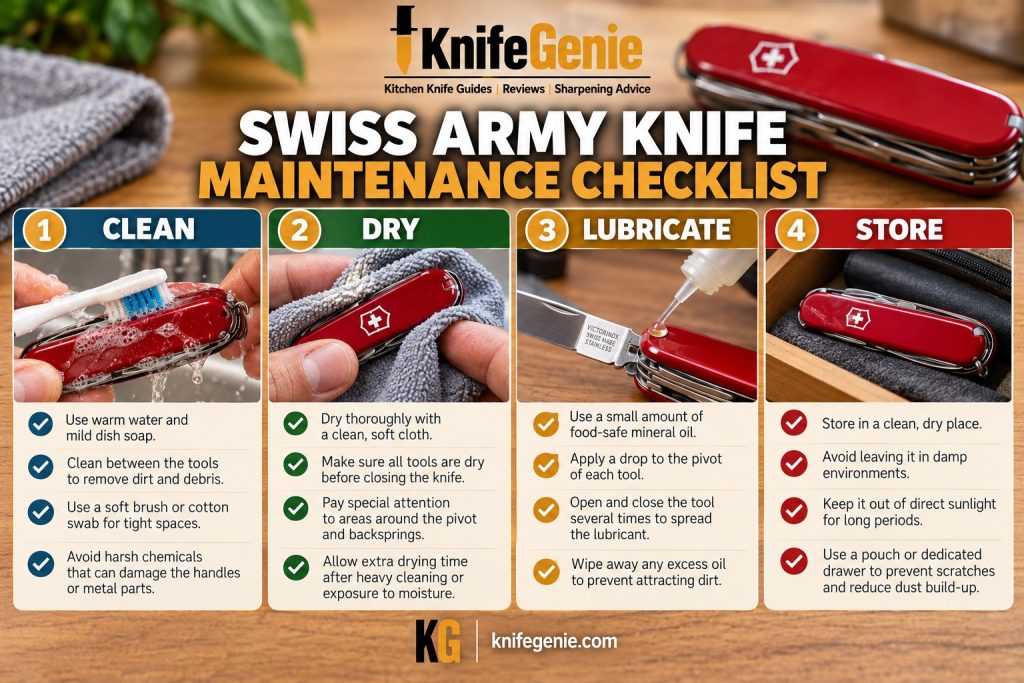
Regular cleaning, careful lubrication, and appropriate use can help prevent blade damage.
❌ Common Mistakes to Avoid
Replacing a Swiss Army Knife blade is one of those repairs where a seemingly small mistake can cause a larger problem.
Avoid these common errors:
❌ Assuming every Swiss Army Knife has a removable blade.
Most traditional models use permanent pivot hardware.
❌ Buying a replacement blade based on appearance alone.
Small dimensional differences can prevent proper operation.
❌ Trying to straighten a cracked blade.
A cracked blade should be removed from service and professionally assessed.
❌ Forcing a stiff blade open.
The problem may involve debris, corrosion, or internal damage.
❌ Using excessive force during disassembly.
The liners, springs, and pivot holes can be damaged.
❌ Assuming every repair is covered by warranty.
Coverage depends on the manufacturer’s terms and the cause of damage.
❌ Ignoring the knife’s collectible value.
Replacing original parts may affect its historical character or value.
💡 KnifeGenie Pro Tips
✔ Check the blade before the handle. A cutting problem may be solved by sharpening.
✔ Identify the exact model. Similar-looking Swiss Army Knives can have different internal components.
✔ Photograph the damage. Clear photographs help explain the problem to a repair center.
✔ Ask about replacement parts. Availability may vary with the model and age of the knife.
✔ Protect sentimental knives. Tell the repairer if retaining original components matters to you.
✔ Never ignore blade movement. A blade that shifts unexpectedly may indicate a damaged mechanism.
✔ Use the right tool for the job. Avoid prying, twisting, or applying sideways force to the cutting blade.
❓ Frequently Asked Questions
Can you replace the main blade on a Victorinox Swiss Army Knife?
Yes, replacement may be possible through professional repair. However, most traditional models do not have a main blade designed for straightforward user replacement.
Does Victorinox replace broken blades?
Victorinox provides repair services for Swiss Army Knives. Whether a particular broken blade can be replaced, and whether charges apply, depends on the model, damage, and warranty conditions.
Can I buy a replacement Swiss Army Knife blade?
Some replacement components may be available through specialist suppliers or from donor knives. However, availability does not guarantee compatibility. Contact the manufacturer or a qualified repairer before purchasing internal blade parts.
Can I replace a Swiss Army Knife blade without taking the knife apart?
For most traditional models, no. The blade is secured within the knife’s layered pivot assembly, so replacement generally requires disassembly.
Can I replace a broken blade with a different blade shape?
Custom modifications may be possible for experienced specialists, but the replacement must be mechanically compatible with the knife’s pivot, backspring, and internal construction.
A different blade shape is not automatically a suitable replacement.
Is it worth repairing an old Swiss Army Knife?
Often, yes—particularly if it has sentimental or collectible value. For an ordinary model, compare the repair estimate with the cost of a replacement knife.
Will replacing the blade void the warranty?
Unauthorized modifications or damage caused by an improper repair may affect warranty coverage. Check Victorinox’s current warranty terms before modifying the knife.
What should I do if the blade is simply difficult to open?
First check for dirt, residue, or dried lubricant and follow the manufacturer’s cleaning guidance. If the blade remains stiff or the mechanism appears damaged, seek professional service rather than forcing it.
🧙 KnifeGenie Final Verdict: Repair the Blade the Right Way
Replacing the blade on a Swiss Army Knife is possible in many circumstances, but it is not usually a simple home-maintenance task.
Traditional Swiss Army Knives are assembled around carefully fitted pivot pins, springs, and internal liners. Removing and replacing a blade requires more than finding a similar piece of steel.
For most owners, professional repair through Victorinox or a qualified specialist is the best starting point.
If the blade is merely dull, sharpening may be all that is needed. If it is bent, cracked, broken, or loose, stop using it until the problem has been properly assessed.
A well-maintained Swiss Army Knife can provide many years of useful service. Knowing when to sharpen, repair, or replace a damaged blade is part of keeping it safe and dependable.
For more guidance on selecting folding knives, read our Pocket Knife Buying Guide.
KnifeGenie provides research-based educational information about knives, maintenance, and safe handling. Internal repairs to folding knives should be performed by qualified professionals when specialized tools or mechanical expertise are required.
