If you’re shopping for a new kitchen knife, you’ll probably come across two terms fairly quickly: forged and stamped.
For years, the conventional wisdom was simple: forged knives were the premium choice, while stamped knives were the cheaper alternative.
But that distinction isn’t nearly as clear-cut today.
Modern manufacturing has produced some excellent stamped knives, while traditional forged knives remain popular with cooks who prefer more weight, rigidity and a substantial feel in the hand.
So, when comparing forged vs stamped knives, which should you actually buy?
⚡ The Quick Answer
Choose a forged knife if you prefer a substantial, solid-feeling knife with more weight and the traditional feel associated with many premium Western chef’s knives.
Choose a stamped knife if you want something lighter, usually less expensive and easier to maneuver.
For most home cooks, the quality of the individual knife matters more than whether it is forged or stamped.
👇 Jump to What You Need
👉 Forged vs Stamped Knives at a Glance
👉 7 Key Differences Between Forged and Stamped Knives
👉 Which Type Holds an Edge Longer?
👉 What to Look for Before Buying
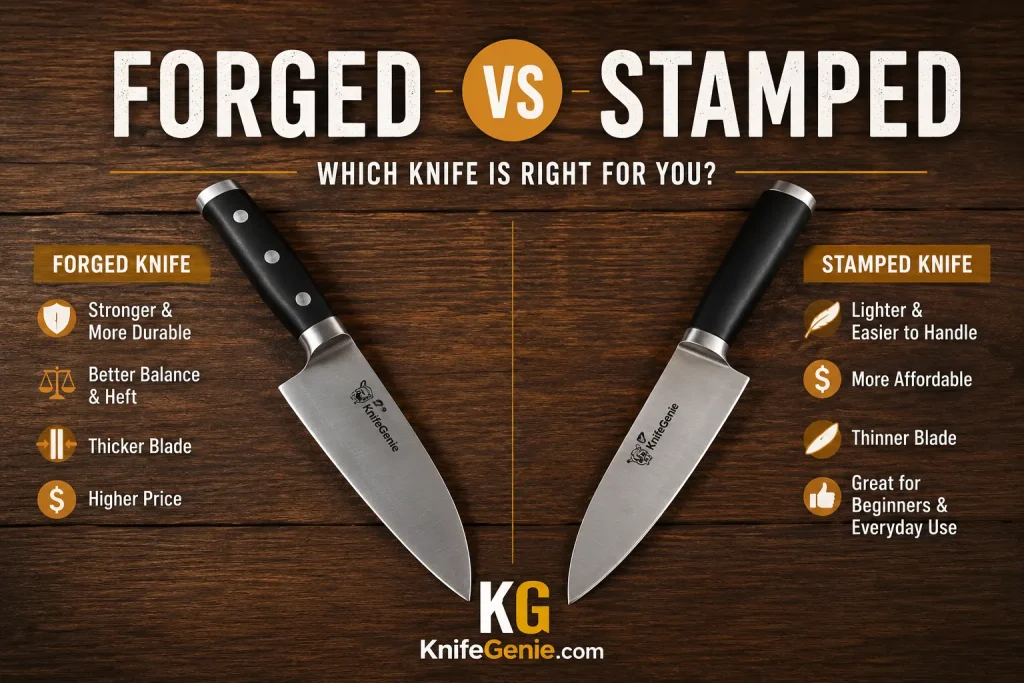
FORGED VS STAMPED
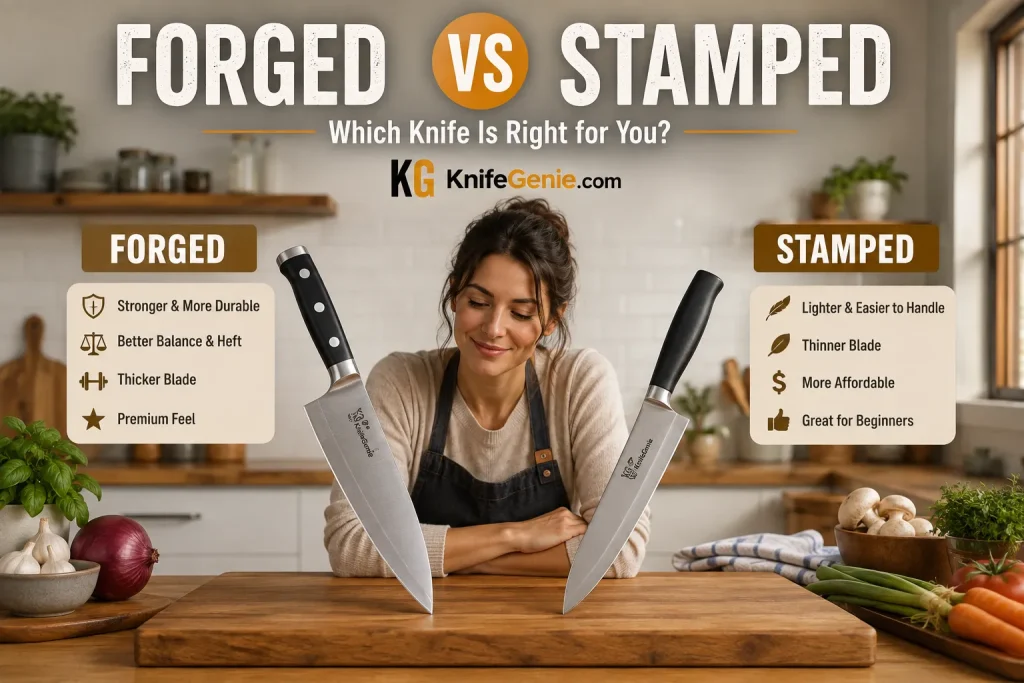
⚖️ Forged vs Stamped Knives at a Glance
Before getting into the details, here’s the easiest way to see how the two types compare.
| Feature | 🔥 Forged Knife | 🪶 Stamped Knife |
|---|---|---|
| Manufacturing | Steel is heated and formed into the knife blank | Blade blank is cut from sheet steel |
| Typical weight | Medium to heavy | Light to medium |
| Bolster | Common, but not universal | Often absent |
| Blade thickness | Often thicker | Often thinner |
| Flexibility | Usually more rigid | Often more flexible |
| Feel | Substantial | Light and agile |
| Price | Usually higher | Usually lower |
| Full tang | Common | Also possible |
| Best for | Weight, stability and traditional feel | Agility, lightness and value |
| Quality potential | Excellent | Also excellent |
🏆 KnifeGenie Quick Pick
🔥 Choose forged if: You like a substantial chef’s knife with reassuring weight and a traditional premium feel.
🪶 Choose stamped if: You prefer a lightweight knife that’s quick and maneuverable or want strong performance without spending as much.
💡 Remember: Don’t choose based on construction alone. Steel, heat treatment, blade geometry, balance and ergonomics can matter just as much—or more.
🔥 What Is a Forged Knife?
A forged knife begins with a piece of steel that is heated and mechanically formed into the basic knife blank.
The blade then goes through additional manufacturing processes that can include:
⚙️ Heat treatment
🔪 Grinding
✨ Polishing and finishing
🎯 Edge sharpening
When people hear the word “forged,” they sometimes picture a bladesmith hammering red-hot steel by hand.
That still happens with artisan knives, but modern commercial forging is generally much more automated.
The important distinction is that the steel is formed into the knife blank rather than simply being cut from sheet steel.
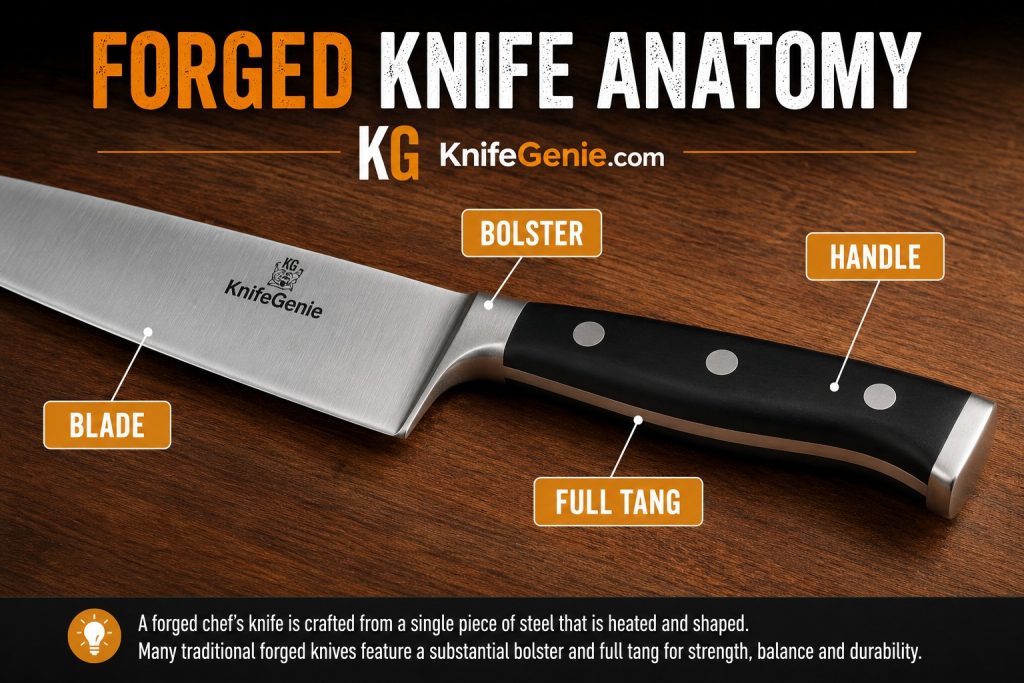
Many traditional forged Western chef’s knives also have a pronounced bolster—the thicker section where the blade transitions into the handle.
🔥 Forged Knives Commonly Feel:
✔️ Heavier
✔️ More substantial
✔️ Rigid
✔️ Stable during chopping
✔️ Balanced around the bolster or pinch-grip area
⚠️ But these are tendencies, not rules.
Modern knife designs vary considerably.
FORGED KNIFE ANATOMY BREAKDOWN
🪶 What Is a Stamped Knife?
A stamped knife starts differently.
Instead of forming heated steel into the basic knife blank, manufacturers generally begin with sheet steel.
The knife blank is cut from that sheet before undergoing processes such as:
✂️ Cutting the blade blank
🌡️ Heat treatment
⚙️ Grinding
✨ Finishing
🔪 Sharpening
Because the initial shaping process can be more efficient, stamped knives can often be manufactured less expensively.
That’s one reason you’ll see stamped construction used on many affordable kitchen knives.
⚠️ But Don’t Make This Mistake
Less expensive manufacturing does not automatically mean poor quality.
Modern stamped knives can be extremely capable cutting tools.
They’re often thinner and lighter than traditional forged knives, which can actually be an advantage if you spend a lot of time preparing food.
💡 Did You Know?
A stamped knife can have a full tang.
A full tang describes how far the steel extends through the handle. It doesn’t tell you whether the blade blank was forged or stamped.
🪶 Stamped Knives Commonly Feel:
✔️ Lighter
✔️ Thinner
✔️ More agile
✔️ Less tiring during extended prep
✔️ More flexible than heavier forged knives
For cooks who dislike heavy chef’s knives, those characteristics can be a major advantage.
The Process of Making These Knives

🔍 7 Key Differences Between Forged and Stamped Knives
The manufacturing process is interesting, but what really matters is how those differences affect the knife in your kitchen.
Let’s compare them.
⚖️ 1. Weight
Weight is one of the easiest differences to notice.
🔥 Forged Knives
Traditional forged chef’s knives tend to contain more steel around the spine, bolster and handle junction.
That often makes them heavier.
Some cooks love the extra mass because it gives the knife a substantial, controlled feeling when chopping.
🪶 Stamped Knives
Stamped knives tend to be lighter.
That can make them feel faster and less tiring during repetitive slicing, trimming and everyday prep.
🏆 Winner: It Depends
🔥 Want a substantial knife? Forged
🪶 Want a light, nimble knife? Stamped
👉 Neither is automatically better.
🎯 2. Balance
Forged knives have traditionally earned a strong reputation for balance.
A substantial bolster and handle construction can place the balance point around the area where many cooks naturally use a pinch grip.
But balance depends on the entire knife design, not simply how the blade was manufactured.
A well-designed stamped knife can also feel beautifully balanced.
🏆 Winner: Forged — Slight Advantage
Particularly if you prefer the traditional balance and feel of a German-style chef’s knife.
Read our German vs Japanese knife article
📏 3. Blade Thickness
Stamped blades are frequently thinner than traditional forged Western blades.
And that’s not necessarily a weakness.
A thin blade can move through vegetables with surprisingly little resistance.
A traditional forged knife may feel more substantial and rigid, especially when you’re chopping larger ingredients.
🏆 Winner: Tie
👉 Thinner isn’t automatically better.
👉 Thicker isn’t automatically better.
Choose according to what you’re cutting.
↔️ 4. Flexibility
Stamped knives are often more flexible because their blades tend to be thinner.
That can be extremely useful.
🐟 Think about a fillet knife following the contours of a fish.
🥩 Or a flexible boning knife working around bones and joints.
For a general-purpose chef’s knife, however, many cooks prefer more rigidity and the ease of sharpening a boning knife or fillet knife.
🏆 Winner: Depends on the Job
👉 For more on this distinction, see KnifeGenie’s Boning Knife vs Fillet Knife: Which One Do You Need?
🛡️ 5. Bolster Design
The bolster is the thicker section where the blade transitions into the handle.
It’s one of the easiest features to notice on many traditional forged chef’s knives.
Stamped knives frequently omit a substantial bolster, helping keep the knife lighter.
👍 Full Bolster Advantages
✔️ Traditional feel
✔️ Added weight around the grip
✔️ Finger protection
✔️ Can contribute to balance
👎 Potential Disadvantages
❌ Additional weight
❌ Some full bolsters can complicate sharpening near the heel
❌ Not everyone likes the feel
🏆 Winner: Personal Preference
A bolster isn’t automatically a sign that one knife will perform better than another.
BOLSTER COMPARISON GUIDE

💰 6. Price
Here’s one category where stamped knives usually have a clear advantage.
Forging can involve additional manufacturing processes, which contributes to higher production costs.
Premium materials, finishing and brand positioning can push prices higher still.
Stamped knives can generally be manufactured more efficiently.
💵 Stamped Knives Make Sense For:
👉 First-time knife buyers
👉 Budget-conscious home cooks
👉 Secondary kitchen knives
👉 Busy kitchens requiring multiple knives
👉 Cooks who value performance over traditional construction
🏆 Winner: Stamped
💡 If value is your priority, don’t dismiss a well-made stamped knife.
✋ 7. Overall Feel
This may matter more than any specification.
Pick up a traditional forged German chef’s knife and then pick up a thin stamped chef’s knife.
They can feel completely different.
🔥 Forged May Feel:
✔️ Solid
✔️ Substantial
✔️ Stable
✔️ Reassuring
🪶 Stamped May Feel:
✔️ Light
✔️ Quick
✔️ Agile
✔️ Nimble
🏆 Winner: You Decide
Comfort beats specifications.
The knife that feels natural in your hand will usually be a better choice than one you bought simply because the box says “forged.”
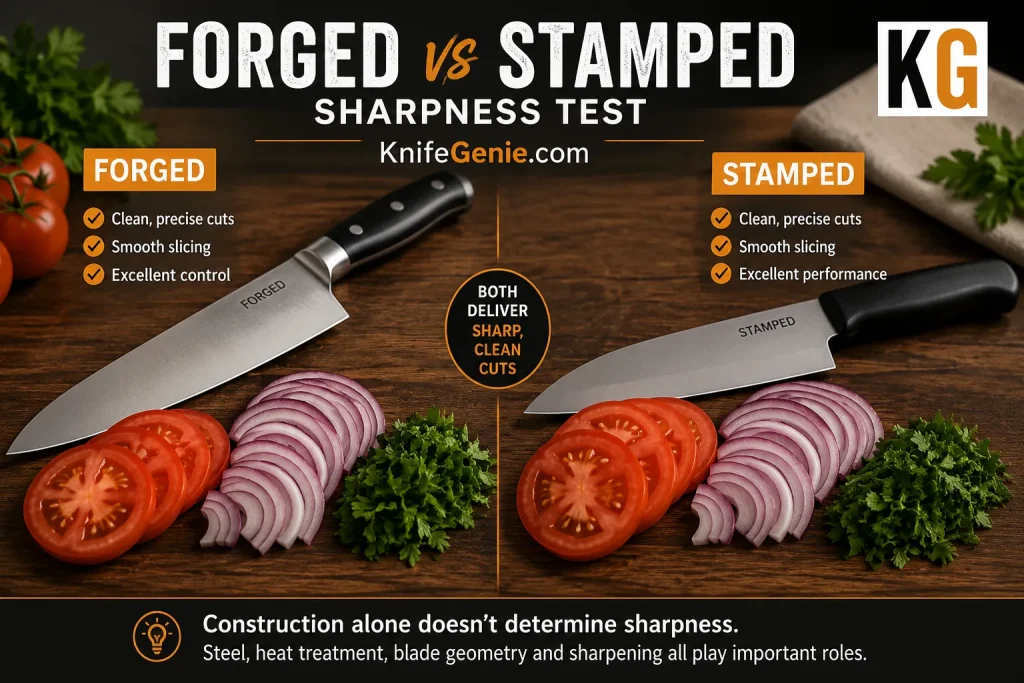
🔪Are Forged Knives Sharper Than Stamped Knives?
No—not automatically.
This is probably the biggest misconception in the forged vs stamped knives debate.
Forging describes how the knife blank is manufactured.
Sharpness describes the cutting edge.
They’re not the same thing.
🎯 Sharpness Depends on Factors Such As:
👉 Edge geometry
👉 Overall blade geometry
👉 Steel
👉 Heat treatment
👉 Edge angle
👉 Thickness behind the edge
👉 Maintenance
An excellent stamped knife can therefore be sharper than a mediocre forged knife.
And after enough use, both will eventually become dull.
🏆 Winner: Tie
⚠️ Don’t pay more for a forged knife simply because someone tells you forged automatically means sharper. It doesn’t.
If your knife no longer slices cleanly through a tomato, read KnifeGenie’s How Often Should You Sharpen Kitchen Knives?
SHARPNESS TEST
⏳ Which Type Holds an Edge Longer?
Here’s another misconception:
Forged doesn’t automatically mean better edge retention.
How long a knife remains sharp depends heavily on:
🧪 Steel
🌡️ Heat treatment
📐 Edge geometry
🔪 How you use it
🪵 Your cutting surface
🧽 How you maintain it
A high-quality stamped blade with suitable steel and excellent heat treatment may hold its edge longer than a poorly made forged knife.
💡 KnifeGenie Tip
When comparing two knives, don’t stop at:
❌ Forged vs stamped
Instead consider:
✅ Steel + heat treatment + geometry + ergonomics + construction + manufacturer
That’s a much better way to judge a kitchen knife.
Learn more about knife edge retention.
🔥 Forged Knife Pros and Cons
👍 Pros
✔️ Substantial feel — Many cooks enjoy the extra weight and solidity.
✔️ Excellent stability — Often relatively rigid during heavier chopping.
✔️ Traditional balance — Bolstered designs can feel excellent with a pinch grip.
✔️ Premium construction options — Many established premium knife lines use forged construction.
✔️ Long service potential — A quality forged knife can provide many years of service with proper care.
👎 Cons
❌ Usually more expensive
❌ Additional weight isn’t for everyone
❌ Full bolsters can make sharpening near the heel more difficult
❌ Forged construction alone doesn’t guarantee quality
Forged or stamped construction should be of primary concern whether they are American-made kitchen knives or foreign.
🪶 Stamped Knife Pros and Cons
👍 Pros
✔️ Lightweight
✔️ Easy to maneuver
✔️ Usually more affordable
✔️ Often thinner
✔️ Can be excellent for repetitive prep
✔️ Flexibility can be useful in specialized knives
👎 Cons
❌ May feel too light for some cooks
❌ Often lacks the substantial feel of a traditional forged knife
❌ Quality varies considerably
❌ Some blades may be more flexible than you want in a chef’s knife
🛒 Forged vs Stamped Knives: Which Should You Buy?
Here’s the easiest way to decide.
🔥 Buy a Forged Knife If…
👉 You like some weight in your knife
👉 You prefer a solid, substantial feel
👉 You enjoy traditional German-style chef’s knives
👉 You like a bolstered design
👉 You frequently use a rocking chopping motion
👉 You don’t mind paying more for the construction you prefer
⭐ Best For:
Cooks who want a traditional, substantial chef’s-knife experience.
🪶 Buy a Stamped Knife If…
👉 You prefer lightweight knives
👉 You do lots of repetitive food prep
👉 You want maximum maneuverability
👉 You’re shopping on a tighter budget
👉 You don’t want a large bolster
👉 You prefer a thinner blade
👉 You need an affordable everyday working knife
⭐ Best For:
Cooks who prioritize lightness, agility and value.
⚠️ Don’t think of stamped construction as something you automatically need to “upgrade” from.
A good stamped knife may be exactly what you need.
🛍️ 7 Things to Check Before Buying Either Type
Whether you’re buying forged or stamped, these factors deserve your attention.
✋ 1. Comfort
Whenever possible, hold the knife.
Ask yourself:
👉 Does the handle fit my hand?
👉 Can I use my normal grip comfortably?
👉 Are there pressure points?
👉 Does it feel secure?
A knife can have superb steel and premium construction and still be the wrong knife for you.
⚖️ 2. Balance
Use your normal grip.
If you use a pinch grip, pay particular attention to the blade-and-handle junction.
A balanced knife should feel controlled rather than awkwardly blade-heavy or handle-heavy.
👉 See KnifeGenie’s How to Hold a Chef Knife for more on proper grip.
🏋️ 3. Weight
Don’t automatically assume heavier means better.
🔥 Some cooks love a substantial 8-inch forged chef’s knife.
🪶 Others perform better with a lightweight knife.
If you’re also deciding on blade length, read What Size Chef Knife Is Best for Home Cooking?
🧪 4. Steel and Heat Treatment
The steel name printed on the box doesn’t tell the whole story.
Heat treatment plays an important role in how that steel ultimately performs.
💡 Look beyond impressive specifications and consider the manufacturer’s reputation for consistent knife production.
📐 5. Blade Geometry
This is easy to overlook.
A knife that’s relatively thin behind its cutting edge can slice very efficiently.
Two knives made from similar steel can feel dramatically different in food because their blade geometry differs.
✋ 6. Handle
Check the:
👉 Shape
👉 Size
👉 Grip security
👉 Handle material
👉 Rivets and seams
👉 Pinch-grip comfort
👉 Knuckle clearance
You’ll interact with the handle every time you use the knife.
Don’t make it an afterthought.
🛡️ 7. Bolster Design
If the knife has a bolster, inspect it.
A traditional full bolster can provide protection and a substantial feel.
A half-bolster or bolsterless design may make it easier to sharpen the entire cutting edge.
💡 KnifeGenie Tip
Don’t automatically choose the knife with the biggest bolster. Choose the design that feels best in your normal grip.
BUYING DECISION

Both construction methods are represented among American-made kitchen knives, so country of manufacture alone doesn’t tell you whether a blade is forged or stamped.
🍽️ Which Construction Is Best for Different Kitchen Knives?
You don’t necessarily need every knife in your kitchen to use the same construction.
| 🔪 Knife Type | 🔥 Forged May Suit You If… | 🪶 Stamped May Suit You If… |
|---|---|---|
| Chef’s knife | You want weight and stability | You want lightness and agility |
| Santoku | You prefer a substantial feel | You want a lightweight prep knife |
| Boning knife | You prefer more rigidity | You want more flexibility |
| Fillet knife | You want greater rigidity | Thinness and flexibility are priorities |
| Paring knife | You prefer a substantial feel | You want maximum nimbleness |
| Bread knife | You value premium construction | You want excellent value |
| Carving knife | You prefer rigidity and weight | You want a thin, lightweight slicer |
💡 A Smart Knife Collection Might Include:
🔥 Forged chef’s knife
➕
🪶 Stamped boning knife
➕
🪶 Stamped bread knife
There is absolutely nothing wrong with mixing construction styles.
Choose the best tool for each job.
⚠️ Myth #1: A Full Tang Means the Knife Is Forged
False.
A full tang means the knife’s steel extends through the handle.
Forging describes how the knife blank was manufactured.
Those are two separate characteristics.
Many traditional forged knives do have full tangs, which probably explains the confusion.
But stamped knives can have full tangs too.
💡 Remember:
FULL TANG ≠ AUTOMATICALLY FORGED
⚠️ Myth #2: Forged Always Means Better
This is probably the biggest myth of all.
There are:
🔥 Superb forged knives
🪶 Superb stamped knives
🔥 Mediocre forged knives
🪶 Mediocre stamped knives
Imagine you’re choosing between:
❌ A poorly designed forged knife
and
✅ A well-designed stamped knife with good steel, proper heat treatment, excellent geometry and a comfortable handle.
🏆 KnifeGenie Choice:
Take the better-designed stamped knife.
Every time.
❓ Frequently Asked Questions
👨🍳 Are Professional Chef Knives Forged or Stamped?
Both.
Professional cooks choose knives according to performance, comfort, reliability, maintenance requirements and the job they’re doing.
Construction method is only one factor.
⭐ Can Stamped Knives Be High Quality?
Absolutely.
Stamped describes a manufacturing method—not a quality grade.
A properly designed stamped knife made from suitable steel and given good heat treatment can be an excellent kitchen tool.
💪 Are Forged Knives Stronger?
Traditional forged chef’s knives are often thicker and more rigid than lightweight stamped knives.
That can give them a very substantial feel.
However, overall durability depends on much more than the initial blade-forming process.
⚖️ Are Forged Knives Heavier?
Usually, but not always.
Traditional forged Western chef’s knives frequently have thicker spines, bolsters and substantial handles that increase their overall weight.
Modern designs vary considerably.
↔️ Are Stamped Knives More Flexible?
Often.
Stamped blades are frequently thinner, which can make them more flexible.
That can be particularly useful for boning and fillet knives.
💰 Are Forged Knives More Expensive?
Generally, yes.
Forging can involve additional manufacturing processes and is commonly found in premium knife lines.
Prices still vary considerably by manufacturer, steel, design and finishing.
🛡️ Does a Bolster Mean a Knife Is Forged?
Not necessarily.
A substantial bolster is strongly associated with traditional forged knives, but you shouldn’t determine the manufacturing process from a single design feature.
Check the manufacturer’s specifications.
🔩 Does a Full Tang Mean a Knife Is Forged?
No.
Stamped knives can also have full tangs.
🧑🍳 Which Is Better for Beginners?
A good stamped chef’s knife can be an excellent first knife because it may offer strong performance at an affordable price.
But a beginner who prefers the feel and balance of a forged knife shouldn’t hesitate to choose one.
👉 Comfort matters more than the label.
🏠 Which Is Better for Serious Home Cooks?
Either.
🔥 If you cook frequently and appreciate a solid, substantial chef’s knife, you may prefer forged construction.
🪶 If you value speed, low weight and maneuverability, a high-quality stamped knife may suit you better.
🏆 KnifeGenie Verdict: Forged or Stamped?
For most buyers, forged vs stamped shouldn’t be the final deciding factor.
🔥 Choose Forged If:
You prefer:
✔️ More weight
✔️ Greater rigidity
✔️ Traditional balance
✔️ A substantial chef’s-knife feel
✔️ Traditional bolstered construction
🪶 Choose Stamped If:
You prioritize:
✔️ Light weight
✔️ Maneuverability
✔️ A thinner feel
✔️ Lower cost
✔️ Excellent value
💡 But Here’s What Really Matters
When comparing two actual knives, look beyond the labels.
Consider:
🧪 Steel
🌡️ Heat treatment
📐 Blade geometry
⚖️ Balance
✋ Handle comfort
🏋️ Weight
🔪 Edge
🍽️ Intended use
And most importantly:
✋ How Does the Knife Feel in Your Hand?
A knife doesn’t automatically become good because it’s forged.
And it doesn’t become inferior simply because it’s stamped.
🏆 The better knife is the one that’s well made, suited to the job and comfortable enough that you’ll actually enjoy using it.
🔪 Continue Reading on KnifeGenie
👉 What Size Chef Knife Is Best for Home Cooking?
👉 How Often Should You Sharpen Kitchen Knives?
👉 Boning Knife vs Fillet Knife: Which One Do You Need?
👉 5 Best Imported Kitchen Knives