If you have spent any time shopping for a good kitchen knife, you would’ve compared full tang vs partial tang knives. Also you’ve probably seen manufacturers proudly advertise “full tang construction.”
It sounds impressive.
But what does it actually mean—and should you refuse to buy a kitchen knife that doesn’t have a full tang?
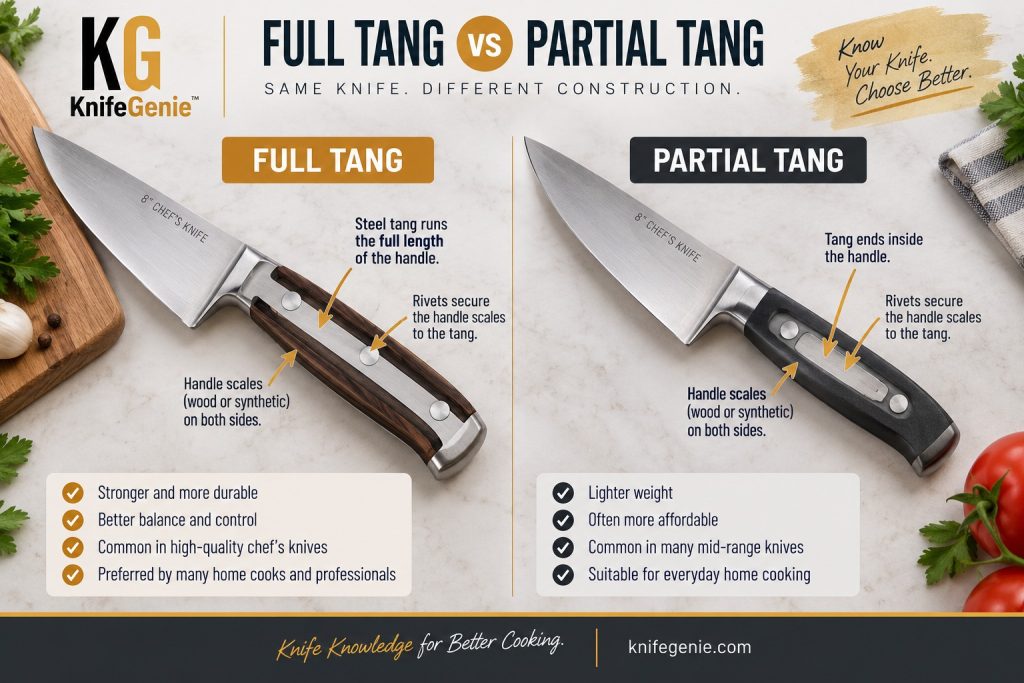
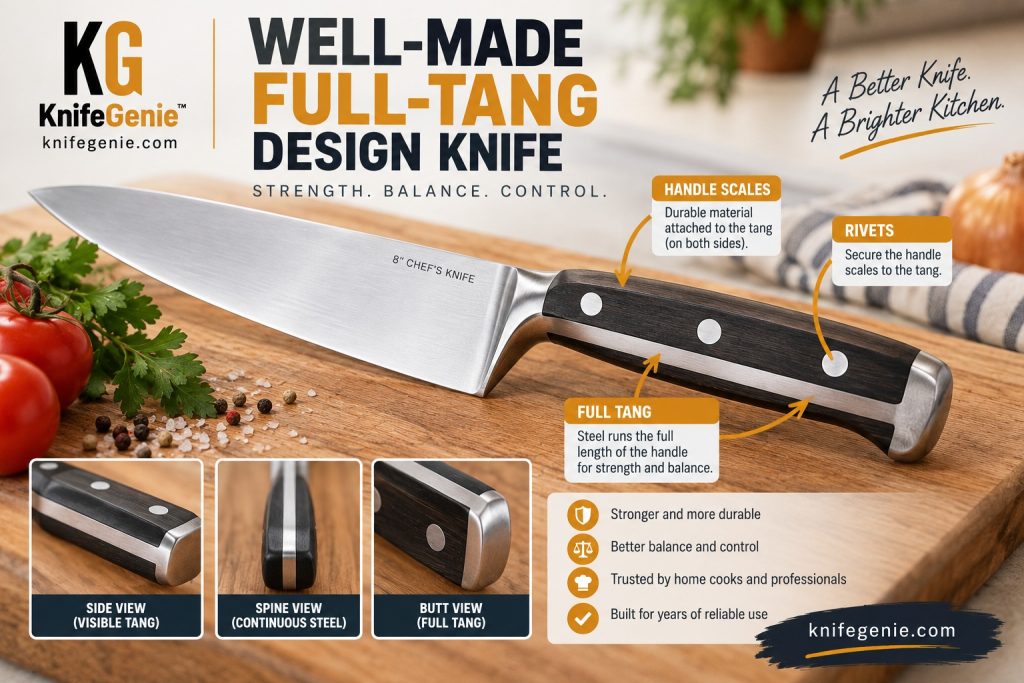
The tang is the portion of the knife’s metal structure that extends from the blade into the handle. With a traditional full-tang knife, that metal extends essentially the full length of the handle. A partial tang extends only partway into the handle.
For a substantial chef’s knife intended for years of everyday use, KnifeGenie generally prefers a well-made full-tang construction because it provides excellent handle strength, stability, and a reassuringly solid feel.
But here’s the part that often gets lost in knife-buying advice:
Full tang does not automatically mean a better knife.
A poorly designed full-tang knife can still have mediocre steel, uncomfortable ergonomics and poor blade geometry. And a properly engineered knife using another tang or handle construction can be an excellent kitchen tool.
So let’s look beyond the marketing.
🔽 Jump to What You Need
👉 Quick Answer
👉 What Is a Knife Tang?
👉 What Is a Full Tang Knife?
👉 What Is a Partial Tang Knife?
👉 Full Tang vs Partial Tang Comparison
👉 Strength & Durability
👉 Weight & Balance
👉 Does Full Tang Mean Better Quality?
👉 How to Identify a Full Tang
👉 Which Should You Buy?
👉 KnifeGenie Pro Tips
👉 Frequently Asked Questions
👉 Final Verdict
🏆 Full Tang vs Partial Tang: The Quick Answer
If you’re choosing a traditional Western-style chef’s knife for frequent home cooking, KnifeGenie generally recommends:

🥇 Full Tang — Best for a Traditional Heavy-Duty Chef’s Knife
A properly designed full tang can provide:
✔ Excellent structural strength
✔ Secure handle construction
✔ Substantial feel
✔ Good durability
✔ Potentially excellent balance
✔ Confidence during demanding everyday prep
That’s one reason full-tang construction appears on premium Western chef’s knives.
⚡ Partial Tang — Can Be Excellent for Lighter or Specialized Knives
Partial-tang and other enclosed-tang constructions can offer:
✔ Lower weight
✔ Different balance characteristics
✔ Simpler handle construction
✔ Lower manufacturing cost in some designs
✔ Excellent performance when properly engineered
The important phrase is properly engineered.
🧙 KnifeGenie Verdict
For a conventional, substantial chef’s knife, we’d usually choose a well-made full tang—but we would never buy a knife solely because the box says “full tang.”
Steel, heat treatment, blade geometry, edge quality, ergonomics and overall construction matter just as much—and sometimes more.
🧠 What Is a Knife Tang?
The easiest way to understand a tang is to imagine removing the handle material from a conventional kitchen knife.
The blade doesn’t necessarily stop where the handle begins.
A section of metal continues backward into the handle.
That extension is the tang.
The tang helps connect the blade to the handle and forms part of the knife’s structural system.
Depending on the knife’s design, it might be:
🔪 Full tang
🔪 Partial tang
🔪 Hidden tang
🔪 Rat-tail tang
🔪 Stick tang
🔪 Encapsulated within a molded handle
These terms describe construction—not cutting performance.
That’s an important distinction.
The tang doesn’t slice your onion.
The blade and edge do.
But tang and handle construction can influence how strong, comfortable, heavy and balanced the entire knife feels.
🔨 What Is a Full Tang Knife?
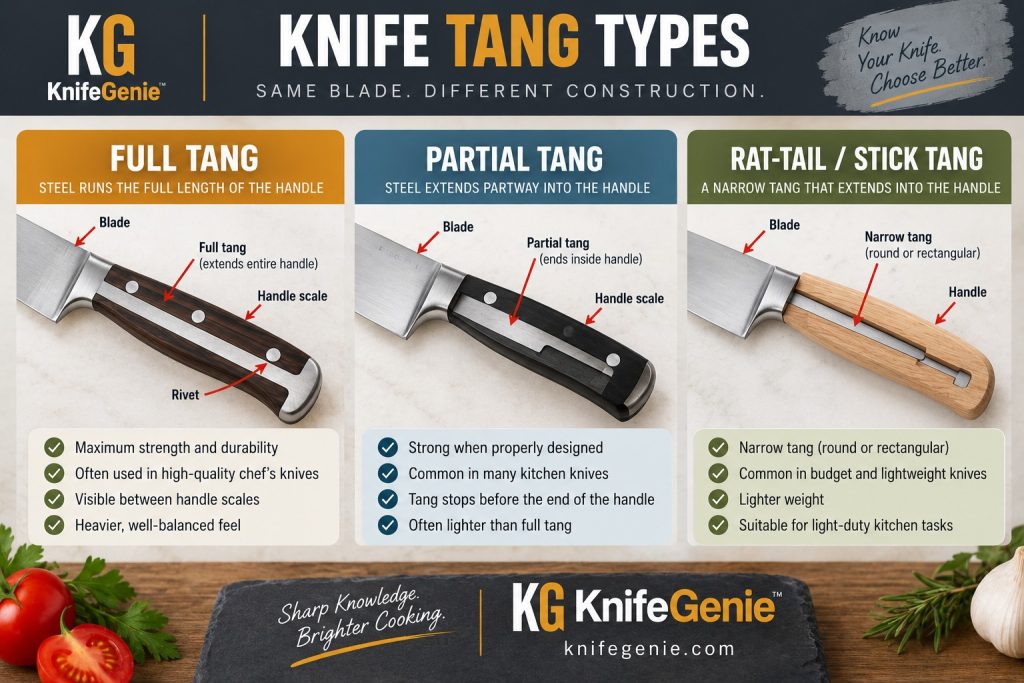
A full tang generally extends from the blade through essentially the full length of the handle.
On a traditional Western chef’s knife, you can often see a strip of steel running between the two handle scales.
The scales are attached to either side, commonly using rivets.
Think of the construction roughly like this:
BLADE ➜ BOLSTER ➜ ================== ➜ HANDLE END
That continuous metal structure is one of the reasons traditional full-tang knives often feel substantial.
For example, WÜSTHOF describes its Classic chef’s knife as having forged German steel, a full tang and a riveted handle, while ZWILLING’s Pro line uses forged construction with a classic three-rivet full-tang design.
💪 Advantages of Full Tang Knives
✔ Strong handle structure
✔ Excellent durability when properly constructed
✔ Can produce reassuring balance
✔ Well suited to larger chef’s knives
✔ Common on premium traditional Western knives
✔ Less dependent on a small section of metal supporting the handle
✔ Traditional riveted construction can be visually inspected
❌ Disadvantages of Full Tang Knives
✘ Additional metal can increase weight
✘ More material and manufacturing can increase cost
✘ “Full tang” is sometimes used as a marketing shortcut for quality
✘ Poorly fitted handle scales can still create problems
✘ Not necessary for every type of kitchen knife
FULL TANG ANATOMY

🔪 What Is a Partial Tang Knife?
A partial tang extends into the handle but stops before reaching the full length of it.
There are several variations.
Some partial tangs are relatively wide and extend a considerable distance into the handle.
Others are narrower.
Some knives use a thin stick tang or rat-tail tang running through part or much of the handle.
That means the simple label “partial tang” doesn’t tell you everything about the knife’s strength.
A substantial, well-secured partial tang is very different from a tiny piece of metal inserted only a short distance into a cheap plastic handle.
⚡ Advantages of Partial Tang Construction
✔ Can reduce overall knife weight
✔ Can shift the balance toward the blade
✔ May reduce manufacturing costs
✔ Works well for many light-duty knives
✔ Allows manufacturers greater freedom in handle design
✔ Can be perfectly durable when properly engineered for the task
❌ Potential Disadvantages
✘ Cheap designs may have weaker blade-to-handle connections
✘ Construction may be difficult to inspect because the tang is hidden
✘ Poor designs may loosen after prolonged hard use
✘ Usually less reassuring for a heavy-duty traditional chef’s knife
✘ “Partial tang” covers many different construction methods
The last point is especially important.
Not all partial tangs are equal.
TANG TYPES
⚔️ Full Tang vs Partial Tang Knives — Comparison
| Feature | 🔨 Full Tang | ⚡ Partial Tang |
|---|---|---|
| Tang length | Essentially full handle length | Stops within handle |
| Typical strength | Excellent when properly built | Varies by design |
| Weight | Often heavier | Often lighter |
| Balance | Can feel handle-neutral | Can feel more blade-forward |
| Durability | Generally excellent | Highly construction-dependent |
| Manufacturing cost | Often higher | Can be lower |
| Traditional riveted handle | Common | Less common |
| Best suited to | Everyday chef’s knives, substantial knives | Lightweight and specialized designs |
| Visible tang | Often | Usually not |
| Automatically better? | ❌ No | ❌ No |
🧙 KnifeGenie Tip
Don’t compare two knives by tang alone.
A knife is a complete cutting system.
The steel, heat treatment, edge geometry, blade thickness, handle ergonomics, weight, balance and manufacturing quality all influence whether the knife is actually good.
💪 Which Is Stronger?
All else being reasonably equal, a substantial full tang provides an excellent structural foundation.
Instead of the blade transitioning into a small piece of metal buried inside the handle, the tang extends through essentially the entire grip.
That gives manufacturers plenty of surface area for securely attaching handle scales and distributes the structure along the handle.
For a large knife receiving regular use, that’s reassuring.
But don’t turn this into:
Full tang = unbreakable.
It doesn’t.
A knife can fail at the blade, edge, handle scales, rivets or other points regardless of its tang design.
And kitchen knives shouldn’t be used for prying, twisting, opening cans or other jobs they weren’t designed to perform.
⚖️ Weight & Balance: Where Things Get Interesting
More steel inside the handle generally means more mass.
That’s not automatically good or bad.
It changes how the knife feels.
🔨 A Traditional Full-Tang Chef’s Knife May Feel:
✔ Substantial
✔ Stable
✔ Solid in the hand
✔ More evenly weighted
✔ Comfortable for rocking cuts
⚡ A Lighter Construction May Feel:
✔ Nimble
✔ Fast
✔ Less tiring
✔ More blade-forward
✔ Better suited to cooks who dislike heavy handles
This is where personal preference becomes extremely important.
A 9-ounce knife isn’t automatically better than a 6-ounce knife.
Some cooks love the reassuring weight of a traditional German chef’s knife.
Others immediately prefer something lighter.
Neither cook is wrong.
BALANCE TEST

🤔 Does Full Tang Mean a Better Knife?
No.
This may be the most important section of this guide.
Full-tang construction is a legitimate feature.
But it is not a universal quality certificate.
Imagine two chef’s knives.
Knife A
🔨 Full tang
❌ Mediocre steel
❌ Thick blade geometry
❌ Uncomfortable handle
❌ Poor heat treatment
❌ Uneven grind
❌ Poor factory edge
Knife B
⚡ Different/hidden tang construction
✔ Excellent steel
✔ Excellent heat treatment
✔ Thin cutting geometry
✔ Comfortable handle
✔ Excellent edge
✔ Proven manufacturing quality
Would you automatically choose Knife A?
We wouldn’t.
This is why KnifeGenie recommends treating full tang as one useful specification rather than the specification that determines quality.
🏭 Real-World Example: WÜSTHOF Classic
Traditional German knives provide one of the clearest examples of why full-tang construction has such a strong reputation.
The WÜSTHOF Classic 8-inch Chef’s Knife uses forged construction, a full tang and riveted synthetic handle.
That combination contributes to the solid, substantial character associated with the Classic.
But its reputation isn’t built on the tang alone.
Its blade steel, forging, heat treatment, edge, bolster, ergonomics and manufacturing quality all contribute to the finished knife.
🧙 KnifeGenie Verdict
Full tang is part of what makes a WÜSTHOF Classic a WÜSTHOF Classic—but it isn’t the only reason the knife works.
🔨 Real-World Example: ZWILLING Pro
ZWILLING takes a similar approach with its Pro collection.
The company describes the knives as forged from a single piece of its special-formula steel and uses a three-rivet full-tang handle design.
Again, the tang works as part of a larger system.
The forged blade, curved bolster, handle, edge geometry and balance all contribute to how the knife performs.
That’s exactly how buyers should think about tang construction:
as one component of overall knife design.
⚡ What About Lightweight Professional Knives?
This is where the “every good knife must be full tang” argument becomes much less convincing.
There are highly respected professional-style kitchen knives that prioritize low weight, molded handles and practical ergonomics rather than traditional exposed full-tang construction.
Victorinox’s Fibrox chef’s knives, for example, are non-forged, lightweight knives with non-slip thermoplastic handles and are marketed for professional performance.
That doesn’t make them equivalent in construction or feel to a forged WÜSTHOF Classic.
They’re deliberately different.
And that’s the point.
A knife can achieve durability and useful cutting performance through more than one construction philosophy.
👀 How Can You Tell If a Knife Is Full Tang?
Sometimes it’s easy.
Sometimes it isn’t.
🔍 Look Along the Handle
Traditional full-tang knives commonly show a strip of steel running along the top and bottom edges between the handle scales.
🔩 Look for Rivets
Three rivets plus visible steel around the handle often indicate traditional full-tang construction.
But rivets alone don’t prove anything.
Decorative rivets exist.
🏷️ Read the Manufacturer’s Specifications
This is the most reliable method when shopping online.
Look for wording such as:
“Full tang”
“Full-tang construction”
“Forged full tang”
⚠️ Don’t Assume Forged Means Full Tang
Forging and tang construction describe different things.
A knife can be forged and have various handle/tang designs.
Likewise, a stamped knife isn’t automatically a partial-tang knife.
Treat these as separate specifications.
HOW TO IDENTIFY FULL TANG

Have a look at some American-made full-tang knives and see examples.
🛒 Which Tang Should YOU Buy?
Let’s make the decision practical.
“I want one premium chef’s knife to keep for years.”
👉 Choose a well-made full-tang knife if you like its weight and handling.
It’s a proven construction for substantial everyday chef’s knives.
“I’m hard on my kitchen equipment.”
👉 Full tang gets our preference.
But proper knife use still matters.
“I hate heavy knives.”
👉 Don’t automatically choose full tang.
Try lighter knives too.
“I’m buying an inexpensive paring or utility knife.”
👉 Tang construction shouldn’t dominate your decision.
Cutting performance, comfort, safety and overall build quality matter more.
“The advertisement says FULL TANG, so it must be premium.”
👉 Absolutely not.
Investigate the steel, manufacturer, construction, blade geometry and reviews too.
“I’m choosing between two equally good chef’s knives.”
👉 Then full tang can be a useful tie-breaker—provided you prefer the resulting balance and weight.
🧱 Tang vs Steel: Which Matters More?
This isn’t really an either/or question because they perform completely different jobs.
The tang primarily concerns the handle structure.
The blade steel influences characteristics such as:
⚔️ Edge retention
🪨 Sharpening behavior
💪 Toughness
💧 Corrosion resistance
🔪 Potential cutting-edge characteristics
If you’re buying a chef’s knife, we’d rather see you choose a reputable, comfortable, properly heat-treated knife with excellent blade geometry than chase the words FULL TANG on a product listing.
Ideally, of course, you get both:
excellent blade construction + excellent handle construction.
🔨 Full Tang vs Forged: Are They the Same Thing?
No.
This causes a surprising amount of confusion.
Forged describes how the knife blank or blade is manufactured.
Full tang describes how the knife’s metal extends through the handle.
They are related in many traditional Western knives, but they’re not synonyms.
A WÜSTHOF Classic, for example, combines forged construction with a full tang.
But you shouldn’t assume that every forged knife has exactly the same tang design—or that every stamped/non-forged knife has an inferior handle structure.
👉 Recommended KnifeGenie reading: Forged vs Stamped Knives: What’s the Difference?
🧙 KnifeGenie Pro Tips
🔪 Buy the complete knife, not one specification. Full tang is useful, but it can’t compensate for poor steel, bad ergonomics or terrible blade geometry.
✋ Hold the knife when possible. Weight and balance are extremely personal.
⚖️ Don’t assume heavier means stronger or better. A heavy knife may feel reassuring—or exhausting.
🔨 Choose construction appropriate to the job. A substantial chef’s knife and a tiny paring knife don’t need identical engineering.
🔩 Inspect handle fit and finish. On traditional scale-handled knives, look for gaps, loose rivets, rough transitions or poorly fitted scales.
🧼 Hand wash quality knives. Even when a manufacturer permits dishwasher cleaning, hand washing is generally the gentler treatment for edges and handle materials.
🪨 Don’t forget sharpening. Tang construction won’t help you slice a tomato with a dull edge.
💰 Ignore exaggerated marketing. Terms such as “professional,” “premium,” “high carbon” and “full tang” should be supported by meaningful specifications and good manufacturing.
❓ Frequently Asked Questions
Is full tang better than partial tang?
For a traditional heavy-duty chef’s knife, KnifeGenie generally prefers a properly constructed full tang because it provides an excellent structural foundation and can contribute to a substantial, balanced feel.
But full tang isn’t automatically better for every knife or every cook.
Are partial tang knives bad?
No.
Partial tang describes a broad family of constructions.
Some inexpensive knives use poor partial-tang designs, which helped give the term a negative reputation.
But tang design should be evaluated as part of the knife’s overall engineering rather than used as an automatic quality test.
Can a partial tang knife break?
Yes—but so can a full-tang knife.
Construction quality, steel, intended use and how the knife is treated all affect durability.
Never use a kitchen knife for prying, twisting, opening cans or other inappropriate jobs.
Does a full tang make a knife stronger?
A substantial full tang can provide a very strong blade-to-handle structure because the metal extends through essentially the entire handle.
However, actual durability depends on the complete construction.
Does full tang make a knife heavier?
It can.
Extending more steel through the handle adds material and can contribute to the substantial feel of traditional Western chef’s knives.
The actual finished weight depends on the entire knife.
Are Japanese knives full tang?
Some are, some aren’t.
Japanese kitchen knives use many handle and tang constructions. Traditional Japanese wa-handled knives commonly use hidden tang arrangements, while Western-handled Japanese knives may use full-tang or other constructions.
Don’t judge Japanese knife quality using Western handle design as the only benchmark.
Not necessarily.
“Hidden tang” means the tang isn’t visible around the outside of the handle. It describes how the tang is enclosed.
A hidden tang can extend a considerable distance through the handle.
Does a full tang stay sharp longer?
No.
Tang length does not determine edge retention.
Steel composition, heat treatment, edge geometry, sharpening, cutting technique and cutting-board material are much more relevant to how the edge behaves.
Is full tang necessary for a chef’s knife?
No.
There are excellent kitchen knives using different construction methods.
However, full-tang construction remains an excellent and proven choice for traditional Western-style chef’s knives.
🏆 Full Tang vs Partial Tang — Final Verdict
So, which wins?
🥇 KNIFEGENIE WINNER FOR TRADITIONAL CHEF’S KNIVES: FULL TANG
For a substantial Western-style chef’s knife intended for regular home cooking, we’d generally choose a well-made full-tang design.
Why?
✔ Excellent structural foundation
✔ Proven durability
✔ Secure traditional handle construction
✔ Substantial feel
✔ Excellent potential balance
✔ Long history in premium Western chef’s knives
But there is a very important qualifier:
We would choose an excellent non-full-tang knife over a bad full-tang knife every time.
Tang construction is one chapter in the story—not the entire book.
When you’re actually buying a kitchen knife, consider:
Boning Knife vs Fillet Knife: Which One Do You Need?
🔪 Blade geometry
🧱 Steel and heat treatment
⚖️ Weight and balance
✋ Handle comfort
⚔️ Edge quality
🔨 Manufacturing quality
💰 Price and value
🪨 Sharpening requirements
🏭 Manufacturer reputation
🔩 Tang and handle construction
Get those things right and you’re far more likely to end up with a knife you’ll enjoy using for years.
Sharp knives. Smart choices.
— KnifeGenie