
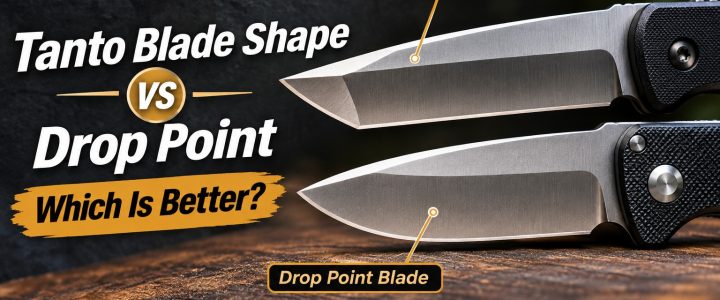
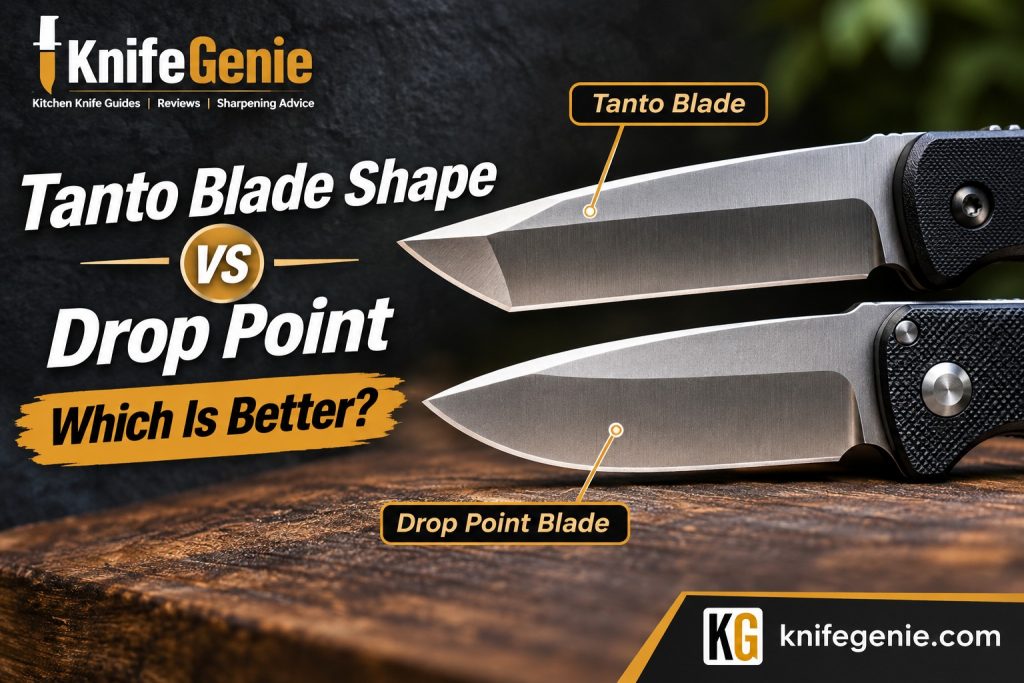
A knife’s blade shape affects how it slices, how its tip behaves, and how easily its edge can be maintained. Two popular designs are the angular tanto blade shape and the versatile drop-point blade.
Although both appear on modern pocket knives, they offer different cutting characteristics. Understanding these differences can help you choose a knife that suits your everyday tasks rather than simply selecting the most dramatic-looking blade.
🏆 Tanto Blade Shape vs Drop Point: Quick Answer
For most everyday cutting tasks, a drop-point blade is the better all-around choice. Its curved cutting edge, often called the belly, is useful for slicing, while its lowered tip provides practical control.
An American-style tanto blade features a more angular profile, usually with a distinct transition between its main cutting edge and the short edge near the tip. Some designs provide additional material behind the point, making them attractive to buyers who prioritize tip geometry and distinctive styling.
However, blade shape alone does not determine strength, sharpness, or durability. Blade thickness, steel, heat treatment, edge geometry, and construction all matter.
🧙 KnifeGenie Quick Verdict
🏆 Best all-around blade: Drop point
📐 Best angular blade design: American tanto
🔪 Best for general slicing: Drop point
🛠️ Best for controlled straight-edge utility work: Tanto can be useful
🪨 Generally easier to sharpen: Drop point
✨ Best for distinctive appearance: Personal preference
KnifeGenie recommendation: Choose a plain-edge drop-point knife for general everyday utility. Consider a tanto if you specifically prefer its angular geometry and understand the maintenance trade-offs.
👉 Jump to:
- 👉 What Is a Tanto Blade Shape?
- 👉 What Is a Drop Point Blade?
- 👉 Tanto vs Drop Point Comparison Chart
- 👉 Blade Shape, Tip Strength and Cutting Performance
- 👉 Which Blade Is Better for Everyday Carry?
- 👉 Sharpening and Maintenance Differences
- 👉 Advantages and Disadvantages
- 👉 Frequently Asked Questions
🔪 What Is a Tanto Blade Shape?
A tanto blade shape is associated with a pointed profile, but the term can describe more than one design.
The traditional Japanese tanto was a short-bladed weapon with several historical blade forms. The modern American-style tanto, commonly found on folding knives, is a different interpretation characterized by an angular cutting-edge profile.
When modern pocket-knife manufacturers advertise a tanto blade, they often mean the American-style version.
📐 Characteristics of an American Tanto Blade
Most American-style tanto blades feature:
- ✔ A relatively straight main cutting edge, although some designs have a slight curve.
- ✔ A distinct angled transition toward the tip.
- ✔ A short secondary edge section near the point.
- ✔ A pronounced, geometric appearance.
- ✔ A tip profile that may retain substantial supporting material.
The short edge near the point is sometimes called a secondary edge or secondary cutting section. It does not necessarily mean the knife has two separately sharpened sides like a double-edged dagger.
The actual geometry varies considerably among manufacturers.
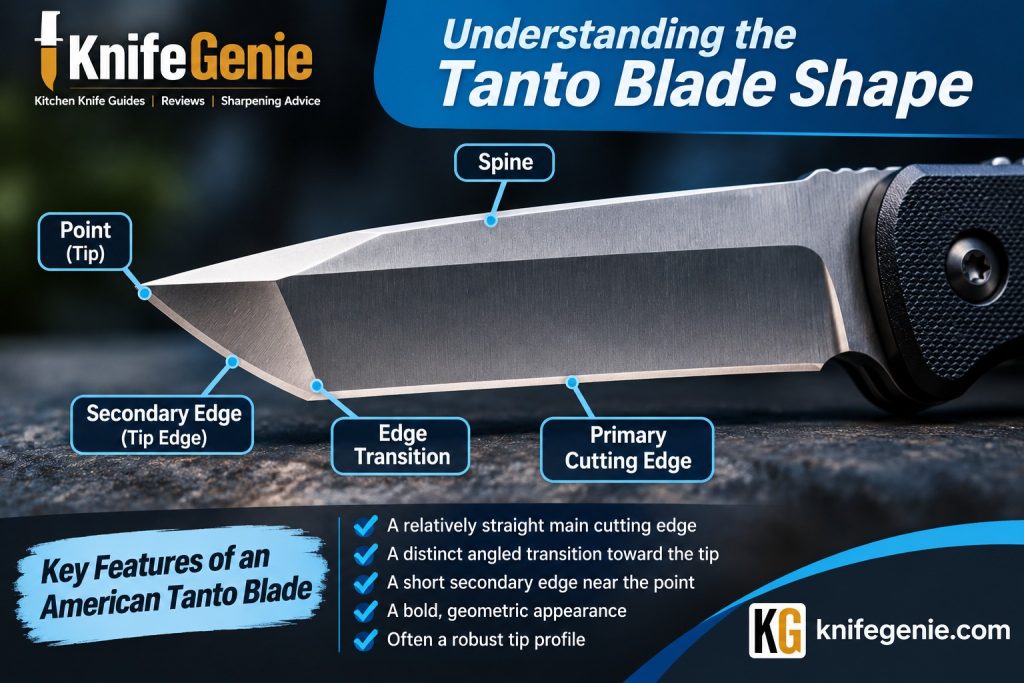
The American tanto blade features a distinct edge transition and angular tip profile.
🧱 Is a Tanto Tip Stronger?
Some American tanto designs have a relatively robust point because the blade retains more material behind the tip. This can be an advantage in certain utility applications.
However, it would be misleading to claim that every tanto tip is stronger than every drop-point tip.
A thick drop-point blade with suitable steel and heat treatment may be more durable than a thin tanto blade made from less suitable materials.
🧙 KnifeGenie Tip: Evaluate the actual knife, not just the blade-shape name. Tip thickness, grind, steel, and heat treatment are important.
🎯 What Is a Drop Point Blade?
A drop-point blade has a spine that slopes downward toward the tip, commonly following a gentle convex curve.
This places the point below the highest part of the blade’s spine and often provides a practical combination of tip control and cutting-edge curvature.
Drop-point blades are common on folding pocket knives, general-purpose utility knives, and many outdoor knife designs.
🔪 Characteristics of a Drop-Point Blade
- ✔ A spine that gradually descends toward the point.
- ✔ A curved cutting edge on many models.
- ✔ A practical tip position for controlled utility work.
- ✔ A versatile profile for everyday slicing.
- ✔ A continuous edge without the sharp corner typical of many American tanto designs.
The curved section of the cutting edge is known as the belly. It helps maintain cutting contact during slicing motions.
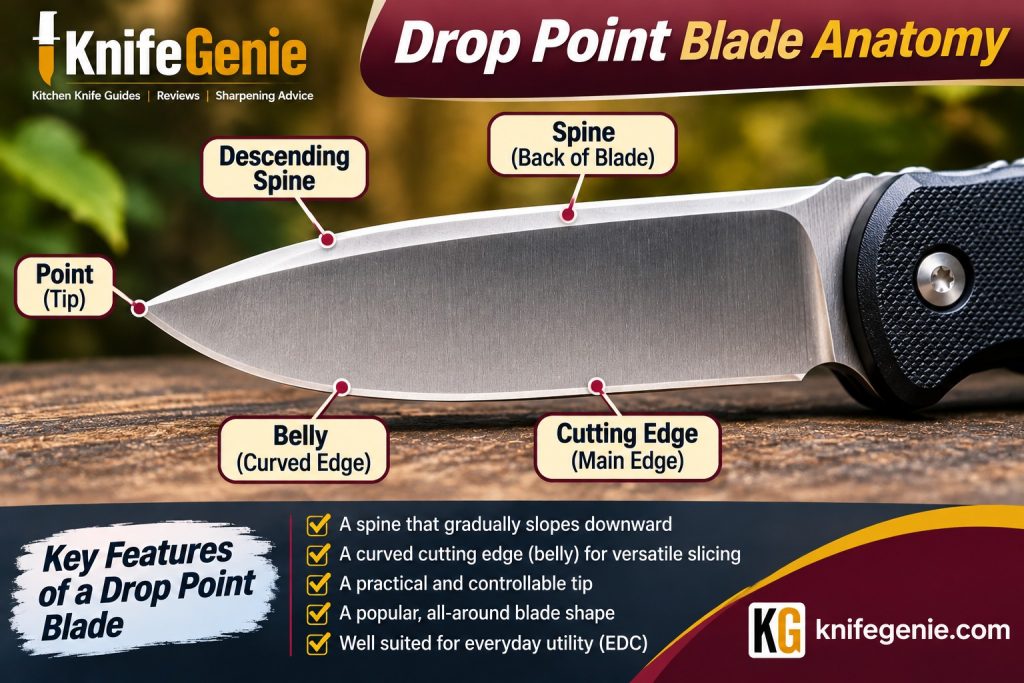
A drop-point blade combines a gradually descending spine with a versatile curved cutting edge.
🏆 Why Are Drop-Point Knives Popular?
Drop-point knives offer a practical balance of general slicing ability, tip control, and straightforward maintenance.
Their usefulness makes them a sensible choice for someone purchasing a first everyday utility knife.
For a broader explanation of pocket-knife features, blade steels, handles, and locking mechanisms, read our Buying a Cool Pocket Knife guide.
⚖️ Tanto vs Drop Point Comparison Chart
The following table compares typical American-style tanto and drop-point blade profiles. Individual knives may differ.
| Feature | American Tanto | Drop Point |
|---|---|---|
| Blade profile | Angular, distinct edge transition | Gradually descending spine |
| Cutting-edge belly | Often limited | Usually more pronounced |
| General slicing | Capable, geometry-dependent | Usually more versatile |
| Tip strength | Can have robust tip geometry | Depends on thickness and design |
| Straight-edge utility | Often well suited | Also capable |
| Sharpening | Edge transition needs attention | Generally simpler continuous edge |
| Everyday versatility | More specialized feel | Excellent general-purpose choice |
| Appearance | Angular and geometric | Smooth and conventional |
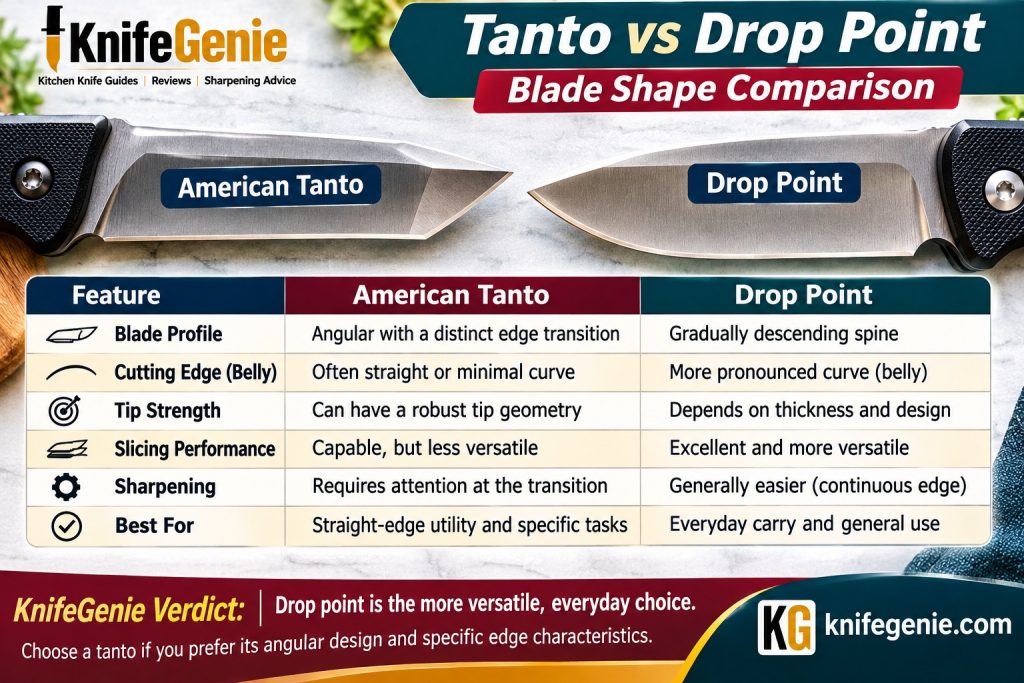
Tanto and drop-point blades differ in their tip geometry, cutting-edge curvature and overall shape.
🧙 KnifeGenie Comparison Verdict
🏆 Drop point wins for everyday versatility.
📐 Tanto offers a distinctive alternative for buyers who prefer a straighter primary edge and angular tip profile.
Neither blade shape guarantees superior steel quality, edge retention, or overall durability.
🛠️ Blade Shape, Tip Strength and Cutting Performance
Blade shape affects cutting behavior, but it is only one part of a knife’s performance.
1. Slicing Performance
Drop-point knives often have a more pronounced belly, making them convenient for slicing tasks that use a smooth drawing motion.
For example, a drop-point folder can be practical for opening packaging, cutting cord, and general light utility work.
A tanto can perform these tasks too, but a relatively straight main edge may feel different when cutting along curved surfaces.
2. Tip Geometry
Some American tanto blades retain more metal near the tip than slender blade profiles. This can make the point comparatively robust within an otherwise similar design.
However, the geometry of the individual knife determines its actual performance.
Neither a tanto nor a drop-point knife should be used as a pry bar, screwdriver, or substitute for a purpose-built tool.
3. Precision and Control
A drop point often provides convenient control during ordinary cutting because its point is positioned below the top of the spine.
An American tanto offers a distinct corner where the main edge meets the short tip section. Some users find this useful for certain controlled utility cuts.
Comfort and precision also depend on blade length, handle ergonomics, and how the knife is held.
4. Edge Geometry and Steel
Two knives with identical blade shapes may cut very differently.
A thin blade with suitable edge geometry may slice more efficiently than a thicker blade of the same general shape.
Steel composition, heat treatment, and sharpening quality also influence cutting performance and durability.
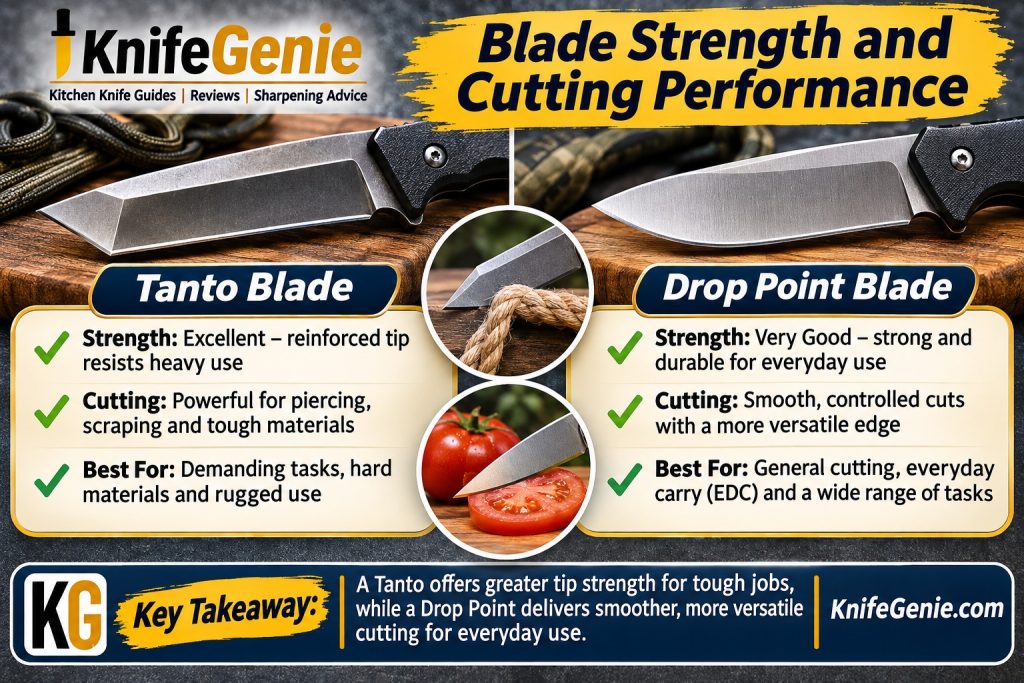
Tip strength and slicing performance depend on blade geometry, thickness, steel and construction.
🧙 KnifeGenie Tip
Don’t assume an angular blade is automatically tougher or a curved blade is automatically sharper. Compare actual knife specifications and intended use.
🎒 Which Blade Is Better for Everyday Carry?
Everyday carry, often shortened to EDC, describes tools selected for routine daily activities.
For a pocket knife, these may include opening boxes, trimming loose material, cutting string, or other lawful light utility tasks.
🏆 Drop Point for General EDC
A plain-edge drop-point folder is a practical option for most everyday users.
Its continuous cutting edge and useful belly offer flexibility across different slicing tasks.
It is also a straightforward design for someone learning basic knife maintenance.
📐 Tanto for Specific Preferences
A tanto-style folder may appeal to someone who prefers a straight primary edge, a pronounced edge transition, or a particular blade appearance.
It can be a capable everyday knife when its size, steel, edge geometry, and handle are appropriate.
However, choosing a tanto purely because it looks stronger is not a reliable buying strategy.
⚖️ Other EDC Features Matter
Before buying either blade shape, consider:
- ✔ Blade length and overall weight.
- ✔ Handle comfort and grip security.
- ✔ Blade steel and corrosion resistance.
- ✔ Folding mechanism and lock condition.
- ✔ Ease of sharpening and maintenance.
- ✔ Local laws and restrictions on possession or carry.
For more ideas, see How to Find a Cool Pocket Knife, which explores several pocket-knife designs and styles.
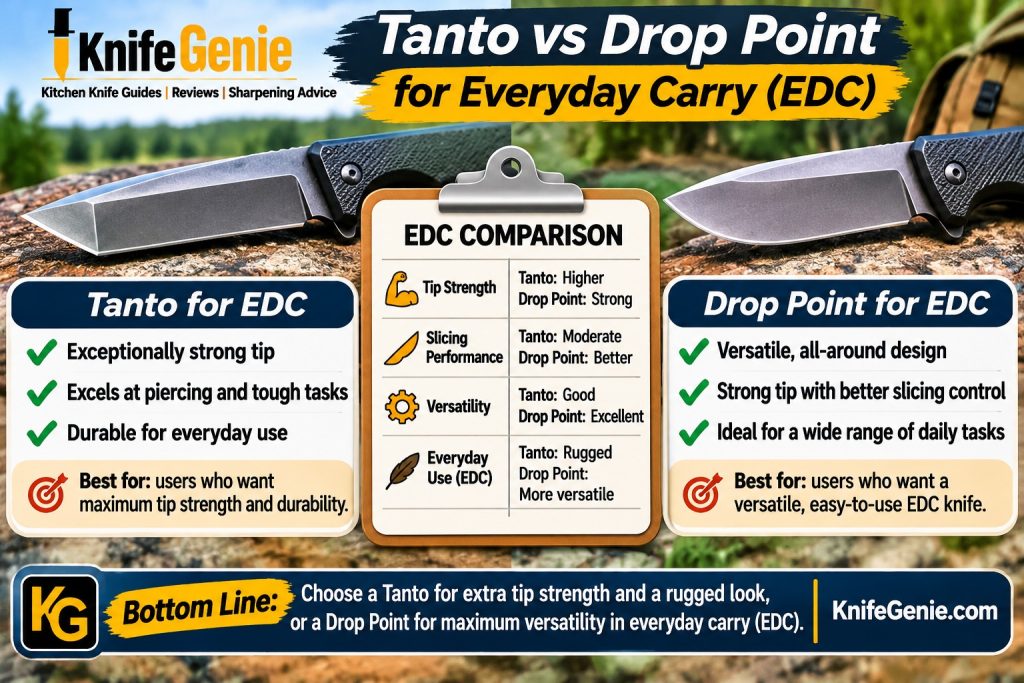
🧙 KnifeGenie EDC Verdict
Best for most people: A medium-size, plain-edge drop-point folder with comfortable handling and dependable construction.
Best alternative: A tanto-style folder when its particular geometry suits your preferences and routine tasks.
🪨 Sharpening and Maintenance Differences
Both tanto and drop-point blades require routine cleaning, inspection, and occasional sharpening.
The main difference is how their cutting edges are shaped.
🔪 Sharpening a Drop-Point Blade
A drop-point blade generally has one continuous cutting edge with a gradual curve.
During sharpening, the user must maintain the appropriate bevel angle while following the changing curve toward the tip.
Consistent technique helps preserve the original edge profile.
📐 Sharpening an American Tanto Blade
Many American tanto blades have two distinct edge sections joined by an angular transition.
Sharpening each section carefully helps preserve that corner instead of gradually rounding it away.
The appropriate sharpening method depends on the original grind and the manufacturer’s guidance.
⚠️ Common Sharpening Mistakes
- ✘ Applying excessive pressure.
- ✘ Ignoring the original edge bevel.
- ✘ Rounding the tanto edge transition unintentionally.
- ✘ Changing the drop-point tip profile unnecessarily.
- ✘ Using unsuitable abrasive equipment.
- ✘ Sharpening without first checking blade condition.
🧙 KnifeGenie Tip: Preserve the manufacturer’s intended geometry. If a blade has significant damage or an unfamiliar grind, professional sharpening may be preferable.
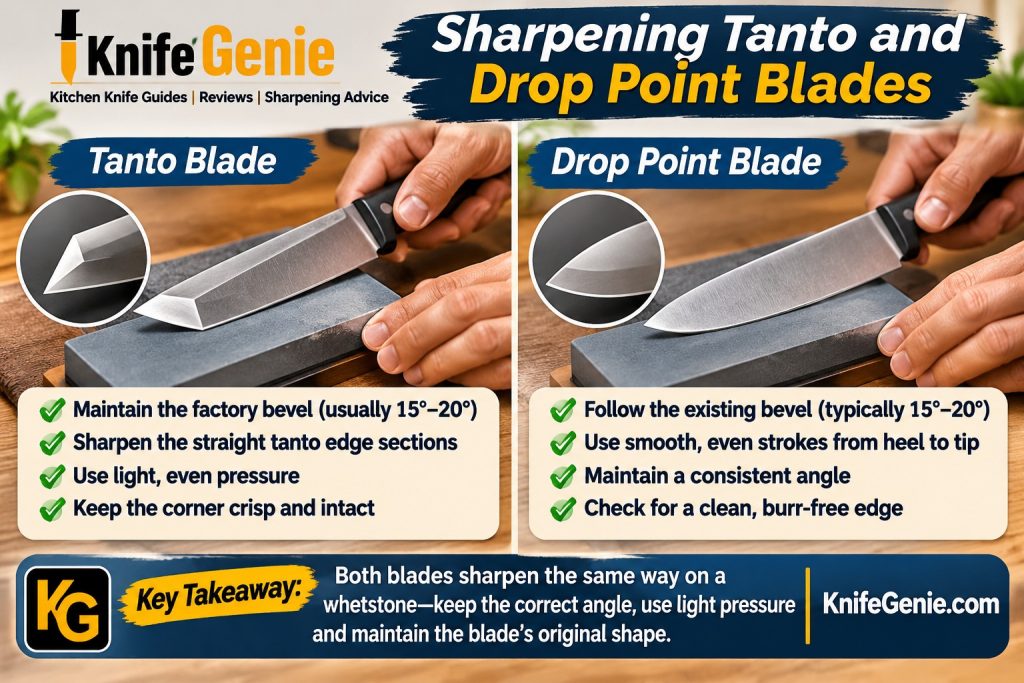
Tanto blades require attention at the angular edge transition, while drop-point blades have a continuous curved edge.
🧼 General Maintenance
After ordinary use, clean the blade according to the manufacturer’s instructions and dry it thoroughly.
Inspect folding mechanisms for debris, corrosion, looseness, or abnormal movement.
Store the knife in a dry location and follow the manufacturer’s lubrication recommendations.
A folding knife lock should never be treated as completely fail-safe.
⚖️ Tanto vs Drop Point: Advantages and Disadvantages
📐 American Tanto Advantages
- ✔ Distinctive angular appearance.
- ✔ Relatively straight main cutting edge on many models.
- ✔ Some designs feature robust tip geometry.
- ✔ Defined edge transition may suit particular utility tasks.
⚠️ American Tanto Disadvantages
- ✘ Often less cutting-edge belly.
- ✘ Angular transition requires care when sharpening.
- ✘ May feel less convenient for some general slicing tasks.
- ✘ Strong-looking geometry does not guarantee durability.
🎯 Drop-Point Advantages
- ✔ Versatile general-purpose blade profile.
- ✔ Useful curved cutting edge on many models.
- ✔ Practical point position for everyday work.
- ✔ Generally straightforward edge maintenance.
- ✔ Wide availability across pocket-knife designs.
⚠️ Drop-Point Disadvantages
- ✘ Tip strength varies considerably between models.
- ✘ Curved edges still require careful sharpening technique.
- ✘ May not offer the angular geometry some buyers prefer.
🏆 Which Blade Shape Should You Buy?
Choose a drop point if: You want one versatile pocket knife for general cutting, easy maintenance, and everyday convenience.
Consider an American tanto if: You prefer its distinctive profile, relatively straight primary edge, and particular tip geometry.
For either design, prioritize reputable manufacturing, suitable steel, comfortable handling, and realistic intended use.
❓ Frequently Asked Questions
What is a tanto blade shape?
A modern American tanto blade typically has a relatively straight main cutting edge and an angular transition leading toward the tip. Its geometry differs from many traditional Japanese tanto blade forms.
Is a tanto blade better than a drop point?
Neither is universally better. Drop-point blades are generally more versatile for everyday slicing, while American tanto blades offer a distinctive angular profile that may suit particular preferences and tasks.
Is a tanto tip stronger than a drop-point tip?
Some tanto designs retain more supporting material near the point. However, actual strength depends on blade thickness, steel, heat treatment, grind, and construction.
What is the advantage of a drop-point blade?
A drop-point blade commonly combines a controllable tip with a useful curved cutting edge. This makes it a practical choice for general-purpose utility work.
Are tanto blades harder to sharpen?
They can require additional attention because the main edge and short tip edge often meet at a pronounced corner. A continuous drop-point edge is generally simpler to maintain, although its curve also requires consistent technique.
Is a tanto blade good for everyday carry?
Yes, a properly designed tanto folder can work well for everyday utility. However, a drop-point folder is usually the more flexible choice for someone who wants a single general-purpose pocket knife.
Does blade shape determine sharpness?
No. Sharpness depends on edge condition and geometry. Steel, heat treatment, sharpening quality, and maintenance also influence cutting performance.
Are tanto and drop-point knives legal to carry?
Knife laws vary by location and may consider blade length, opening mechanism, intended use, and other factors. Check the applicable laws before purchasing, carrying, or traveling with any pocket knife.
🏆 Final KnifeGenie Verdict: Tanto or Drop Point?
For most people choosing an everyday pocket knife, the drop-point blade is the more practical all-around design.
Its useful belly, continuous cutting edge, and versatile profile make it suitable for a broad range of ordinary cutting tasks.
The American tanto remains a worthwhile alternative for buyers who appreciate its angular shape and specific edge characteristics.
However, a blade’s shape should never be the only buying consideration.
🧙 KnifeGenie Final Buying Checklist
✔ Choose the blade shape for your actual cutting needs.
✔ Check steel quality and manufacturer specifications.
✔ Consider tip geometry and blade thickness.
✔ Select a comfortable handle and suitable size.
✔ Understand the sharpening requirements.
✔ Inspect the construction and locking mechanism.
✔ Check applicable knife laws.
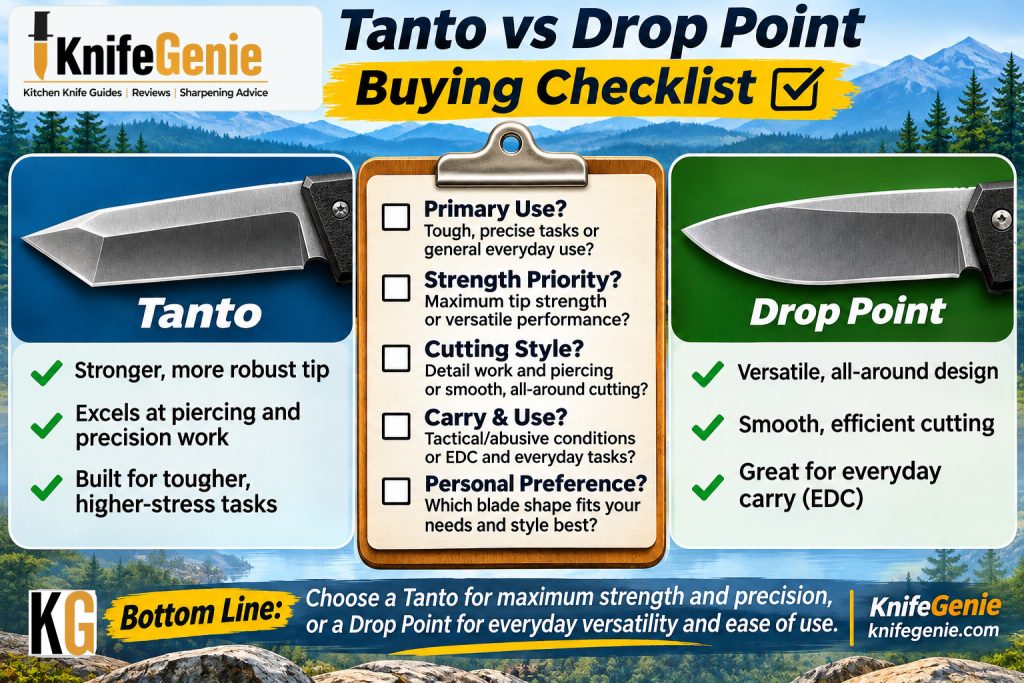
Choose the best knife by considering blade shape, steel quality, tip geometry, maintenance and intended use.KnifeGenie Overall Recommendation: Start with a quality plain-edge drop-point knife for everyday utility. Choose a tanto when you have a clear reason to prefer its particular geometry.
For more pocket-knife buying advice, visit our complete pocket-knife buying guide.
📚 Manufacturer References
For additional explanations of blade terminology and design, consult these manufacturer resources: