
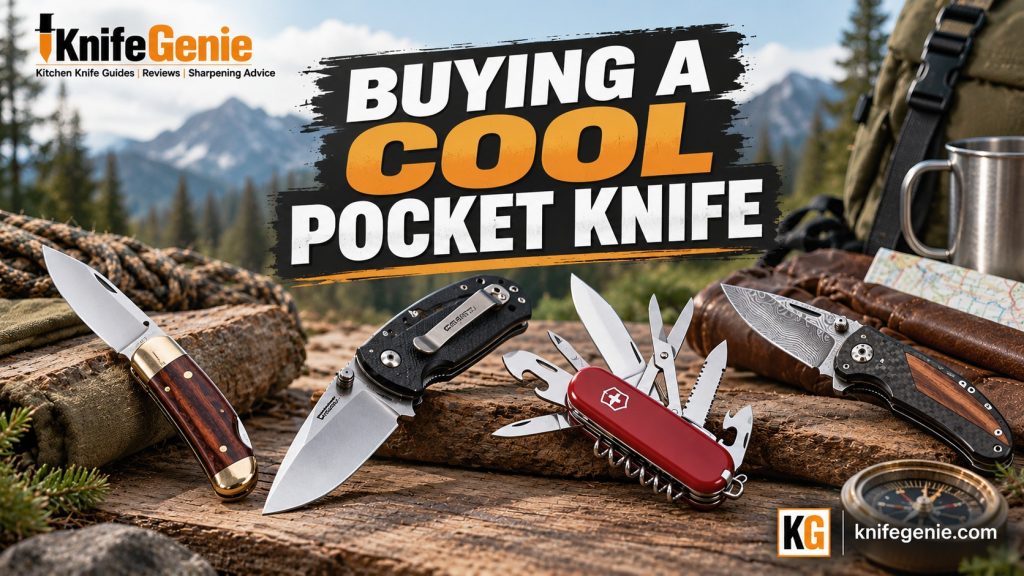
🏆 Cool Pocket Knives: The Quick Answer
A cool pocket knife should do more than look impressive.
The best pocket knives combine a useful blade shape, dependable construction, comfortable handling, suitable blade steel, and a size that fits your intended activities. See our Best Pocket Knives Comparison guide.
For most beginners, a medium-size folding knife with a plain-edge drop-point blade is an excellent starting point.
But perhaps you prefer a traditional wooden handle, a modern locking folder, or an oversized design that stands out in a collection.
Each has its advantages.
🧙 KnifeGenie Quick Verdict
🏆 Best all-around choice: Medium-size locking folder
🔪 Best blade shape for beginners: Drop point
🪵 Best traditional style: Classic slipjoint
🛠️ Best versatility: Multi-tool
✨ Best for collectors: Distinctive specialty folding knives
💰 Best buying strategy: Pay for useful features, not appearance alone.
The KnifeGenie rule: Choose the knife that fits your needs, not simply the one with the most dramatic design.
👉 Jump to:
- What Makes a Cool Pocket Knife?
- Pocket Knife Features to Consider
- Types of Pocket Knives
- Pocket Knife Blade Steels
- Blade Shapes and Edge Types
- Pocket Knife Lock Types
- Handle Materials
- Cold Steel Espada
- Pocket Knife Size Guide
- Which Pocket Knife Should You Buy?
- Common Buying Mistakes
- Pocket Knife Maintenance
- Frequently Asked Questions
- Final KnifeGenie Verdict
🔪 What Makes a Cool Pocket Knife?
A pocket knife can be attractive, practical, collectible, or all three.
Some buyers love traditional wooden handles and polished bolsters. Others prefer modern G-10 handles, stainless steel blades, and contemporary folding mechanisms.
But appearance is only one part of the equation.
A genuinely worthwhile pocket knife should offer:
✔ Useful cutting performance — The blade handles its intended tasks efficiently.
✔ Comfortable handling — The handle feels secure without creating pressure points.
✔ Dependable construction — The blade, pivot, and other components operate correctly.
✔ Appropriate portability — The closed knife suits your storage or carrying needs.
✔ Manageable maintenance — The blade steel and mechanism match the care you’re willing to provide.
✔ Good value — The price reflects practical features, materials, and construction quality.
🧙 KnifeGenie Tip
Don’t judge a pocket knife solely by its appearance. A simple, well-made folder may outperform an expensive novelty design in everyday use.
⚙️ Seven Features to Consider Before Buying
📏 1. Blade Length
Blade length affects cutting reach, portability, weight, and legal considerations.
| Blade length | Typical use |
|---|---|
| Under 2.5 inches | Compact, light-duty utility |
| 2.5–3.5 inches | General everyday cutting |
| 3.5–4.5 inches | Larger outdoor and utility tasks |
| Over 4.5 inches | Specialized or collector-oriented designs |
These are practical categories, not legal limits.
🏆 KnifeGenie Choice: For many adults, a blade around 2.5–3.5 inches offers a useful balance of size and portability, where lawful.
🧱 2. Blade Steel
Blade steel affects corrosion resistance, edge retention, toughness, and sharpening.
A premium steel isn’t automatically the best choice.
A moderately priced stainless steel that sharpens easily may be more convenient for a beginner than a highly wear-resistant steel requiring additional maintenance.
🎯 3. Blade Shape
The blade shape influences how the knife cuts.
Drop-point blades are versatile, clip points offer a relatively fine tip, and sheepsfoot blades emphasize controlled straight-edge cutting.
🔒 4. Folding and Locking Mechanism
Many modern folding knives include a mechanism designed to hold the blade open during normal cutting.
However, no folding lock should be treated as fail-safe.
✋ 5. Handle Comfort
Look for a handle that provides comfortable finger placement and a secure grip without sharp pressure points.
⚖️ 6. Weight and Portability
A heavy folding knife may feel substantial but become inconvenient to carry.
A compact knife is often more practical for everyday utility.
💰 7. Price and Manufacturer Support
Consider the manufacturer’s reputation, warranty, published specifications, and replacement-part support.
🧙 KnifeGenie Tip: Blade geometry, heat treatment, and ergonomics often matter more than decorative finishes.
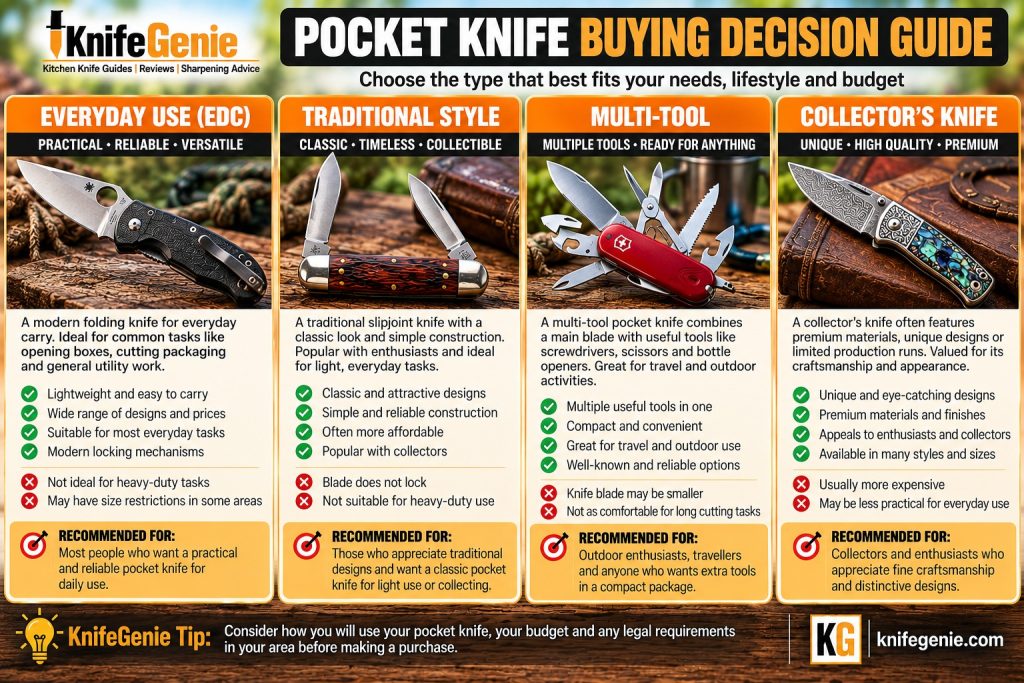
🗂️ Popular Types of Pocket Knives
🪵 Traditional Slipjoint Knives
Traditional slipjoints use spring pressure rather than a positive lock to resist blade closure.
✅ Strengths
✔ Classic appearance
✔ Often compact
✔ Available with attractive handle materials
✔ Simple, familiar designs
❌ Weak Points
✘ Blade does not positively lock
✘ Extra care needed around closing forces
✘ Not ideal for demanding cutting
🔒 Modern Locking Folders
Modern folding knives commonly feature a single blade, pocket clip, and dedicated locking mechanism.
✅ Strengths
✔ Wide range of designs
✔ Many blade steels and handle materials
✔ Useful for general utility
✔ Numerous size options
❌ Weak Points
✘ Mechanisms require inspection
✘ Some models are bulky
✘ Carry restrictions vary
🛠️ Multi-Tool Pocket Knives
Multi-tools combine a knife with implements such as scissors, screwdrivers, pliers, or bottle openers.
They are useful when versatility matters more than dedicated cutting performance.
✨ Specialty and Collector Knives
These may feature unusual blade shapes, premium materials, decorative finishes, or oversized construction.
Their appeal may be craftsmanship and design rather than everyday convenience.
🧙 KnifeGenie Verdict
🏆 Most practical: Modern medium-size folding knife
🪵 Most traditional: Slipjoint
🛠️ Most versatile: Multi-tool
✨ Most distinctive: Specialty collector’s folder
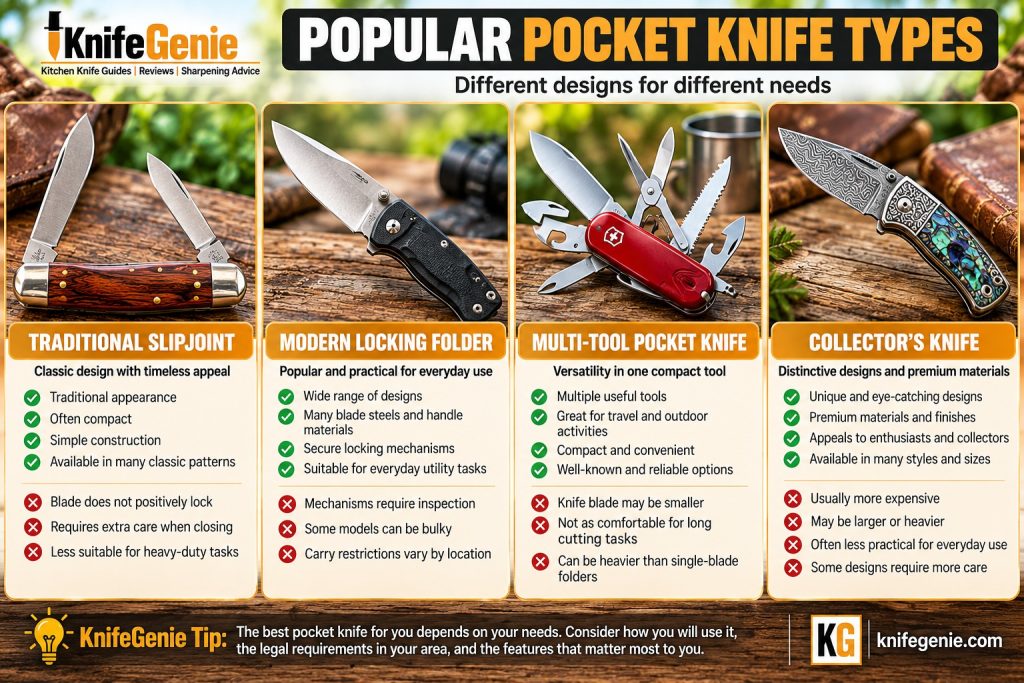
Popular pocket knife designs offer different combinations of portability, utility and appearance.
🧱 Pocket Knife Blade Steels Compared
Blade steel is one of the most important buying considerations.
However, steel composition alone doesn’t determine how a knife performs.
Heat treatment, blade geometry, and sharpening quality also matter.
| Steel | Main advantage | Main consideration |
|---|---|---|
| 420HC | Corrosion resistance and ease of sharpening | Edge retention varies with heat treatment |
| 8Cr13MoV | Affordable and easy to maintain | Moderate wear resistance |
| AUS-8 | Balanced everyday performance | Manufacturer quality varies |
| 14C28N | Good corrosion resistance and toughness potential | Geometry and heat treatment matter |
| D2 | High wear resistance | More corrosion care required |
| CPM S30V | Strong wear resistance and good stainless performance | Higher cost and more sharpening effort |
🛡️ Stainless Steel vs Tool Steel
Stainless steels are formulated for corrosion resistance, although none is completely immune to corrosion.
Tool steels such as D2 can offer excellent wear resistance but may require more attention to moisture.
🔬 Why Heat Treatment Matters
Two knives made from the same steel can perform differently.
Heat treatment influences hardness and toughness, while edge geometry determines how efficiently the blade cuts.
For technical explanations, Knife Steel Nerds provides detailed research into knife steels, metallurgy, and heat treatment.
🧙 KnifeGenie Tip
Don’t buy the knife with the most impressive steel name simply because it sounds premium. Choose a steel that fits your intended tasks and sharpening habits.
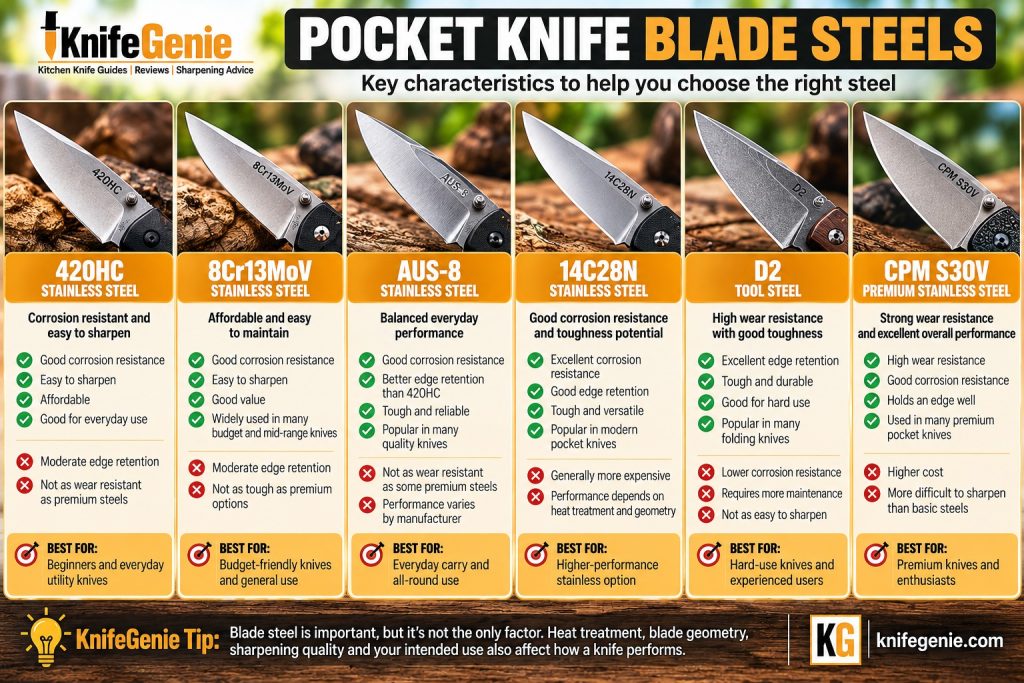
Pocket knife steels differ in corrosion resistance, wear resistance and ease of sharpening.
⚔️ Pocket Knife Blade Shapes and Edge Types
The shape of a pocket knife affects how it performs.
🔪 Drop Point
A drop-point blade has a spine that slopes toward the tip.
Best for: General-purpose cutting and everyday utility.
✔ Versatile cutting profile
✔ Controllable point
✔ Excellent beginner choice
🎯 Clip Point
A clip-point blade has a clipped section near its tip.
Best for: Tasks requiring a relatively fine point.
✔ Traditional appearance
✔ Good tip control
✔ Useful for detailed cutting
⚠ Some fine tips are relatively delicate.
📐 Sheepsfoot
A sheepsfoot blade generally has a straight cutting edge and a curved spine leading to a less pointed tip.
Best for: Controlled straight-edge cutting.
✔ Practical utility profile
✔ Less aggressive tip
✔ Good for controlled slicing
⚡ Tanto-Style Blade
A tanto-style blade typically features an angular profile and a distinct transition toward its tip.
Best for: Buyers who specifically prefer this geometry.
✔ Distinctive appearance
✔ Angular tip design
✔ Useful in appropriate cutting applications
✘ The angled edge can require extra sharpening attention.

Four common pocket knife blade shapes designed for different cutting tasks.
✂️ Plain Edge vs Serrated Edge
| Plain edge | Serrated edge |
|---|---|
| Versatile for clean slicing | Useful for some fibrous materials |
| Generally easier to sharpen | More complicated to sharpen |
| Good everyday choice | More specialized |
| Smooth, continuous cutting edge | Scalloped or toothed cutting edge |
🏆 KnifeGenie Choice: A plain-edge drop-point blade is an excellent general-purpose starting point.
🔒 Understanding Pocket Knife Lock Types
Folding knives use different mechanisms to hold the blade open.
🔹 Liner Lock
A spring-like section of the handle liner engages the blade tang when opened.
✔ Compact design
✔ Common on modern folders
✔ Straightforward construction
🔹 Frame Lock
A portion of the handle frame serves as the locking component.
✔ Integrated construction
✔ Common on metal-handled folders
✔ Wide range of designs
🔹 Back Lock
A locking bar positioned along the handle spine engages the blade.
✔ Established design
✔ Used in traditional and modern knives
✔ Familiar operating mechanism
🔹 Crossbar-Style Lock
A moving bar engages the blade tang to help hold the blade open.
✔ Available on many modern folders
✔ Various manufacturer-specific designs
✔ Often supports convenient operation
⚠️ Important Safety Reminder
No folding mechanism should be considered completely fail-safe.
Keep your fingers out of the closing path and follow the manufacturer’s operating instructions.
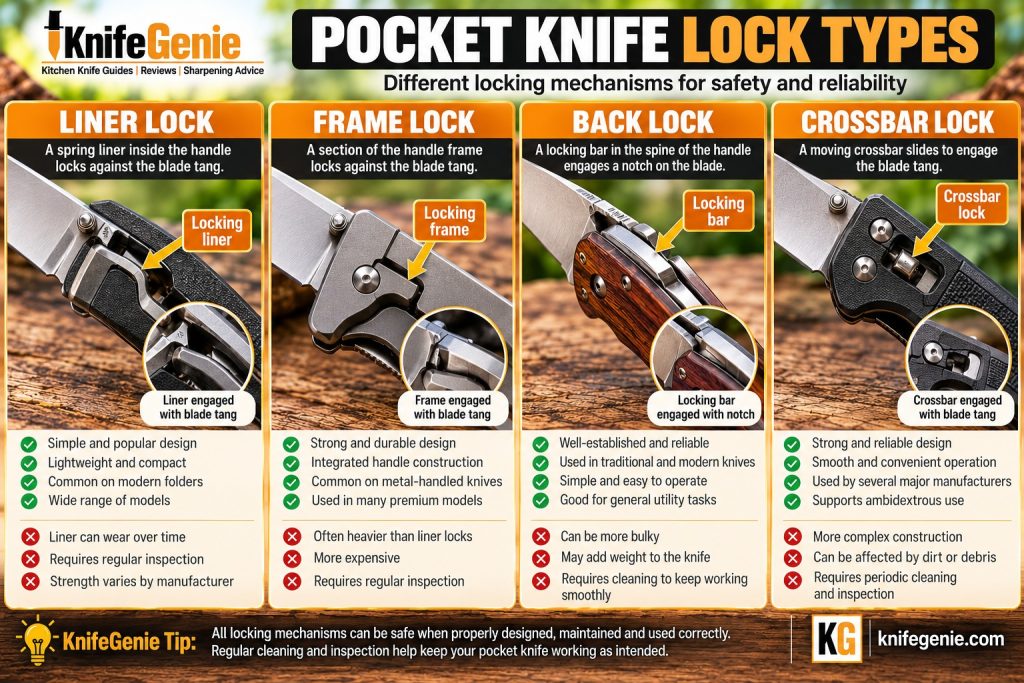
Pocket knife locks use different mechanical designs to hold a blade open.
🪵 Pocket Knife Handle Materials Compared
A comfortable handle can make a bigger difference than an expensive blade finish.
| Material | Advantages | Potential drawbacks |
|---|---|---|
| G-10 | Durable, moisture resistant, textured | Aggressive texture may feel abrasive |
| Micarta | Comfortable, distinctive appearance | Surface appearance may change with use |
| Aluminum | Lightweight and rigid | Smooth finishes may be slippery |
| Stainless steel | Strong and durable | Often heavier |
| Titanium | Strong and corrosion resistant | Expensive |
| Wood | Attractive, traditional feel | Requires moisture care |
🧙 KnifeGenie Tip
If possible, handle a knife before buying it. A beautiful handle is of little benefit if it feels uncomfortable in your hand.
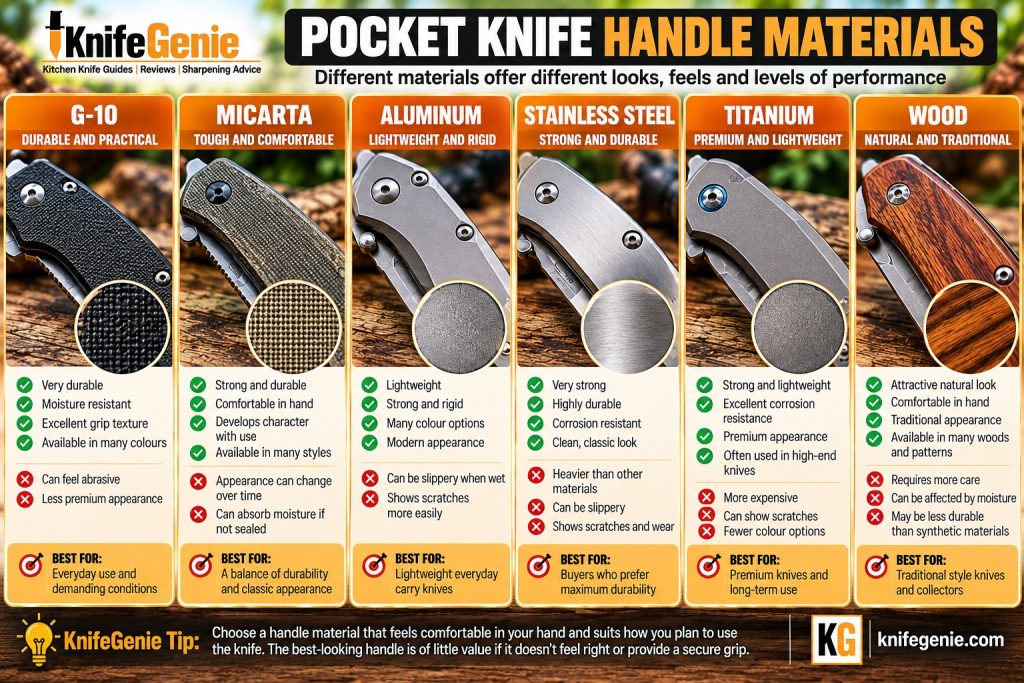
Pocket knife handle materials affect grip, weight, appearance and maintenance.
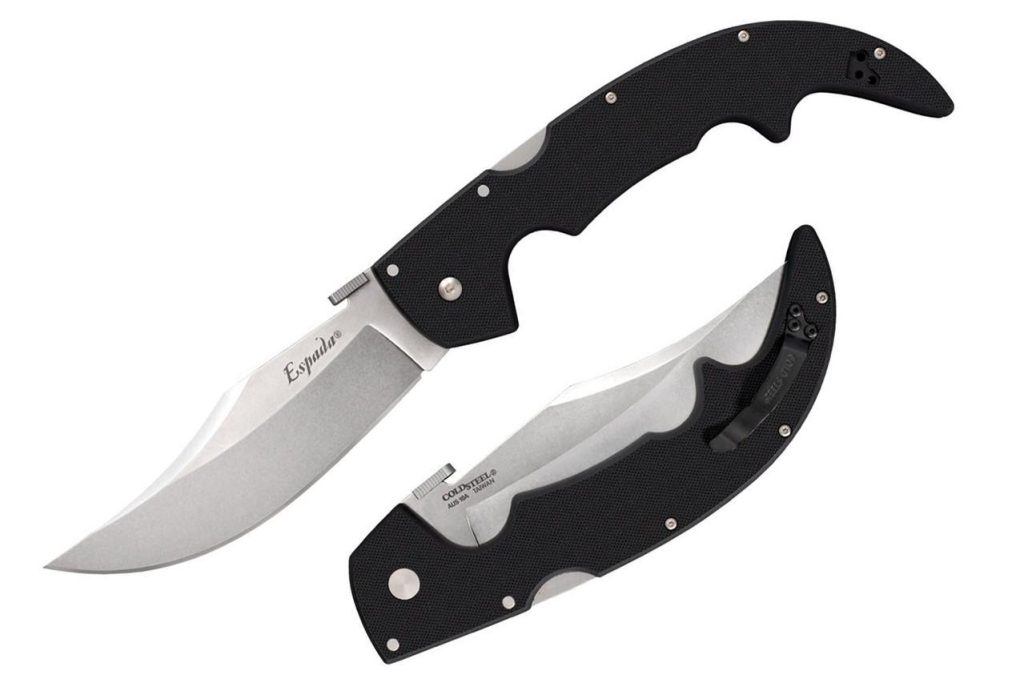
✨ Cold Steel Espada: A Large Folding Knife Example
The Cold Steel Espada family provides an interesting example of a distinctive, oversized folding-knife design.
Rather than representing the typical everyday pocket knife, the Espada emphasizes substantial proportions and recognizable styling.
Different Espada sizes and generations have used different specifications, so buyers should confirm the exact model before comparing blade steel, dimensions, or handle materials.
💪 What Makes the Espada Interesting?
✔ Distinctive curved blade profile
✔ Large folding-knife options
✔ Recognizable handle styling
✔ Tri-Ad locking mechanism on applicable models
✔ Appeal to collectors of unusual folders
❌ Potential Drawbacks
✘ Larger versions can be bulky
✘ Greater weight reduces portability
✘ Higher purchase prices on some versions
✘ Large blades may face additional legal restrictions
🧙 KnifeGenie Verdict
BEST FOR DISTINCTIVE LARGE-FOLDER DESIGN
The Espada may appeal to collectors and enthusiasts who appreciate oversized folding knives.
For most first-time buyers seeking a practical everyday cutting tool, a smaller folder is the more sensible choice.
COLD STEEL ESPADA
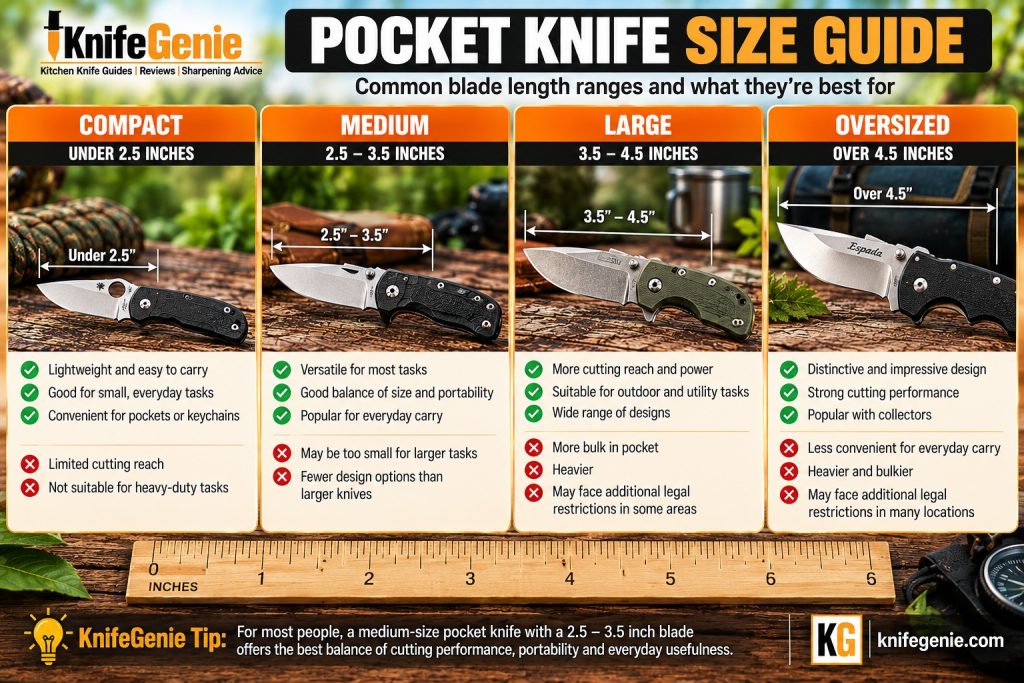
📏 Pocket Knife Size Guide
Choosing the right size is often more important than choosing an exotic steel.
🔹 Compact: Under 2.5 Inches
✔ Lightweight
✔ Convenient for small tasks
✔ Easy to store
🔹 Medium: 2.5–3.5 Inches
✔ Versatile
✔ Comfortable for many utility tasks
✔ Good balance of cutting length and portability
🔹 Large: 3.5–4.5 Inches
✔ More cutting reach
✔ Suitable for some outdoor utility tasks
✘ More bulk
🔹 Oversized: Over 4.5 Inches
✔ Distinctive design
✔ Collector appeal
✘ Less convenient for routine use
✘ Additional legal considerations
🏆 KnifeGenie Size Winner
Medium-size folding knife — for most general-purpose buyers.
🛒 Which Pocket Knife Should You Buy?
The right knife depends on your priorities.
| Your priority | KnifeGenie recommendation |
|---|---|
| First pocket knife | Plain-edge drop-point folder |
| Everyday light utility | Compact or medium folder |
| Traditional appearance | Slipjoint |
| Multiple functions | Multi-tool |
| Humid environments | Corrosion-resistant steel |
| Easy maintenance | Straightforward stainless design |
| Collecting | Specialty folder |
| Lower budget | Reputable entry-level model |
🧙 KnifeGenie Five-Question Buying Test
Before purchasing, ask:
- 🔪 What tasks will I use this knife for?
- 📏 Is the size appropriate?
- ✋ Does the handle feel comfortable?
- 🪨 Can I maintain its edge?
- ⚖️ Is it lawful to possess and carry where intended?
⚠️ Common Pocket Knife Buying Mistakes
❌ Buying the Largest Blade Available
Bigger isn’t always better.
A large knife may be more difficult to carry and unnecessary for routine tasks.
❌ Choosing Appearance Over Comfort
An attractive handle is not useful if it creates pressure points or poor grip.
❌ Ignoring Maintenance
Some steels require more corrosion prevention or sharpening effort than others.
❌ Assuming Every Lock Is Equally Reliable
Locking mechanisms differ in construction, quality, and condition.
❌ Ignoring Local Laws
Pocket-knife restrictions vary by location and circumstances.
Verify the rules where you intend to purchase, possess, carry, or use a knife.
❌ Believing Every Marketing Claim
Statements such as “never needs sharpening” or “unbreakable blade” should be treated cautiously.
🧙 KnifeGenie Rule
Comfort + suitable steel + practical size + dependable construction = a better pocket-knife purchase.
🧼 Pocket Knife Care and Maintenance
A well-maintained pocket knife can provide years of reliable utility.
🧽 Keep It Clean
Remove dirt and cutting residue according to the manufacturer’s instructions.
Avoid leaving moisture trapped around the pivot or handle.
💧 Dry It Thoroughly
Even corrosion-resistant steels benefit from prompt drying.
🔍 Inspect the Lock and Pivot
Check for unusual movement, damaged parts, debris, or improper lock engagement.
Stop using the knife if the mechanism is damaged.
🪨 Sharpen When Necessary
Sharpen when cutting performance deteriorates rather than following a rigid calendar.
For additional maintenance guidance, see KnifeGenie’s Sharpening and Care Guide. It focuses on kitchen knives, but its basic discussion of edge maintenance provides useful background.
🧴 Lubricate Appropriately
Use a manufacturer-recommended lubricant where necessary.
Avoid excessive oil, which can attract debris.
🔐 Store Safely
Store the knife closed, clean, dry, and inaccessible to children or unauthorized users.
🧙 KnifeGenie Tip
Good maintenance habits are often more valuable than premium materials.
Though most knife maintenance is DIY, some are not. Repairing or replacing a Swiss Army Knife blade for instance, should be done by a professional.
❓ Frequently Asked Questions
What is the best pocket knife for a beginner?
A medium-size folding knife with a plain-edge drop-point blade, comfortable handle, and easy-to-maintain stainless steel is a sensible starting point.
What is the best pocket knife blade steel?
There is no universally best steel. The right choice depends on corrosion resistance, edge retention, toughness, sharpening effort, and intended use.
Is D2 steel good for pocket knives?
D2 can provide strong wear resistance and good edge retention, but it generally requires more corrosion care than many stainless steels.
Are expensive pocket knives worth buying?
Some premium knives offer better materials, manufacturing, and support. However, higher prices do not always produce greater practical usefulness.
Are folding pocket knives safe?
They can be used safely when handled properly and maintained in good condition. No folding mechanism eliminates all risk.
Can I take a pocket knife on an airplane?
Under U.S. TSA rules, knives are generally prohibited in carry-on baggage. Consult the TSA knife guidance and check your airline and destination requirements.
How often should a pocket knife be sharpened?
Sharpen when the blade no longer cuts effectively. Frequency depends on steel, blade geometry, use, and maintenance.
Is the Cold Steel Espada good for everyday use?
Larger Espada models may be less convenient for everyday utility because of their size and weight. They may be more appealing to enthusiasts and collectors.
🏆 Final KnifeGenie Verdict: Which Pocket Knife Wins?
The coolest pocket knife isn’t necessarily the largest, most expensive, or most unusual.
The best choice is the one that matches your intended activities and feels comfortable to use.
🥇 Best All-Around Choice
🔪 Medium-size plain-edge folding knife
🪵 Best Traditional Choice
Classic slipjoint pocket knife
🛠️ Best Multi-Purpose Choice
Quality multi-tool
✨ Best Collector-Oriented Choice
Distinctive specialty folding knife
🧙 KnifeGenie Overall Recommendation
Choose a pocket knife based on:
✔ Blade shape
✔ Blade steel
✔ Handle comfort
✔ Size and weight
✔ Construction quality
✔ Maintenance needs
✔ Legal suitability

Buy for performance first and appearance second.
A well-chosen pocket knife should be useful, comfortable, dependable, and appropriate for its intended purpose.