Best boning knives for home butchers, with options for poultry, beef, pork and game processing.There’s something satisfying about breaking down your own meat.
Whether you buy whole chickens, trim briskets before they hit the smoker, portion larger cuts of beef and pork, or process venison after hunting season, doing the work yourself gives you more control over the final result.
But it also makes one thing obvious very quickly:
The right knife matters.
A chef’s knife is excellent for general kitchen work, but its wide blade becomes awkward when you need to trace around a joint, separate meat from bone or slip beneath silverskin. That’s where a good boning knife earns its place.
For most home butchers, KnifeGenie recommends starting with a 5- to 6-inch boning knife with a narrow blade and enough stiffness for controlled meat work. If you regularly work with poultry or delicate cuts, some additional flexibility can be useful. For beef, pork and game, a firmer blade generally provides better control.
After researching current manufacturer specifications, construction, blade design, intended uses and value, our best overall choice is the Victorinox Fibrox 6-inch Curved Boning Knife.
But it isn’t the best choice for everybody.
Let’s find the one that fits the meat you actually prepare.
🔎 How We Chose These Knives
KnifeGenie has not personally tested every knife in this guide. These recommendations are research-based rather than the result of hands-on comparative testing. We compared manufacturer specifications, blade design, materials, flexibility, handle construction, intended uses, maintenance requirements, brand reputation and overall value. Where we discuss how a design should perform, that assessment is based on those characteristics rather than a claim of personal use.
🔽 Jump to What You Need
👉 Quick Answer
👉 Comparison Table
👉 Victorinox Fibrox — Best Overall
👉 Mercer Millennia — Best Budget
👉 Dexter-Russell SOFGRIP — Best for Heavy Meat
👉 Wüsthof Classic — Best Premium
👉 What Is a Boning Knife?
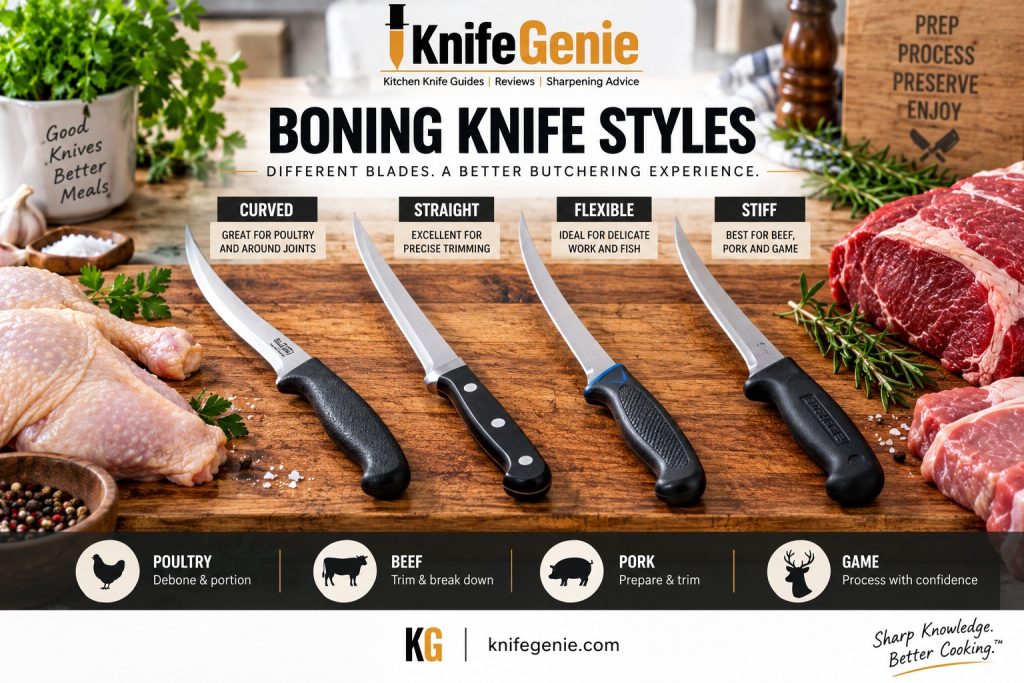
👉 Stiff vs Flexible
👉 Straight vs Curved
👉 Blade Material
👉 Handle & Grip
👉 How to Choose
👉 KnifeGenie Pro Tips
👉 Frequently Asked Questions
👉 Final Verdict
🏆 Best Boning Knife for Home Butchers: Quick Answer
If you don’t want to spend half an hour comparing steel specifications, here’s the short version.
🥇 Best Overall — Victorinox Fibrox 6-Inch Curved Boning Knife
Choose it for: Poultry, pork, beef and general home butchery.
Its narrow curved blade, light weight and textured Fibrox-style handle make this a particularly practical design for somebody who wants a working knife rather than a showpiece.
💰 Best Budget — Mercer Culinary Millennia 6-Inch Boning Knife
Choose it for: Affordable everyday meat preparation.
Mercer’s combination of a 6-inch high-carbon Japanese-steel blade and textured Santoprene/polypropylene handle makes it an appealing entry-level choice.
🥩 Best for Heavy Meat — Dexter-Russell SOFGRIP 6-Inch Boning Knife
Choose it for: Beef, pork, venison and tougher trimming jobs.
Dexter’s stiff versions make particular sense when control is more useful than excessive flexibility.
⭐ Best Premium — Wüsthof Classic Boning Knife
Choose it for: The home butcher who wants traditional forged construction and premium fit and finish.
It costs considerably more, but it offers a different ownership proposition from the commercial-style Victorinox, Mercer and Dexter knives.
🧙 KnifeGenie Quick Verdict
Best choice for most home butchers: 🥇 Victorinox Fibrox 6-inch curved
Best inexpensive choice: 💰 Mercer Millennia 6-inch
Best for beef and game: 🥩 Dexter-Russell SOFGRIP stiff/wide 6-inch
Best premium choice: ⭐ Wüsthof Classic
BONING KNIFE BUYING GUIDE
🔐 Affiliate Disclosure
KnifeGenie.com is a participant in the Amazon Services LLC Associates Program. As an Amazon Associate, we earn from qualifying purchases. If you purchase through an affiliate link on this page, we may earn a commission at no additional cost to you. Our recommendations are based on research and are not influenced by whether a product pays a higher commission.
Prices and availability can change. Use the Amazon links below to see current product information.
⚔️ Best Boning Knives — Comparison Table
| Knife | Blade | Construction | Best For | Check Price |
|---|---|---|---|---|
| 🥇 Victorinox Fibrox Curved | 5.9″ | Stamped | General home butchery | Check Price on Amazon |
| 💰 Mercer Millennia | 6″ | Stamped | Budget/general use | Check Price on Amazon |
| 🥩 Dexter-Russell SOFGRIP | 6″ | Stiff options | Beef, pork & game | Check Price on Amazon |
| ⭐ Wüsthof Classic | 5.5″ | Forged | Premium home use | Check Price on Amazon |
🥇 Victorinox Fibrox 6-Inch Curved Boning Knife — Best Overall
There is a reason commercial-style boning knives tend to look less glamorous than expensive chef’s knives.
They’re tools.
When your hands are damp and you’re trying to guide an edge around a chicken joint or trim a piece of pork cleanly, a beautiful wooden handle isn’t necessarily your first priority.
Grip and control matter more.
Victorinox’s current Fibrox curved boning knife uses a 5.9-inch curved blade paired with a textured, non-slip thermoplastic handle. It is Swiss-made and weighs only about 3.4 ounces.
That combination is what makes it our research-based choice for most home butchers.
🔪 Material & Construction
Blade: Stainless-steel blade
Blade length: 5.9 inches
Construction: Stamped/non-forged
Handle: Textured thermoplastic elastomer
Origin: Switzerland
Blade profile: Narrow and curved
🥩 Best Used For
✔ Deboning chicken
✔ Trimming pork
✔ Working around beef joints
✔ Removing fat
✔ Removing silverskin
✔ General home meat processing
The curved blade is particularly interesting for meat preparation because it provides useful contact through slicing motions while still giving you a fine point for detailed work.
✅ Pros
✔ Excellent all-purpose blade length
✔ Lightweight and maneuverable
✔ Textured non-slip handle
✔ Curved blade well suited to meat work
✔ Swiss-made
✔ Sensible price for a specialized knife
✔ Practical rather than decorative
❌ Cons
✘ Stamped rather than forged
✘ Utilitarian appearance
✘ Home cooks wanting a heavier premium knife may prefer Wüsthof
✘ You need to choose the appropriate Victorinox blade-flex variant for your intended work
🧙 KnifeGenie Verdict
BEST ALL-AROUND CHOICE
For somebody building a practical home-butchering setup, this is where we would start.
It doesn’t win because it has the fanciest steel or most impressive handle.
It wins because the overall design makes sense for the job.
🎯 Perfect for: The home cook who wants one practical boning knife for poultry, pork, beef and routine trimming.
💰 Mercer Culinary Millennia 6-Inch — Best Budget Boning Knife
Not everyone needs a premium forged knife to remove a chicken thigh bone.
For many home cooks, spending less on a well-designed commercial-style knife makes considerably more sense.
That’s where the Mercer Millennia becomes interesting.
Mercer specifies a 6-inch high-carbon Japanese-steel blade, a 15-degree blade angle and approximately 53–54 HRC for its standard Millennia boning knife. The handle combines Santoprene for grip and comfort with polypropylene for durability.
It is also NSF certified.
🔪 Material & Construction
Blade: High-carbon Japanese steel
Length: 6 inches
Hardness: Approximately 53–54 HRC
Blade angle: 15°
Construction: Stamped
Handle: Santoprene + polypropylene
Certification: NSF
🐔 Best Used For
✔ Poultry
✔ Pork
✔ General meat trimming
✔ Removing fat
✔ Smaller joints
✔ Home cooks learning to butcher meat
Mercer also produces flexible and curved Millennia variants, so don’t assume every knife carrying the Millennia name behaves exactly the same way.
✅ Pros
✔ Affordable
✔ Useful 6-inch length
✔ Textured grip
✔ Protective finger guard
✔ Straightforward edge maintenance
✔ NSF certified
✔ Several blade profiles available
❌ Cons
✘ Stamped construction
✘ Softer steel will normally require more frequent edge maintenance than harder premium steels
✘ Less premium fit and finish
✘ Buyers need to pay attention to whether they’re ordering the standard, curved or flexible version
🧙 KnifeGenie Verdict
BEST VALUE FOR BEGINNERS
If you’re experimenting with breaking down your own meat and aren’t ready to spend heavily on a specialty knife, Mercer gives you a sensible starting point.
🎯 Perfect for: Beginners, occasional home butchers and value-focused cooks.
🥩 Dexter-Russell SOFGRIP 6-Inch — Best for Beef, Pork & Game
Here’s where blade flexibility becomes important.
If you’re working around delicate poultry or fish, some flex can help the blade follow contours.
Start trimming dense beef, pork or venison and your priorities change.
A firmer blade gives you more feedback and control.
Dexter-Russell offers its 6-inch SOFGRIP boning knives in configurations including wide, narrow and flexible blades. Dexter specifically positions the wide stiff design for thicker, less tender meat such as beef and poultry.
That makes the line particularly interesting for a home butcher who processes larger proteins or game. These are American-made specialty knives and worth a look.
🔪 Material & Construction
Blade: Stain-resistant high-carbon steel
Length: 6 inches
Blade choices: Wide/stiff, narrow and flexible options
Handle: Textured SOFGRIP
Design emphasis: Grip, control and professional food preparation
🦌 Best Used For
✔ Beef
✔ Pork
✔ Venison
✔ Large roasts
✔ Tough connective tissue
✔ Heavy trimming
✅ Pros
✔ Different blade-flex options
✔ Stiff versions suit dense meat
✔ Slip-resistant handle
✔ Commercial/work-oriented design
✔ 6-inch blade remains maneuverable
✔ Established butchery-oriented manufacturer
❌ Cons
✘ Utilitarian styling
✘ A stiff model isn’t the best choice for delicate fish work
✘ Several variants make the buying decision slightly more complicated
✘ Buyers need to check the exact blade configuration before ordering
🧙 KnifeGenie Verdict
BEST FOR HEAVIER BUTCHERY
If deer processing, pork shoulders and substantial beef cuts are higher on your list than fish and delicate poultry, we’d favor a relatively stiff Dexter over an extremely flexible blade.
🎯 Perfect for: Hunters, BBQ enthusiasts and home butchers processing beef, pork or game.
STIFF VS FLEXIBLE BONING KNIFE
⭐ Wüsthof Classic Boning Knife — Best Premium Choice
The first three recommendations are fundamentally working knives.
The Wüsthof Classic takes a different approach.
Wüsthof specifies forged construction, German manufacture and approximately 58 HRC for its Classic boning knife. The current U.S. specification lists a blade length of approximately 5.5 inches.
The narrow, curved profile is intended for deboning, skinning and removing tendons and fat.
Do you need forged construction to debone a chicken?
No.
But if you enjoy owning premium kitchen knives and want your specialty knife to have the substantial construction and finish associated with Wüsthof’s Classic series, this becomes the more appealing option.
🔪 Material & Construction
Blade: Stainless steel
Blade length: Approximately 5.5 inches
Hardness: 58 HRC
Construction: Forged
Origin: Germany
Handle: Traditional riveted Classic-series design
🥩 Best Used For
✔ Poultry
✔ Beef and pork trimming
✔ Skinning meat
✔ Removing tendons and fat
✔ Premium home-kitchen setups
✅ Pros
✔ Forged construction
✔ German-made
✔ 58 HRC specification
✔ Compact and maneuverable
✔ Premium fit and finish
✔ Traditional handle construction
❌ Cons
✘ Much more expensive than commercial-style alternatives
✘ Extra cost doesn’t automatically mean proportionally better deboning
✘ May be unnecessary for occasional use
✘ Buyers wanting maximum flexibility should consider another design
🧙 KnifeGenie Verdict
BEST PREMIUM CHOICE
Buy the Wüsthof because you appreciate its construction, balance, brand heritage and ownership experience—not because an inexpensive Victorinox or Mercer suddenly becomes incapable of removing meat from a bone.
🎯 Perfect for: Knife enthusiasts and home cooks who prefer premium forged cutlery.
🔪 What Is a Boning Knife?
A boning knife is a relatively short, narrow kitchen knife designed to work closely around bones, joints, tendons, skin and connective tissue.
The key word is control.
Imagine removing the breast from a whole chicken.
A wide 8-inch chef’s knife can make the cut, but the blade gets in your way when you begin following the rib cage.
A narrow boning knife lets the tip and edge follow those contours much more naturally.
Typical jobs include:
🐔 Deboning poultry
🥩 Trimming beef
🐖 Preparing pork
🦌 Processing game
✂️ Removing silverskin
🥓 Trimming fat
🦴 Working around joints
🍖 Cleaning tenderloin
If you’re unsure how this differs from a fillet knife, read KnifeGenie’s Boning Knife vs Fillet Knife comparison.
The simple distinction is:
Boning knife = control around meat and bone.
Fillet knife = flexibility and reach for fish.
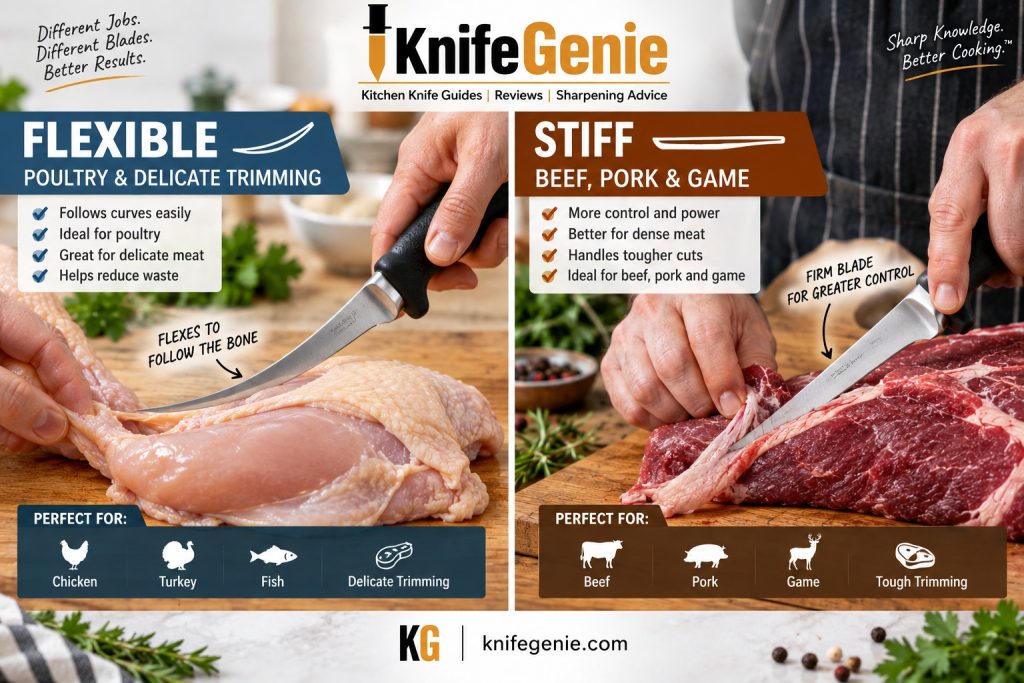
🦴 Stiff vs Flexible Boning Knife: Which Do You Need?
This may be more important than the brand name printed on the handle.
🥩 Stiff Boning Knife
Choose a stiffer blade for:
✔ Beef
✔ Pork
✔ Venison
✔ Dense meat
✔ Tough connective tissue
✔ Controlled trimming
Stiffness gives you greater control when you’re applying pressure against heavier meat.
🐔 Flexible Boning Knife
Choose greater flexibility for:
✔ Chicken
✔ Turkey
✔ Delicate trimming
✔ Following curved bones
✔ Occasional fish preparation
✔ Removing skin
The blade can conform more closely to the food rather than forcing a straight cutting path.
🧙 KnifeGenie Tip
If you’re buying only one: choose somewhere in the middle.
A 6-inch narrow blade with modest flexibility is arguably the most versatile setup for general home butchery.
📐 Straight vs Curved Boning Knife
You’ll also encounter both straight and curved blades.
Straight Blade
A straight profile gives you excellent point control and works particularly well when you’re making precise cuts around joints and working in tight spaces.
Curved Blade
A curved blade creates a slightly longer cutting path during a slicing stroke.
That makes curved boning knives particularly useful for:
🥩 Trimming
🐔 Poultry
🍖 Removing meat from larger bones
✂️ Skinning and detailed slicing
Neither shape is universally superior.
For general home meat preparation, however, a narrow curved 5- to 6-inch knife is an exceptionally useful configuration.
🧱 Boning Knife Blade Material
Don’t get trapped by marketing terminology here.
You’ll see descriptions including:
Stainless steel
High-carbon stainless steel
High-carbon steel
Japanese steel
Those labels alone don’t tell you whether a knife is good.
Heat treatment, hardness, blade geometry, thickness and edge design all matter.
A boning knife also has slightly different requirements from a chef’s knife.
You don’t necessarily want the hardest, thinnest edge possible.
Why?
Because boning involves working close to hard bones and joints.
A little toughness and forgiveness can be extremely useful.
That is one reason commercial meat-processing knives often use relatively straightforward steels that can be sharpened easily rather than chasing extreme hardness numbers.
✋ Handle & Grip Matter More Than You Think
A beautiful handle makes a great photograph.
A secure handle makes a better boning knife.
Meat preparation can leave your hands damp or greasy, so grip deserves serious consideration.
Look for:
✔ Textured surfaces
✔ Comfortable handle shape
✔ Secure finger positioning
✔ Adequate finger protection
✔ Easy cleaning
✔ No uncomfortable pressure points
This is one area where the Victorinox, Mercer and Dexter commercial-style designs make considerable sense.
Their handles aren’t primarily designed to impress somebody looking through a glass display cabinet.
They’re designed to be held while working.
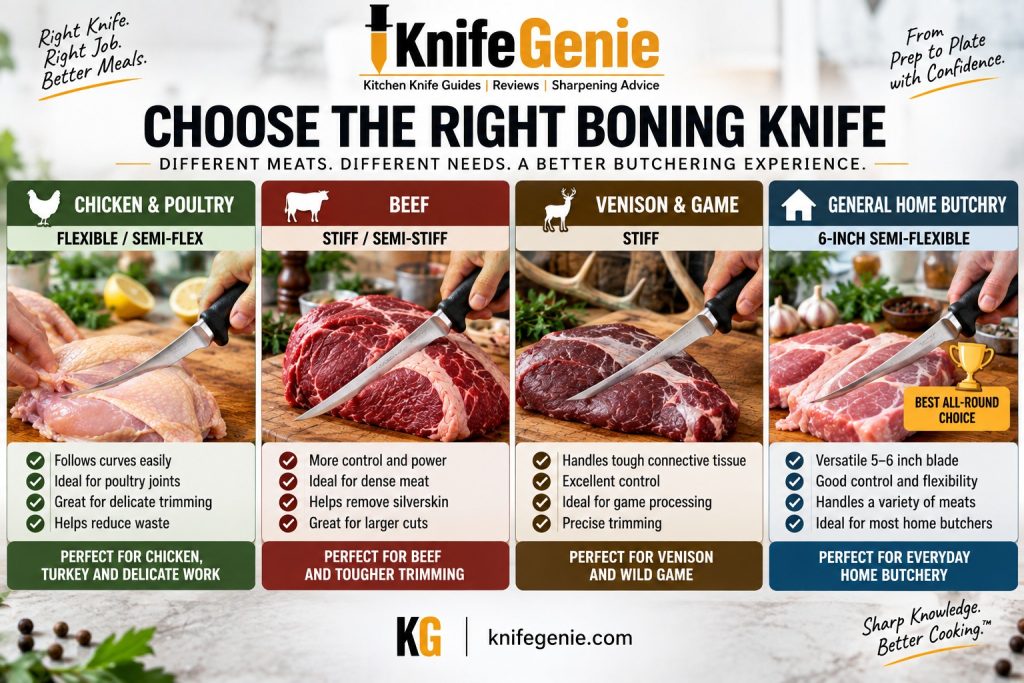
🛒 How to Choose the Best Boning Knife for YOU
| Your Main Job | Recommended Style |
|---|---|
| 🐔 Chicken & poultry | 5–6″ semi-flex/flexible |
| 🥩 Beef | 6″ stiff or semi-stiff |
| 🐖 Pork | 6″ semi-stiff |
| 🦌 Deer & game | 6″ stiff |
| ✂️ Silverskin | Narrow/semi-flexible |
| 🐟 Occasional fish | Flexible |
| 🏠 General home butchery | 6″ semi-flexible |
| ⭐ Premium home kitchen | Forged 5–6″ |
🏆 The Sweet Spot
For the average home butcher:
5–6 inches + narrow blade + secure handle + moderate flexibility
That’s more useful than chasing the most expensive steel or fanciest handle.
HOW TO CHOOSE A BONING KNIFE
🪨 Keeping a Boning Knife Sharp
A narrow boning knife becomes considerably less useful when dull.
More importantly, don’t compensate for a dull edge by pushing harder.
Maintain the knife according to its steel and manufacturer’s recommendations.
For a detailed walkthrough, see KnifeGenie’s How to Sharpen a Boning Knife guide.
Also understand the difference between maintenance and actual sharpening.
Honing can help maintain or realign an appropriate edge.
Sharpening removes steel to create a fresh cutting edge.
Our Honing vs Sharpening guide explains exactly when you need each one.
And if you’re unsure about frequency, see How Often Should You Sharpen Kitchen Knives?
🧙 KnifeGenie Pro Tips
🦴 Follow the bone—don’t chop through it. A boning knife is designed to separate meat from bone, not function as a cleaver.
🔪 Use the tip intelligently. The narrow point is one of the knife’s biggest advantages when working around joints.
✋ Keep your free hand out of the cutting path. Meat can shift unexpectedly during trimming.
🧼 Hand washing is the safer general habit for edge life. Even where a manufacturer describes a knife as dishwasher safe, hand washing and prompt drying avoids the rough environment inside a dishwasher.
🪨 Maintain the edge. Don’t wait until the knife feels completely blunt before thinking about maintenance.
🪵 Use an edge-friendly cutting board. Avoid glass, stone and similarly hard surfaces.
🎯 Buy for your meat, not the marketing. Somebody processing venison has different requirements from somebody deboning two chickens a month.
💰 Don’t equate price with suitability. An inexpensive commercial boning knife can be a better butchering tool for your needs than a beautiful forged knife costing several times as much.
👍 Boning Knife Pros & Cons
✅ Advantages
✔ Excellent control around bones and joints
✔ Narrow blade reaches tight spaces
✔ Reduces unnecessary meat waste
✔ Excellent for removing fat and silverskin
✔ Useful for poultry, beef, pork, lamb and game
✔ Short blade is easy to maneuver
✔ Multiple flexibility levels available
✔ Relatively affordable specialty knife
❌ Limitations
✘ Not intended for chopping through substantial bones
✘ Too narrow for many general chef-knife jobs
✘ Flexible models can feel unstable during heavy meat work
✘ Stiff models aren’t ideal for delicate fish preparation
✘ Requires a sharp edge to perform properly
✘ One blade-flex level won’t be perfect for every task
🎯 Who Should Own a Boning Knife?
A boning knife makes particular sense if you’re:
✔ Buying whole chickens instead of individual pieces
✔ Buying larger cuts to portion at home
✔ Trimming brisket for smoking
✔ Processing venison or other game
✔ Removing silverskin from tenderloin
✔ Regularly preparing pork or lamb
✔ Trying to reduce meat waste
✔ Building a serious home-butchering setup
If you only buy pre-trimmed boneless meat, you may use a boning knife relatively infrequently.
That’s worth considering before buying an expensive one.
❓ Frequently Asked Questions
What is the best boning knife for home butchers?
For general home butchery, KnifeGenie’s research-based overall recommendation is a 6-inch Victorinox Fibrox curved boning knife because its length, narrow curved profile, low weight and textured handle make it a practical all-around configuration.
For heavy beef and game work, consider a stiffer Dexter-Russell design.
What size boning knife is best?
Around 5 to 6 inches is the sweet spot for most home cooks.
That gives you enough cutting edge for efficient trimming without sacrificing maneuverability around bones and joints.
Should a boning knife be flexible or stiff?
It depends on what you’re cutting.
Choose more flexibility for poultry, delicate meat and fish. Choose greater stiffness for beef, pork, venison and other dense proteins.
For mixed home use, semi-flexible is a useful compromise.
Is a curved or straight boning knife better?
Neither is universally better.
Straight blades provide excellent precision and point control. Curved blades are particularly effective for trimming and sweeping cuts around meat and bones.
Can you use a boning knife for deer?
Yes.
A stiff or semi-stiff 5- to 6-inch boning knife is an excellent tool for trimming and processing venison.
Don’t use it to chop through substantial bone.
Can I use a boning knife to fillet fish?
Yes, particularly if the blade is flexible.
However, people who regularly prepare whole fish will normally benefit from the additional length and flexibility of a dedicated fillet knife.
See Boning Knife vs Fillet Knife for the full comparison.
Is a forged boning knife better than stamped?
Not automatically.
Forged knives can offer premium construction, weight and finish, but lightweight stamped knives are extremely common in professional-style meat-processing applications.
For a boning knife, blade geometry, flexibility, grip, edge maintenance and control matter at least as much as whether the blade is forged.
Read Forged vs Stamped Knives if you want a deeper explanation.
How often should I sharpen a boning knife?
There isn’t one correct calendar interval.
Sharpen according to use and cutting performance rather than blindly sharpening every few weeks.
When the edge begins requiring excessive pressure or stops making clean, controlled cuts, assess whether it needs honing or sharpening.
Can a boning knife cut through bone?
A boning knife is primarily intended to cut around bone—not hack through substantial bones.
Use poultry shears, a cleaver, bone saw or another appropriate tool when you actually need to divide bone.
What is the best boning knife for beginners?
A relatively inexpensive 6-inch knife with a secure textured handle is a sensible starting point.
The Mercer Millennia and Victorinox Fibrox designs are particularly attractive on paper because they emphasize practical handling rather than expensive decorative construction.
🏁 Final Cut: Which Boning Knife Should You Buy?
After digging through the specifications, blade designs and intended uses, one thing stands out:
You don’t need an exotic knife to butcher meat well.
You need the right knife.
For the average home butcher, we’d choose the Victorinox Fibrox 6-inch curved boning knife. Its compact size, narrow curved blade, light construction and grippy handle make it the strongest all-around choice in this group based on our research.
If you’re keeping costs down, the Mercer Millennia makes a convincing budget alternative.
If you’re regularly processing beef, pork or venison, look seriously at one of Dexter-Russell’s stiffer 6-inch configurations.
And if you’re a knife enthusiast who wants a premium forged knife that feels at home beside high-end chef’s knives, the Wüsthof Classic fills that role nicely.
🏆 KnifeGenie Final Recommendations
🥇 Best Overall: Victorinox Fibrox 6-Inch Curved Boning Knife
💰 Best Budget: Mercer Culinary Millennia 6-Inch
🥩 Best for Beef & Game: Dexter-Russell SOFGRIP 6-Inch Stiff
⭐ Best Premium: Wüsthof Classic Boning Knife
The important part is matching the blade to the work in front of you.
A sharp, controllable, reasonably priced working knife that suits your meat is more useful than an expensive knife chosen because it looked impressive online.
That’s one of the lessons knife enthusiasts eventually learn:
Buy for the cut. Maintain the edge. Let the knife do the work.
Sharp knives. Smart choices.
— KnifeGenie