
5 Key Things Home Cooks Should Know
If you’ve been comparing kitchen knives, you may have come across the term hollow grind and wondered what it actually means.
The quick answer is surprisingly simple:
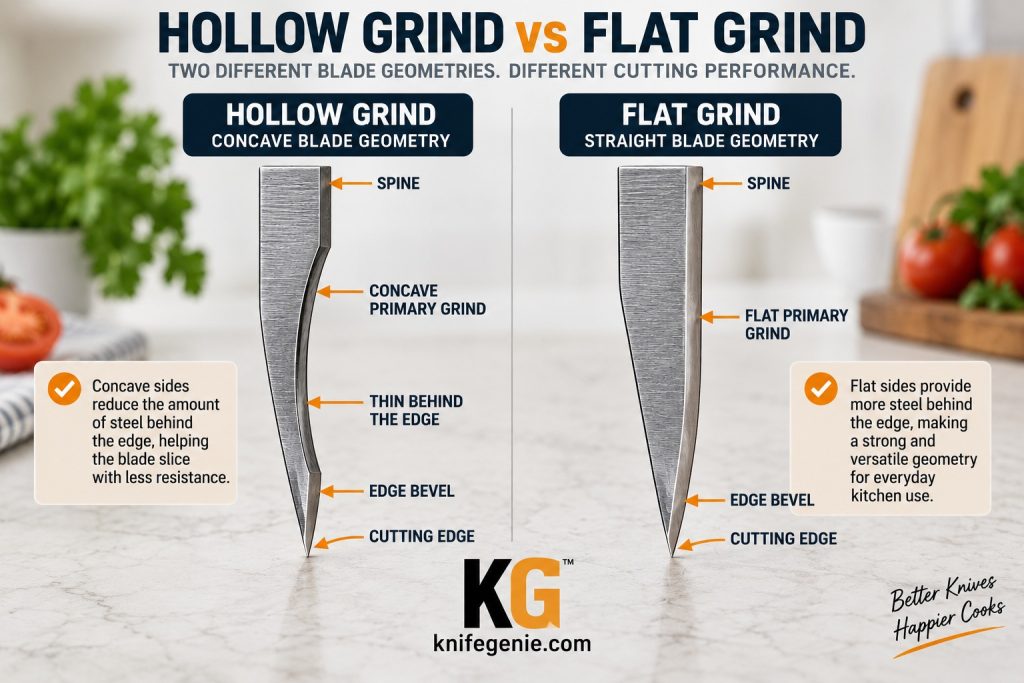
A hollow grind is a blade geometry in which the sides of the blade curve inward—or become concave—as they approach the cutting edge.
That concave shape can leave relatively little steel immediately behind the edge, helping a properly designed knife cut with very little resistance at the start of a slice.
But there’s an important catch.
A hollow grind is not automatically sharper than every flat-ground knife, and it isn’t necessarily the best geometry for an all-purpose chef’s knife. The blade’s steel, heat treatment, thickness, edge angle and overall geometry all affect how it actually performs.
And there’s another source of confusion:
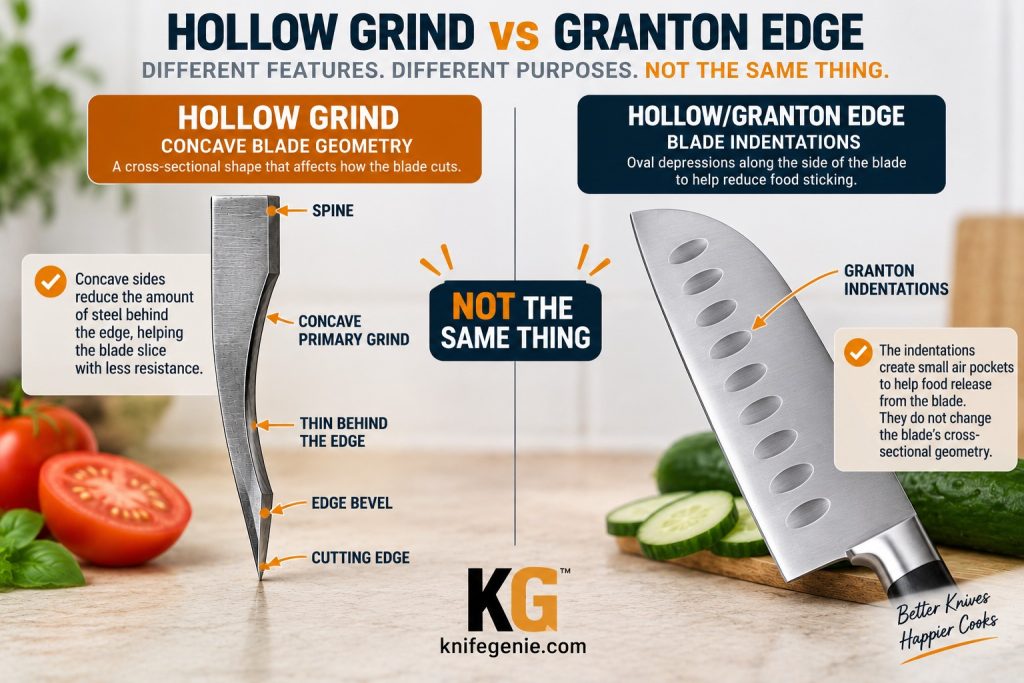
A hollow-ground blade is not the same thing as a “hollow-edge” or Granton-style kitchen knife with dimples along the blade.
Let’s look at what hollow grinding really means, how it affects kitchen performance, and whether you should choose one.
🔽 Jump to What You Need
👉 Quick Answer
👉 What Is a Hollow Grind?
👉 Hollow Grind vs Hollow Edge
👉 How Does a Hollow Grind Work?
👉 Hollow Grind vs Flat Grind
👉 Bread
👉 Tomatoes
👉 Meat
👉 Vegetables
👉 Does a Hollow Grind Make a Knife Sharper?
👉 Sharpening and Maintenance
👉 Pros and Cons
👉 Which Should You Buy?
👉 Frequently Asked Questions
👉 Overall Recommendation
🏆 What Is a Hollow Grind? The Quick Answer
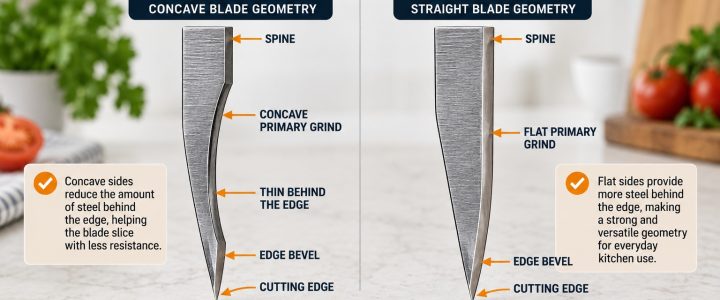
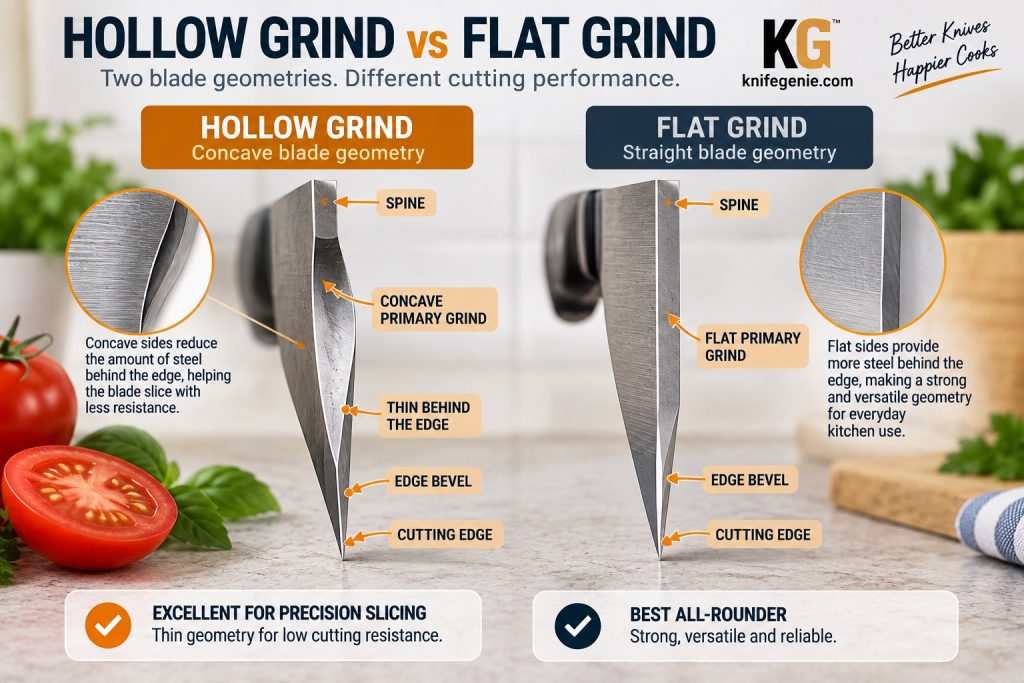
A hollow grind describes the cross-sectional geometry of a knife blade.
Instead of the blade tapering toward the edge along straight surfaces, as it does with a flat grind, a hollow-ground blade has inward-curving, concave surfaces.
Think of it this way:
Flat grind: \ /
Hollow grind: ) (
The illustration is simplified, but it demonstrates the basic difference.
The hollow section is normally produced during manufacture using a grinding wheel. Because the wheel is round, removing steel from the blade creates the characteristic concave surface.
🧙 KnifeGenie Quick Verdict
✔ Best characteristic: Thin geometry immediately behind the edge
✔ Best suited to: Controlled slicing and relatively shallow cuts
✔ Potential weakness: Less steel supporting a very thin edge
✔ For general kitchen prep: A good flat or appropriately designed chef’s-knife grind is usually more versatile
✔ Most important: Don’t confuse a hollow grind with Granton dimples
HOLLOW GRIND EXPLAINED
Hollow Grind Cross-Section
🔪 What Is a Hollow Grind on a Knife?
One of the problems with discussions about knife grinds is that blade grind and sharpening are often treated as though they’re the same thing.
They’re not.
The primary grind describes how the main body of the blade becomes thinner as it approaches the cutting edge.
The edge bevel is the much smaller bevel at the very bottom of many knives that actually forms the cutting edge.
So when someone says:
“This knife has a hollow grind.”
They’re normally describing the geometry behind the cutting edge, not simply the angle at which the knife was last sharpened.
That distinction matters because you generally don’t need to reproduce the entire hollow grind every time you sharpen the knife.
For an ordinary double-bevel kitchen knife, you’re normally maintaining its existing cutting-edge bevel.
🧙 KnifeGenie Tip
Grind = overall blade geometry.
Sharpening angle = geometry at the cutting edge.
They’re related, but they’re not interchangeable terms.
🥔 Hollow Grind vs Hollow Edge: Don’t Confuse Them
This is probably the biggest terminology trap for kitchen-knife buyers.
You’ve almost certainly seen Santoku knives, carving knives and other kitchen knives with oval depressions running along the sides of the blade.
These are frequently marketed using terms such as:
Hollow edge
Granton edge
Granton-style edge
Kullenschliff
Those depressions are not what knife makers mean by a hollow grind.
A hollow grind describes the blade’s cross-sectional shape.
Granton-style indentations are scallops or dimples on the blade face, generally intended to help reduce food adhesion.
A knife can therefore have:
✔ A hollow grind without Granton dimples
✔ Granton dimples without a hollow grind
✔ Both features
✔ Neither feature
HOLLOW GRIND vs HOLLOW EDGE
Hollow Grind vs Granton Edge
⚙️ How Does a Hollow Grind Work?
Imagine pressing the side of a knife blank against a large rotating grinding wheel.
Because the wheel has a curved surface, it removes steel in a corresponding curve.
The result is a concave section of blade.
How pronounced that hollow becomes depends on factors including the wheel diameter, blade thickness, grind height and how much material is removed.
The important result for the cook is what happens behind the edge.
A well-executed hollow grind can leave this area quite thin.
That’s useful because cutting isn’t determined solely by whether the very tip of the edge feels sharp.
Once that edge enters a tomato, onion or piece of meat, the rest of the blade has to follow it.
The geometry behind the edge therefore plays a major role in cutting resistance.
But hollow grinding has a trade-off.
As a deep cut moves farther up the blade, the food eventually encounters thicker portions of the blade. Depending on the design, that can create more wedging than you’d get from a thin full-flat-ground blade.
That is one reason hollow grinding shouldn’t automatically be interpreted as “better cutting geometry.”
⚔️ Hollow Grind vs Flat Grind — Kitchen Comparison
For kitchen use, the most useful comparison is usually between hollow and flat blade geometry.
| Kitchen Task | 🔪 Hollow Grind | 🔪 Flat Grind |
|---|---|---|
| Bread | ⭐⭐⭐ – grind matters less than good serrations | ⭐⭐⭐⭐⭐ – excellent with proper bread-knife geometry/serrations |
| Tomatoes | ⭐⭐⭐⭐⭐ – thin geometry can start slices beautifully | ⭐⭐⭐⭐⭐ – excellent when thin and sharp |
| Meat | ⭐⭐⭐⭐⭐ – very good for controlled slicing | ⭐⭐⭐⭐⭐ – excellent and highly versatile |
| Vegetables | ⭐⭐⭐⭐ – good for many vegetables; geometry may wedge in tall dense produce | ⭐⭐⭐⭐⭐ – excellent all-purpose performance |
| Deep cuts | ⭐⭐⭐ – depends heavily on grind depth and blade thickness | ⭐⭐⭐⭐⭐ – predictable taper through food |
| Edge support | ⭐⭐⭐ – can be relatively delicate when ground very thin | ⭐⭐⭐⭐ – generally more material behind the edge |
| Maintenance | ⭐⭐⭐⭐ – normal edge sharpening can be straightforward | ⭐⭐⭐⭐⭐ – straightforward for most kitchen users |
| Best user | Precision slicer who understands the trade-offs | Most home cooks |
| KnifeGenie choice | Excellent specialist geometry | Best all-purpose choice |
🧙 KnifeGenie Tip: Grind type alone doesn’t tell you how well a knife will cut. Blade thickness, steel, heat treatment, edge angle and thickness behind the edge can matter just as much.
🍞 Hollow Grind for Bread
For bread knives, serration design is far more important than simply looking for a hollow grind.
Crusty bread presents a special problem: the knife has to bite through a resistant crust without crushing the softer interior.
That’s why serrated bread knives work so well.
A properly designed hollow grind could contribute to cutting performance, but I wouldn’t choose a bread knife primarily because the manufacturer advertises hollow-ground blade geometry.
🏆 Winner for Bread
A well-designed serrated bread knife.
The grind is secondary.
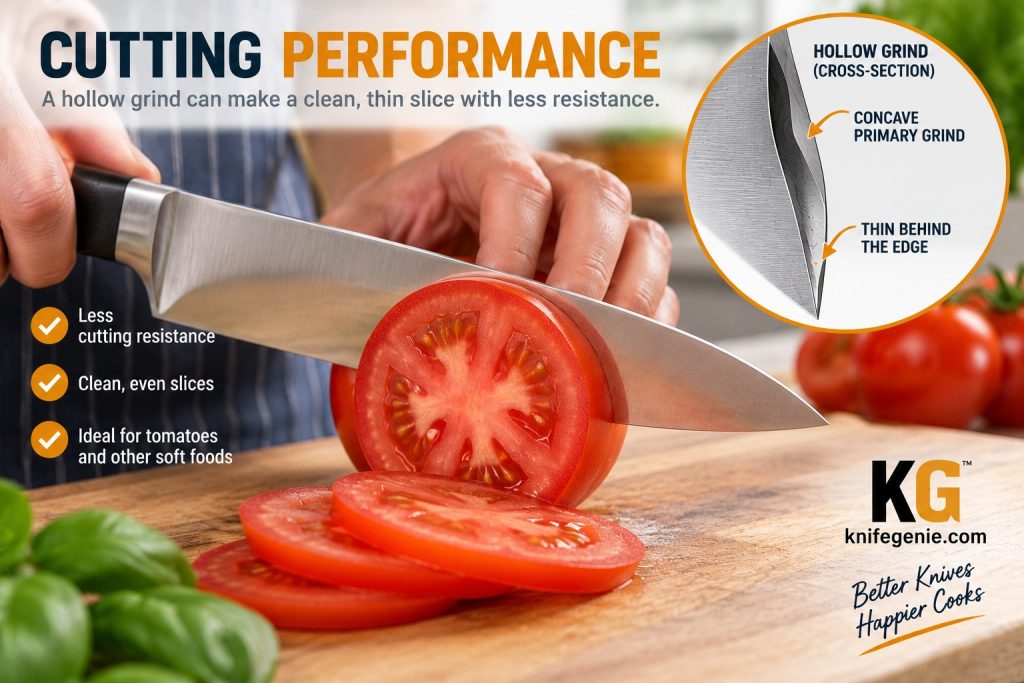
🍅 Hollow Grind for Tomatoes
Now we’re entering territory where thin geometry becomes much more interesting.
A ripe tomato is a surprisingly revealing knife test.
You want the edge to break through the skin without needing enough downward force to crush the soft flesh underneath.
A thin, sharp hollow-ground blade can perform extremely well here because there may be relatively little steel directly behind the cutting edge.
But don’t assume hollow automatically wins.
A thin, sharp flat-ground kitchen knife can slice tomatoes beautifully too.
🏆 Hollow-Grind Performance: EXCELLENT
Particularly when the knife is thin behind the edge and properly sharpened.
CUTTING PERFORMANCE
Tomato Cutting Test
🥩 Hollow Grind for Meat
Hollow-ground geometry can make considerable sense on a knife primarily intended for slicing boneless meat.
Think:
🥩 Roast beef
🍗 Boneless cooked poultry
🥓 Ham
🥩 Steaks
🍖 Other boneless proteins
These jobs benefit from a keen edge and relatively low cutting resistance.
But there is an important word there:
Boneless.
A thin precision-oriented edge should not be treated like a cleaver.
Don’t twist it against bone or assume that exceptional slicing ability means exceptional toughness.
For heavier meat preparation, choose a knife specifically designed for the job.
🏆 Hollow-Grind Performance: EXCELLENT FOR SLICING
🥕 Hollow Grind for Vegetables
This category is more complicated.
For:
🥒 Cucumbers
🍅 Tomatoes
🫑 Peppers
🍄 Mushrooms
🌿 Herbs
a thin hollow-ground knife can be an excellent performer.
Tall, hard produce presents a different challenge.
Think:
🎃 Squash
🥔 Large potatoes
🥕 Thick carrots
🥬 Large cabbage
The initial edge may enter easily, but as a deep cut progresses, the food encounters progressively thicker parts of the blade.
Depending on the particular grind, blade thickness and food, this can increase wedging.
A thin full-flat-ground chef’s knife often provides more predictable performance across the wide range of vegetables encountered in an ordinary home kitchen.
🏆 Hollow Grind: GREAT FOR PRECISION
🏆 Flat Grind: BETTER ALL-ROUNDER
🔬 Does a Hollow Grind Make a Knife Sharper?
Potentially—but this needs qualification.
A hollow grind can produce very thin geometry behind the edge, which reduces resistance as a cut begins.
That can make a knife feel exceptionally sharp.
But sharpness isn’t determined by grind type alone.
A knife’s cutting performance also depends on:
✔ Edge angle
✔ Thickness behind the edge
✔ Blade thickness
✔ Steel
✔ Heat treatment
✔ Sharpening quality
✔ Surface finish
✔ Intended use
You could easily have a poorly sharpened hollow-ground knife that cuts worse than a properly sharpened flat-ground chef’s knife. Or worse, sharpening a boning knife poorly and complaining about your deboning results.
🧙 KnifeGenie Tip
Don’t buy a kitchen knife simply because the box says HOLLOW GROUND.
Judge the entire knife.
🪨 Sharpening a Hollow-Ground Kitchen Knife
This is where the older explanations of hollow grinding often become unnecessarily confusing.
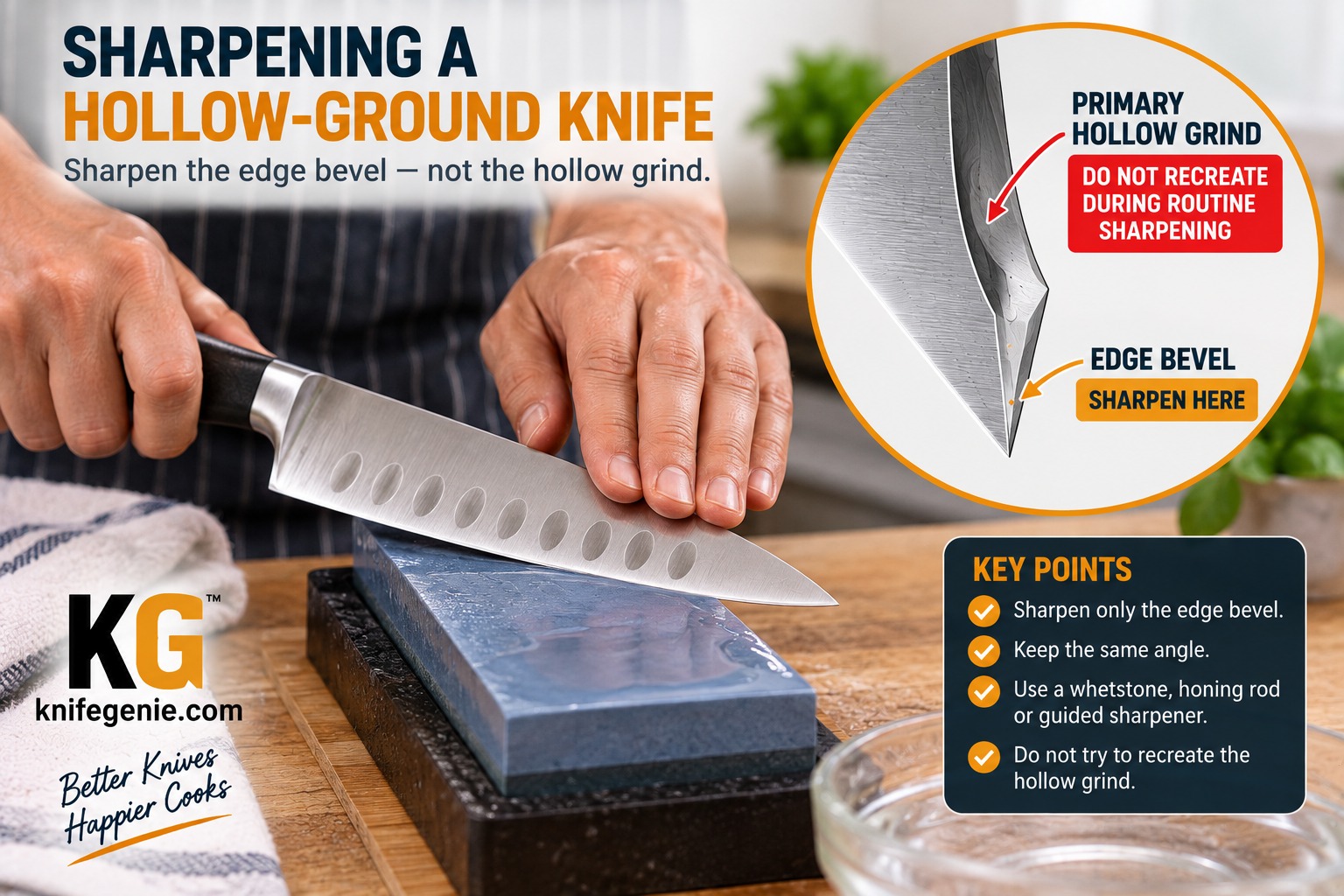
For most conventional double-bevel kitchen knives, you are sharpening the cutting edge—not recreating the manufacturer’s entire primary hollow grind every time the knife becomes dull.
If the knife has a normal secondary edge bevel, that bevel can generally be maintained using an appropriate sharpening method.
A whetstone is an excellent option when you know the knife’s geometry and can maintain a consistent angle.
The important rule is:
Follow the manufacturer’s recommended sharpening angle when available.
Don’t choose an arbitrary angle merely because the blade is hollow ground.
What About Repeated Sharpening?
Repeated sharpening gradually moves the cutting edge farther up the blade.
One potential advantage of hollow geometry is that it can remain relatively thin behind the edge through multiple sharpening cycles.
Eventually, however, any heavily used knife may require thinning or professional reprofiling if it becomes too thick behind the edge.
That is different from routine sharpening.
⚠️ Don’t Make This Mistake
Don’t attempt to recreate the hollow primary grind on a normal flat whetstone as part of routine maintenance.
Maintain the edge bevel.
Major blade-geometry work is better left to an experienced sharpener unless you know exactly what you’re doing.
SHARPENING & MAINTENANCE
Sharpening Hollow-Ground Knife
⚖️ Hollow Grind Pros & Cons
✅ Advantages
✔ Can be extremely thin behind the cutting edge
✔ Excellent initial cutting performance when properly executed
✔ Very good for controlled slicing
✔ Particularly effective on soft foods and boneless proteins
✔ Can maintain relatively thin behind-the-edge geometry through repeated sharpening
✔ Can produce a very precise cutting feel
❌ Disadvantages
✘ Very thin versions sacrifice some edge support
✘ Not automatically ideal for heavy kitchen work
✘ Can encounter additional resistance farther into deep cuts depending on blade geometry
✘ Doesn’t automatically outperform a good flat grind
✘ “Hollow grind” terminology is frequently confused with Granton/hollow-edge dimples
✘ Overall performance still depends heavily on steel, heat treatment, blade thickness and sharpening
🛒 Should You Buy a Hollow-Ground Kitchen Knife?
If you’re shopping for your first good chef’s knife, I wouldn’t make hollow grinding a requirement.
Look at the whole package:
Choose a Hollow-Ground Knife If You Want:
✔ Excellent slicing performance
✔ Thin geometry immediately behind the edge
✔ Controlled precision cuts
✔ A knife primarily intended for slicing
✔ An interesting alternative to conventional flat geometry
Choose a Flat-Ground Knife If You Want:
✔ Maximum everyday versatility
✔ Predictable performance through deep cuts
✔ Excellent vegetable preparation
✔ Straightforward maintenance
✔ One primary knife for most kitchen tasks
🧙 KnifeGenie Buying Advice
For most home cooks buying one all-purpose chef’s knife, a good thin flat or near-flat grind is the safer recommendation.
For cooks building a collection, however, a well-designed hollow-ground slicer can be a useful addition—particularly when clean, controlled slicing is the priority.
And remember:
Don’t choose by grind alone.
A beautifully executed flat grind will outperform a badly executed hollow grind every time.
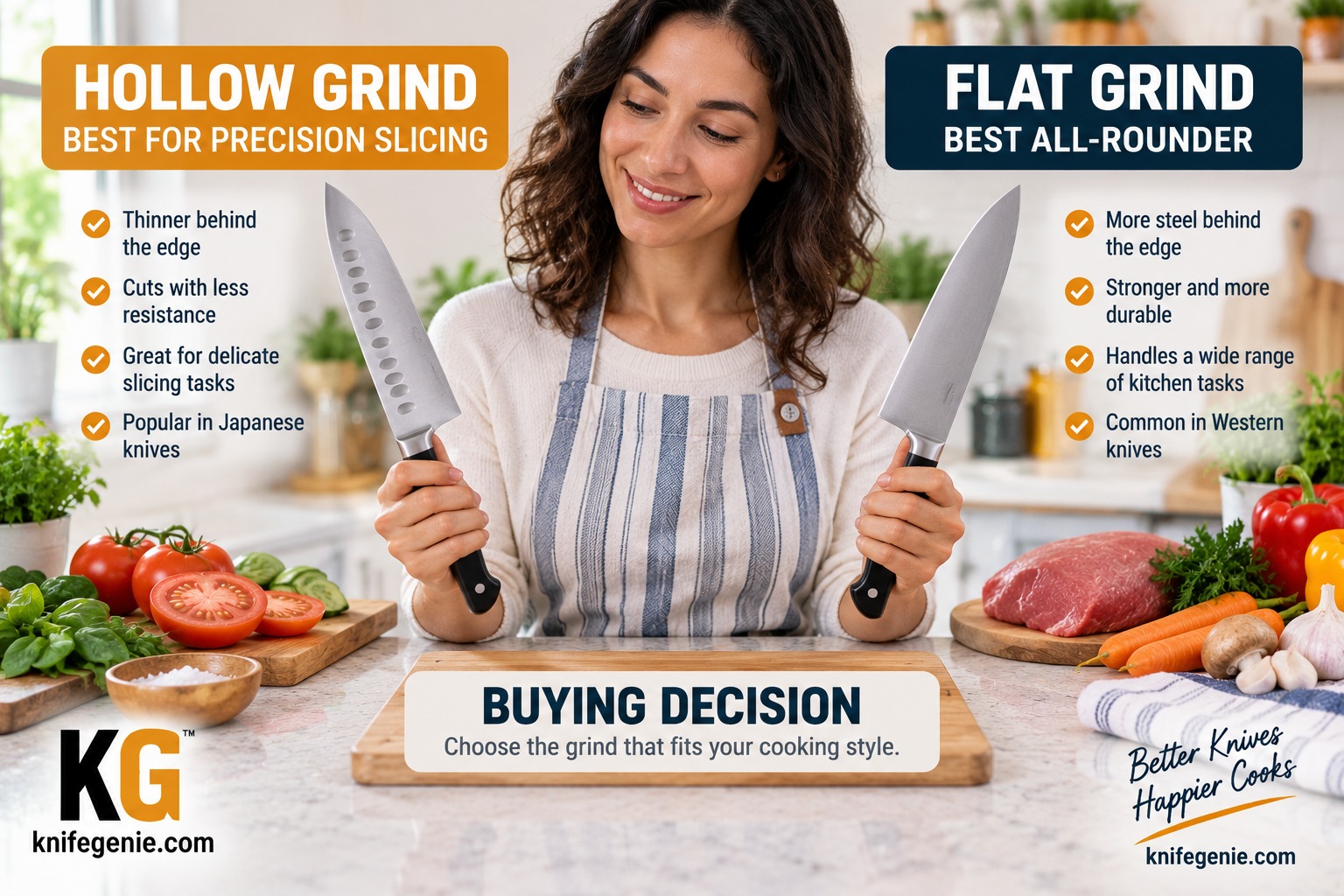
BUYING DECISION
🖼️ IMAGE PLACEHOLDER — Hollow vs Flat Buying Decision
❓ Frequently Asked Questions
Is a hollow grind good for kitchen knives?
Yes. A well-designed hollow grind can provide excellent slicing performance because it can leave relatively little steel immediately behind the cutting edge. However, a flat grind is often a more versatile choice for an all-purpose chef’s knife.
Is a hollow grind sharper than a flat grind?
Not automatically. Hollow geometry can make a blade very thin behind the edge, but actual sharpness depends on the cutting edge itself as well as the steel, edge angle, sharpening quality and overall blade geometry.
Is a hollow grind the same as a Granton edge?
No.
A hollow grind refers to concave blade geometry when viewed in cross-section.
A Granton or so-called hollow edge refers to indentations along the side of the blade intended to help reduce food sticking.
Are hollow-ground knives fragile?
Not necessarily.
Durability depends on how deeply the blade is hollow ground, how thin it is behind the edge, its edge angle, steel, heat treatment and intended use.
However, extremely thin geometry generally provides less support behind the edge than thicker geometry.
Are hollow-ground knives difficult to sharpen?
Not necessarily.
If the knife has a conventional secondary cutting bevel, routine sharpening generally means maintaining that small edge bevel—not reproducing the concave primary grind.
Can I sharpen a hollow-ground knife on a whetstone?
Usually, yes, provided you’re sharpening a conventional edge bevel and using an appropriate angle for the particular knife.
Does a hollow-ground knife need to be stropped?
Stropping can refine an edge in appropriate circumstances, but hollow-ground kitchen knives do not universally require stropping simply because they’re hollow ground. Follow the maintenance appropriate for the knife’s steel and edge.
Is a hollow grind good for tomatoes?
It can be excellent. Thin behind-the-edge geometry combined with a keen cutting edge can slice tomato skin with very little pressure.
Is a hollow grind good for vegetables?
Yes for many vegetables, particularly precision slicing. For tall, dense produce, however, a thin flat-ground chef’s knife may pass through the food more predictably.
What’s the best grind for most home cooks?
For a general-purpose chef’s knife, a well-executed flat or near-flat grind offers an excellent combination of cutting performance, durability and versatility.
🏆 Overall Recommendation
A hollow grind is neither an outdated curiosity nor a magic formula for making a knife sharper.
It’s simply one approach to blade geometry.
Its concave surfaces can create exceptionally thin geometry immediately behind the cutting edge, making a well-designed hollow-ground knife an impressive precision slicer.
But kitchen knives have to do more than start cuts.
They need to travel through tomatoes, meat, onions, potatoes, carrots and dozens of other ingredients while providing an appropriate balance of:
Sharpness → cutting resistance → edge stability → durability → maintenance
That’s why KnifeGenie’s recommendation is straightforward:
🥇 Best for most home cooks:
A well-made flat or near-flat-ground chef’s knife
🎯 Best for precision slicing:
A well-designed hollow-ground knife
🧙 KnifeGenie Final Tip
Buy the knife—not the marketing term.
Steel, heat treatment, blade thickness, geometry, edge quality, balance, handle comfort and how the knife fits your cooking style ultimately matter more than whether the blade is simply described as “hollow ground.”