

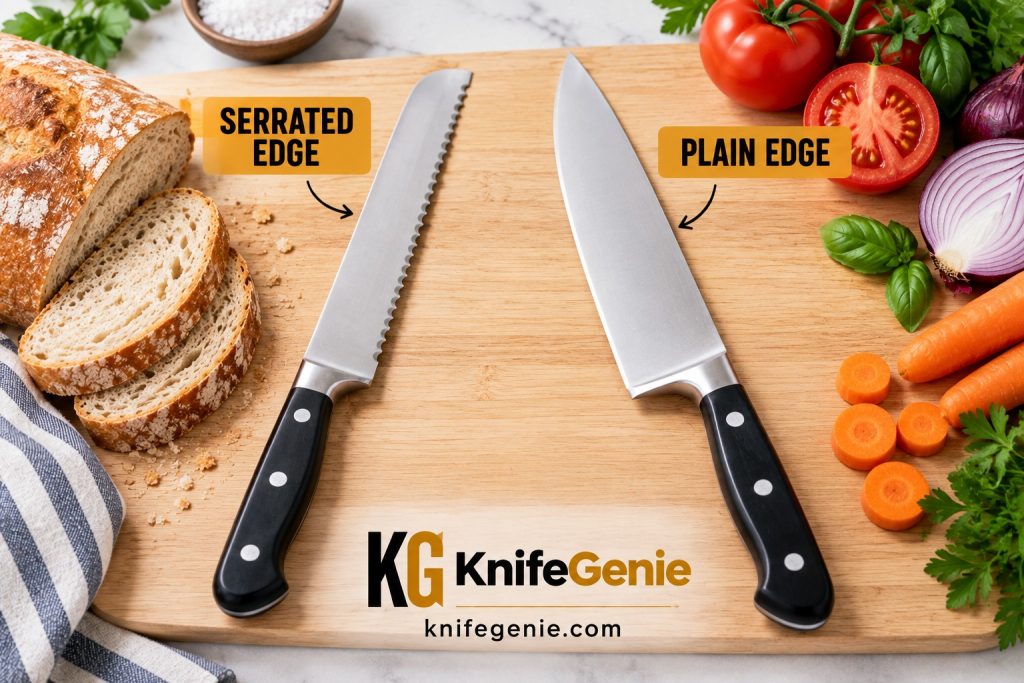
If you’ve ever tried to slice a crusty loaf with a chef’s knife—or chop an onion cleanly with a bread knife—you already know that serrated and plain edges aren’t interchangeable.
Ever ask yourself this question? Serrated vs plain edge kitchen knives: Which is better? Well, here we will answer it for you. A serrated knife has a row of pointed teeth and recessed scallops along its cutting edge. Those teeth help the knife bite into foods with a tough exterior and softer interior, which is why serrated knives are so effective on bread and ripe tomatoes.
A plain-edge knife has one continuous cutting edge. It gives you cleaner, more controlled contact with the cutting board and is usually the better choice for chopping, dicing, mincing, slicing meat and most everyday food preparation.
So which should you buy?
🔪 The Quick Answer
For most everyday kitchen work, choose a good plain-edge chef’s knife.
It is the more versatile option for vegetables, herbs, raw meat, cooked meat and general food preparation.
But that doesn’t make a serrated knife unnecessary.
A serrated bread knife is one of the most useful companion knives you can own, particularly if you regularly cut crusty bread, soft rolls, cakes or ripe tomatoes.
For a well-equipped home kitchen, therefore, the answer isn’t really serrated or plain edge.
Ideally, you want both.
 Jump to What You Need
👉 Quick Comparison
👉 What Is a Serrated Edge?
👉 What Is a Plain Edge?
👉 How They Actually Cut
👉 Bread
👉 Tomatoes
👉 Meat
👉 Vegetables
👉 Which Edge Stays Sharp Longer?
👉 Sharpening and Maintenance
👉 Pros and Cons
👉 Which Should You Buy?
👉 Frequently Asked Questions
👉 Overall Recommendation
🔪 Serrated vs Plain Edge: Quick Comparison
| Kitchen task | Serrated edge | Plain edge | Winner |
|---|---|---|---|
| Crusty bread | Excellent | Fair to good | Serrated |
| Soft bread & rolls | Excellent | Good if very sharp | Serrated |
| Ripe tomatoes | Excellent | Excellent when sharp | Serrated / Tie |
| Raw meat | Limited | Excellent | Plain edge |
| Carving cooked meat | Fair to good | Excellent | Plain edge |
| General vegetables | Fair | Excellent | Plain edge |
| Herbs | Poor | Excellent | Plain edge |
| Chopping & dicing | Poor | Excellent | Plain edge |
| Edge maintenance | Less frequent, but harder | More frequent, but easier | Depends |
| Ease of sharpening | Difficult | Relatively easy | Plain edge |
| Everyday versatility | Specialized | Very high | Plain edge |
| Best user | Bread/tomato specialist | Most home cooks | Plain edge |
The important point is that serrations don’t automatically make a knife sharper or better. The two edge styles simply apply cutting force differently.
SERRATED VS PLAIN EDGE
🔪 What Is a Serrated Knife Edge?
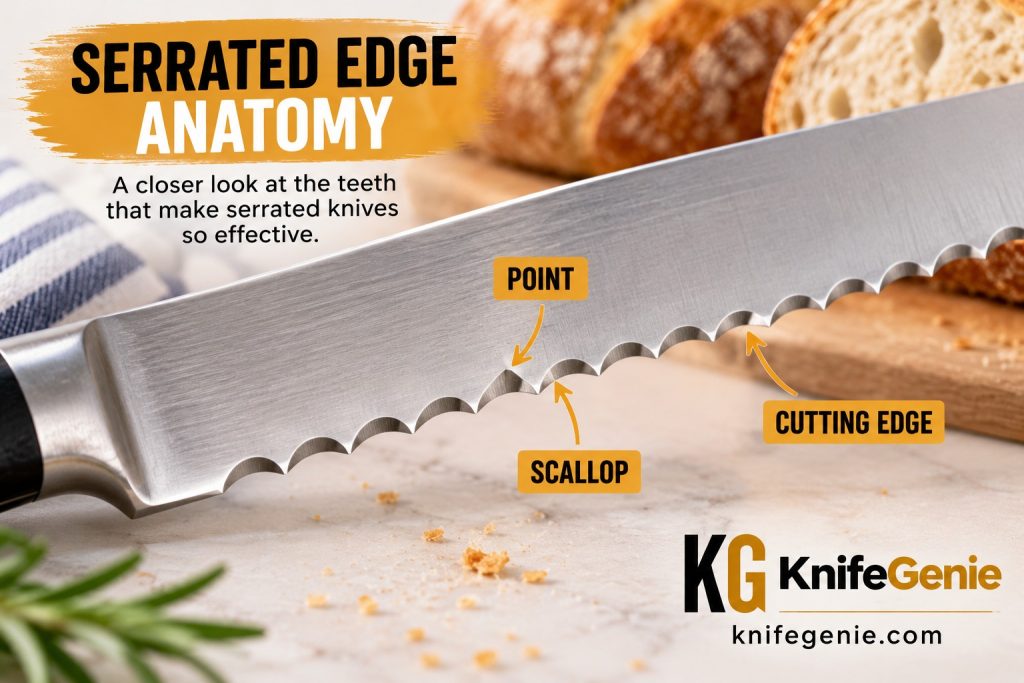
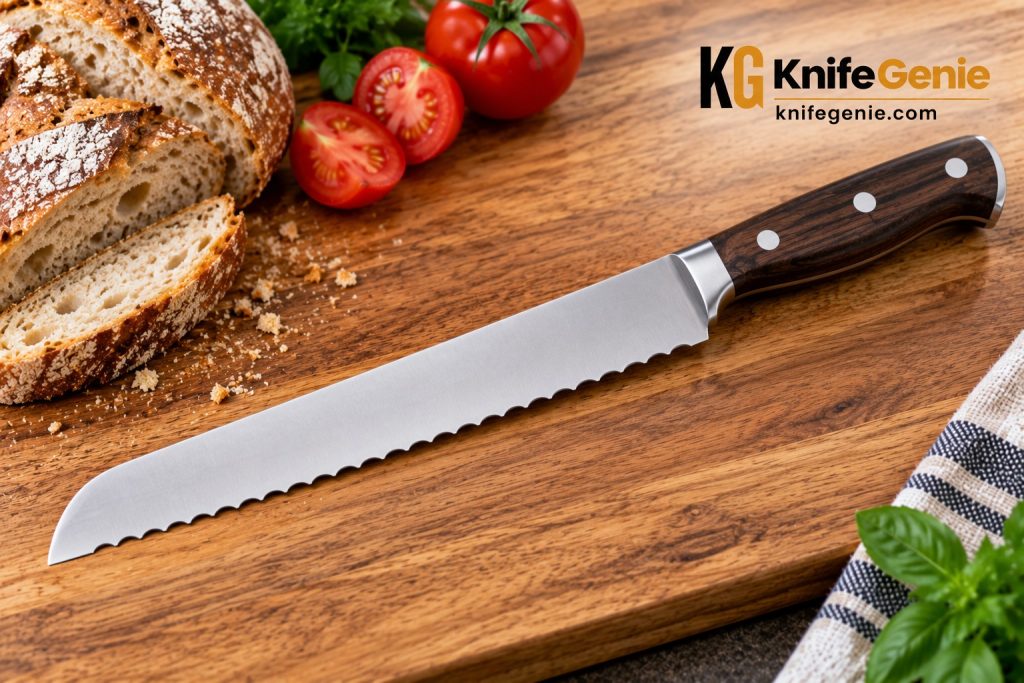
Look closely at a bread knife and you’ll see a series of teeth and recessed scallops rather than one uninterrupted edge.
That’s a serrated edge.
When you begin a slicing motion, the projecting points make initial contact with the food. They can bite through a resistant exterior while the recessed sharpened sections continue the cut.
This is especially useful when a food has contrasting textures.
Think about a loaf of sourdough:
Hard crust outside. Soft crumb inside.
Pressing down with a dull or unsuitable knife can crush the loaf before the blade gets through the crust. A long serrated bread knife allows you to use a controlled back-and-forth slicing motion instead.
The same principle helps with:
- crusty bread
- bagels and rolls
- ripe tomatoes
- citrus fruit
- cakes with firmer exteriors
- some thick-skinned fruits
That doesn’t mean serrated knives are automatically superior cutters. Their advantage comes from matching their edge geometry to the food. Let’s continue with our serrated vs plain-edge kitchen knives comparison.
SERRATED EDGE ANATOMY
Read also: Boning Knife vs Fillet Knife: Which One Do You Need?
🔪 What Is a Plain Edge?
A plain—or straight—edge has a continuous sharpened edge from heel toward tip without serrations.
Your chef’s knife, santoku, gyuto, paring knife and many carving knives use some form of plain edge.
Its greatest advantage is continuous, predictable contact with the ingredient.
When you’re chopping an onion, mincing parsley or slicing chicken breast, you usually don’t want a blade that saws through the food. You want a sharp edge that passes cleanly through it.
A plain edge is therefore much better suited to the cutting motions used in everyday meal preparation:
Rock. Push. Slice. Chop. Dice. Mince.
It is also considerably easier for most owners to sharpen.
PLAIN EDGE ANATOMY

🍅 How Do Serrated and Plain Edges Actually Cut?
This is where the comparison becomes more useful.
A serrated knife concentrates the initial cutting pressure at its projecting points. With a slicing motion, those points can penetrate resistant skins and crusts without requiring you to push heavily downward.
A plain edge distributes the cutting action along a continuous sharpened edge.
When properly sharpened, that continuous edge produces exceptionally clean cuts.
That’s why a serrated knife can feel surprisingly effective on a tomato even when it hasn’t been sharpened for a long time, while a dull chef’s knife may skid across the skin.
But compare that same serrated knife with a properly sharpened chef’s knife while dicing an onion and the advantage reverses.
The plain edge gives you cleaner, more predictable cuts.
🍞 Which Is Better for Bread?
Winner: SERRATED
This is the easiest category to call.
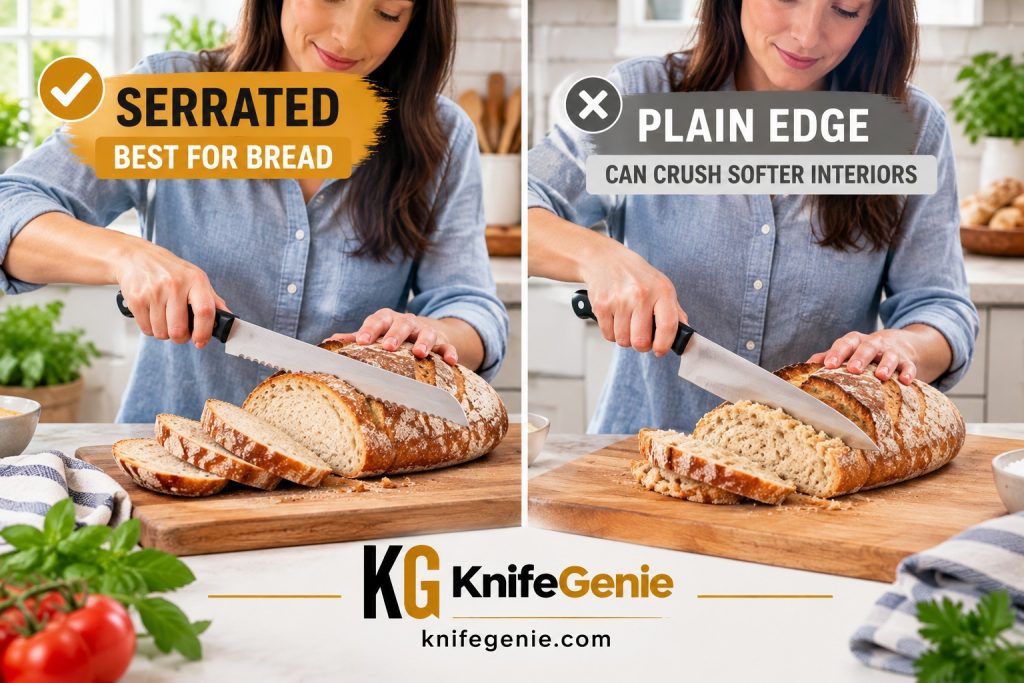
A long serrated bread knife is designed to slice through a resistant crust while minimizing compression of the softer interior.
That’s particularly noticeable with:
- sourdough
- baguettes
- artisan loaves
- bagels
- soft sandwich loaves
- bread rolls
A very sharp plain-edge knife can slice bread, but there’s little reason to make it do the job if you have a good bread knife available.
KnifeGenie verdict
If bread is the main food you’re cutting, buy serrated.
BREAD CUTTING TEST
🍅 Which Is Better for Tomatoes?
Winner: SERRATED—unless your plain edge is very sharp
Tomatoes expose dull knives immediately.
Their thin skin resists penetration while the soft flesh underneath is easily crushed.
A small serrated utility or tomato knife bites into the skin with very little downward pressure. That makes it exceptionally forgiving.
But here’s the important qualification:
A properly sharpened plain-edge chef’s knife should also slice a tomato beautifully.
In fact, a very sharp chef’s knife can produce exceptionally thin, clean slices.
If your chef’s knife squashes tomatoes rather than slicing them, that’s often telling you more about the condition of its edge than about plain-edge knives in general.
KnifeGenie verdict
For effortless tomato slicing, serrated has an advantage.
For a sharp knife that can slice the tomato and then handle the rest of your meal prep, plain edge wins on versatility.
🥩 Which Is Better for Meat?
Winner: PLAIN EDGE
For most meat preparation, plain edge is the clear choice.
Raw meat benefits from clean slicing rather than a sawing action. A suitable chef’s, boning, carving or slicing knife can make controlled cuts without unnecessarily tearing the fibers.
A plain edge is preferable for jobs such as:
- trimming meat
- portioning boneless cuts
- slicing chicken breast
- carving roast meat
- slicing steak
- removing fat
- general meat preparation
There are exceptions. Serrated steak knives are common at the table, and a serrated knife can be useful on foods with a particularly crisp exterior.
But don’t confuse that specialist role with general meat preparation.
KnifeGenie verdict
Choose a plain edge for kitchen meat preparation.
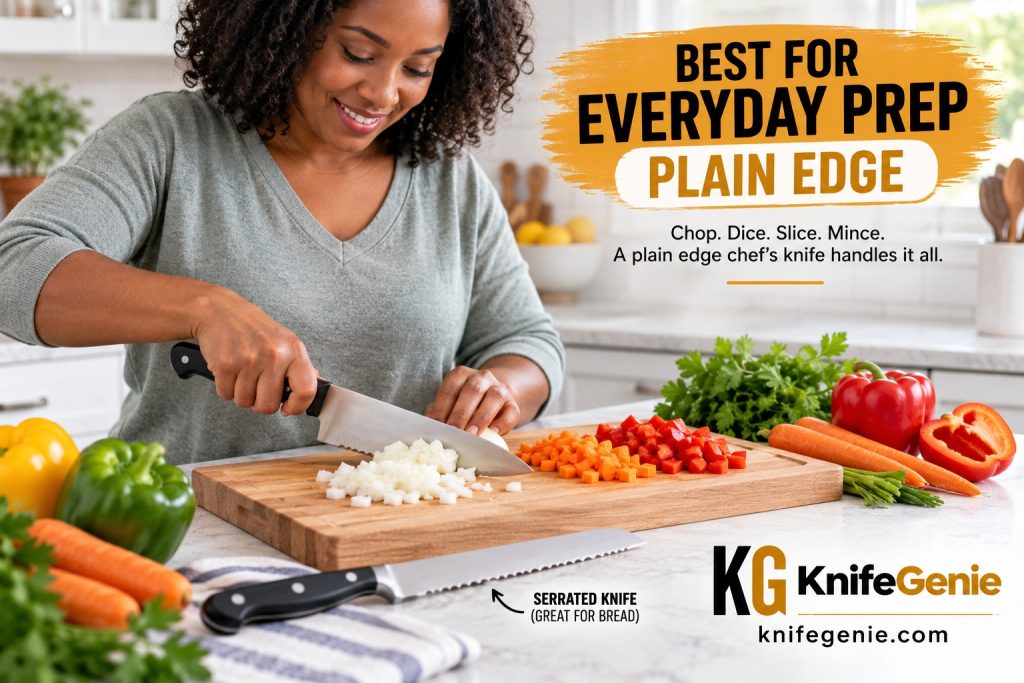
🥕 Which Is Better for Vegetables?
Winner: PLAIN EDGE
For the majority of vegetables, this isn’t close.
Imagine preparing dinner with onions, carrots, celery, peppers and herbs.
You need to:
chop → slice → dice → mince.
A sharp chef’s knife or santoku can perform all of those jobs efficiently.
A serrated knife’s teeth can catch and tear softer ingredients, and its sawing action isn’t well suited to repetitive board work.
There are some exceptions.
A serrated utility knife can be useful for vegetables and fruits with slippery or resistant skins and softer interiors.
But for everyday vegetable prep, choose plain edge.
VEGETABLE CUTTING TEST
⏱️ Which Edge Stays Sharp Longer?
This question needs a little nuance.
You’ll often hear that serrated knives “stay sharp longer.”
In practical use, they can certainly remain functional for a long time.
Part of the reason is their geometry. The recessed portions of the edge receive less direct contact with the cutting board than a continuous plain edge does.
But that doesn’t mean serrated knives never become dull.
They do.
The points can wear, the scalloped cutting surfaces can lose sharpness and eventually performance deteriorates.
A plain edge receives more consistent contact with food and the cutting board, so regular maintenance becomes more noticeable.
The trade-off is important:
Plain edges generally need attention more often, but they’re much easier to maintain and resharpen.
🪨 Sharpening: The Biggest Maintenance Difference
This is one of the most important differences between the two styles.
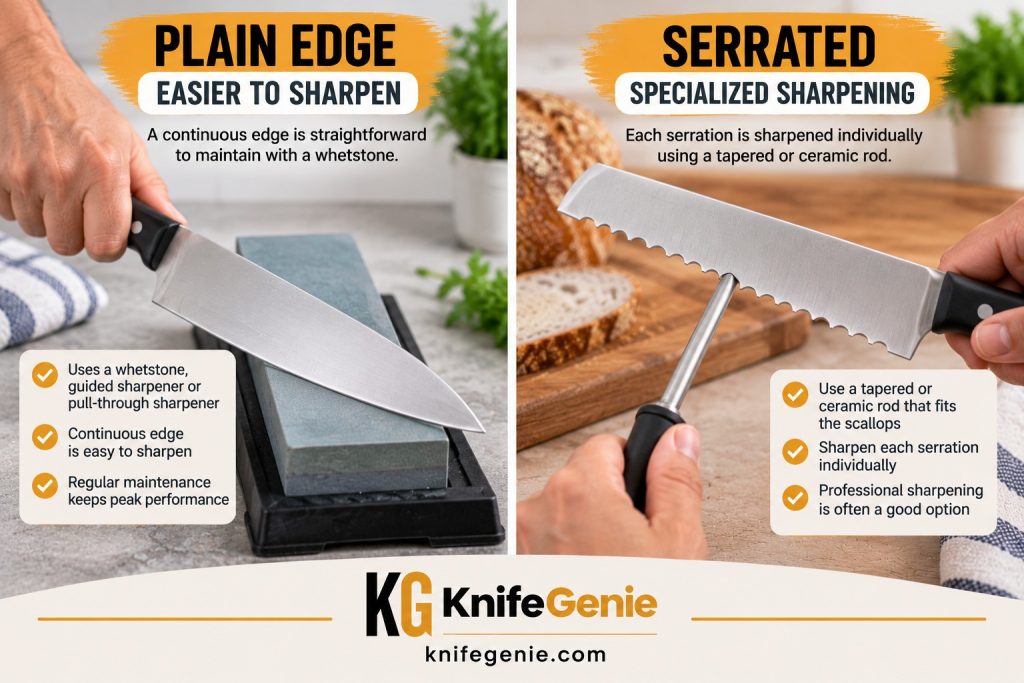
Sharpening a Plain Edge
A conventional plain-edge kitchen knife can usually be sharpened using an appropriate:
- whetstone
- guided sharpening system
- manufacturer-approved pull-through sharpener
- professional sharpening service
The precise method depends on the knife and its edge geometry.
The major advantage is that you’re dealing with a continuous edge.
That makes sharpening comparatively straightforward.
Sharpening a Serrated Edge
A serrated knife requires a different approach.
You generally should not simply run a serrated blade through an ordinary straight-edge pull-through sharpener unless its manufacturer specifically states that the device is suitable for that blade.
Instead, serrated edges may require an appropriately sized tapered or ceramic sharpening rod that fits the scallops.
The individual serrations are worked while maintaining the existing bevel. Afterward, any resulting burr on the opposite side is removed carefully.
That requires more time and precision than sharpening an ordinary plain edge.
And serrations vary.
Some are wide. Some are narrow. Some knives use unusual scallop patterns, micro-serrations or double serrations.
For expensive serrated knives—or whenever you’re unsure of the correct technique—professional sharpening is often the safer choice.
Important
Always follow the knife manufacturer’s instructions before sharpening a serrated blade. Don’t assume a sharpener that works with your chef’s knife is also suitable for your bread knife.
SHARPENING COMPARISON
👍👎 Serrated Knife Pros and Cons
👍 Pros
- Excellent for crusty bread
- Very good for tomatoes
- Works well on foods with firm skins and soft interiors
- Requires little downward pressure when used correctly
- Recessed sections of the edge receive less cutting-board contact
- Useful specialist addition to a home knife collection
👎 Cons
- Poor choice for most chopping and mincing
- Can tear delicate foods
- Less versatile for everyday preparation
- More difficult to sharpen properly
- Different serration patterns may require different sharpening tools
- Not a replacement for a chef’s knife
👍👎 Plain-Edge Knife Pros and Cons
👍 Pros
- Excellent all-purpose kitchen edge
- Clean, controlled cuts
- Ideal for chopping, slicing, dicing and mincing
- Excellent for vegetables
- Better suited to raw meat preparation
- Easier to sharpen
- Available on chef’s knives, santokus, gyutos, paring knives and more
👎 Cons
- A dull edge may skid on tomato skin
- Requires regular edge maintenance
- Less effective than serrations on hard bread crust
- Poor sharpening technique can alter the intended edge geometry
Read our guide on why knife edges become dull.
🛒 Which Should You Buy?
If you’re building a kitchen knife collection from scratch, don’t start by asking:
“Serrated or plain?”
Ask:
“What foods do I need to cut?”
Choose Plain Edge If…
You want one main knife for everyday meal preparation.
A good 8-inch chef’s knife—or a suitable santoku or gyuto—is a far more versatile starting point than a serrated bread knife.
Choose plain edge if you regularly:
✓ chop vegetables
✓ dice onions
✓ mince herbs
✓ slice meat
✓ prepare poultry
✓ perform general kitchen prep
✓ want to sharpen your own knives
Best for: Most home cooks
Choose Serrated If…
You already have a good chef’s knife and need a specialist blade for foods your chef’s knife doesn’t handle as comfortably.
Choose serrated if you regularly cut:
✓ sourdough
✓ baguettes
✓ crusty artisan bread
✓ bagels
✓ soft bread
✓ ripe tomatoes
✓ cakes with firmer exteriors
Best for: Bread lovers and specialist slicing
Buy Both If…
You cook regularly.
This is the option I would recommend to most home kitchens.
You don’t need two competing versions of the same knife.
You need two knives designed for different jobs.
A quality plain-edge chef’s knife handles the bulk of food preparation.
A long serrated bread knife takes over when you encounter bread, delicate baked goods and other foods where its toothed edge offers a genuine advantage.
That’s a much more practical setup than trying to make either knife do everything.
BUYING DECISION

❓ Frequently Asked Questions
Are serrated knives sharper than plain-edge knives?
Not inherently.
Sharpness depends on edge condition, geometry, steel and sharpening. Serrations do, however, concentrate initial contact at their points, helping them penetrate foods such as crusty bread and tomato skin effectively.
A properly sharpened plain edge can be extremely sharp.
Are serrated knives better for tomatoes?
They’re extremely good for tomatoes because the points readily penetrate the skin without requiring much downward pressure.
However, a properly sharpened chef’s knife can also slice tomatoes very cleanly.
Can you sharpen a serrated kitchen knife?
Yes, many conventional serrated knives can be sharpened.
Yes
A tapered sharpening rod sized to fit the scallops can be used to work individual serrations while maintaining their original bevel. Because the process is more complicated than sharpening a plain edge, professional sharpening is often worthwhile.
Some specialized or micro-serrated edges may have different maintenance requirements, so check the manufacturer’s instructions.
Can I use my regular knife sharpener on a serrated knife?
Don’t assume you can.
Many conventional pull-through sharpeners are intended for straight edges and can damage or alter serrations.
Only use a sharpening device on a serrated knife when the manufacturer specifically says that combination is compatible.
Is a serrated knife good for cutting meat?
It can cut meat, but for most kitchen meat preparation a suitable sharp plain-edge knife is preferable because it makes cleaner, more controlled cuts.
Serrated steak knives are useful at the table, but that’s a different job from trimming, portioning or carving meat during food preparation.
Is a serrated knife better for vegetables?
Generally, no.
A sharp plain-edge chef’s knife or santoku is much more versatile for chopping, dicing and mincing vegetables.
Serrated knives are particularly useful for produce with resistant skins and soft interiors, such as ripe tomatoes.
Do serrated knives need sharpening?
Yes.
Serrated knives can remain useful for a long time, but the edge eventually wears. When cutting performance deteriorates noticeably, the knife may need sharpening.
🏆 Overall Recommendation
Choose a plain-edge knife as your everyday kitchen workhorse.

If you’re buying your first serious kitchen knife, a versatile chef’s knife, santoku or gyuto with a plain edge should normally come before a bread knife.
It will handle far more of your daily preparation.
Then add a serrated bread knife.
That’s where serrations make the most sense.
Choose plain edge for:
🥕 Vegetables
🧅 Chopping and dicing
🌿 Herbs
🥩 Meat preparation
🔪 Everyday cooking
Choose serrated for:
🍞 Bread
🥖 Hard crusts
🍅 Ripe tomatoes
🍰 Some cakes and baked goods
🍊 Firm-skinned, soft-interior foods
The mistake is treating this as a contest in which one edge has to defeat the other.
A good kitchen uses each where its design works best.
For most home cooks, the ideal combination is simple:
🔪 One quality plain-edge chef’s knife + one quality serrated bread knife.
That pair will handle an enormous percentage of everyday kitchen cutting without forcing either blade to do a job it wasn’t designed for.