

The best kitchen knife sharpening angle is not one fixed number for every knife. Many everyday double-bevel kitchen knives have edge angles somewhere around 10° to 20° per side, but the correct choice depends on the blade’s design, steel, intended use, and manufacturer’s recommendations.
A thinner edge may glide through vegetables with less resistance, while a more robust edge can better tolerate demanding kitchen work. Neither is automatically better for every knife.
If you’re learning to sharpen at home, there’s one principle worth remembering: preserve the existing bevel whenever practical, and concentrate on keeping your sharpening angle consistent.
In this KnifeGenie guide, we’ll explain what sharpening angles mean, how to choose an appropriate angle, and how to maintain it without turning a simple sharpening session into a complicated geometry lesson.
📐 Kitchen Knife Sharpening Angle: Quick Answer
For most home cooks, the best starting point is the angle recommended by the knife manufacturer.
-
🔪 15° per side: A common sharpening setting for many fine-edged double-bevel kitchen knives, but not a universal standard.
-
🔪 20° per side: A more robust edge setting appropriate for some kitchen knives and heavier-duty applications.
-
🇩🇪 German-style knives: Check the specific model. Modern German manufacturers may use angles considerably narrower than 20°.
-
🇯🇵 Japanese-style knives: Often feature relatively acute edges, but their geometry varies by manufacturer and design.
-
📏 Single-bevel knives: Require specialized sharpening techniques rather than simply applying the same angle to both sides.
🧙 KnifeGenie Recommendation: Don’t automatically change a 14° factory edge to 20° just because you’ve read that Western knives should be sharpened at 20°. Follow the knife’s original geometry unless there’s a specific reason to modify it.
Already comfortable with sharpening angles and ready to practise? Follow our step-by-step chef knife whetstone sharpening tutorial.
👇 Jump To: Kitchen Knife Sharpening Angles Explained
👉 What Does Sharpening Angle Mean?
👉 Kitchen Knife Sharpening Angle Chart
👉 German vs Japanese Knife Angles
👉 How to Find Your Existing Bevel
👉 How to Choose the Right Angle
👉 How to Maintain a Consistent Angle
👉 Common Sharpening Angle Mistakes
📏 What Does a Kitchen Knife Sharpening Angle Mean?
When sharpening a knife, the sharpening angle describes how the cutting-edge bevel is positioned relative to the abrasive surface.
Imagine placing a chef knife on a flat whetstone.
If you gradually raise the spine while keeping the cutting edge near the stone, you create an angle between the blade and the stone.
That angle determines how the abrasive contacts the bevel.
🔍 Per-Side Angle vs Total Edge Angle
This distinction causes plenty of confusion, especially when comparing sharpening equipment.
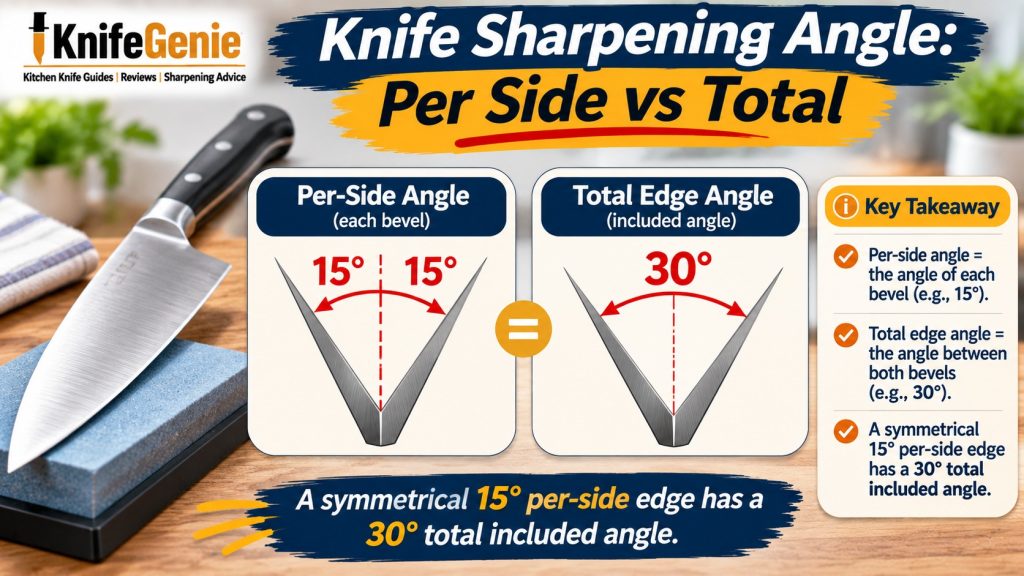
A double-bevel kitchen knife has two sides that meet to form its cutting edge.
For a symmetrical double-bevel edge:
-
15° per side produces a total included edge angle of 30°.
-
20° per side produces a total included edge angle of 40°.
-
12° per side produces a total included edge angle of 24°.
The total included angle is the angle between the two sharpened bevel surfaces.
Important: These calculations assume a symmetrical double-bevel edge. An asymmetrical or single-bevel knife requires a different interpretation.
Whenever you see an angle advertised, check whether the manufacturer means per side or total included angle.
Per-Side vs Total Edge Angle Diagram
🪒 Why the Angle Matters
A smaller included angle generally creates a more acute edge, while a larger included angle creates a more robust edge geometry.
However, sharpening angle is only part of the story.
Blade thickness, steel hardness, toughness, heat treatment, cutting technique, and the material being cut all affect performance.
A knife sharpened to 12° per side is not automatically better than one sharpened to 18° per side.
The right angle balances cutting performance with the durability required for the knife’s intended work.
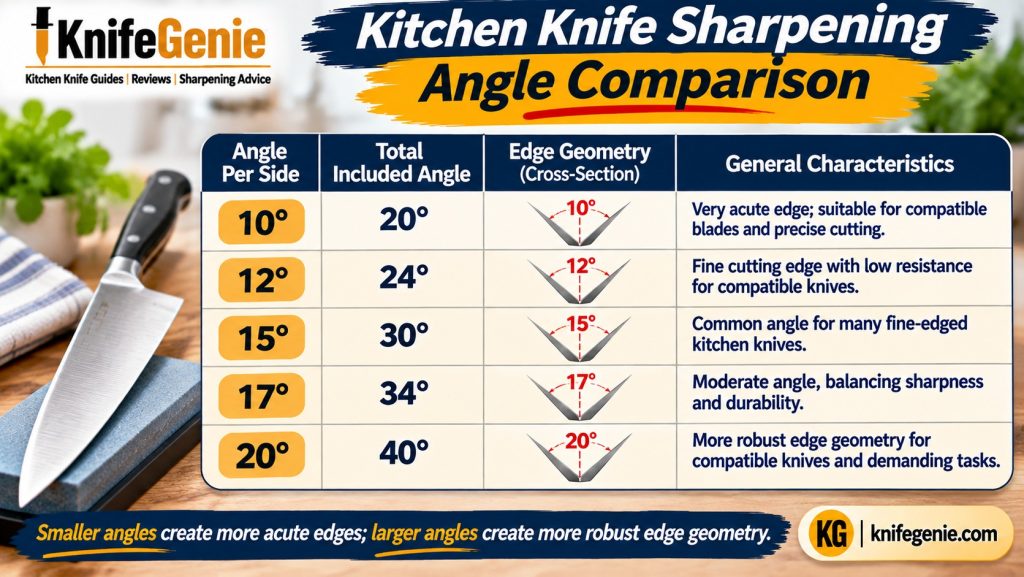
📊 Kitchen Knife Sharpening Angle Chart
| Angle Per Side | Total Included Angle | General Characteristics |
|---|---|---|
| 10° | 20° | Very acute edge; requires suitable blade geometry, steel, and use |
| 12° | 24° | Fine cutting edge for compatible knives |
| 15° | 30° | Common fine-edged kitchen knife setting |
| 17° | 34° | Moderate angle balancing cutting ability and robustness |
| 20° | 40° | More robust geometry for compatible knives and demanding tasks |
Note: The table describes symmetrical double-bevel edges. Actual factory specifications and sharpening requirements vary.
🧙 KnifeGenie Tip
Think of these numbers as reference points rather than a competition to achieve the smallest angle.
A well-maintained 17° edge can perform better in everyday use than a poorly sharpened 12° edge.
🇩🇪 🇯🇵 German vs Japanese Kitchen Knife Sharpening Angles
You may have heard that German knives should always be sharpened at 20° per side and Japanese knives at 15°.
That’s an oversimplification.
Different manufacturers use different steels, edge profiles, and sharpening specifications. Even knives from the same brand can have different recommended angles.
🇩🇪 German-Style Kitchen Knives
German-style chef knives are often associated with durable construction and versatile everyday cutting.
Older sharpening advice frequently recommends angles around 20° per side for Western kitchen knives.
But modern manufacturing has changed the picture.
For example, WÜSTHOF states that its standard blades use a 14° angle per side, while its Asian-style Santoku and Nakiri blades use 10° per side.
That’s a useful reminder that country of origin alone cannot determine the correct sharpening angle.
🇯🇵 Japanese-Style Kitchen Knives
Many Japanese kitchen knives are designed for precise slicing and relatively low cutting resistance.
Some have thin double-bevel edges. Others use asymmetrical or traditional single-bevel geometry.
For example, Shun describes its double-bevel knife edges as sharpened to 16° per side.
That doesn’t mean every Japanese knife should be sharpened at 16°.
A Japanese gyuto, Santoku, yanagiba, and deba can have substantially different edge designs.
🔪 What About Single-Bevel Knives?
Traditional single-bevel knives need particular care.
Their geometry is not equivalent to a symmetrical double-bevel chef knife. The back of the blade may also have a specialized surface and a small micro-bevel.
Sharpening both sides equally can change the intended geometry.
If you own a traditional single-bevel knife, follow the manufacturer’s sharpening procedure or use a professional familiar with that design.
For a broader explanation of blade construction and cutting characteristics, read our German vs Japanese Kitchen Knives comparison.
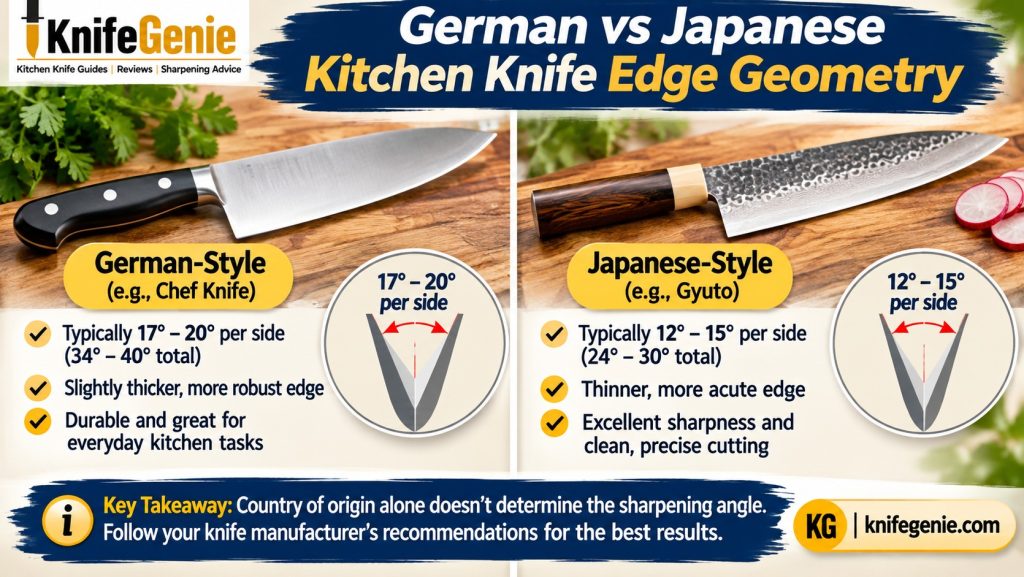
German and Japanese knife sharpening angles vary by manufacturer and model.
🔍 How to Find the Existing Sharpening Angle on Your Knife
What if you don’t know your knife’s factory sharpening angle?
Before choosing a new number, try identifying the existing edge bevel.
1. Check the Manufacturer’s Information
Look for the knife’s model number, care guide, product specifications, or official sharpening instructions.
This is usually the most reliable starting point.
If the manufacturer specifies an angle, check whether it refers to each side or the total included angle.
2. Examine the Edge Under Good Lighting
With the knife stationary and its edge safely oriented away from you, inspect the narrow polished bevel near the cutting edge.
A bright light may help you distinguish the edge bevel from the rest of the blade.
Keep your fingers away from the cutting edge.
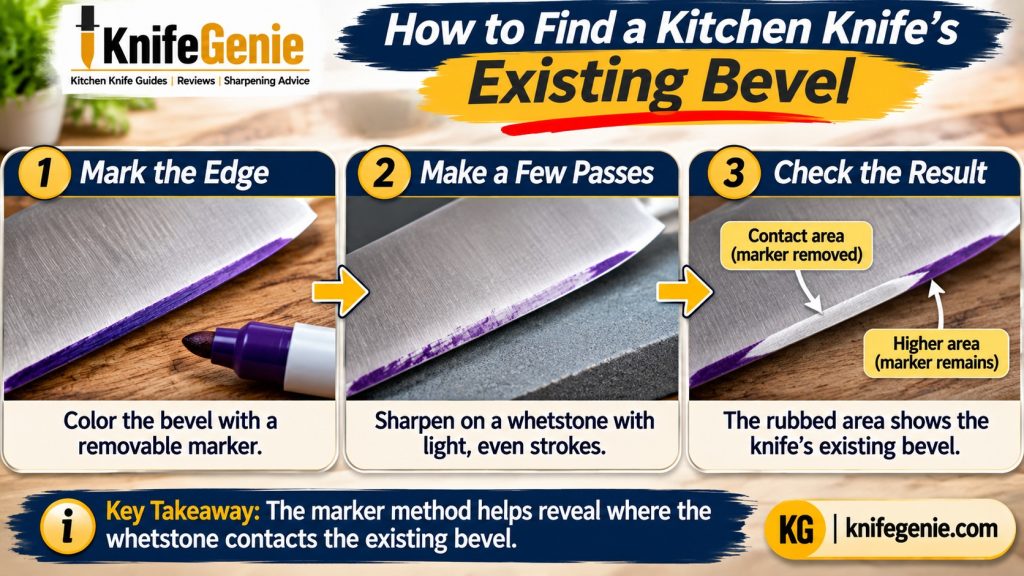
3. Try the Marker Method
One useful way to check sharpening contact is to apply a small amount of removable marker ink to the existing edge bevel.
-
Clean and dry the knife.
-
Mark the edge bevel lightly.
-
Secure your whetstone on a stable, nonslip surface.
-
Position the knife at your estimated sharpening angle.
-
Make one gentle, controlled test pass.
-
Inspect where the marker has been removed.
If the abrasive contacts mainly the shoulder of the bevel, the angle is likely too low for that bevel. If it contacts mainly the very edge, the angle is likely too high.
Adjust gradually until contact covers the intended bevel more evenly.
Important: The marker method helps reveal contact with an existing bevel. It does not independently measure the exact factory angle or prove that the existing edge has never been modified.
Remove any marker residue and thoroughly clean the knife before food preparation.
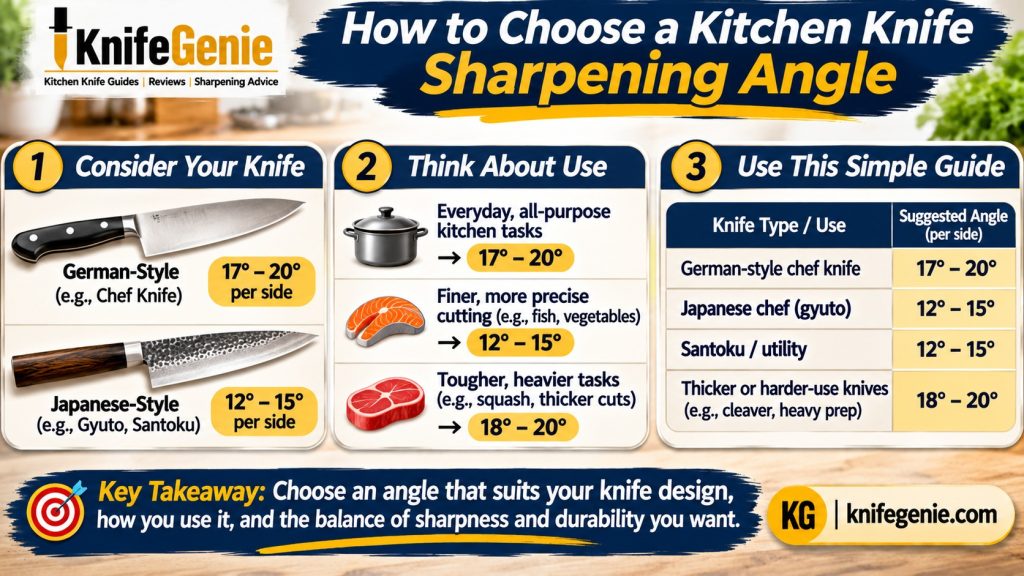
🎯 How to Choose the Right Sharpening Angle
1. Start With the Factory Geometry
If the knife performs well and its edge is simply dull, maintaining the original bevel is usually the most sensible approach.
Changing the sharpening angle unnecessarily can remove extra steel and alter cutting performance.
2. Consider the Knife’s Intended Use
A fine slicing knife and a heavy-duty kitchen knife may benefit from different edge geometries.
For delicate slicing, a relatively acute edge can reduce resistance.
For demanding tasks, a more robust edge may offer better resistance to deformation or chipping.
But a more robust edge is not permission to use an ordinary chef knife for bones, frozen food, or other tasks the manufacturer advises against.
3. Consider Steel and Blade Construction
Hardness alone doesn’t determine the correct angle.
Steel toughness, heat treatment, blade thickness, and the geometry behind the edge also matter.
Two knives with similar hardness ratings may behave differently at the same sharpening angle.
4. Think About Your Sharpening Equipment
Some manual and electric sharpeners use fixed angles.
Guided systems may allow you to select from several settings, while freehand whetstones offer considerable flexibility.
Before using a fixed-angle device, make sure its geometry is compatible with your knife.
If you’re still choosing sharpening equipment, see our Best Knife Sharpeners for Beginners guide.
5. Don’t Confuse Angle Selection With Grit Selection
Sharpening angle determines the edge geometry you’re working toward.
Whetstone grit determines how aggressively the abrasive removes material and how the edge is refined.
They are related parts of sharpening, but they solve different problems.
Read our guide to choosing the right whetstone grit for kitchen knives to understand when coarse, medium, and fine stones are appropriate.
🪨 How to Maintain a Consistent Sharpening Angle
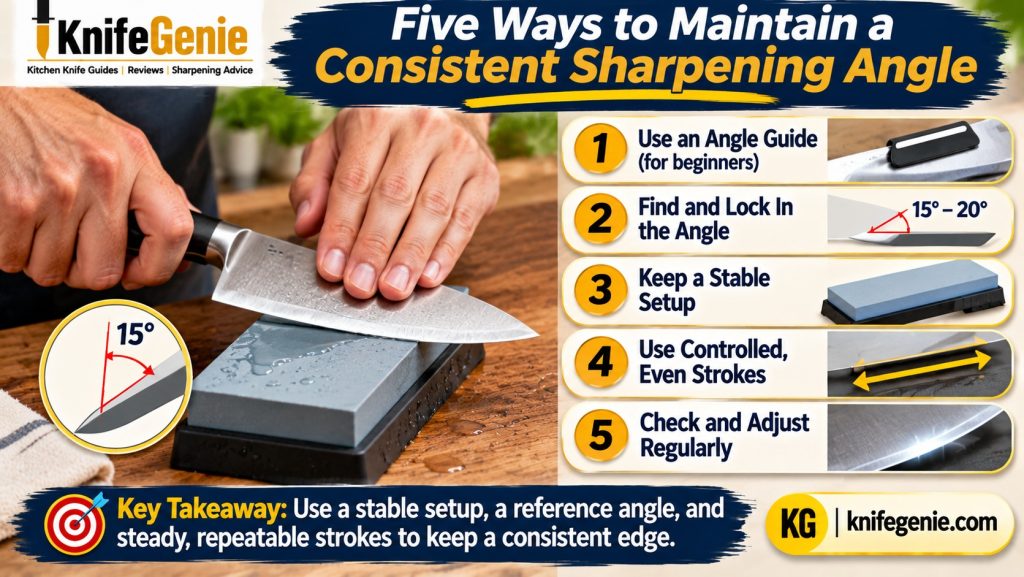
For beginners, maintaining a steady angle is often more challenging than selecting one.
You might begin at approximately 15°, gradually raise the spine, and finish each stroke at a noticeably different angle.
That inconsistency can create an uneven bevel and make it harder to form a clean edge.
1. Use a Stable Sharpening Setup
Place the whetstone on a secure, nonslip holder or base.
Use the stone according to its manufacturer’s instructions. Water stones, oil stones, and diamond plates do not all require the same preparation.
2. Establish Your Starting Angle
Position the knife at the angle recommended for its edge.
A suitable angle guide can help you visualize the position, although the guide must be compatible with the blade and sharpening setup.
3. Keep the Knife’s Position Controlled
Use smooth, deliberate movements and light, controlled pressure.
Try to maintain the same angle as the blade moves across the stone.
When following a curved blade toward the tip, adjust the knife’s position carefully to maintain appropriate bevel contact.
4. Work Slowly Before Increasing Speed
There’s no prize for finishing your first sharpening session quickly.
Practise controlled movements until the angle feels natural.
Consistent contact is more important than making a large number of hurried strokes.
5. Check Your Progress
Inspect the bevel regularly. A marker test can help reveal whether you’re maintaining contact across the intended edge.
If your angle keeps changing, stop and reset your position rather than trying to correct the problem by applying more pressure.
For the complete sharpening process, including stone preparation, sharpening strokes, burr management, and finishing, follow our How to Sharpen a Chef Knife With a Whetstone tutorial.
⚠️ Common Kitchen Knife Sharpening Angle Mistakes
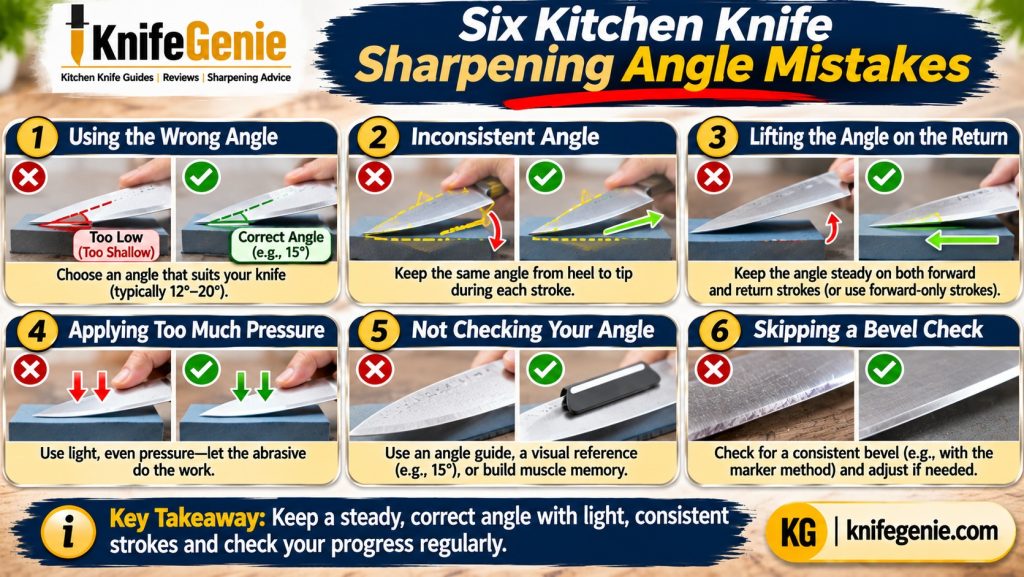
❌ 1. Assuming Every Knife Needs the Same Angle
A universal 15° or 20° recommendation ignores differences in knife design.
Better approach: Check the manufacturer and existing bevel before choosing your angle.
❌ 2. Confusing Per-Side and Total Angles
Sharpening at 30° per side when the intended total included angle is 30° would produce a dramatically different edge.
Better approach: Confirm which angle measurement is being used.
❌ 3. Changing the Angle During Every Stroke
Repeatedly rocking the blade can create an uneven or rounded bevel.
Better approach: Slow down and practise maintaining consistent bevel contact.
❌ 4. Choosing the Smallest Angle Possible
An extremely acute edge may perform poorly if the knife’s geometry, steel, or intended use doesn’t support it.
Better approach: Choose a practical balance of cutting performance and durability.
❌ 5. Applying Too Much Pressure
Heavy pressure can make angle control more difficult and remove unnecessary material.
Better approach: Use controlled pressure appropriate for the stone and sharpening stage.
❌ 6. Using an Incompatible Fixed-Angle Sharpener
A fixed-angle sharpener may substantially change a knife’s existing bevel.
Better approach: Verify compatibility before sharpening, especially with expensive or specialty knives.
🔁 Does a Knife Need Sharpening Every Time It Feels Dull?
Not necessarily.
A knife can lose cutting performance because of edge deformation, wear, or damage.
Honing may improve a slightly deformed edge, depending on the knife and honing tool, while sharpening removes metal to restore the cutting geometry.
Unnecessary sharpening can shorten the useful life of a knife by removing steel that didn’t need to be removed.
Learn how to recognize when maintenance is enough and when actual sharpening is appropriate in How Often Should You Sharpen Kitchen Knives?.
❓ Frequently Asked Questions About Kitchen Knife Sharpening Angles
What is the best sharpening angle for a chef knife?
The best angle is usually the one recommended by the manufacturer or already established on the knife. Many double-bevel chef knives use angles in the approximate 10°–20° per-side range, but individual specifications vary.
Is 15° or 20° better for a kitchen knife?
Neither is universally better. A 15° edge is more acute and can offer lower cutting resistance, while a 20° edge provides more robust geometry. The knife’s design, steel, and intended use determine which is more appropriate.
Should I sharpen a German knife at 20°?
Not automatically. Some German manufacturers use narrower factory edges. WÜSTHOF, for example, specifies 14° per side for its standard blades. Check your exact model before sharpening.
Are all Japanese knives sharpened at 15°?
No. Japanese kitchen knives include different blade types, steels, and edge geometries. Some are double-bevel, while others use specialized single-bevel designs. Follow the individual knife’s specifications.
Can I change my knife from 20° to 15°?
It is possible to reprofile a suitable double-bevel knife, but reducing the angle changes the edge geometry and requires removing steel. It may also reduce edge durability under certain conditions. Beginners should generally maintain the existing bevel unless there’s a clear reason to change it.
How can I sharpen at the correct angle without an angle guide?
Start by identifying the existing bevel. Practise maintaining steady contact with a secure whetstone, use a marker test to check contact, and work slowly. Exact angle measurement is less important than maintaining the appropriate bevel consistently.
Does sharpening angle matter more than whetstone grit?
Both matter, but they affect different aspects of sharpening. Angle determines the edge geometry, while grit influences material removal and refinement. A fine stone cannot compensate for consistently sharpening at the wrong angle.
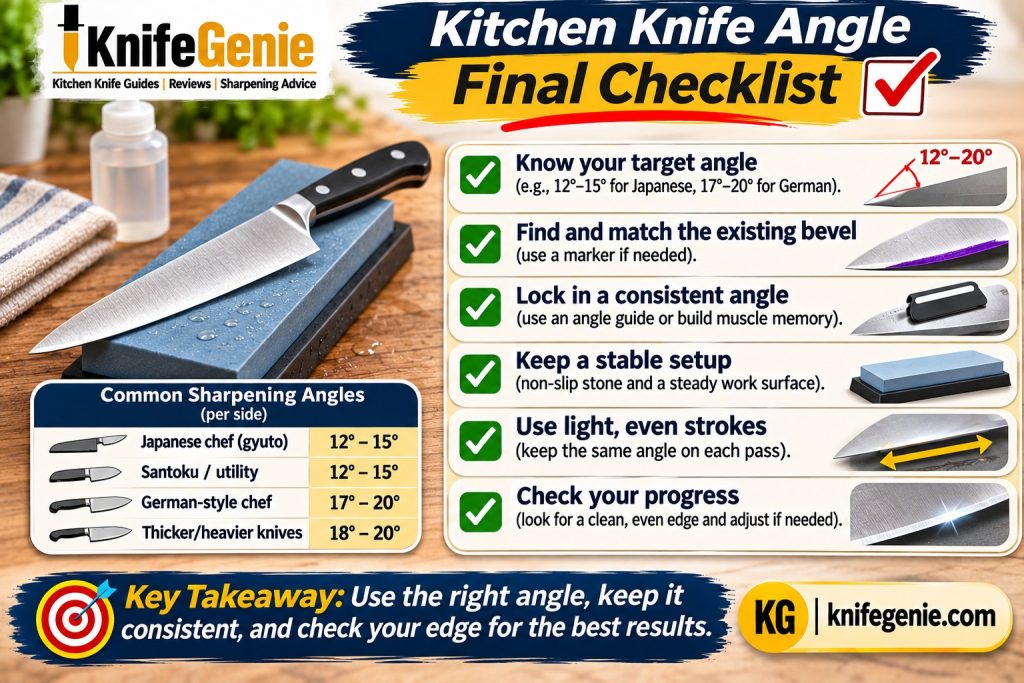
🏆 KnifeGenie Final Recommendation: Choose the Angle That Fits Your Knife
The best kitchen knife sharpening angle isn’t necessarily 15°, 17°, or 20°.
It’s the angle that suits your particular knife and allows you to maintain a dependable cutting edge.
For most home cooks, that means:
-
✔ Start with the manufacturer’s guidance.
-
✔ Understand the difference between per-side and total edge angles.
-
✔ Preserve the existing bevel when appropriate.
-
✔ Don’t assume German and Japanese knives each have one universal angle.
-
✔ Prioritize consistency over unnecessary precision.
-
✔ Avoid changing the edge geometry without a good reason.
🧙 KnifeGenie Final Verdict: A carefully maintained factory bevel is usually a better starting point than chasing a supposedly perfect universal sharpening angle.
Once you understand the angle, the next step is learning to sharpen consistently.
Continue with our whetstone sharpening tutorial, explore the Sharpen & Care hub, or review our beginner sharpening equipment guide.
KnifeGenie provides general educational guidance. Always follow the instructions supplied with your particular knife and sharpening equipment.