
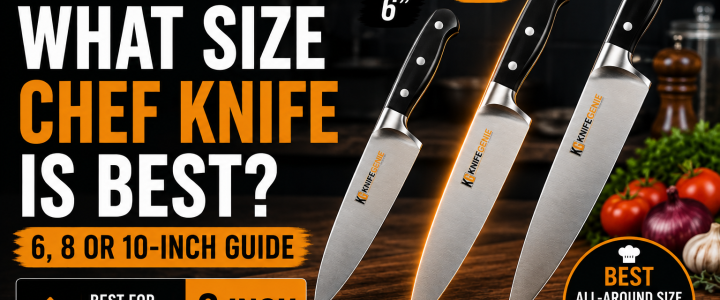
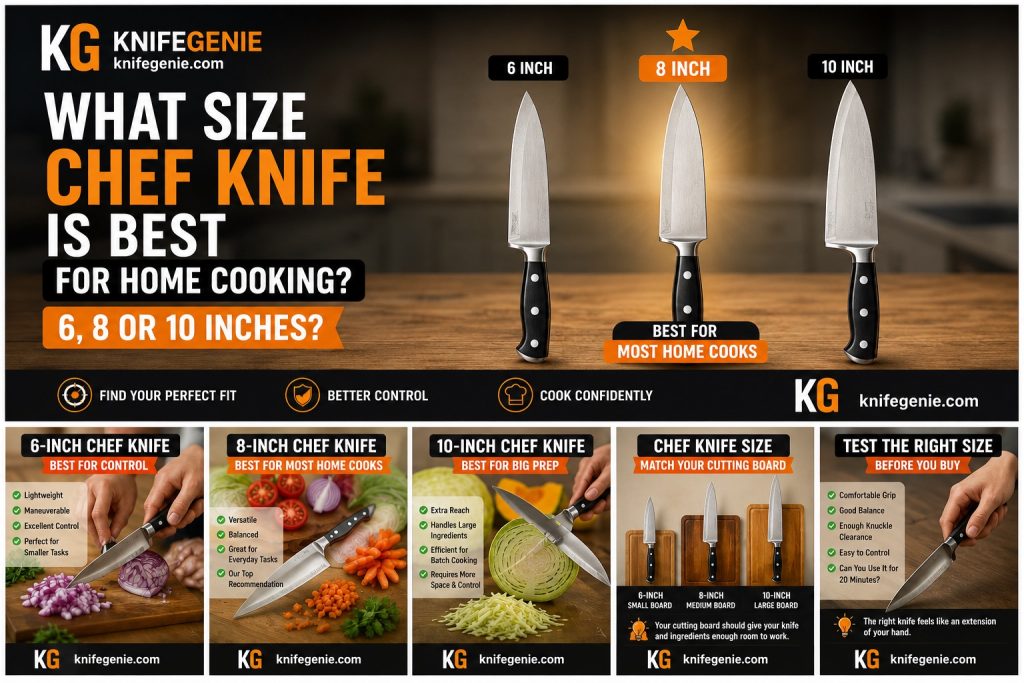
For most home cooks, an 8-inch chef’s knife offers the best balance of control, versatility and cutting length.
Choosing a chef’s knife sounds simple—until you discover the same knife may be available in 6-inch, 8-inch and 10-inch versions.
So which size should you actually buy?
For most home cooks, the answer is surprisingly straightforward:
An 8-inch chef’s knife is the best all-around size for home cooking.
It gives you enough blade length for chopping vegetables, slicing meat, mincing herbs and tackling larger ingredients without feeling unnecessarily large or difficult to control.
But that doesn’t mean an 8-inch knife is perfect for everyone.
Your hand size, cutting board, kitchen space, cooking habits and confidence with a knife can make a 6-inch—or even a 10-inch—chef’s knife the better choice.
In this KnifeGenie guide, we’ll help you figure out which size actually fits you.
🔽 Jump to What You Need
👉 Quick Answer
👉 Chef Knife Size Comparison
👉 6-Inch Chef Knife
👉 8-Inch Chef Knife
👉 10-Inch Chef Knife
👉 Best Size for Beginners
👉 Does Hand Size Matter?
👉 Cutting Board Size Matters Too
👉 Japanese vs German Knife Sizes
👉 How to Test the Right Size
👉 KnifeGenie Recommendation
👉 Frequently Asked Questions
🏆 What Size Chef Knife Is Best? The Quick Answer
If you want our recommendation:
🥇 Best Overall for Home Cooking — 8 Inches
For the majority of home cooks, an 8-inch chef’s knife is the sweet spot. This answers the question: what size chef knife is best for home cooking?
It is long enough to handle most everyday kitchen jobs but short enough to remain comfortable and controllable on an ordinary home cutting board.
Think:
🥕 Chopping carrots
🧅 Dicing onions
🌿 Mincing herbs
🥩 Slicing boneless meat
🍗 Preparing chicken
🍅 Cutting tomatoes
🥔 Chopping potatoes
🥬 Preparing cabbage and leafy vegetables
You can certainly perform these jobs with other knife sizes.
The advantage of the 8-inch knife is that it handles all of them reasonably well.
🧙 KnifeGenie Quick Verdict
If you’re buying your first serious chef’s knife and aren’t sure which size to choose, buy the 8-inch version.
Move down to 6 inches if control and compactness are especially important to you.
Move up to 10 inches if you regularly prepare large ingredients or big batches of food.
⚔️ Chef Knife Sizes Compared: 6 vs 8 vs 10 Inches
| Chef Knife Size | Control | Large Ingredients | Small Kitchens | Best For |
|---|---|---|---|---|
| 6 inch | ⭐⭐⭐⭐⭐ | ⭐⭐ | ⭐⭐⭐⭐⭐ | Small hands, compact kitchens, precision |
| 8 inch | ⭐⭐⭐⭐½ | ⭐⭐⭐⭐ | ⭐⭐⭐⭐ | Most home cooks |
| 10 inch | ⭐⭐⭐ | ⭐⭐⭐⭐⭐ | ⭐⭐ | Large prep jobs, experienced cooks |
🧙 KnifeGenie Tip
Don’t assume a larger knife is automatically better. Some smaller sizes may work if you wonder what size chef knife is best for home cooking or other tasks.
A chef’s knife works best when the blade feels like an extension of your hand, rather than something you’re constantly trying to control.
🔪 6-Inch Chef Knife — Best for Control
A 6-inch chef’s knife can be surprisingly capable.
Its biggest advantage is maneuverability.
Because there is less blade in front of your hand, the knife can feel easier to steer when you’re doing smaller cutting jobs.
That makes it particularly attractive for cooks who find a traditional 8-inch chef’s knife intimidating.

👍 Advantages of a 6-Inch Chef Knife
✔ Lightweight and maneuverable
✔ Excellent control
✔ Comfortable in smaller kitchens
✔ Works well on compact cutting boards
✔ Useful for detailed prep
✔ Less intimidating for some beginners
✔ Easy to store
👎 Disadvantages
✘ Shorter cutting edge
✘ Requires more strokes during larger prep jobs
✘ Awkward for large melons and squash
✘ Less efficient when preparing big batches
✘ May not provide enough knuckle clearance depending on blade design
👨🍳 Who Should Buy One?
Consider a 6-inch chef’s knife if you:
- Have smaller hands
- Work on a small cutting board
- Have limited counter space
- Prefer lightweight knives
- Mostly prepare smaller meals
- Feel uncomfortable using an 8-inch blade
🧙 KnifeGenie Verdict
BEST FOR CONTROL
A 6-inch chef’s knife can be an excellent home kitchen tool, but for many cooks it works better as a secondary knife than as their only chef’s knife.
🥇 8-Inch Chef Knife — Best for Most Home Cooks
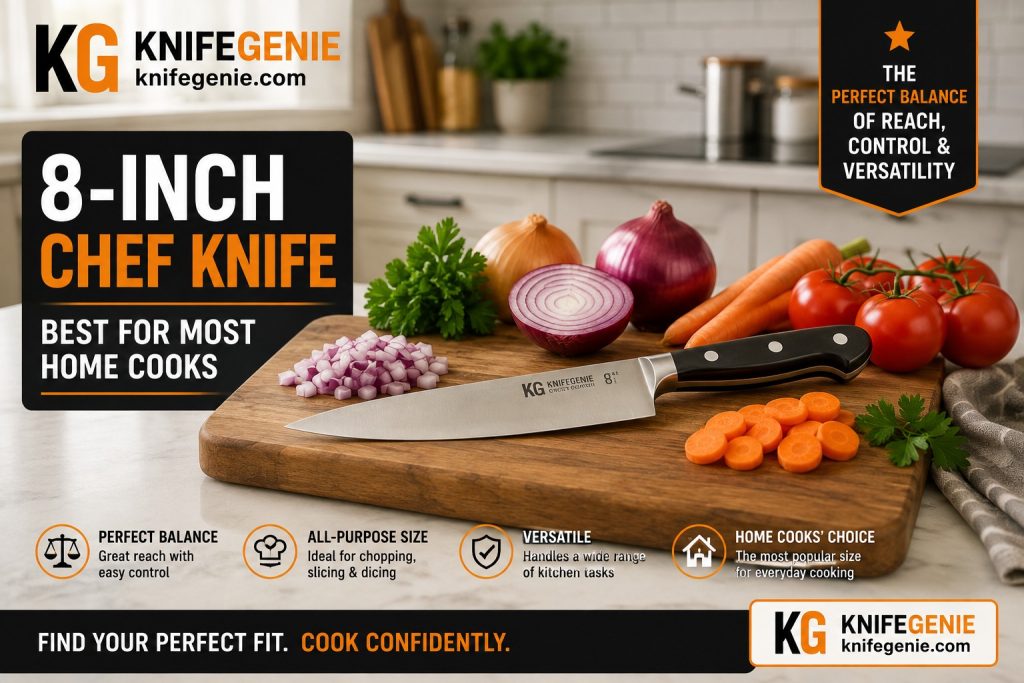
There’s a reason the 8-inch chef’s knife has become such a common all-purpose kitchen knife.
It sits right in the middle.
You get substantially more cutting edge than a 6-inch knife without moving into the more demanding dimensions of a 10-inch blade.
That combination makes the 8-inch knife exceptionally versatile.
👍 Advantages of an 8-Inch Chef Knife
✔ Excellent all-purpose size
✔ Enough length for most vegetables
✔ Comfortable for chopping onions
✔ Good for slicing boneless meats
✔ Suitable for mincing herbs
✔ Fits normal home cutting boards
✔ Easy to find from major knife manufacturers
✔ Works for beginners and experienced cooks
👎 Disadvantages
✘ May feel large if you’re accustomed to small knives
✘ Less efficient than a 10-inch knife for bulk prep
✘ Very small cutting boards can feel cramped
🧙 KnifeGenie Verdict
BEST CHEF KNIFE SIZE FOR MOST HOME COOKS
If KnifeGenie had to recommend one chef’s knife size without knowing anything else about the cook, we’d choose 8 inches.
It is simply the most versatile starting point.
💪 10-Inch Chef Knife — Best for Large Prep Jobs
A 10-inch chef’s knife changes the experience considerably.
Those extra two inches don’t sound dramatic.
Put a 10-inch chef’s knife next to an 8-inch knife, however, and the difference becomes obvious.
You have more cutting edge, more reach and usually more overall knife to control.
That can be fantastic when you’re cutting large ingredients.

👍 Advantages of a 10-Inch Chef Knife
✔ Longer cutting edge
✔ Excellent for large vegetables
✔ Efficient for bulk food preparation
✔ Useful for large cuts of boneless meat
✔ More reach across large ingredients
✔ Can reduce the number of cutting strokes required
👎 Disadvantages
✘ Requires more control
✘ Can feel intimidating to beginners
✘ Takes up more cutting-board space
✘ May feel cumbersome in small kitchens
✘ Usually heavier than comparable shorter knives
✘ More blade isn’t useful if your normal prep is small
👨🍳 Who Should Buy One?
Consider 10 inches if you:
- Regularly prepare large meals
- Meal-prep in bulk
- Use a large cutting board
- Frequently cut large vegetables
- Prefer longer knives
- Already have confident knife skills
🧙 KnifeGenie Verdict
BEST FOR BIG PREP
A 10-inch chef’s knife can be incredibly efficient in the right hands.
But most home cooks don’t need the additional length.
👶 What Size Chef Knife Is Best for Beginners?
Usually, 8 inches.
A beginner might assume that buying the smallest chef’s knife is automatically safer.
Not necessarily.
Control is extremely important, but a knife also needs enough blade length and height to perform normal kitchen jobs comfortably.
A 6-inch chef’s knife may feel less intimidating, but you’ll notice its limitations sooner when you begin working with larger foods.
That’s why an 8-inch knife remains our general beginner recommendation.
One Important Exception
If an 8-inch knife genuinely feels uncomfortable or intimidating in your hand, don’t force yourself to use it simply because it’s the conventional recommendation.
Try a 6-inch or 7-inch knife.
Comfort and control matter more than following a rule.
✋ Does Hand Size Determine Chef Knife Size?
It matters—but perhaps not as much as people sometimes think.
Someone with large hands may enjoy the extra space and leverage of a larger chef’s knife.
Someone with smaller hands may prefer a shorter, lighter knife.
But blade length is only part of the equation.
Also consider:
- Handle thickness
- Handle length
- Knife weight
- Blade height
- Balance
- Bolster shape
- Grip style
Two different 8-inch chef’s knives can feel dramatically different in your hand.
A lightweight Japanese gyuto, for example, can feel considerably more agile than a thick, heavy Western chef’s knife with exactly the same nominal blade length.
🧙 KnifeGenie Tip
Don’t buy solely by blade length.
The right 8-inch knife can feel easier to control than the wrong 6-inch knife.
📏 Your Cutting Board Matters More Than You Think
This is one of the most overlooked parts of choosing chef knife size.
Imagine putting a 10-inch chef’s knife onto a tiny cutting board.
Technically, you can use it.
Practically, you’ll spend a lot of time worrying about running out of board.
A larger knife works much better when it has enough room to move.
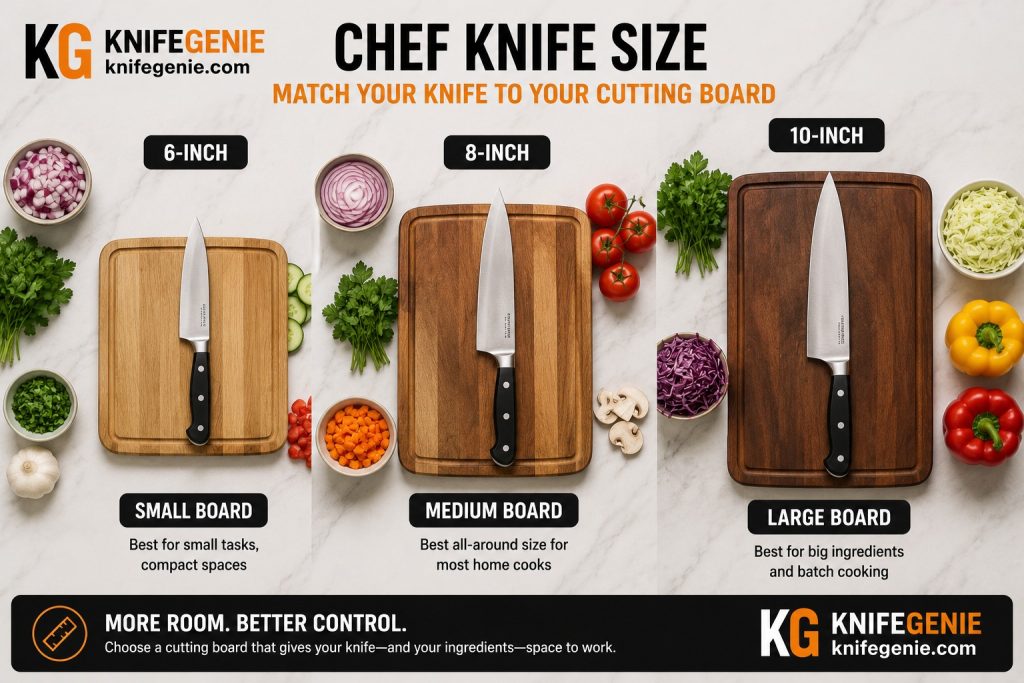
Small Cutting Board
A 6- or 8-inch knife generally makes more sense.
Medium Everyday Board
An 8-inch chef’s knife is ideal for most cooks.
Large Prep Board
An 8- or 10-inch chef’s knife can work extremely well.
🧙 KnifeGenie Tip
Don’t choose your knife in isolation.
Think of the system:
Your hands + knife + cutting board + ingredients.
All four need to work together.
🇯🇵 Japanese vs 🇩🇪 German Chef Knife Sizes
Blade length isn’t the only measurement that affects how large a knife feels.
Construction matters too.
🇯🇵 Japanese-Style Chef Knives
Japanese chef’s knives and gyutos often emphasize:
⚡ Lighter weight
🔪 Thinner blade geometry
🎯 Precision
✨ Harder steels
🥕 Low-resistance slicing
A Japanese gyuto around 210 mm (roughly 8.3 inches) can therefore feel surprisingly nimble.
🇩🇪 German-Style Chef Knives
Traditional German chef’s knives often emphasize:
💪 Robust construction
⚖️ More substantial weight
🔄 Curved profiles suited to rocking cuts
🔨 Toughness and versatility
Consequently, an 8-inch German knife may feel more substantial than a similarly sized Japanese knife.
Neither approach is automatically better.
They’re simply different.
If you’d like to see examples of both styles, KnifeGenie’s Best Imported Kitchen Knives guide compares several well-known Japanese and German chef’s knives.
🧪 How to Test Whether a Chef Knife Is the Right Size
If possible, hold the knife before buying it.
Don’t just hold it vertically and admire it.
Pretend you’re actually cooking.
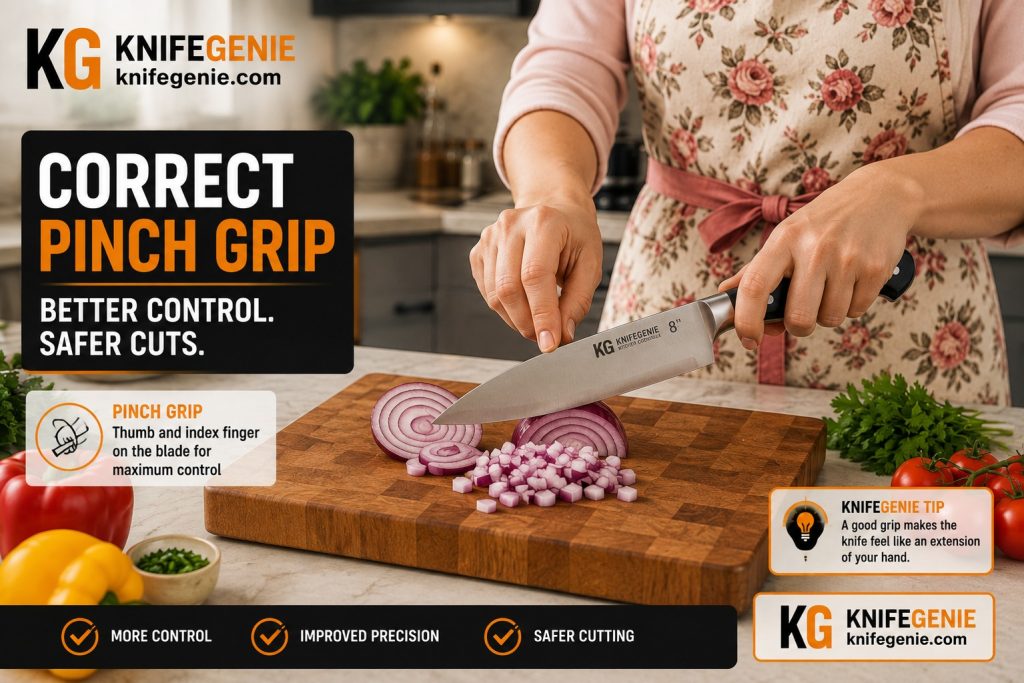
Use your normal grip and make a few slow chopping motions—without contacting anything unless you’re in a store that specifically allows knife testing.
Ask yourself:
1️⃣ Can I control the tip easily?
You shouldn’t feel as though the front of the knife is wandering around.
2️⃣ Does the handle fit comfortably?
Your fingers shouldn’t feel cramped.
3️⃣ Is there enough knuckle clearance?
Your knuckles shouldn’t constantly strike the cutting board.
4️⃣ Does the knife feel balanced?
A knife can be light but poorly balanced—or heavier yet extremely comfortable.
5️⃣ Can I imagine using it for 20 minutes?
This is more useful than asking whether the knife feels impressive for 20 seconds.
⚖️ Is a 7-Inch Chef Knife Worth Considering?
Absolutely.
The chef’s-knife world isn’t limited to 6, 8 and 10 inches.
A 7-inch chef’s knife can be a great compromise for someone who finds an 8-inch blade slightly cumbersome but doesn’t want the limitations of a 6-inch knife.
Similarly, Japanese gyutos commonly use metric dimensions.
For example:
180 mm ≈ 7.1 inches
210 mm ≈ 8.3 inches
240 mm ≈ 9.4 inches
So don’t become obsessed with finding a knife measuring exactly eight inches.
The goal is finding the size that works for you.
🍉 Match Your Chef Knife to What You Actually Cook
Still undecided?
Think about what’s normally on your cutting board.
| What You Usually Prepare | Suggested Size |
|---|---|
| Garlic, herbs, fruit, small vegetables | 6–8″ |
| Everyday family meals | 8″ |
| Onions, carrots, potatoes | 8″ |
| Chicken and boneless meats | 8″ |
| Large squash and cabbage | 8–10″ |
| Melons and large produce | 8–10″ |
| Large meal-prep sessions | 10″ |
| Small apartment-kitchen prep | 6–8″ |
| One chef knife for almost everything | 8″ |
🚫 Don’t Make These Chef Knife Size Mistakes
❌ Mistake #1: Buying the Biggest Knife Because It Looks Professional
Professional kitchens and home kitchens aren’t the same environment.
You probably don’t need restaurant-sized equipment to prepare dinner for two.
❌ Mistake #2: Buying a Tiny Knife Because It Feels Safer
A knife that’s too short can make certain cutting jobs more awkward.
The safest choice is generally a knife that gives you good control while being appropriately sized for the task.
❌ Mistake #3: Ignoring Your Cutting Board
A huge knife and tiny board are a frustrating combination.
❌ Mistake #4: Choosing Based Only on Hand Size
Your hand matters, but so do weight, balance, blade height and handle design.
❌ Mistake #5: Assuming All 8-Inch Knives Feel the Same
They definitely don’t.
Compare a thin Japanese gyuto with a substantial forged German chef’s knife and you’ll understand immediately.
🧙 KnifeGenie Recommendation
Here’s the simplest way to choose.
🥇 Choose an 8-Inch Chef Knife If…
You want one versatile chef’s knife for normal home cooking, or if you prefer classic American-made chef’s knives.
This is our recommendation for most people.
🎯 Choose a 6-Inch Chef Knife If…
You prioritize control, compactness and maneuverability, or you genuinely find an 8-inch knife uncomfortable.
💪 Choose a 10-Inch Chef Knife If…
You regularly tackle large ingredients, big batches or high-volume meal preparation and already feel comfortable handling longer knives.
⭐ Choose a 7-Inch Knife If…
Six inches feels too short but eight inches feels just a little too large.
🏆 Final Verdict: What Size Chef Knife Is Best for Home Cooking?
For most people:
Buy an 8-inch chef’s knife.
It provides the strongest combination of:
✔ Control
✔ Cutting length
✔ Versatility
✔ Maneuverability
✔ Cutting-board compatibility
✔ Beginner friendliness
✔ Everyday usefulness
A 6-inch knife offers more compact handling.
A 10-inch knife provides more cutting capacity.
But the 8-inch chef’s knife sits comfortably between those two extremes, which is exactly why it works so well in a home kitchen.
The important thing isn’t owning the biggest knife.
It’s owning the knife you can control comfortably and use confidently.
And for the majority of home cooks, that’s an 8-inch chef’s knife.
❓ Frequently Asked Questions
Is an 8-inch chef knife too big for home cooking?
For most adults, no. An 8-inch chef’s knife is generally an excellent size for everyday home cooking because it balances useful cutting length with manageable handling.
Is a 6-inch or 8-inch chef knife better?
An 8-inch knife is more versatile overall. A 6-inch knife can be better if you have limited working space, prefer a lighter knife or simply feel more comfortable with shorter blades.
Should a beginner use a 6-inch chef knife?
They can, but beginners don’t automatically need a smaller knife. An 8-inch chef’s knife is usually a better long-term all-purpose choice if it feels comfortable.
Is a 10-inch chef knife too large for home use?
Not necessarily. A 10-inch knife can be excellent for cooks who regularly prepare large quantities of food or large ingredients. However, it requires more board space and generally feels less maneuverable than an 8-inch knife.
What chef knife size do professional chefs use?
There isn’t one universal professional size. Chefs select knives based on their work, preferences and technique. Longer blades can be useful in high-volume kitchens because more food can be processed per stroke.
Is a 7-inch chef knife big enough?
Yes. A 7-inch knife is an excellent middle ground for cooks who want more versatility than a 6-inch knife while retaining a compact feel.
What size Japanese chef knife should I buy?
A 210 mm gyuto, approximately 8.3 inches, is an excellent general-purpose starting size for many home cooks. A 180 mm knife provides a more compact option, while 240 mm gives experienced users additional reach.
Do I need both an 8-inch and 10-inch chef knife?
Usually not. Most home cooks can perform the majority of everyday preparation with a good 8-inch chef’s knife. Add a 10-inch knife later if your cooking habits genuinely justify the extra length.
8-Inch vs 10-Inch Chef Knife: Which Should You Buy?
🔗 Related KnifeGenie Guides
Continue learning with KnifeGenie:
👉 How Often Should You Sharpen Kitchen Knives?
👉 Boning Knife vs Fillet Knife: Which One Do You Need?
👉 5 Best Imported Kitchen Knives of 2026
👉 Best Kitchen Knives Made in the USA