
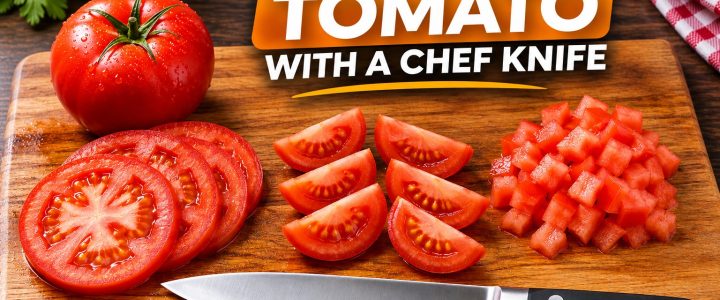

Tomatoes are among the most useful ingredients to practise cutting with a chef knife. They are also surprisingly easy to crush. Their delicate skin, soft flesh, and juicy interior mean that a dull knife or too much downward pressure can turn a neat slice into a squashed mess.
The good news is that you do not need a special knife for most tomato-cutting jobs. A sharp chef knife, a stable cutting board, and a few simple techniques are usually enough to make clean slices, even wedges, and tidy diced tomatoes.
In this beginner-friendly guide, you will learn how to cut a tomato with a chef knife without crushing it, whether you are preparing slices for sandwiches, wedges for salads, or diced tomatoes for cooking.
⚡ Quick Answer: How Do You Cut a Tomato Without Crushing It?
To cut a tomato with a chef knife, use a sharp blade and a stable cutting board. Rinse and dry the tomato, position it securely, and keep your fingertips tucked away using the claw grip. Start each cut with a gentle forward slicing motion rather than pressing straight down. For slices, cut across the tomato into even rounds. For wedges, halve the tomato through the stem end and divide each half into sections. For dice, cut the tomato into manageable pieces before making evenly spaced cuts.
The key is a sharp edge, gentle pressure, and controlled slicing. If your chef knife slips on the skin or squashes the flesh, stop and check its sharpness.
 Jump to What You Need
👉 Avoid Common Cutting Mistakes
👉 When to Use a Serrated Knife
🔪 Choose the Right Knife for Cutting Tomatoes
A chef knife is a versatile choice for cutting tomatoes because its long blade can make smooth, controlled cuts through the skin and flesh.
For most home cooks, an 8-inch chef knife provides enough blade length to slice medium and large tomatoes comfortably.
However, sharpness matters more than blade length.
A properly sharpened plain-edge chef knife should cut through tomato skin without needing excessive force. If you find yourself pressing hard, sawing repeatedly, or crushing the tomato, your knife may need attention.
Why a Sharp Chef Knife Makes a Difference
Tomato skin is thin but relatively tough compared with the soft flesh beneath it.
A sharp knife penetrates the skin cleanly, allowing the blade to pass through the tomato with less pressure. A dull edge may slide across the skin or compress the flesh before cutting.
📖 Read More: For a better understanding of kitchen knife sharpness, see:
If your knife needs more than routine maintenance, our Best Knife Sharpeners for Beginners guide can help you understand your options.
SHARP VS DULL KNIFE

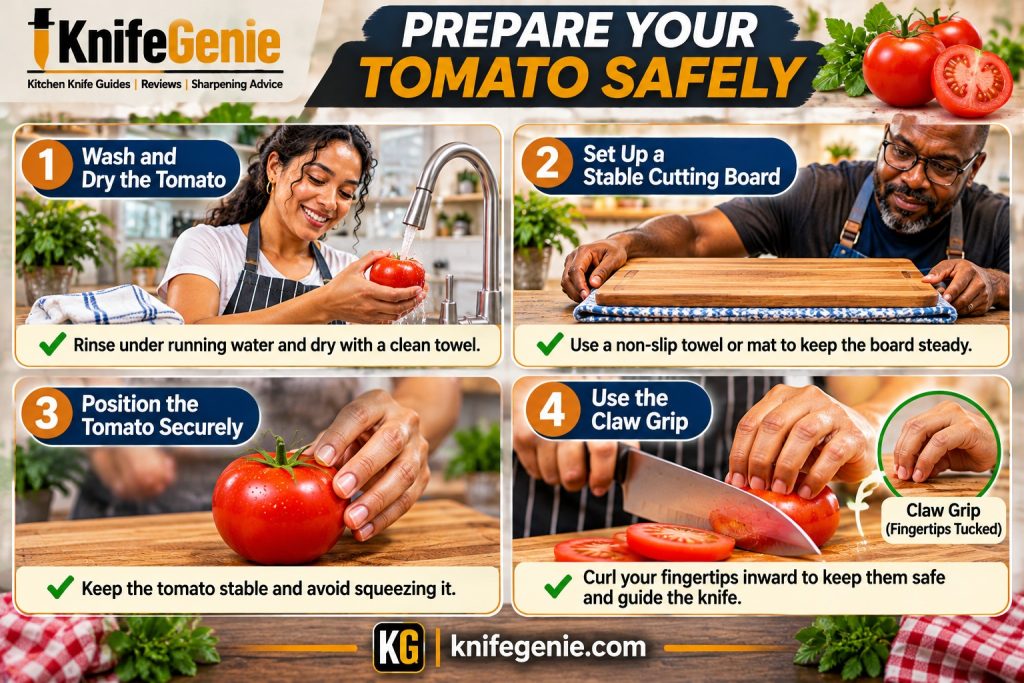
🧼 Prepare the Tomato Safely Before Cutting
Good tomato-cutting technique begins before the knife touches the tomato.
1️⃣ Step 1: Wash and Dry the Tomato
Rinse the tomato under cool running water and gently rub its surface to remove dirt.
Do not use soap, detergent, or household cleaning products on fresh produce.
Dry the tomato with a clean paper towel or kitchen towel. A dry tomato is easier to handle and less likely to slip.
The U.S. Food and Drug Administration’s guide to selecting and serving produce safely provides additional advice on washing produce and preventing contamination.
2️⃣ Step 2: Set Up a Stable Cutting Board
Place your cutting board on a clean, level work surface.
If the board moves, place a damp towel or suitable non-slip mat underneath it.
⚠️ Safety Tip: A moving cutting board can be dangerous, particularly when you are working with a round ingredient.
3️⃣ Step 3: Position the Tomato Securely
A tomato’s rounded shape can make it roll during cutting.
For the first cut, rest it on its most stable natural surface and steady it gently with your guiding hand. Once you have made a flat cut surface, place that surface against the board whenever practical.
Avoid squeezing the tomato while holding it.
4️⃣ Step 4: Use the Claw Grip
Curl the fingertips of your guiding hand inward, keeping them away from the cutting edge.
Your knuckles can help guide the blade while your fingertips remain tucked safely behind them.
📖 Read More: If you are unfamiliar with this technique, read How to Use the Claw Grip With a Chef Knife before continuing.
Keep Your Preparation Area Clean
Before preparing tomatoes, wash your hands and make sure your knife and cutting board are clean.
If you have been preparing raw meat, poultry, or seafood, thoroughly clean the equipment before using it for fresh produce.
The FDA’s Safe Food Handling guide explains these basic food safety precautions.
SAFE TOMATO CUTTING SETUP
🍅 How to Cut a Tomato With a Chef Knife or
Slice It
Tomato slices are ideal for sandwiches, burgers, salads, and serving alongside meals.
The challenge is producing even slices without squeezing out the juice or damaging the delicate flesh.
1️⃣ Step 1: Remove the Stem
Remove the leafy stem and any attached hard stem material.
If the tomato has a firm core, carefully remove it with a suitable small knife. Keep the tomato supported on the cutting board rather than holding it in your palm while cutting.
2️⃣ Step 2: Position the Tomato
For round slices, position the tomato so you can cut across its width.
A stable position is more important than producing perfectly circular slices. If the tomato rolls, remove a thin section from one side to create a flat base, or halve it and cut half-moon slices instead.
3️⃣ Step 3: Make the First Slice
Place the sharp chef knife against the tomato skin.
Begin with a gentle forward slicing motion, allowing the edge to penetrate the skin before continuing through the flesh.
Avoid pushing straight down with excessive pressure.
4️⃣ Step 4: Continue Cutting Even Slices
Move the knife across the tomato, making slices of approximately 1/4 inch (6 mm) for sandwiches or burgers.
For thinner salad slices, use a smaller spacing if your knife is sharp and you can maintain good control.
Do not rush. Keep your guiding hand safely positioned as the tomato becomes smaller.
5️⃣ Step 5: Transfer the Slices Carefully
Use a spatula or the flat side of the knife, with the cutting edge turned away from your hand, to move the slices onto a plate.
💡 KnifeGenie Tip: A gentle forward-and-down slicing action is usually more effective than a heavy chopping motion. Use a smooth stroke, and let the sharp edge do the work.

Use smooth slicing strokes to produce even tomato rounds.
🥗 How to Cut Tomato Wedges for Salads
Tomato wedges are a practical choice for garden salads, side dishes, and serving fresh tomatoes with meals.
Wedges retain more of the tomato’s natural structure than thin slices and are generally easier for beginners to prepare.
1️⃣ Step 1: Remove the Stem
Remove the stem and any tough central core.
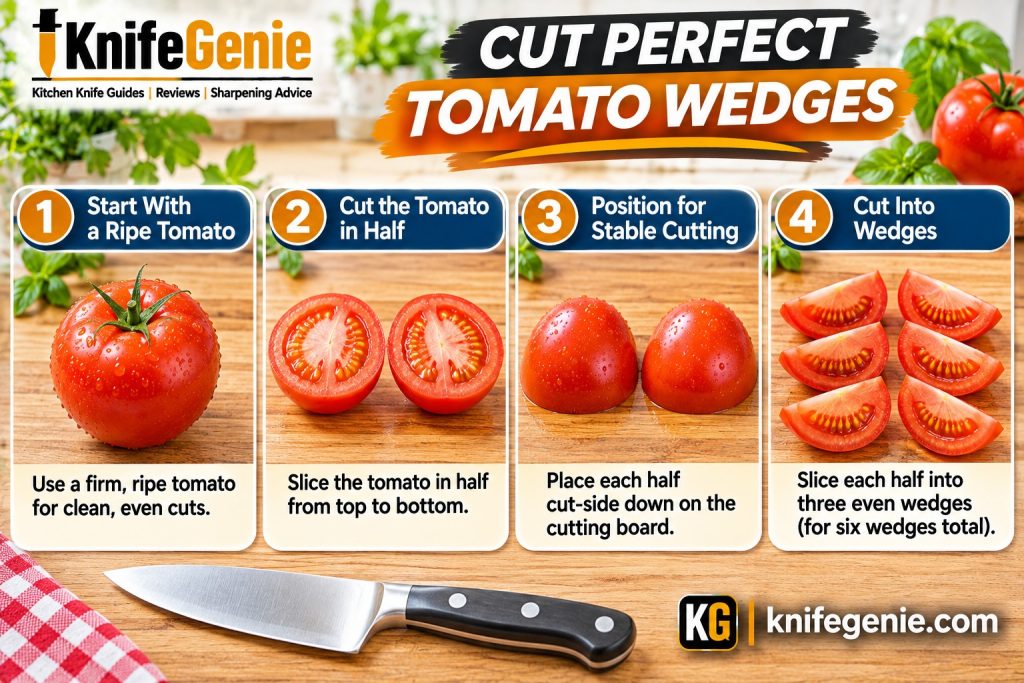
2️⃣ Step 2: Cut the Tomato in Half
Place the tomato securely on the cutting board.
Cut vertically through the stem end, dividing the tomato into two halves.
3️⃣ Step 3: Place the Halves Cut-Side Down
Turn each half so its flat cut surface rests on the board.
This helps prevent rolling and provides a more stable position for the next cuts.
4️⃣ Step 4: Cut Each Half Into Wedges
Cut each half into two or three wedges, depending on the size of the tomato.
For a medium tomato, dividing each half into three sections produces six wedges overall.
For larger tomatoes, eight wedges may be more suitable.
5️⃣ Step 5: Check the Wedge Sizes
Try to keep the wedges reasonably even so they look attractive and are easy to serve.
💡 KnifeGenie Tip: For salad wedges, choose tomatoes that are ripe but still firm enough to hold their shape. Very soft tomatoes are more difficult to cut neatly.
TOMATO WEDGES
🔪 How to Dice a Tomato With a Chef Knife
Diced tomatoes are useful for salsa, salads, sauces, soups, and many everyday recipes.
Unlike firm vegetables such as carrots, tomatoes contain soft flesh and juicy seed pockets. For that reason, a gentle approach produces better results.
1️⃣ Step 1: Start With a Firm Tomato
Choose a ripe tomato that still has enough firmness to hold its shape.
Overripe tomatoes can become mushy when diced, especially if you apply too much pressure.
2️⃣ Step 2: Remove the Stem and Core
Remove the stem and carefully trim away the tough core if necessary.
3️⃣ Step 3: Cut the Tomato Into Halves or Quarters
Halve the tomato through the stem end.
For large tomatoes, cut the halves into quarters. Place each piece cut-side down on the board to create a stable cutting surface.
4️⃣ Step 4: Make Lengthwise Cuts
Using gentle slicing strokes, cut each tomato section into strips of your preferred width.
For a medium dice, aim for pieces approximately 1/2 inch (12 mm) across.
Keep the tomato pieces stable rather than forcing the blade through them.
5️⃣ Step 5: Cut Across the Strips
Turn or reposition the strips as needed and cut across them to form small pieces.
Work with a few strips at a time instead of trying to control a large, slippery stack.
6️⃣ Step 6: Collect the Diced Tomato
Transfer the diced pieces to a bowl.
If the recipe calls for tomato juice, include the liquid from the cutting board. Otherwise, drain off excess liquid if the recipe requires a drier mixture.
Should You Remove the Seeds Before Dicing?
Not always.
For everyday salads, soups, and sauces, you can usually leave the seeds and juicy interior intact.
For fresh salsa, bruschetta, or other dishes where excess liquid may affect the texture, removing some of the seed pockets can be helpful.
To do this, cut the tomato into quarters and gently scoop out the watery seed pockets with a small spoon before slicing the firmer flesh into strips.
💡 KnifeGenie Tip: When you want very neat, uniform dice, use the firmer outer tomato flesh. When flavor and juiciness matter more than appearance, keep the seeds and interior.

Make stable sections, then cut strips and crosswise pieces for tomato dice.
⚠️ Common Tomato-Cutting Mistakes and How to Avoid Them
Even experienced home cooks sometimes struggle with tomatoes. Most problems come from knife sharpness, tomato ripeness, or unstable cutting technique.
❌ Mistake 1: Using a Dull Knife
A dull knife may slide across the skin or crush the tomato before cutting through it.
✅ Better Approach: Maintain a sharp cutting edge and use controlled slicing strokes.
❌ Mistake 2: Pressing Straight Down
Excessive downward pressure compresses the soft flesh and can squeeze out juice and seeds.
✅ Better Approach: Start with a gentle forward slicing movement and continue smoothly through the tomato.
❌ Mistake 3: Cutting an Unstable Tomato
A round tomato can roll unexpectedly when the knife touches it.
✅ Better Approach: Position it securely, use a flat cut surface whenever possible, and keep the cutting board stable.
❌ Mistake 4: Holding the Tomato Too Tightly
Squeezing the tomato while cutting can damage the flesh and cause juice to escape.
✅ Better Approach: Use a relaxed guiding hand and maintain the claw grip without crushing the tomato.
❌ Mistake 5: Choosing an Overripe Tomato for Fine Dice
Very soft tomatoes may fall apart during detailed cutting.
✅ Better Approach: Choose firmer ripe tomatoes when appearance and uniform pieces are important.
❌ Mistake 6: Cutting Too Quickly
Trying to cut tomatoes at high speed can lead to uneven pieces and reduced control.
✅ Better Approach: Prioritize accuracy, stable positioning, and safe hand placement over speed.
📖 Read More: For additional beginner-friendly cutting guidance, visit How to Use a Chef Knife: Beginner’s Guide to Cutting Safely.

🪚 When Is a Serrated Tomato Knife Better Than a Chef Knife?
A sharp chef knife is an excellent all-purpose tool for tomatoes, but there are situations where a serrated tomato knife may be more convenient.
A serrated knife has small teeth along its cutting edge. These teeth can grip the tomato skin and begin cutting with relatively little pressure.
✅ A Serrated Knife May Be Better When:
- Your chef knife is not sharp enough to cut through the skin cleanly.
- You are cutting very ripe, soft tomatoes.
- You want thin slices but are having trouble starting the cut.
- You prefer a smaller knife designed specifically for tomatoes.
A small serrated tomato knife can be particularly helpful when working with delicate tomatoes.
However, a serrated knife is not automatically better for every job.
A sharp chef knife is often more versatile for making wedges, preparing larger tomatoes, and dicing ingredients for cooking.
| Cutting Task | Practical Knife Choice |
|---|---|
| Sandwich slices | Sharp chef knife or serrated tomato knife |
| Thin slices from soft tomatoes | Serrated tomato knife |
| Salad wedges | Sharp chef knife |
| Medium or large dice | Sharp chef knife |
| Very ripe tomatoes | Serrated knife may be easier |
📖 Read More: For a detailed comparison of blade types, read Serrated vs Plain Edge Kitchen Knives.
⚠️ Safety Reminder: A serrated knife can make cutting easier, but it does not replace safe knife handling or a stable cutting surface.

A sharp chef knife handles most tomato-cutting tasks, while a serrated tomato knife can help with delicate or very ripe tomatoes.
✅ Quick Tomato-Cutting Checklist
Before cutting your next tomato, use this simple checklist:
Rinse the tomato under running water and dry it.
Place the cutting board on a stable surface.
Check that your chef knife is sharp.
Position the tomato securely.
Keep your guiding fingertips tucked away.
Begin each cut with gentle slicing pressure.
Use stable halves or quarters for wedges and dice.
Slow down if the tomato begins to slip or crush.
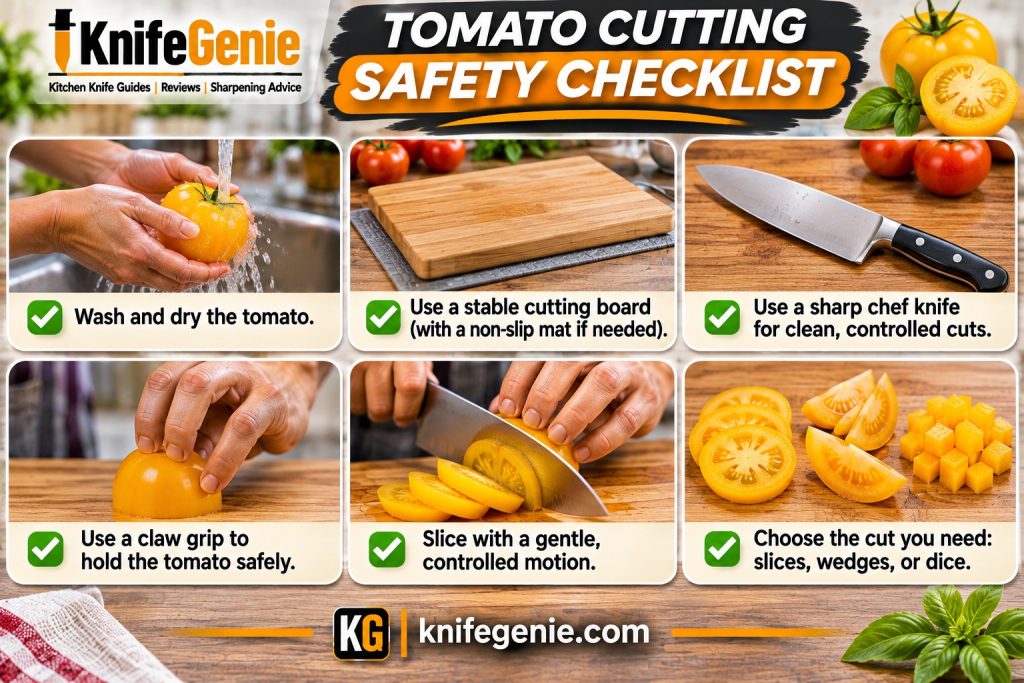
A sharp knife, stable board, safe grip, and gentle cutting motion are the foundations of successful tomato preparation.
❓ Frequently Asked Questions
Can You Cut a Tomato With a Chef Knife?
Yes. A sharp chef knife is suitable for slicing, wedging, and dicing tomatoes. The important factors are blade sharpness, gentle pressure, and secure positioning.
Why Does My Knife Crush Tomatoes Instead of Cutting Them?
The most common reason is a dull cutting edge. Excessive downward pressure, a very soft tomato, or poor cutting technique can also cause crushing.
Is a Serrated Knife Better for Cutting Tomatoes?
A serrated knife can be particularly useful for very ripe tomatoes because its teeth grip the skin. However, a sharp chef knife works well for most tomato-cutting tasks and offers greater versatility.
How Thick Should Tomato Slices Be?
For sandwiches and burgers, slices approximately 1/4 inch (6 mm) thick are a practical starting point. Thinner slices may work better for salads, while thicker slices are useful for certain cooked dishes.
Should You Remove Tomato Seeds Before Dicing?
Usually not. The seeds and surrounding juice can remain in tomatoes used for soups, sauces, and many salads. For dishes where excess moisture is undesirable, you can remove some of the watery seed pockets before dicing.
What Is the Safest Way to Cut a Round Tomato?
Use a stable cutting board, steady the tomato with a safe guiding-hand position, and make the first cut slowly. Once a flat surface is available, place it against the board for additional stability.
🎯 Final Thoughts: Cut Tomatoes Cleanly and Confidently
Learning how to cut a tomato with a chef knife is a useful beginner skill that can make everyday food preparation easier.
The technique does not require complicated movements. Start with a sharp knife, keep the tomato stable, protect your guiding hand, and use smooth slicing strokes rather than excessive downward pressure.
For sandwiches, practise making even rounds. For salads, begin with simple wedges. When you feel more comfortable, move on to dicing tomatoes into smaller, more uniform pieces.
📖 Keep Learning: If you are still developing your kitchen knife skills, continue with our How to Use a Chef Knife: Beginner’s Guide and How to Use the Claw Grip With a Chef Knife.
With a little practice, you will be able to prepare tomatoes neatly, safely, and without unnecessary waste.