

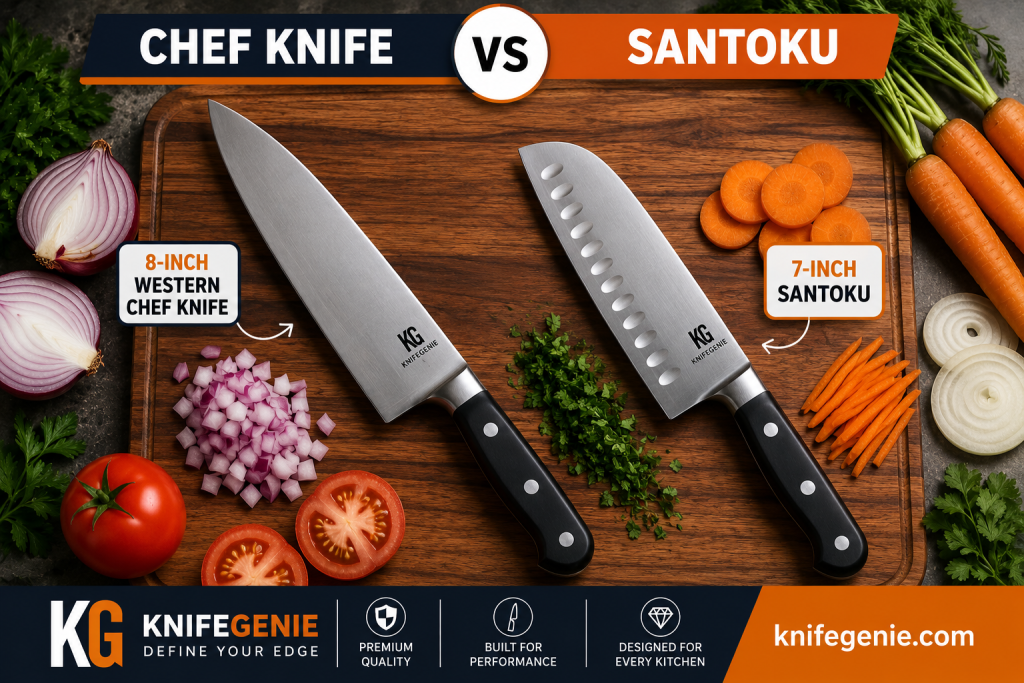
Walk into almost any serious kitchen and you’ll probably find one—or both—of these knives: a chef knife and a Santoku.
At first glance, they seem to do essentially the same job.
Both can chop onions, slice meat, mince herbs, cut vegetables and handle most of the food preparation an ordinary home cook does.
So why choose one over the other?
The difference becomes much clearer once you actually start cutting.
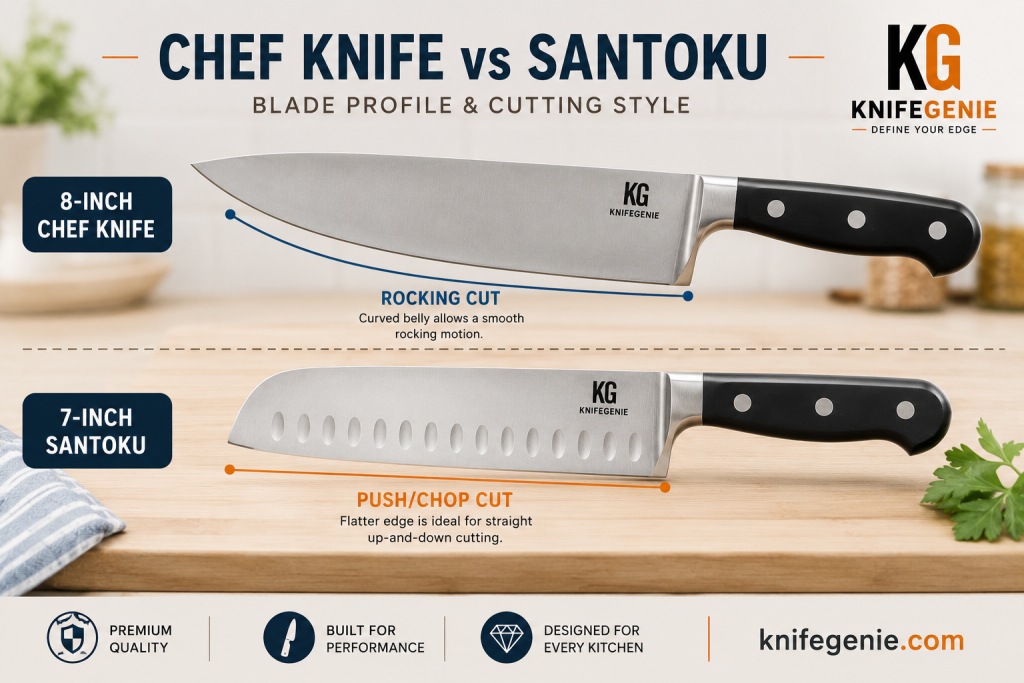
A traditional Western chef knife generally gives you a longer blade, curved cutting edge and more weight, making it particularly good for rocking cuts and larger ingredients.
A Santoku is usually shorter, lighter and flatter through the cutting edge, which makes it exceptionally nimble for chopping vegetables, making precise cuts and using an up-and-down or forward slicing technique.
For this KnifeGenie comparison, we’re looking beyond which knife looks better.
We’re comparing the two based on what actually matters in an everyday kitchen:
🔪 Versatility
🥕 Vegetable prep
🥩 Meat preparation
🌿 Herb chopping
✋ Control
⚖️ Weight
📏 Blade size
🔄 Cutting technique
🧼 Everyday practicality
👨🍳 Ease of use
And although this is a close contest, KnifeGenie’s overall recommendation for most home cooks is the 8-inch chef knife.
But there’s an important exception.
If you prefer a lighter knife and do a lot of vegetable preparation, you may actually be happier with a Santoku.
🔽 Jump to What You Need
👉 Quick Answer
👉 Chef Knife vs Santoku Comparison
👉 What Is a Chef Knife?
👉 What Is a Santoku?
👉 Blade Shape
👉 Size & Weight
👉 Vegetables
👉 Meat & Fish
👉 Herbs & Garlic
👉 Which Is Easier to Use?
👉 Which Should Beginners Buy?
👉 Which Should You Buy?
👉 KnifeGenie Final Verdict & Scorecard
👉 Frequently Asked Questions
🏆 Chef Knife vs Santoku: The Quick Answer
If you simply want our recommendation:
🥇 Best Overall for Everyday Cooking — Chef Knife
For most home cooks who want one primary kitchen knife, KnifeGenie gives the chef knife the advantage.
Why?
Versatility.
A good 8-inch chef knife gives you enough blade for large vegetables and substantial cuts of meat while remaining manageable enough for onions, carrots, herbs, fruit and everyday chopping.
Its curved belly also supports the rocking technique many Western cooks naturally learn.
🥕 Best for Vegetables & Precision — Santoku
The Santoku fights back with lighter handling, a flatter cutting edge and excellent control.
A typical 7-inch Santoku feels extremely agile when you’re slicing carrots, dicing onions, preparing peppers, chopping cabbage or making thin, consistent vegetable cuts.
✋ Best for Smaller Hands — Santoku
Its shorter blade and typically lighter construction can make a Santoku less intimidating and easier to maneuver.
🌿 Best for Rocking Herbs — Chef Knife
If your preferred technique involves keeping the knife tip near the board and rocking the blade through parsley, cilantro and other herbs, the curved belly of a Western chef knife is particularly well suited to the job.
🧙 KnifeGenie Verdict
If you’re buying only one: start with an 8-inch chef knife.
Choose the Santoku instead if you know you prefer a shorter, lighter knife and a chopping/push-cutting technique.
⚔️ Chef Knife vs Santoku — Side-by-Side Comparison
| Feature | 🔪 Chef Knife | 🇯🇵 Santoku |
|---|---|---|
| Typical blade | Around 8 inches | Around 5.5–7 inches |
| Blade profile | More curved | Flatter |
| Tip | Pointed | Lower/sheepsfoot-style profile common |
| Weight | Usually heavier | Usually lighter |
| Cutting style | Rock, chop, slice | Chop, push-cut, slice |
| Large ingredients | ⭐⭐⭐⭐⭐ | ⭐⭐⭐ |
| Vegetables | ⭐⭐⭐⭐½ | ⭐⭐⭐⭐⭐ |
| Herbs | ⭐⭐⭐⭐⭐ | ⭐⭐⭐⭐½ |
| Boneless meat | ⭐⭐⭐⭐⭐ | ⭐⭐⭐⭐½ |
| Precision cuts | ⭐⭐⭐⭐ | ⭐⭐⭐⭐⭐ |
| Maneuverability | ⭐⭐⭐⭐ | ⭐⭐⭐⭐⭐ |
| Rock chopping | ⭐⭐⭐⭐⭐ | ⭐⭐⭐ |
| Small cutting boards | ⭐⭐⭐½ | ⭐⭐⭐⭐⭐ |
| Best all-rounder | 🏆 Winner | Excellent |
| Best for lighter handling | Very good | 🏆 Winner |
🧙 KnifeGenie Tip
Don’t assume that “Japanese” automatically means better—or that a heavier Western knife is automatically more durable.
Modern chef knives and Santokus are made using an enormous variety of steels, edge angles, blade thicknesses and manufacturing methods.
Compare the actual knife, not just the category name.
🔪 What Is a Chef Knife?
The chef knife is the classic multipurpose workhorse of Western kitchens.
While sizes vary considerably, 8 inches is the sweet spot for most home cooks.
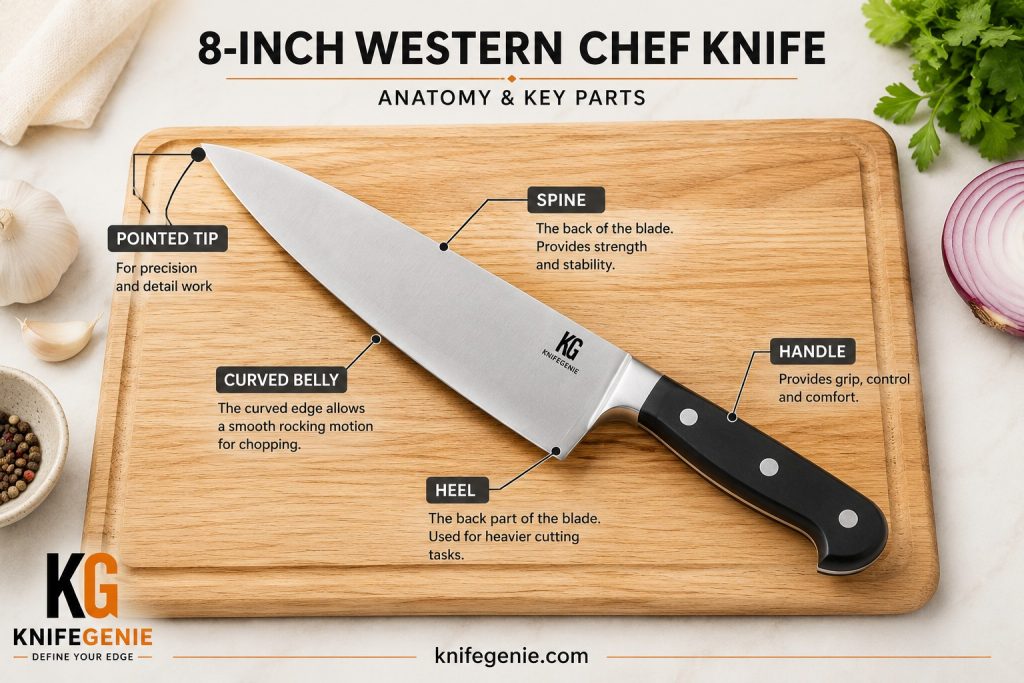
A Western-style chef knife normally has a pointed tip and noticeable curve toward the front of the cutting edge.
That curve isn’t cosmetic.
It allows you to rock the knife smoothly across your cutting board.
Think about chopping parsley.
The tip can remain close to the board while your cutting hand raises and lowers the heel of the knife.
That familiar rocking action is one of the defining characteristics of a Western chef knife.
⚙️ Typical Chef Knife Characteristics
🔪 Blade: Usually around 8–10 inches
📐 Edge: Curved toward the tip
⚖️ Weight: Medium to relatively heavy
✋ Handling: Substantial and balanced
🔄 Technique: Excellent for rocking cuts
🥩 Foods: Meat, vegetables, herbs, fruit and general prep
🏠 Best for: Cooks wanting maximum versatility
✅ Chef Knife Strengths
✔ Extremely versatile
✔ Excellent for large ingredients
✔ Superb rocking action
✔ Long blade handles substantial produce efficiently
✔ Pointed tip is useful for detailed work
✔ Excellent for chopping herbs
✔ Effective for slicing boneless meat
✔ Huge selection available
✔ Familiar to many Western cooks
❌ Chef Knife Weak Points
✘ Can feel heavy compared with a Santoku
✘ 8–10 inch blades require more cutting-board space
✘ May feel intimidating to cooks accustomed to small knives
✘ More blade than necessary for some precision jobs
🧙 KnifeGenie Verdict
BEST OVERALL EVERYDAY KNIFE
If you’re building a kitchen knife collection from scratch, the chef knife remains the safest starting point.
CHEF KNIFE ANATOMY
🇯🇵 What Is a Santoku Knife?
Santoku is a Japanese-style multipurpose kitchen knife.
The name is commonly translated as “three virtues” or “three strengths.”
Exactly what those three virtues represent is sometimes described differently, but the essential idea is straightforward:
The Santoku is designed as a versatile all-purpose kitchen knife.
It is particularly associated with preparing meat, fish and vegetables.
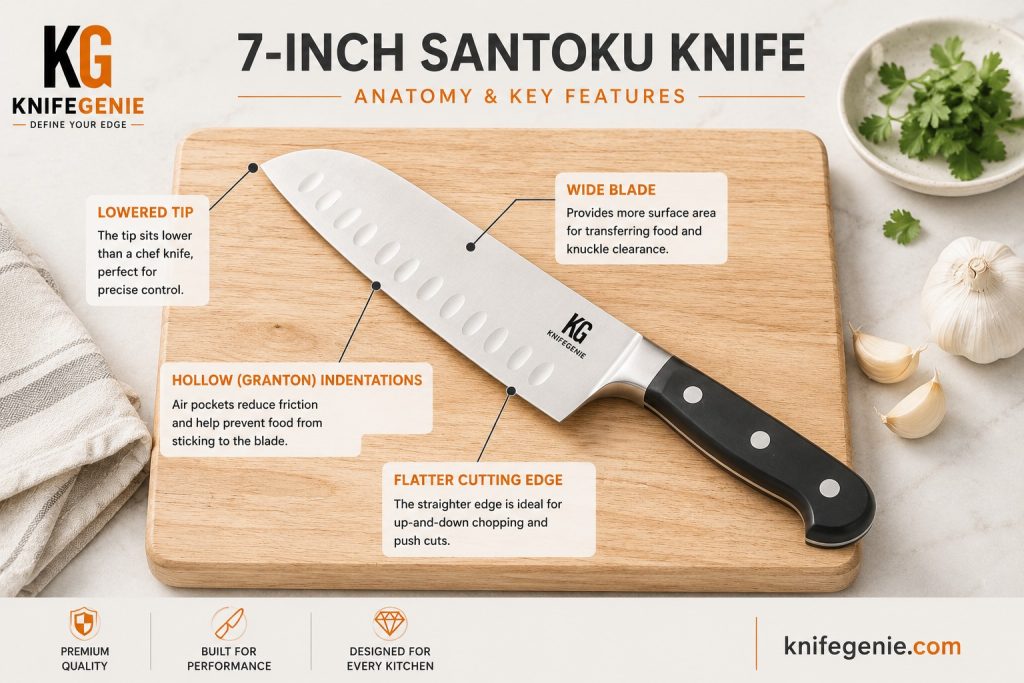
A Santoku usually has a wider blade, relatively flat cutting edge and a spine that curves downward toward the tip.
Many are approximately 7 inches long, although smaller versions are common.
That shorter length changes how the knife feels.
Compared with a substantial 8-inch Western chef knife, a Santoku can feel remarkably quick and controllable.
⚙️ Typical Santoku Characteristics
🔪 Blade: Commonly 5.5–7 inches
📐 Edge: Relatively straight
⚖️ Weight: Usually light
✋ Handling: Nimble and controlled
⬆️ Technique: Chopping, push-cutting and slicing
🥕 Foods: Vegetables, fish, boneless meat and herbs
🏠 Best for: Precision-oriented everyday preparation
✅ Santoku Strengths
✔ Lightweight
✔ Highly maneuverable
✔ Excellent vegetable knife
✔ Superb for precise cuts
✔ Good knuckle clearance
✔ Wide blade can help transfer chopped food
✔ Comfortable on smaller cutting boards
✔ Excellent for cooks who dislike heavy knives
✔ Hollow-edge versions may help reduce sticking with some foods
❌ Santoku Weak Points
✘ Shorter blade is less efficient on very large ingredients
✘ Flatter edge isn’t ideal for pronounced rocking cuts
✘ Less reach when slicing large cuts of meat
✘ Some cooks miss the pointed tip of a chef knife
🧙 KnifeGenie Verdict
BEST LIGHTWEIGHT EVERYDAY KNIFE
The Santoku isn’t merely an alternative to a chef knife.
For vegetable-heavy cooking and cooks who value agility, it may actually be the better tool.
SANTOKU ANATOMY
- Zwilling Santoku Knives — useful reference for the shorter, lighter, flatter characteristics of Santoku knives.
📐 Chef Knife vs Santoku: Blade Shape Matters
This is where the comparison gets interesting.
Put both knives on a cutting board and look at the cutting edges.
The chef knife generally has more curve.
The Santoku generally has more usable flat edge contacting the board at once.
That affects how you cut.
🔪 Chef Knife
The curved belly makes this motion natural:
Forward → down → rock → lift → repeat
🇯🇵 Santoku
The flatter edge favors something closer to:
Forward/down → lift → reposition → repeat
Neither technique is inherently superior.
They’re simply different.
🏆 Winner for Rocking — Chef Knife
🏆 Winner for Straight Chopping & Push Cuts — Santoku
BLADE PROFILE COMPARISON
📏 Size & Weight: Which Feels Better?
There’s a noticeable difference here.
A traditional 8-inch chef knife puts more blade in front of your hand.
Move up to a 10-inch model and that difference becomes even more pronounced.
A typical 7-inch Santoku feels considerably more compact.
That can be useful if you have:
🏠 A small kitchen
🪵 A compact cutting board
✋ Smaller hands
🥕 Mostly small-to-medium ingredients
🔪 A preference for nimble knives
But longer blades have advantages too.
Try halving a large cabbage with a 5.5-inch Santoku and you’ll immediately understand why blade length matters.
The longer chef knife simply gives you more reach.
🏆 Maneuverability — Santoku
🏆 Large Ingredients — Chef Knife
🏆 Small Cutting Boards — Santoku
🏆 Overall Versatility — Chef Knife
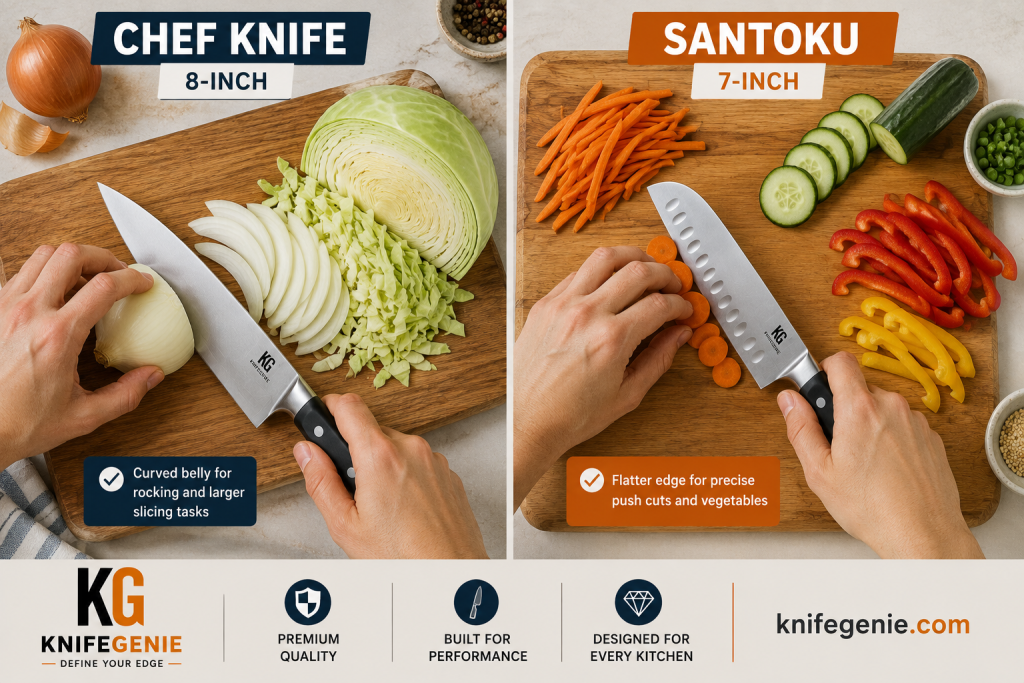
🥕 Which Is Better for Vegetables?
Santoku wins—but narrowly.
Vegetables are where the Santoku really starts making sense.
Its relatively flat edge and broad blade are extremely comfortable for:
🧅 Dicing onions
🥕 Chopping carrots
🫑 Slicing peppers
🥒 Cutting cucumbers
🥔 Preparing potatoes
🍄 Slicing mushrooms
🧄 Mincing garlic
🥬 Chopping greens
The broad blade is also convenient for scooping chopped ingredients from the board.
A chef knife is still an outstanding vegetable knife.
In fact, if you’re chopping a large cabbage, butternut squash or other substantial produce, its additional length can make it more useful.
🏆 Winner: Santoku
Santoku: 9.6/10
Chef Knife: 9.3/10
VEGETABLE TEST
🥩 Which Is Better for Meat?
This one goes to the chef knife.
For ordinary boneless chicken, beef, pork and similar ingredients, both knives perform extremely well.
But the longer chef knife provides more slicing length.
That’s especially useful when you’re cutting larger pieces of meat and want to complete a slice using fewer strokes.
The pointed tip can also be helpful when working around joints and making smaller detail cuts.
🏆 Winner: Chef Knife
Chef Knife: 9.5/10
Santoku: 8.9/10
⚠️ Important
Neither knife should be treated like a meat cleaver.
Avoid chopping through bones, frozen food or other extremely hard materials with a fine-edged chef knife or Santoku.
Use the appropriate heavy-duty tool instead.
🐟 What About Fish?
Now the Santoku closes the gap again.
Its thin, nimble construction can be excellent for portioning boneless fish and making clean slices.
However, neither replaces a proper fillet knife when you need to flex around bones, skin a fillet or perform delicate fish preparation.
🧙 KnifeGenie Tip
Think of chef knives and Santokus as general-purpose knives.
Specialized knives still exist for a reason.
Boning Knife vs Fillet Knife: Which One Do You Need?
🌿 Which Is Better for Herbs & Garlic?
It depends on your technique.
If you place parsley on your board and instinctively rock the knife backward and forward, you’ll probably prefer the chef knife.
If you prefer controlled chopping or push cuts, the Santoku feels excellent.
For garlic, shallots and similar small ingredients, either works beautifully.
🏆 Rock-Mincing Herbs — Chef Knife
🏆 Controlled Chopping — Santoku
🏆 Garlic & Shallots — Tie
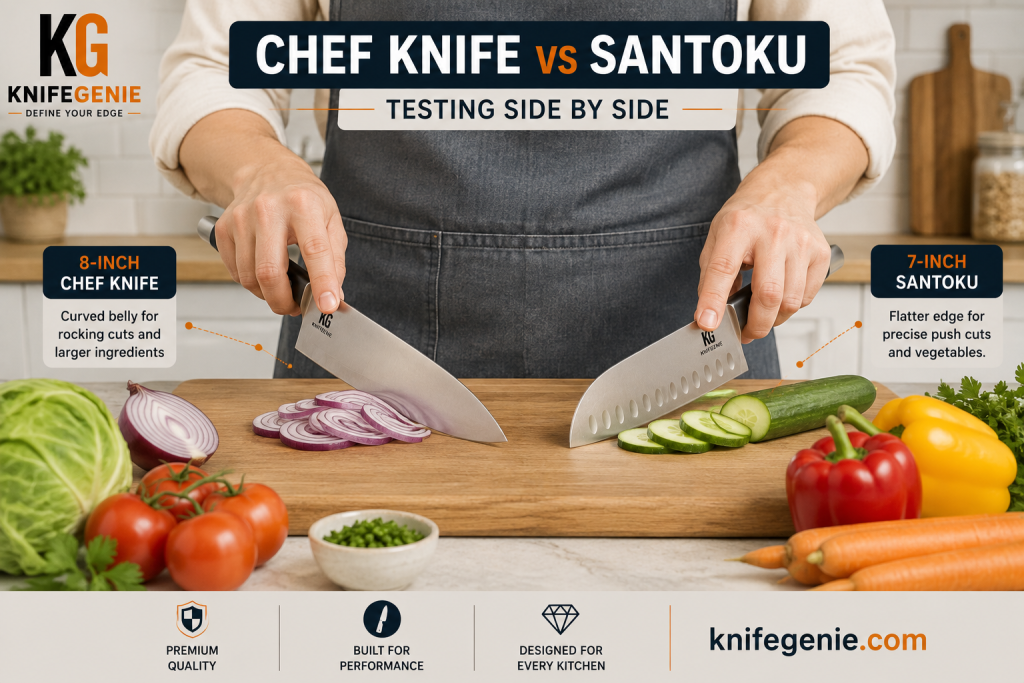
✋ Which Knife Gives You More Control?
For many home cooks:
Santoku.
A shorter, lighter blade simply has less mass and length to control.
That doesn’t automatically make it safer.
Safe knife handling still depends on good technique, a stable cutting board, a secure grip and paying attention to what you’re doing.
But the compact dimensions of a Santoku can feel more approachable.
This is particularly noticeable for someone moving up from a small utility knife.
An 8-inch chef knife may initially feel huge.
A 7-inch Santoku often doesn’t.
🏆 Winner: Santoku
👨🍳 Which Is Better for Beginners?
This one is almost a tie.
A Santoku can feel easier because it is shorter and lighter.
But KnifeGenie still gives the overall beginner recommendation to the 8-inch chef knife.
Why?
Learning with a chef knife gives you an exceptionally versatile foundation.
You can develop:
✔ Pinch grip
✔ Claw grip
✔ Rock chopping
✔ Push cutting
✔ Slicing
✔ Dicing
✔ Mincing
✔ Tip work
And you’ll be learning on a blade style you’re likely to encounter repeatedly.
🏆 KnifeGenie Beginner Pick — 8-Inch Chef Knife
But if an 8-inch knife feels uncomfortable or intimidating in your hand, don’t force it.
A good Santoku is a perfectly legitimate first serious kitchen knife.
HANDLING TEST
🔪 Does a Santoku Replace a Chef Knife?
For many cooks, yes.
There is no rule saying every kitchen must contain a Western chef knife.
If you primarily prepare:
🥕 Vegetables
🐟 Fish
🍗 Boneless chicken
🥩 Boneless meat
🌿 Herbs
🍎 Fruit
a good Santoku can handle an enormous percentage of your everyday prep.
But the chef knife’s additional length and curved profile make it somewhat more adaptable across different foods and cutting techniques.
That’s why KnifeGenie gives it the overall versatility crown.
⚔️ Do You Need Both?
No.
But owning both makes more sense than it might initially appear.
They overlap heavily, but their different personalities become useful once you understand them.
You might reach for your:
🔪 Chef Knife When…
✔ Cutting a cabbage
✔ Slicing a large roast
✔ Rock-mincing herbs
✔ Breaking down large produce
✔ Working with bigger ingredients
✔ You want maximum versatility
🇯🇵 Santoku When…
✔ Dicing onions
✔ Slicing carrots
✔ Preparing cucumbers
✔ Chopping peppers
✔ Making precise cuts
✔ Working on a smaller board
✔ You want a lighter knife
If you cook frequently, owning both isn’t redundant.
It’s convenient.
- Wüsthof Chef’s Knives — manufacturer explanation of the Western chef-knife profile and rocking motion.
💰 Chef Knife vs Santoku: Which Should You Buy?
Here’s the easiest way to decide.
🥇 Buy a Chef Knife If…
✔ You want one primary kitchen knife
✔ You regularly cut large ingredients
✔ You like rocking cuts
✔ You prepare substantial cuts of boneless meat
✔ You want maximum versatility
✔ You have enough cutting-board space
✔ You like a little weight behind your knife
KnifeGenie Recommendation
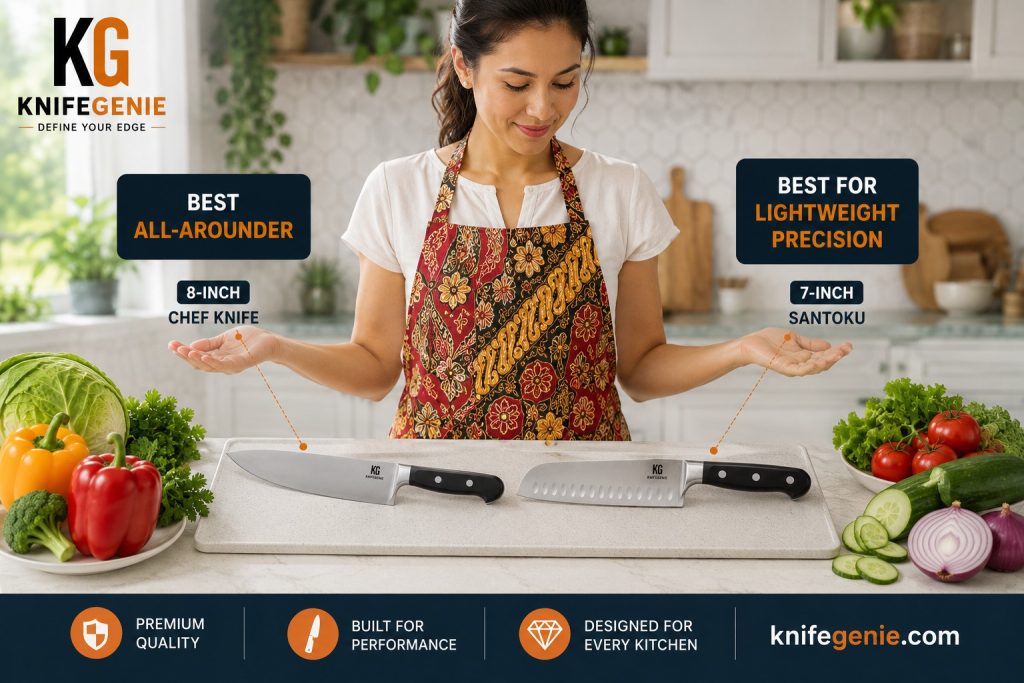
Start with an 8-inch chef knife.
🇯🇵 Buy a Santoku If…
✔ You prefer lightweight knives
✔ You mostly prepare vegetables
✔ You like push cuts and straight chopping
✔ You use a smaller cutting board
✔ You prefer shorter blades
✔ Precision matters more than maximum reach
✔ An 8-inch chef knife feels unnecessarily large
KnifeGenie Recommendation
Start with a 7-inch Santoku.
BUYING DECISION
🏆 KnifeGenie’s Final Scorecard
| Category | Winner |
|---|---|
| 🏆 Best Overall | 🔪 Chef Knife |
| 🥕 Vegetable Prep | 🇯🇵 Santoku |
| 🥩 Meat Preparation | 🔪 Chef Knife |
| 🐟 Boneless Fish | 🇯🇵 Santoku |
| 🌿 Rock-Mincing Herbs | 🔪 Chef Knife |
| 🧄 Small Precision Prep | 🇯🇵 Santoku |
| ✋ Maneuverability | 🇯🇵 Santoku |
| ⚖️ Lightweight Handling | 🇯🇵 Santoku |
| 📏 Large Ingredients | 🔪 Chef Knife |
| 🔄 Rocking Technique | 🔪 Chef Knife |
| ⬆️ Push Cutting | 🇯🇵 Santoku |
| 🏠 Small Kitchens | 🇯🇵 Santoku |
| 👨🍳 Beginner’s First Knife | 🔪 Chef Knife |
| ⚔️ Maximum Versatility | 🔪 Chef Knife |
🧙 KnifeGenie Final Verdict
🥇 OVERALL WINNER: 8-INCH CHEF KNIFE
This was closer than it might appear.
The Santoku actually wins several categories.
It’s lighter.
It’s exceptionally maneuverable.
It’s superb for vegetables.
And for a cook who prefers controlled push cuts instead of pronounced rocking cuts, it can feel better from the first slice.
But we’re answering a specific question:
Which is better for everyday cooking?
For the widest range of home cooks and the widest range of everyday foods, KnifeGenie gives the advantage to the 8-inch chef knife.
Its combination of blade length, pointed tip, curved cutting edge and broad versatility makes it extremely difficult to beat as the one knife you reach for every day.
🏆 KnifeGenie Winner
8-INCH CHEF KNIFE
Best for: Home cooks wanting one highly versatile kitchen workhorse.
🇯🇵 Santoku Runner-Up
7-INCH SANTOKU
Best for: Cooks wanting lighter handling, excellent vegetable performance and precise chopping.
The important thing is that there isn’t a bad choice here.
The better knife is the one whose size, weight and cutting style fit the way you actually cook.
❓ Frequently Asked Questions
Is a Santoku better than a chef knife?
Not universally. A Santoku is generally shorter, lighter and flatter-edged, making it particularly good for controlled chopping and vegetable preparation. A chef knife’s longer blade and curved belly make it more versatile for large ingredients, slicing and rocking cuts.
Can a Santoku do everything a chef knife can?
It can perform most everyday jobs a chef knife handles, including chopping vegetables, slicing boneless meat, preparing fish and mincing herbs. A chef knife nevertheless has an advantage with larger ingredients and pronounced rocking cuts.
What size Santoku is best?
For most home cooks, around 7 inches provides an excellent balance between maneuverability and usable cutting length.
- Wüsthof’s Santoku guide – useful supporting reference for Santoku shape, use and cutting technique.
What size chef knife is best?
For most home kitchens, 8 inches remains the KnifeGenie recommendation because it balances control, reach and versatility.
Is a Santoku good for cutting meat?
Yes. Santokus work very well on boneless meat and poultry. Avoid using fine-edged Santokus on bones, frozen foods or other extremely hard ingredients.
Why do some Santoku knives have dimples?
Those indentations are generally intended to reduce contact between food and the blade, helping some ingredients release more easily while slicing. They do not completely eliminate sticking.
Is a chef knife or Santoku better for vegetables?
KnifeGenie gives the Santoku a slight advantage for routine vegetable prep because its flatter edge, broad blade and nimble handling work extremely well for chopping and push cuts.
Which is better for small hands?
Many people with smaller hands find a 5.5–7-inch Santoku easier to maneuver than a large chef knife. However, handle shape and balance matter just as much as blade length.
Should a beginner buy a chef knife or Santoku?
KnifeGenie recommends starting with an 8-inch chef knife if it feels comfortable in your hand. If it feels too large or heavy, a 7-inch Santoku is an excellent alternative.
Do professional chefs use Santoku knives?
Yes. Santokus are serious multipurpose kitchen knives, not merely specialty vegetable knives. Professional and home cooks choose them according to their preferred technique and the food they’re preparing.
Should I own both?
You don’t need both, but they complement each other nicely. Use the chef knife when you want reach, rocking ability and maximum versatility, and the Santoku when you want compact, lightweight precision.
🔪 One Last KnifeGenie Tip
Don’t buy your next knife solely because someone tells you Japanese knives are sharper, German knives are tougher or professional chefs use a particular style.
Hold the knife if you can.
Use a proper pinch grip.
Think about the size of your cutting board.
Consider what you actually cook.
And pay attention to whether you naturally rock, chop, push or slice.
A knife that fits your cooking technique will usually serve you better than one that simply has the most impressive specifications.
For most people, that leads us back to the 8-inch chef knife.
For plenty of others, however, the Santoku will be the knife they reach for first.