
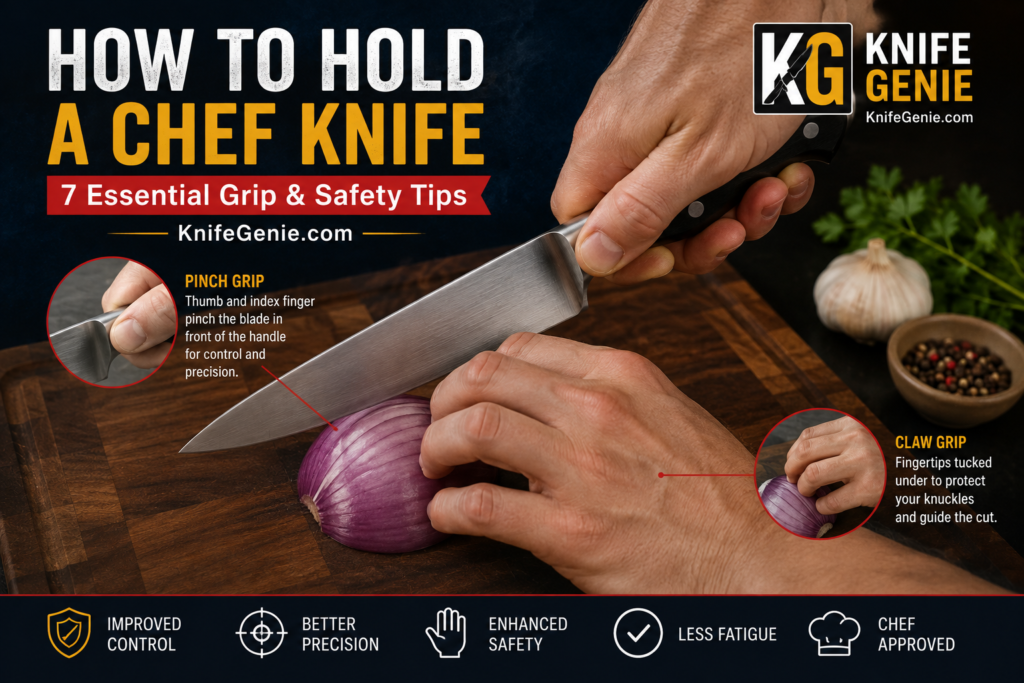
Learn how to hold a chef knife correctly using the pinch grip and claw grip. Discover 7 essential tips for better control, precision, comfort and kitchen safety.
If you’re wondering how to hold a chef knife, here’s the short answer:
👉 Use a relaxed pinch grip.
Instead of wrapping your entire hand around the handle, gently pinch the blade near the handle between your thumb and index finger, then wrap your remaining three fingers around the handle.
Your other hand matters just as much.
Use a claw grip with your fingertips curled safely away from the blade while your knuckles help guide the knife.
Sounds simple?
It is—but this one small change can give you noticeably better control over a chef’s knife.
If you’ve always held your knife like a hammer, the pinch grip may feel strange for the first few minutes. Give it a little time.
Once it clicks, you’ll probably wonder why you ever held a chef’s knife any other way.
🔽 In This Chef Knife Grip Guide
👉 How to Hold a Chef Knife: The Quick Answer
👉 Pinch Grip vs Handle Grip
👉 What Is the Pinch Grip?
👉 How to Hold a Chef Knife in 7 Easy Steps
👉 Why the Claw Grip Matters
👉 7 Common Chef Knife Grip Mistakes
👉 Rocking vs Push Cutting
👉 Chef Knife Brands & Grip Design
👉 KnifeGenie Pro Tips
👉 How to Hold a Chef Knife FAQ
👉 Final Cut: The Best Way to Hold a Chef Knife
🔪 How to Hold a Chef Knife: The Quick Answer
For most general chef-knife work, use a pinch grip.
Here’s what that means:
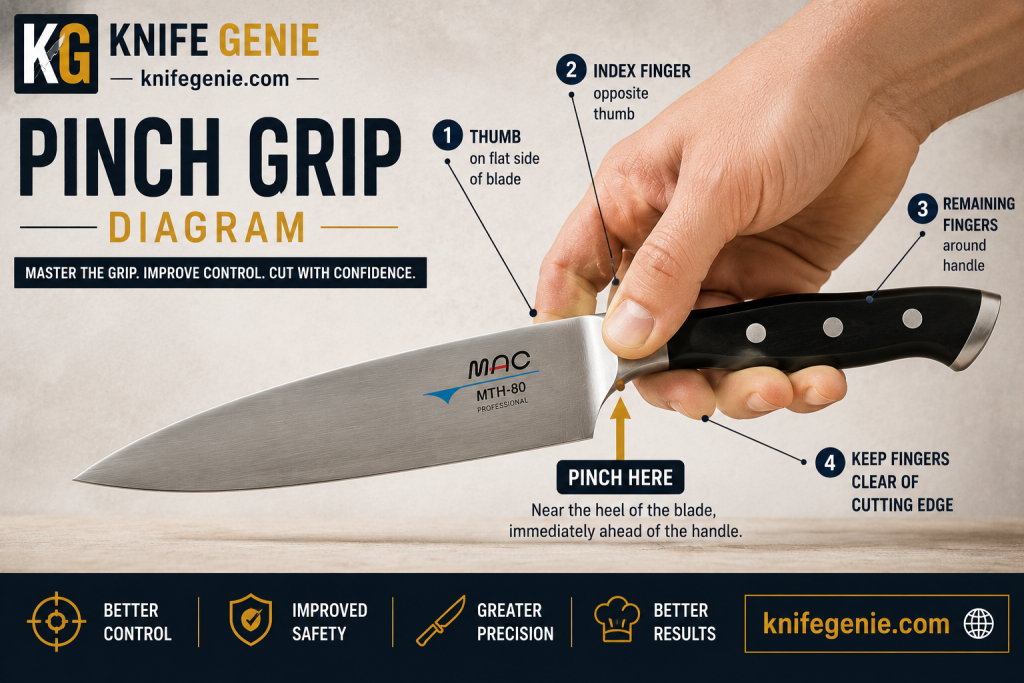
Thumb: against one flat side of the blade near the handle.
Index finger: on the opposite side of the blade.
Middle, ring and little fingers: comfortably around the handle.
Wrist: relaxed and reasonably straight.
Other hand: fingertips tucked inward in a claw position.
Wüsthof describes the pinch grip as the standard grip and recommends placing the dominant hand close to the bolster, with the thumb against the flat of the blade and the index finger providing counterbalance from the opposite side. It also cautions against squeezing excessively. (WÜSTHOF)
🏆 KnifeGenie Quick Rule
Pinch the blade.
Relax the handle hand.
Claw the food with the other hand.
Keep your fingertips away from the edge.
That’s the foundation.
PROPER CHEF KNIFE PINCH GRIP
Learn how to hold a chef knife correctly using the pinch grip and claw grip. Discover 7 essential tips for better control, precision, comfort and kitchen safety.
🆚 Pinch Grip vs Handle Grip
A chef knife has a handle.
So naturally, you’d think you’re supposed to hold only the handle.
That’s where many beginners start.
And it isn’t necessarily impossible to cut that way.
But for general chef-knife work, moving your hand slightly forward into a pinch grip usually gives you much better control of the blade.
| Feature | 🔪 Pinch Grip | ✋ Handle-Only Grip |
|---|---|---|
| Blade control | ⭐⭐⭐⭐⭐ | ⭐⭐⭐ |
| Precision | ⭐⭐⭐⭐⭐ | ⭐⭐⭐ |
| Balance | ⭐⭐⭐⭐⭐ | ⭐⭐⭐ |
| Fine chopping | Excellent | Acceptable |
| Learning curve | Takes practice | Immediately familiar |
| Hand position | Near blade/handle junction | Entirely on handle |
| Best choice for chef knife | 🏆 Yes | Situational |
Wüsthof specifically notes that completely wrapping the fingers and thumb around the handle can reduce precision and control compared with its recommended pinch grip. (WÜSTHOF)
🎯 KnifeGenie Verdict
For normal slicing, dicing and chopping with a chef knife:
Pinch grip wins.
🤏 What Is the Pinch Grip?
The name tells you exactly what to do.
You pinch the blade.
But not near the cutting edge.
Your thumb and index finger sit on the flat sides of the blade near the handle or bolster.
Think of that point as the knife’s control center.
Instead of controlling an 8-inch blade entirely from several inches behind it, you’re bringing your hand closer to the blade.
The remaining fingers then comfortably hold the handle.
Important
You’re not squeezing the blade between your fingers with all your strength.
You want:
Firm enough to control it.
Relaxed enough to move naturally.
Think controlled, not white-knuckle grip.
Pinch Grip Close-Up
✋ How to Hold a Chef Knife in 7 Easy Steps
1. Start With Your Dominant Hand
If you’re right-handed, your right hand normally holds the knife.
If you’re left-handed, use your left.
Place the knife flat on a stable cutting board before getting your grip organized.
Don’t practice by waving the knife in the air.
2. Move Your Hand Toward the Blade
Instead of holding the knife at the very back of the handle, move your hand forward.
You’re looking for the area where the blade meets the handle.
On some knives there will be a pronounced bolster.
On others—especially stamped chef knives—there may be little or no traditional bolster.
That’s fine.
The pinch grip still works.
3. Pinch the Blade
Place your thumb against one flat side of the blade close to the handle.
Place the side of your index finger on the opposite face.
Your fingers should remain well above the sharpened cutting edge.
Wüsthof’s current instructions similarly place the thumb on the blade near the bolster and allow the index finger to counterbalance on the other side according to the user’s hand anatomy. (WÜSTHOF)
4. Wrap Three Fingers Around the Handle
Your:
- Middle finger
- Ring finger
- Little finger
support the handle.
Don’t strangle it.
A common beginner mistake is gripping a knife much harder than necessary.
That creates tension in your hand and wrist.
Think:
Secure, not squeezed.
5. Keep Your Wrist Relaxed
Your hand, wrist and forearm should work together.
Avoid sharply bending the wrist sideways while chopping.
Wüsthof recommends keeping the wrist relaxed and in line with the forearm rather than bending or torquing it. (WÜSTHOF)
That relaxed alignment can also make repetitive prep work feel more natural.
6. Make a Claw With Your Other Hand
Now we get to the hand that isn’t holding the knife.
It’s just as important.
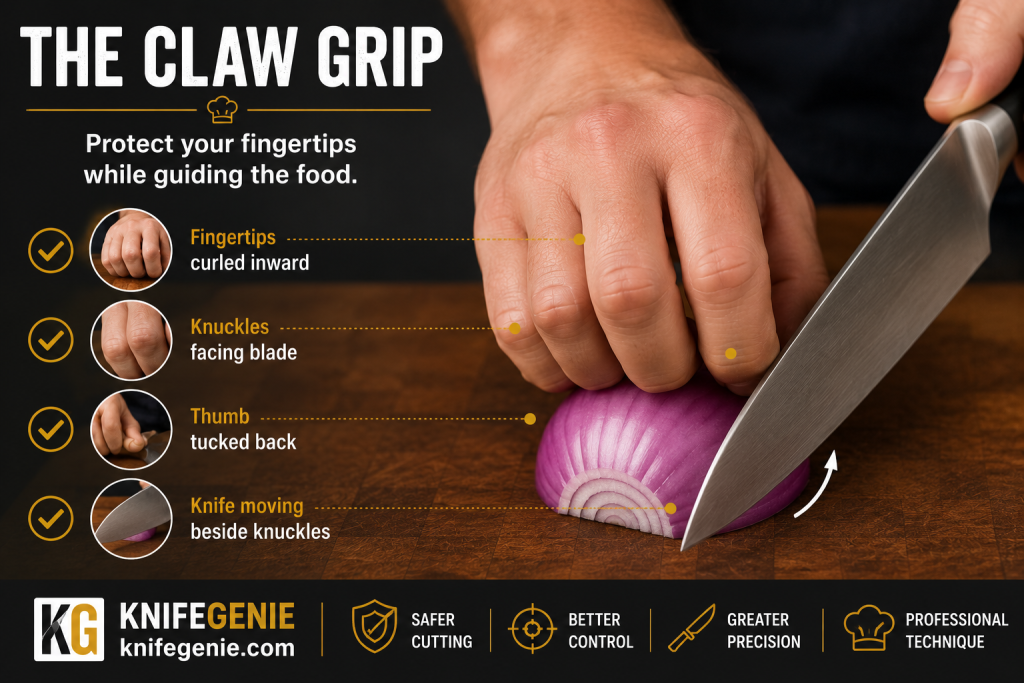
Curl the fingertips inward so they aren’t sticking out toward the cutting edge.
Your knuckles become the forward-most part of the hand.
The side of the knife can then work near those knuckles while the fingertips remain tucked back.
That’s commonly called the:
🦀 Claw Grip
Your non-knife hand becomes your guide hand.
7. Start Slowly
Speed is not the goal.
Control is.
Practice slowly on something stable and forgiving, such as:
🥔 A potato
🥕 A carrot
🥒 A cucumber
🧅 Half an onion placed flat-side down
Get comfortable with the movement first.
Speed comes naturally with repetition.
Trying to imitate a professional chef chopping at high speed before you’ve developed control is unnecessary—and unsafe.
Claw Grip Diagram
🦀 Why the Claw Grip Matters
Imagine you’re chopping an onion.
Without a claw grip, your fingertips may point directly toward the cutting edge.
Not ideal.
With the fingertips curled inward, your knuckles become the part of your hand nearest the knife.
Your guiding hand can then gradually move backward as you work through the ingredient.
The goal isn’t to press the knife hard against your knuckles.
Your knuckles simply provide a useful positional reference while your fingertips remain protected.
KnifeGenie Rule
Knife hand controls the blade.
Claw hand controls the food.
You need both.
❌ 7 Common Chef Knife Grip Mistakes
1. The Death Grip
You’re squeezing the handle like the knife is trying to escape.
Relax.
Too much tension can make your movements stiff and uncomfortable.
2. Holding Only the Very Back of the Handle
This gives you less direct control over the blade.
Move forward toward the blade-handle junction.
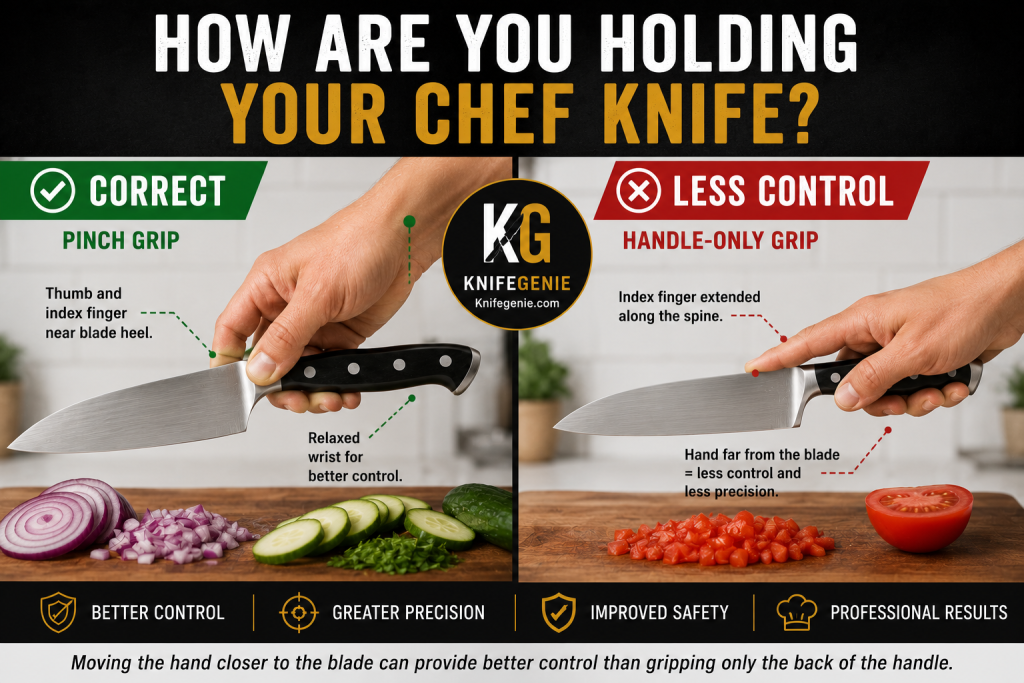
3. Putting Your Index Finger on Top of the Blade
You’ve probably seen people do this:
👉 Index finger stretched straight down the spine.
It feels precise.
But for routine chef-knife work, a pinch grip generally offers better lateral control.
Use your thumb and index finger on opposite sides of the blade instead.
4. Putting a Finger Too Close to the Edge
Pinch the flat portion of the blade.
Never wrap a finger underneath toward the sharpened edge.
5. Leaving Your Guide-Hand Fingers Flat
This places fingertips in the path of the knife.
Curl them back into the claw position.
6. Chopping Too Fast
Speed does not equal skill.
Control first.
Speed later.
7. Using a Dull Knife
A dull chef knife often requires more force to complete the same cut.
If your knife is struggling through foods it once handled easily, check the edge.
KnifeGenie covers exactly when honing or sharpening becomes necessary in our guide:
How Often Should You Sharpen Kitchen Knives?
Correct vs Incorrect Grip
🔪 Do All Chef Knives Use the Same Grip?
Not exactly.
The pinch grip works extremely well for many Western and Japanese-style chef knives, but knife shapes and handles vary.
You may be using a:
- German chef knife
- French chef knife
- Gyuto
- Santoku
- Chinese-style chef knife
- Compact 6-inch chef knife
- Large 10-inch chef knife
Your exact finger position may shift slightly depending on the knife and your hand size.
What shouldn’t change is the goal:
Control + comfort + safe finger placement
Don’t force your hand into an uncomfortable position merely because a diagram says your finger should be exactly 12 millimeters from the bolster.
Human hands aren’t identical.
👨🍳 Should Beginners Use the Pinch Grip?
Yes—assuming they can do so comfortably.
In fact, learning the pinch grip early means you don’t have to unlearn a less-efficient habit later.
But don’t expect it to feel completely natural immediately.
If you’ve spent years holding knives entirely by the handle, the pinch grip can feel strange.
Try it for several short prep sessions.
You’ll probably notice that the knife begins to feel less like something hanging off your hand and more like an extension of it.
🔄 Rocking vs Push Cutting
Your grip doesn’t exist in isolation.
The way you hold the knife should work with the cutting motion.
🌙 Rocking Motion
Many Western chef knives have enough belly curvature to support a rocking action.
The blade moves through the ingredient while part of the edge remains close to the board.
Useful for:
🌿 Herbs
🧅 Onions
🥕 Vegetables
➡️ Push Cutting
Push cutting moves the knife forward and downward through the ingredient.
It’s commonly used with many chef knives and flatter-profile Japanese blades.
The pinch grip works well here too because you have direct control near the blade.
KnifeGenie Tip
Don’t force your chef knife into one specific cutting style.
Let the knife’s geometry help determine which motion feels natural.
🪵 Your Cutting Board Matters Too
You can learn the perfect grip and still create an unsafe cutting setup if your board is sliding all over the counter.
The cutting board should be:
Stable.
Flat.
Large enough for the job.
If necessary, stabilize an appropriate board using a damp kitchen towel or other non-slip method underneath it.
Avoid routinely cutting directly on extremely hard surfaces such as glass, stone or ceramic.
They can also be rough on knife edges.
If your chef knife has begun struggling even though your technique is correct, check our guide:
How Often Should You Sharpen Kitchen Knives?
🔪 Chef Knife Brands That Demonstrate Good Grip Design
You don’t need a particular brand to learn the pinch grip.
But different chef-knife designs demonstrate how blade shape, handle texture, bolster design and weight can change how the grip feels.
Here are four useful examples:
🥇 Wüsthof — Traditional Forged Chef Knife Feel
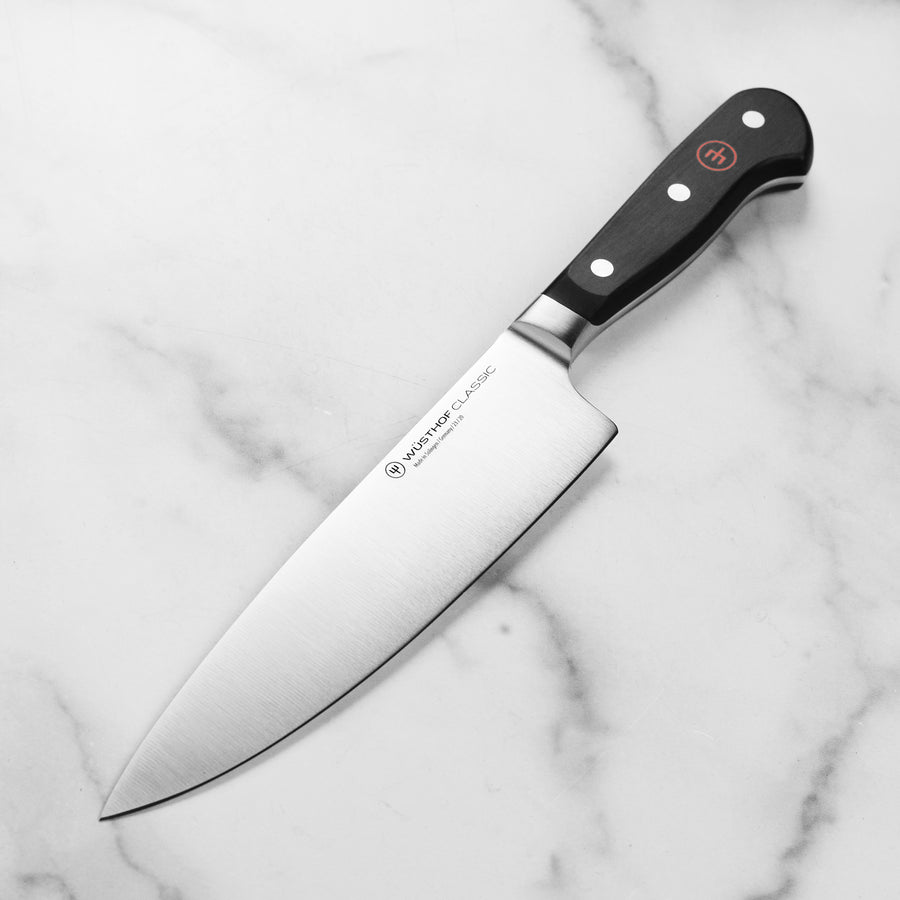
Wüsthof is particularly relevant to this guide because the company currently teaches the pinch grip directly in its knife-skills material.
Its advice emphasizes controlling the knife near the bolster, using the thumb and index finger for stability and keeping the wrist relaxed. (WÜSTHOF)
Wüsthof Chef Knife Grip Pros
✔ Pronounced blade/handle transition on many models
✔ Traditional chef-knife proportions
✔ Pinch grip works naturally with many models
✔ Manufacturer provides specific grip instruction
✔ Good reference point for learning Western chef-knife technique
Cons
✘ Forged models can feel heavier than lightweight stamped knives
✘ A large bolster may feel different if you’re accustomed to bolsterless Japanese knives
✘ Premium models can be expensive if you’re only learning knife technique
Best For
🏆 Cooks who like traditional German chef-knife balance and a substantial feel.
Visit the Wüsthof official website
🥈 Victorinox — Lightweight and Practical

Victorinox chef knives—particularly the well-known Fibrox style—offer a noticeably more utilitarian approach.
The relatively lightweight construction can make them approachable for cooks who don’t want a heavy forged knife.
The important point here is that the pinch grip doesn’t depend on having a large traditional bolster.
You can pinch the blade immediately forward of the handle.
Victorinox Pros
✔ Lightweight feel
✔ Practical handle designs
✔ Easy to maneuver
✔ Good platform for learning general chef-knife technique
✔ Less intimidating than some heavier forged knives
Cons
✘ Utilitarian appearance
✘ Lighter construction won’t appeal to cooks who prefer substantial weight
✘ Handle shape feels different from traditional triple-riveted knives
Best For
🏆 Home cooks who prefer a lightweight, functional chef knife.
Visit the Victorinox official website
🥉 Mercer Culinary — Grip-Focused Handle Design
Mercer’s current 8-inch Millennia chef knife uses a Santoprene/polypropylene handle with textured finger points and a protective finger guard. Mercer specifically describes these features as improving grip, comfort and safety. The current model uses stamped construction and an 8-inch high-carbon Japanese-steel blade. (Mercer Culinary)

Mercer Millennia Pros
✔ Textured handle
✔ Slip-resistant finger points
✔ Protective finger guard
✔ Lightweight stamped construction
✔ Practical design for high-volume prep
Cons
✘ Less traditional appearance
✘ Finger guard and handle geometry may influence where different users find the most comfortable pinch point
✘ Doesn’t have the forged feel some cooks prefer
Best For
🏆 Cooks prioritizing practical grip texture and straightforward ergonomics.
Visit the Mercer Culinary official website
⭐ Zwilling — Classic Western Chef Knife Option
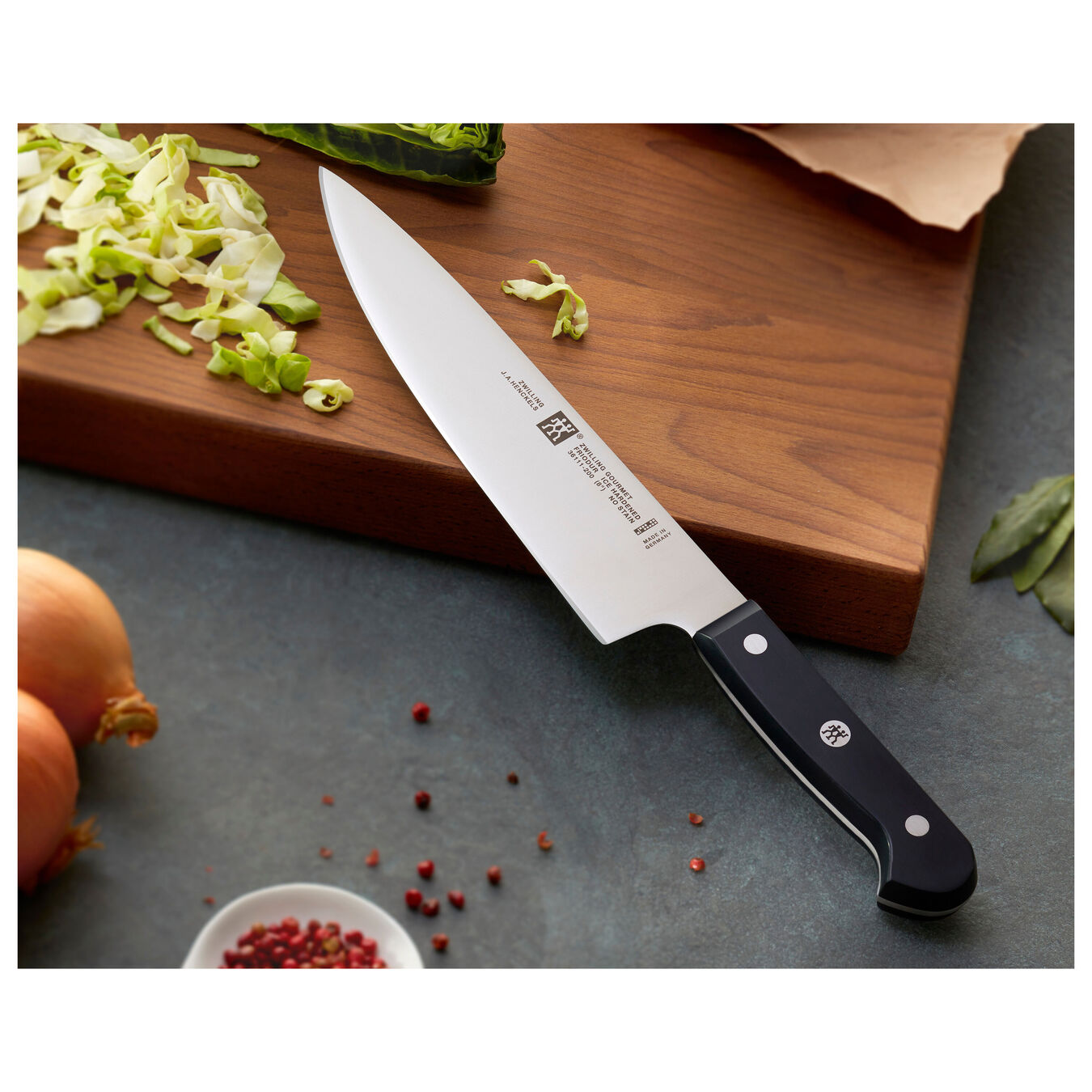
Zwilling produces a broad range of Western-style chef knives, from stamped models to more substantial forged designs.
A traditional 8-inch Zwilling chef knife gives you enough blade height near the heel to practice the pinch grip while keeping the other three fingers around the handle.
Zwilling Pros
✔ Wide range of chef-knife styles
✔ Forged and lighter-weight options available
✔ Familiar Western chef-knife geometry
✔ Multiple handle shapes
Cons
✘ Grip feel varies considerably between product lines
✘ Heavier forged knives aren’t everyone’s preference
✘ You should choose by the individual knife rather than by brand alone
Best For
🏆 Cooks who want plenty of choices in weight, handle style and construction.
Visit the Zwilling official website
🖐️ What If You Have Small Hands?
You don’t necessarily need a completely different grip.
But you may benefit from a smaller chef knife.
If an 8-inch knife feels unwieldy, try a:
6-inch chef knife
or possibly a:
7-inch chef knife
The important thing is whether you can comfortably:
✔ Pinch the blade
✔ Wrap your remaining fingers around the handle
✔ Keep your wrist relaxed
✔ Control the tip
✔ Guide the knife without excessive effort
Don’t buy a 10-inch knife simply because you saw a professional chef using one.
The knife should fit your hand and your kitchen.
🤲 What If You Have Large Hands?
The reverse applies.
A tiny handle can feel cramped.
You may prefer an 8- or 10-inch chef knife with more handle room and blade clearance.
Again, there’s no prize for owning the biggest knife.
Comfort and control matter more.
🥕 How Should You Hold a Chef Knife When Chopping Vegetables?
Use the same basic setup:
Knife hand: pinch grip.
Food hand: claw grip.
Then work gradually through the ingredient.
For something round like an onion, potato or carrot, first create a stable surface when appropriate rather than trying to control food that’s rolling underneath the knife.
Stability is one of the easiest ways to make knife work more predictable.
🍗 Can You Use the Same Grip for Cutting Meat?
For ordinary slicing and trimming with a chef knife, the pinch grip still works well.
But a chef knife isn’t the best choice for every meat-preparation task.
If you’re working closely around:
🦴 Bones
🐔 Poultry joints
🥩 Silverskin
🐖 Irregular meat contours
a dedicated boning knife can give you better access and precision.
Read KnifeGenie’s:
Best Boning Knife for Home Butchers
And if you’re unsure whether you need a boning knife or a flexible fillet knife:
Boning Knife vs Fillet Knife: Which One Do You Need?
Those articles fit naturally with this guide because good knife control starts with choosing the correct knife for the job. KnifeGenie’s current boning guide emphasizes precision, flexibility and control around bone, while its boning-vs-fillet guide explains how specialized blade shape changes the task. (KnifeGenie.com)
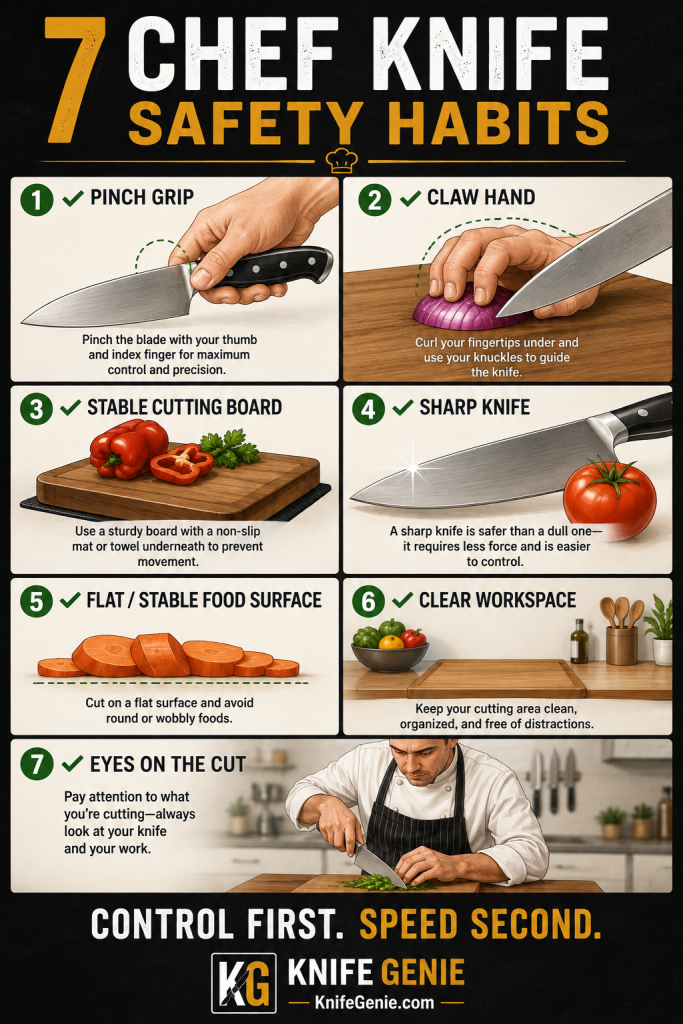
⚠️ Is the Pinch Grip Safer?
Don’t interpret the pinch grip as magically making knives safe.
A sharp chef knife can cause serious injury regardless of how well you hold it.
What the pinch grip can give you is greater blade control.
Good knife safety still means:
- Keep fingertips away from the cutting path.
- Stabilize the food before cutting.
- Use a stable cutting board.
- Keep your workspace uncluttered.
- Don’t try to catch a falling knife.
- Cut away from yourself where appropriate.
- Pay attention to what you’re doing.
- Keep the knife appropriately sharp.
- Use the correct knife for the task.
The safest grip is one you can maintain comfortably and predictably.
Knife Safety Infographic
🧠 KnifeGenie Pro Tips
🔪 Pinch, Don’t Crush
You need control—not maximum grip strength.
🦀 Learn the Claw at the Same Time
Learning only the knife hand is half the job.
🐢 Slow Down
If you’re learning, deliberately cut slowly.
Accuracy is more important than speed.
🪵 Stabilize Your Board
A good grip won’t compensate for a cutting board sliding across the countertop.
🍅 Practice on Easy Ingredients
Don’t learn your grip while breaking down an awkward whole chicken.
Start with vegetables.
🔧 Keep Your Knife Sharp
If you need excessive pressure, the knife may need maintenance.
Read:
How Often Should You Sharpen Kitchen Knives?
✋ Adjust for Your Hand
The exact contact point can vary slightly according to your hand anatomy and the knife’s design. Even Wüsthof notes that where the index finger naturally rests can vary between users. (WÜSTHOF)
🎯 Perfect For
This guide is especially useful for:
✔ Beginner home cooks
✔ New chef-knife owners
✔ Anyone transitioning from a handle grip
✔ Culinary students
✔ Home cooks learning better knife skills
✔ People who feel their chef knife is difficult to control
✔ Anyone trying to improve chopping and slicing technique
❓ How to Hold a Chef Knife FAQ
What Is the Proper Way to Hold a Chef Knife?
For most general chef-knife work, use a pinch grip.
Place your thumb and index finger on opposite flat sides of the blade near the handle, then wrap the other three fingers comfortably around the handle.
Your grip should feel secure but relaxed.
Should You Hold a Chef Knife by the Handle?
Partly.
Your middle, ring and little fingers hold the handle, but with the pinch grip your thumb and index finger move forward onto the blade.
Holding only the handle can work, but the pinch grip generally gives you more direct control over the chef knife.
Where Do You Pinch a Chef Knife?
Pinch the flat sides of the blade near the handle or bolster.
Keep both fingers well away from the cutting edge.
Should Your Index Finger Go on Top of a Chef Knife?
For routine chef-knife work, extending the index finger along the top of the blade isn’t generally the preferred grip.
A pinch grip places the thumb and index finger on opposite sides of the blade, giving you more control from near the blade’s heel.
How Hard Should You Grip a Chef Knife?
Firm enough that the knife remains secure.
But don’t squeeze unnecessarily.
Your hand and wrist should remain relatively relaxed.
Wüsthof similarly advises a comfortable but firm grip without squeezing too tightly. (WÜSTHOF)
What Is the Claw Grip?
The claw grip is the position used by the hand holding the food.
Curl the fingertips inward and keep them behind the knuckles.
This helps keep your fingertips away from the path of the blade while the hand guides the ingredient.
Should the Knife Touch Your Knuckles?
During some chopping techniques, the side of the blade may work alongside the forward knuckles of the guiding hand.
The goal isn’t to press or scrape aggressively against your fingers.
The knuckles provide a positional guide while the fingertips remain curled safely back.
Is the Pinch Grip Uncomfortable at First?
It can be.
If you’ve spent years gripping chef knives entirely by the handle, the pinch grip may initially feel unnatural.
Practice slowly for several cooking sessions before deciding whether it works for you.
Can Left-Handed Cooks Use a Pinch Grip?
Yes.
Simply use your dominant left hand as the knife hand and your right hand as the guiding claw hand.
Most ordinary double-bevel Western chef knives can be used from either side.
Does Chef Knife Size Affect Your Grip?
Yes.
The basic pinch-grip principle stays the same, but handle size, blade height, bolster design, balance and overall knife length can affect comfort.
A 6-inch knife may feel more controllable to some cooks, while others prefer an 8- or 10-inch blade.
Can I Use a Pinch Grip on a Japanese Chef Knife?
Generally, yes.
Many gyuto and similar Japanese chef knives work well with a pinch grip.
Because handle and blade geometry can differ considerably from Western knives, the exact finger position may feel slightly different.
Does a Sharp Knife Make the Grip More Important?
Good grip is important regardless of sharpness.
A sharp knife should cut with less unnecessary force, while a dull knife may tempt you to push harder.
If your chef knife has become noticeably harder to use, see:
How Often Should You Sharpen Kitchen Knives?
🔪 Keep Learning With KnifeGenie
Once you’ve learned how to hold a chef knife, the next step is understanding how to maintain it and when another knife is better suited to the job.
For knife maintenance:
How Often Should You Sharpen Kitchen Knives?
For meat preparation:
Best Boning Knife for Home Butchers
For choosing between two similar specialty knives:
Boning Knife vs Fillet Knife: Which One Do You Need?
Or browse more knife guides at:
🏁 Final Cut: What’s the Best Way to Hold a Chef Knife?
So, how should you hold a chef knife?
For most everyday chef-knife work:
🏆 KnifeGenie Verdict
Knife hand:
🔪 Use the pinch grip.
Thumb and index finger:
🤏 Control opposite sides of the blade near the handle.
Remaining fingers:
✋ Wrap comfortably around the handle.
Guide hand:
🦀 Use the claw grip.
Wrist:
➡️ Keep it relaxed and naturally aligned.
Cutting speed:
🐢 Start slowly.
The biggest mistake beginners make isn’t failing to chop fast enough.
It’s trying to go fast before they have control.
Learn the grip.
Learn the claw.
Keep the cutting board stable.
Use a properly maintained knife.
Then allow speed to develop naturally.
Once the pinch grip becomes comfortable, a chef knife starts feeling less like a large blade you’re trying to control from the handle—and more like an extension of your hand.
Control first. Speed second.
Sharp knives. Smart choices.
— KnifeGenie