

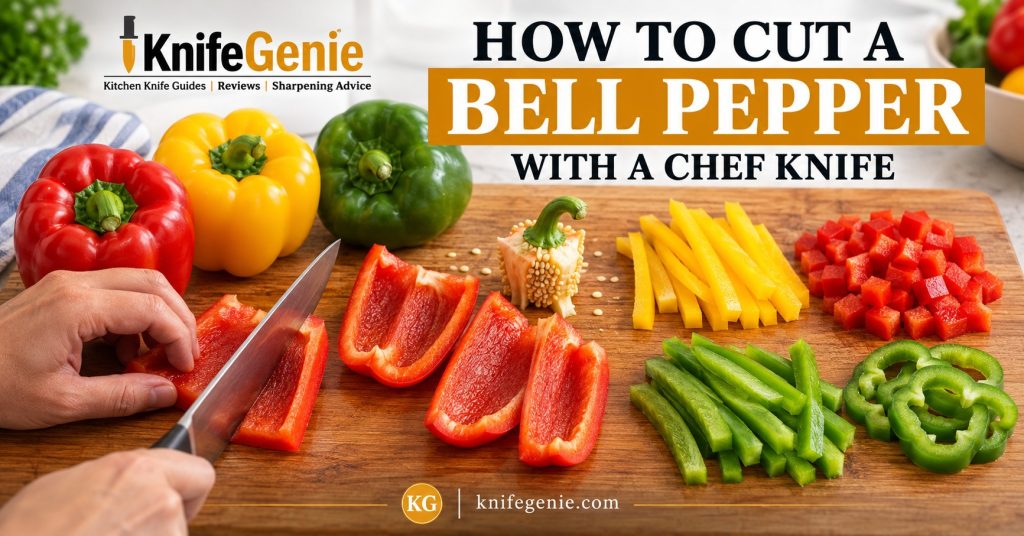
Bell peppers are among the most useful vegetables to prepare with a chef knife. They add color, crunch, and sweetness to salads, stir-fries, fajitas, soups, and countless other dishes. This guide will show you how to cut a bell pepper with a chef knife.
With their rounded shape, hollow center, slippery seeds, and uneven walls, they can be awkward to cut—especially when you’re still developing your knife skills.
The good news? Once you know how to remove the core and turn a bell pepper into flat, manageable pieces, cutting it becomes much easier.
You don’t need a special vegetable knife, complicated technique, or years of cooking experience. A sharp chef knife, a stable cutting board, and a few controlled movements will do the job.
This KnifeGenie guide explains how to prepare a bell pepper safely, remove the seeds and core, cut even strips, and make neat, consistent dice.
You’ll also learn how to use your guiding hand safely and avoid the mistakes that make pepper preparation unnecessarily difficult.
KnifeGenie editorial note: This instructional guide is based on established kitchen knife techniques and food-preparation safety principles. It is not presented as a record of personal testing or hands-on evaluation of any particular knife.
🔽 Jump to What You Need
👉 Quick Answer
👉 Prepare Your Bell Pepper
👉 Remove the Core and Seeds
👉 Create Flat Pepper Panels
👉 Cut Strips and Dice
👉 Use a Safe Claw Grip
👉 Common Mistakes and Safety Tips
👉 Frequently Asked Questions
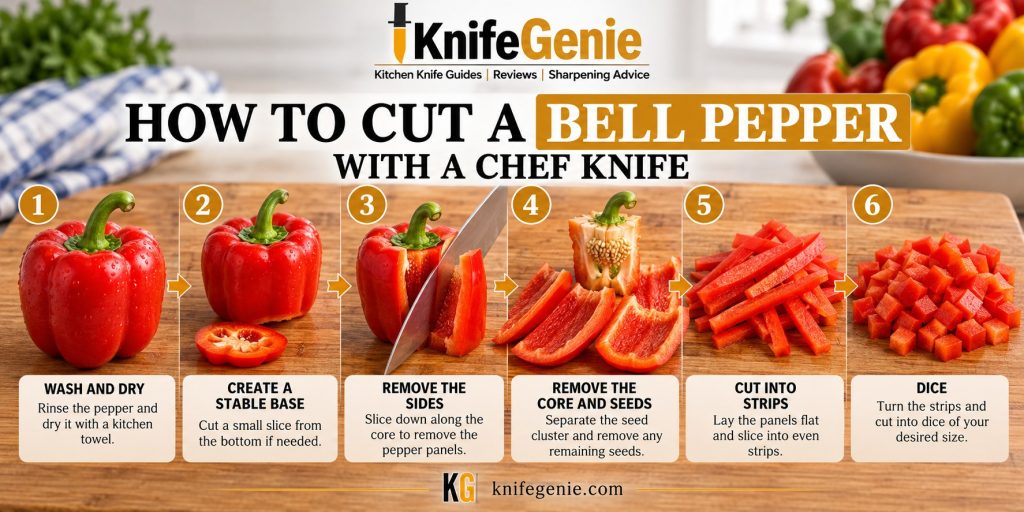
🏆 How to Cut a Bell Pepper: The Quick Answer
The easiest way to cut a bell pepper with a chef knife is to remove its sides in panels, leaving the stem, core, and most of the seeds behind.
Follow these six steps:
- 🧼 Wash the pepper under running water and dry it.
- 🔪 Place it securely on a cutting board and cut off the bottom if needed to create a stable base.
- 🫑 Stand the pepper upright and slice down along its sides, working around the central core.
- ✋ Remove any remaining seeds and white membrane from the panels.
- ➡️ Lay each panel flat, skin-side down, and cut it into strips.
- 🎯 Turn the strips across your cutting direction and cut them into dice if needed.
🧙 KnifeGenie Quick Tip: The secret is creating flat, stable pieces before making smaller cuts. A flat pepper panel is easier to control than an entire rounded pepper.
This approach works with red, yellow, orange, and green bell peppers.
BELL PEPPER CUTTING OVERVIEW
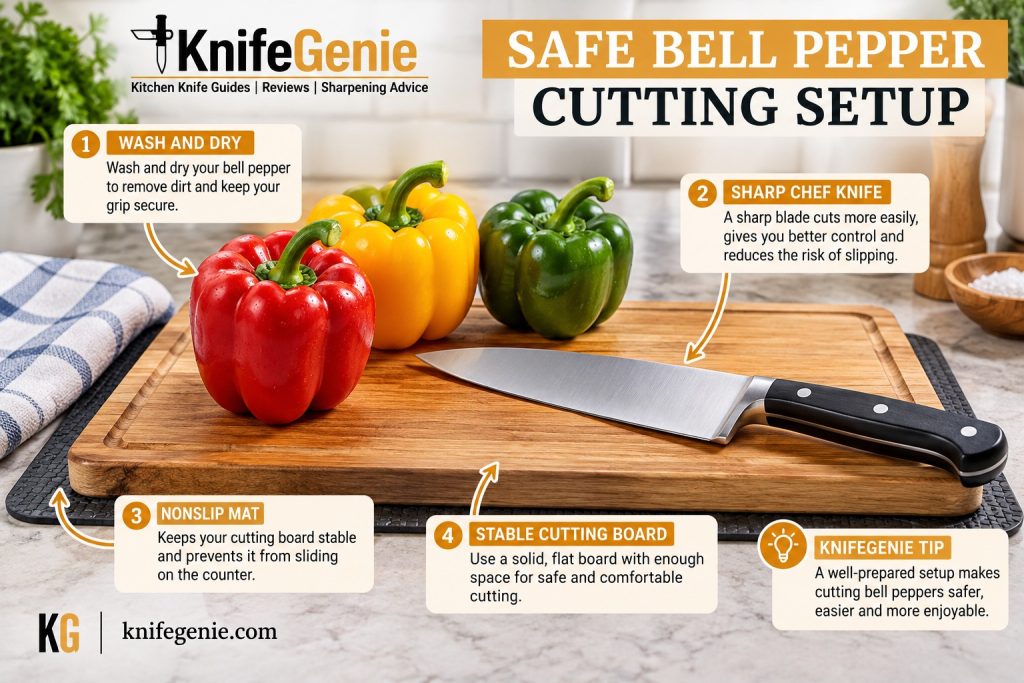
🧼 Prepare Your Bell Pepper Before Cutting
Good knife work begins before the blade touches the vegetable.
Bell peppers have smooth, sometimes slippery skin, and their shape can make them roll or shift on the cutting board.
A little preparation makes a noticeable difference.
1. Wash and Dry the Pepper
Rinse the whole pepper thoroughly under cool running water, rubbing the surface gently to remove visible dirt.
Do not use soap or household cleaning products.
Dry the pepper with a clean kitchen towel or paper towel.
Why dry it?
A wet pepper can be harder to grip, and moisture on the cutting board may make the work area less secure.
Remember the FDA — Selecting and Serving Produce Safely: Supports washing bell peppers under running water, drying them with a clean towel, and avoiding soap or produce detergents.
2. Set Up a Stable Cutting Board
Choose a board large enough to hold the pepper and your knife comfortably.
If it moves across the counter, place a damp towel or nonslip mat beneath it.
The board should stay firmly in place while you work.
3. Choose a Suitable Chef Knife
An ordinary 8-inch chef knife is a practical choice for most home cooks.
Its blade is long enough to slice through a pepper panel without excessive sawing, while its handle provides good control.
A smaller chef knife can work equally well if it suits your hands.
What matters most is a sharp, well-maintained cutting edge.
If you’re new to handling this type of knife, begin with KnifeGenie’s How to Use a Chef Knife guide.
🧙 KnifeGenie Tip: You should not need to force a sharp knife through a bell pepper. Use controlled slicing movements rather than pressing aggressively downward.
SETTING UP BELL PEPPER FOR CUTTING
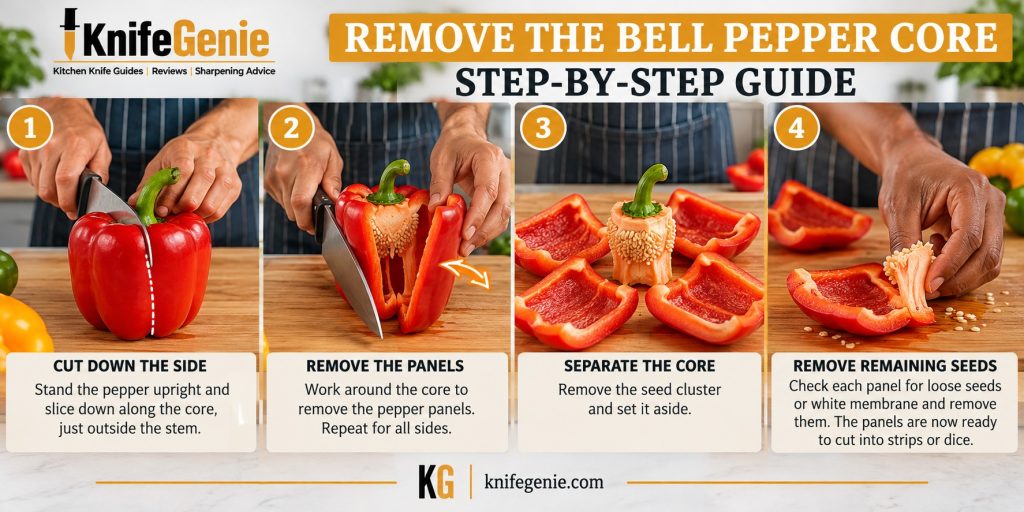
🔪 How to Remove the Core and Seeds From a Bell Pepper
There are several ways to core a bell pepper, but cutting around the central core is particularly useful when your goal is to make strips or dice.
Instead of opening the pepper and pulling everything apart, you can remove its usable sides in controlled sections.
Step 1: Create a Stable Base
Place the pepper on its side.
If its bottom is uneven, carefully cut off a thin slice to create a flat base.
You only need to remove enough to help the pepper stand securely.
Keep that bottom slice—it can also be trimmed and diced.
Step 2: Stand the Pepper Upright
Place the pepper on its flat base, with the stem pointing upward.
Keep your guiding hand well away from the cutting path.
The aim is to work down the outside of the pepper without cutting directly through the hard stem.
Step 3: Slice Down Along the Core
Position the blade just outside the central core.
Cut downward to remove one side of the pepper.
Turn the pepper and repeat, working around the stem and seed cluster.
Depending on its shape, you’ll usually obtain three or four broad panels, sometimes more.
Step 4: Remove the Remaining Seeds
Set the central core aside.
Check the pepper panels for loose seeds or attached white membrane.
Remove them with your fingers or carefully trim them away with the knife while the pieces rest securely on the board.
Avoid scraping seeds away with the sharp edge toward your hand.
Step 5: Save the Usable Trimmings
Some peppers have useful flesh around the bottom or near the stem.
Trim these sections carefully rather than discarding them automatically.
They can be added to soups, sauces, omelets, or vegetable mixtures.
🧙 KnifeGenie Tip: Don’t try to remove every seed with the blade. Once the core is separated, many loose seeds can simply be shaken or brushed away.
HOW TO REMOVE THE BELL PEPPER CORE LIKE A PRO
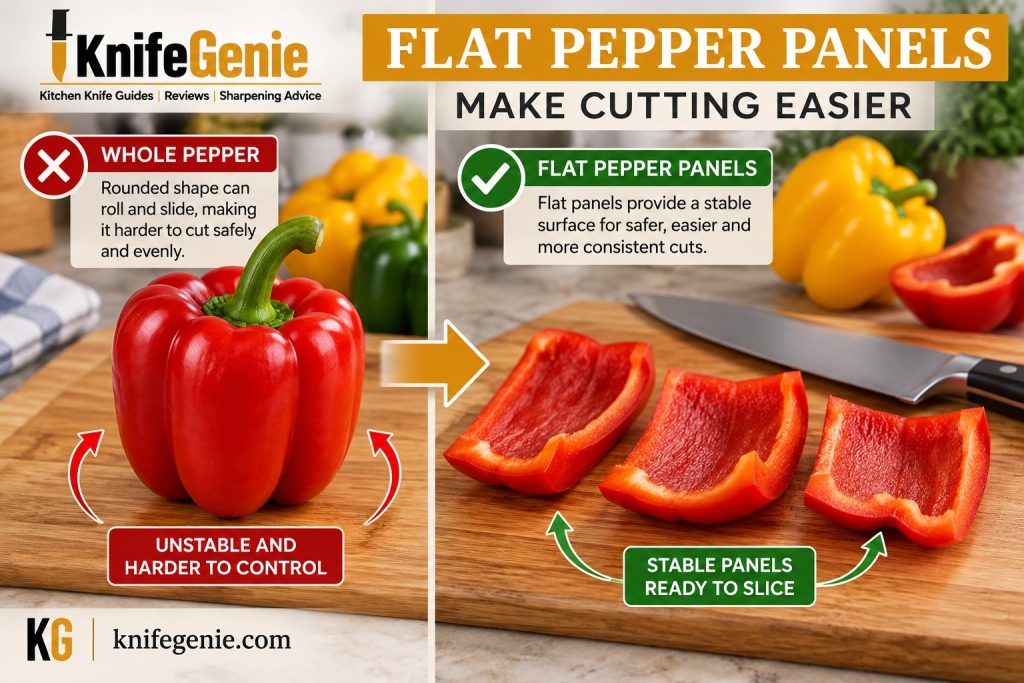
🫑 Why Flat Pepper Panels Make Cutting Easier
This is the most important principle in the entire lesson.
A whole bell pepper is rounded, hollow, and uneven.
A separated pepper panel is relatively flat and can rest securely on the board.
That difference makes smaller cuts much more manageable.
Place the Skin Against the Cutting Board
After removing the core, place a pepper panel with its shiny outer skin facing down and its inner flesh facing up.
This position generally gives the knife a more accessible starting surface.
Bell pepper skin can be surprisingly resistant to a dull blade. Starting from the flesh side often makes the cut easier.
Flatten the panel gently if necessary, but don’t force it completely flat or place your hand beneath the knife.
Trim Thick Ribs When Necessary
Some peppers have thick white ribs attached to the inside.
These are edible, but they may create uneven strips or dice.
For more consistent cuts, trim away the thickest portions while the panel lies flat.
You don’t need to remove every trace of white membrane.
Keep the Panels Manageable
Large pepper panels can be cut into smaller sections before slicing.
This is especially helpful for beginners.
A smaller piece is easier to position, hold, and cut consistently.
The basic sequence is:
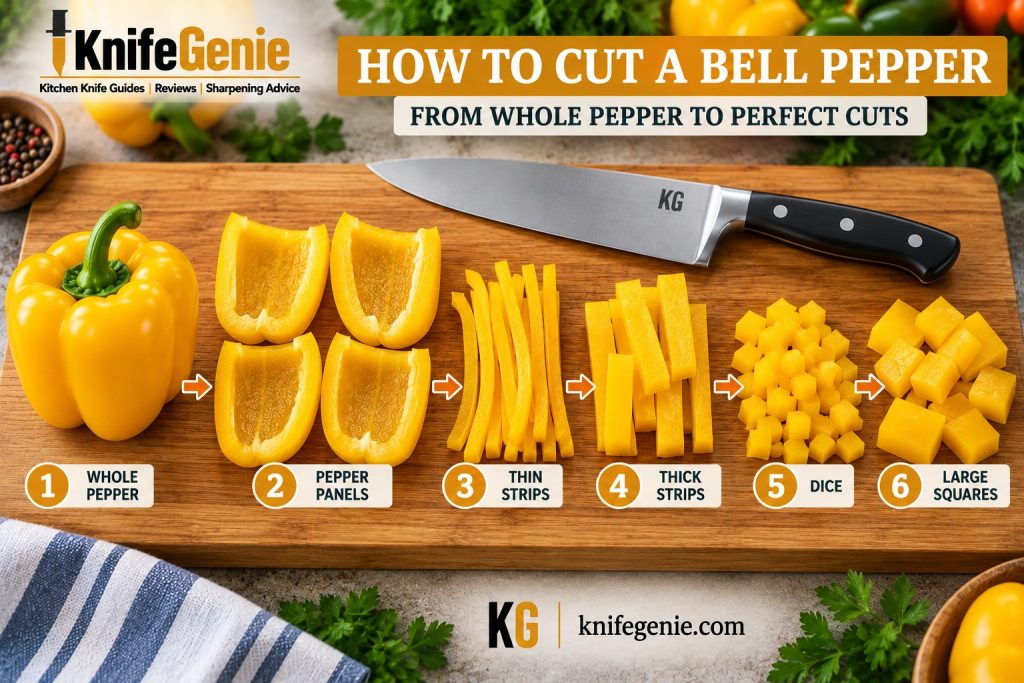
Whole pepper → Flat panels → Strips → Dice
FLAT PEPPER PANELS FOR CUTTING
🎯 How to Cut Bell Pepper Strips and Dice
Once the pepper has been separated into panels, you can prepare several useful cuts.
The same basic method works for most recipes. What changes is the width and spacing of your knife cuts.
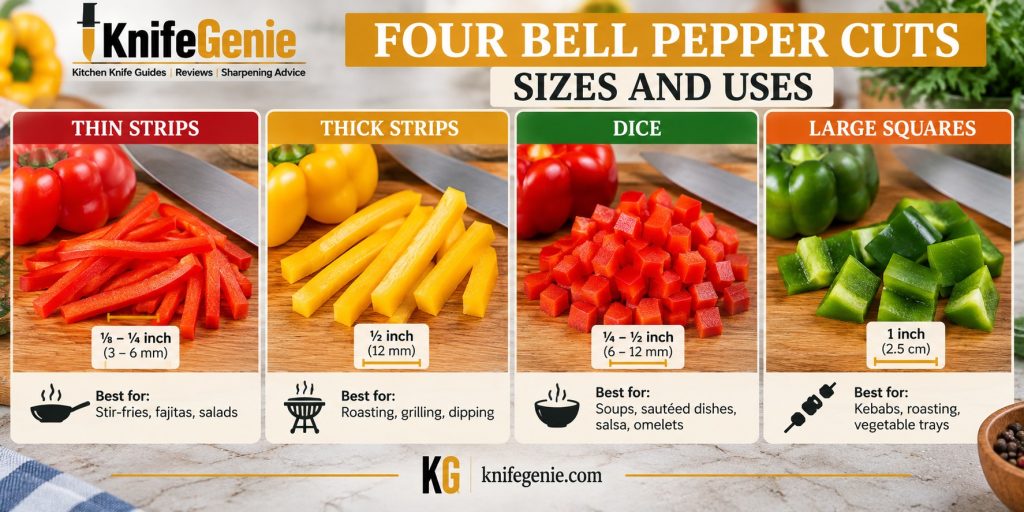
1. Cut Thin Bell Pepper Strips
Thin strips are useful for fajitas, stir-fries, sandwiches, and salads.
Method:
- Lay a pepper panel skin-side down.
- Position it so you can cut comfortably across its width.
- Curl your guiding fingers into a safe claw position.
- Slice through the panel using a controlled forward-and-down movement.
- Repeat at regular intervals.
For thin strips, aim for approximately ⅛–¼ inch (3–6 mm), depending on the recipe.
You don’t need perfect measurements. Consistency matters more than achieving an exact width.
2. Cut Thick Bell Pepper Strips
Thicker strips work well for roasting, grilling, dipping, and recipes where the pepper should retain more texture.
Use the same cutting method, but increase the spacing between cuts.
A width of approximately ½ inch (12 mm) is a useful starting point.
For grilling or roasting, larger pieces may be preferable.
3. Cut Diced Bell Pepper
Dicing simply means cutting the pepper into relatively small pieces.
Start by making strips.
Then:
- Gather a few strips into a neat, stable arrangement.
- Align their ends without forcing them into a tall stack.
- Hold them with a claw grip.
- Cut across the strips at regular intervals.
- Continue until you have pieces of the desired size.
For everyday cooking, approximately ¼–½ inch (6–12 mm) dice are suitable for many recipes.
Smaller dice are useful for salsa, omelets, and finely chopped vegetable mixtures.
Larger dice work well in soups, stews, and sautéed dishes.
4. Cut Bell Pepper Squares
For kebabs, roasting, or vegetable trays, you may want broad square pieces rather than small dice.
Cut the panels into wide strips, then cut across those strips to form squares.
Aim for pieces around 1 inch (2.5 cm), adjusting to your recipe.
These larger pieces are easier to thread onto skewers and less likely to become overly soft during cooking.
🫑 Bell Pepper Cutting Size Guide
| Cut | Approximate size | Common uses |
|---|---|---|
| Thin strips | ⅛–¼ inch | Stir-fries, fajitas, salads |
| Thick strips | ½ inch | Roasting, dipping |
| Small dice | ¼ inch | Salsa, omelets |
| Medium dice | ½ inch | Soups, sautéed vegetables |
| Large squares | 1 inch | Kebabs, roasting |
These sizes are practical guidelines rather than strict culinary rules.
4 DIFFERENT BELL PEPPER CUTS
✋ Use a Safe Claw Grip When Cutting Bell Peppers
A sharp knife is only part of safe vegetable preparation.
Your guiding hand is equally important.
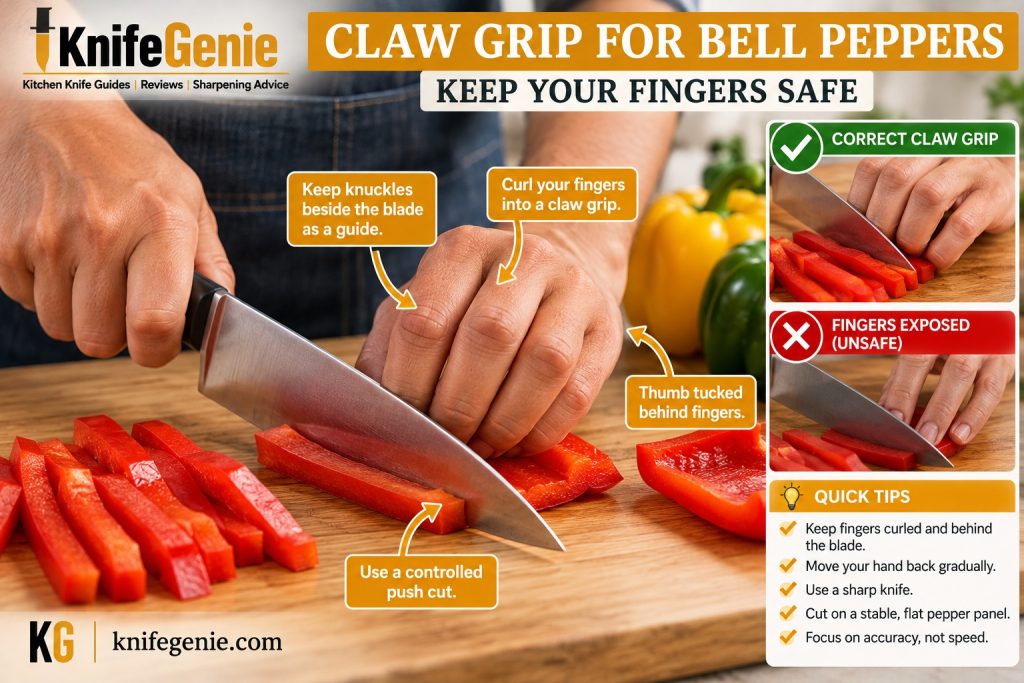
The claw grip helps keep your fingertips away from the blade while allowing you to control the food.
This guide by the American Heart Association — Knife Skills 101 supports using a sharp chef knife, maintaining control, and developing basic cutting techniques.
How to Position Your Guiding Hand
Curl your fingertips inward toward your palm.
Rest the curled fingers lightly on the pepper panel or strips.
Keep your thumb tucked safely behind your fingers.
Your knuckles can provide a reference for the side of the blade, but they should never be pushed into its cutting edge.
Move your guiding hand backward gradually as you work.
The knife should travel in a controlled path while your guiding fingers remain curled and clear of the edge.
For a detailed explanation, see How to Use the Claw Grip With a Chef Knife.
Don’t Rush the Final Cuts
As the remaining pepper piece becomes smaller, it can be difficult to maintain a comfortable claw grip.
Slow down.
If the piece becomes too small to hold safely, reposition it or stop rather than trying to cut every last fragment.
The goal is not to produce the maximum number of pieces in the shortest possible time.
It’s to maintain control throughout the process.
Which Cutting Motion Works Best?
For bell pepper panels, a gentle forward-and-down slicing motion is often effective.
A controlled push cut helps the blade pass through the flesh and skin without excessive pressure.
A rocking motion can also work with suitable blade geometry, particularly when chopping smaller pieces.
However, large exaggerated rocking movements are unnecessary for most pepper preparation.
KnifeGenie explains the differences in Rock Chop vs Push Cut.
🧙 KnifeGenie Tip: When cutting pepper strips, move the guiding hand only after the knife has completed its cut and is safely clear of your fingers. Accuracy comes before speed.
USING CLAW GRIP FOR BELL PEPPERS PREPARATION
⚠️ Common Bell Pepper Cutting Mistakes and Safety Tips
Bell peppers are relatively soft vegetables, but their shape and smooth skin can create avoidable problems.
Here are the mistakes worth watching for.
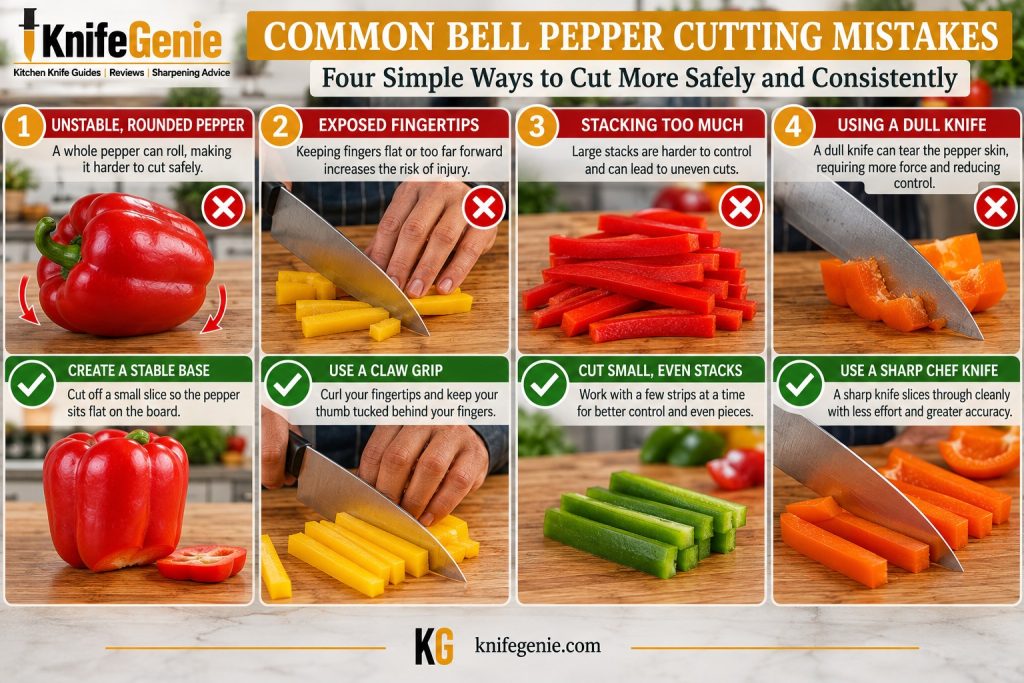
❌ Mistake 1: Cutting an Unstable Whole Pepper
Trying to make repeated cuts through a rounded pepper can cause it to shift unexpectedly.
Better approach: Create a flat base when necessary, remove the sides, and work with stable panels.
❌ Mistake 2: Using a Dull Chef Knife
A dull knife may struggle to penetrate the pepper’s outer skin.
That can encourage excessive pressure or repeated sawing.
Better approach: Use a properly sharpened knife and a smooth slicing motion.
❌ Mistake 3: Leaving Fingertips Extended
Straight fingers positioned near the cutting edge are vulnerable.
Better approach: Use a claw grip and keep the guiding hand behind the cutting line.
❌ Mistake 4: Cutting Several Unstable Layers at Once
Stacking too many curved pepper strips can cause the pieces to slide apart.
Better approach: Cut a few stable strips at a time, or dice each panel separately.
❌ Mistake 5: Trying to Cut Through the Stem
The stem and central core are firmer than the surrounding pepper flesh.
Forcing a chef knife through them is unnecessary for ordinary vegetable preparation.
Better approach: Cut around the core and remove the useful flesh.
❌ Mistake 6: Moving Too Quickly
Speed can make your cuts less consistent and reduce your control.
Better approach: Work slowly enough to maintain a predictable cutting motion and safe hand position.
COMMON BELL PEPPER CUTTING MISTAKES
🧙 KnifeGenie Pro Tips for Better Bell Pepper Cuts
A few small adjustments can make vegetable preparation easier and more consistent.
✔ Keep the pepper dry. A dry surface is generally easier to handle.
✔ Start with flat panels. Stable pieces are easier to control than rounded vegetables.
✔ Use the flesh side as your starting surface. The blade can often enter the softer interior more easily than the smooth skin.
✔ Make deliberate cuts. A smooth slicing movement usually works better than forcing the blade straight down.
✔ Match the cut to the recipe. Thin strips cook differently from large squares.
✔ Keep your board clear. Move finished pieces away from the active cutting area using a bench scraper or the knife’s spine with the edge directed safely away from your hand.
✔ Use a sharp knife. Sharpness helps the blade cut predictably without excessive pressure.
✔ Practice consistency before speed. Uniform pieces help food cook more evenly.
For more info to improve your skills, the Culinary Institute of America — Skills and Techniques offers professional culinary education resources, including knife skills, sharpening, and consistent vegetable cutting.
🥕 Build on Your Other Vegetable-Cutting Skills
Once you’re comfortable cutting bell peppers, try applying the same principles to other vegetables.
Our How to Cut Carrots With a Chef Knife guide shows how to create stable surfaces and produce several useful cuts from a firm, cylindrical vegetable.
The ingredients are different, but the underlying lesson is the same: stabilize the food, control the knife, and keep your guiding fingers protected.
🛡️ Bell Pepper Cutting Safety Checklist
Before you begin, make sure:
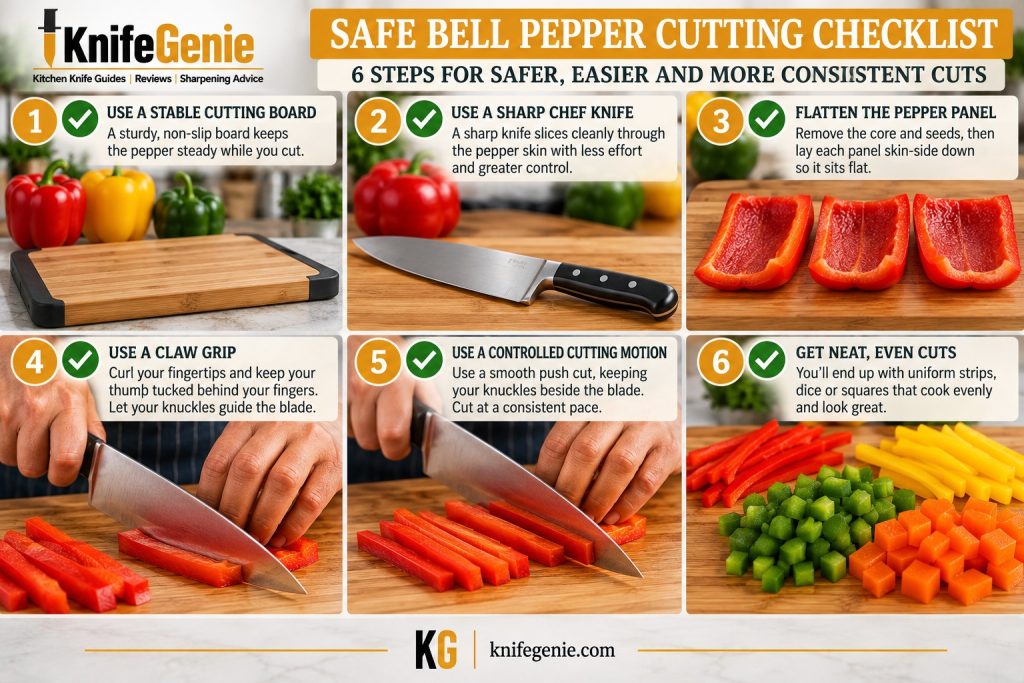
- ✔ Your cutting board is stable.
- ✔ Your bell pepper has been washed and dried.
- ✔ Your chef knife is sharp and comfortable to control.
- ✔ You have enough room to work.
- ✔ Your guiding fingertips remain curled.
- ✔ Your pepper panels rest securely on the board.
- ✔ You are cutting at a manageable pace.
- ✔ You are keeping finished pieces away from the blade’s path.
PEPPER CUTTING CHECKLIST
❓ Frequently Asked Questions
What is the easiest way to cut a bell pepper?
For strips or dice, one of the easiest methods is to stand the pepper upright and cut away its sides around the central core.
Lay the resulting panels flat before slicing them into smaller pieces.
This reduces the need to cut through the stem and seed cluster.
Should you remove the seeds before cutting a bell pepper?
Yes, removing the core and loose seeds makes the remaining pepper easier to prepare.
You can remove the core first or cut away the outer panels and leave the seed cluster behind.
Should you cut bell peppers skin-side up or down?
For many home cooks, cutting with the skin against the board and the flesh facing upward is easier.
The knife enters the softer flesh before reaching the firmer skin.
However, either orientation can work when the pepper is stable and the knife is sharp.
What size should bell peppers be for fajitas?
Strips around ¼–½ inch wide work well for many fajita recipes.
The ideal width depends on how you prefer the texture and how long the vegetables will cook.
Can you cut a bell pepper with an 8-inch chef knife?
Yes. An 8-inch chef knife is a versatile choice for preparing bell peppers and many other vegetables.
A smaller chef knife can also work well.
Is the white part inside a bell pepper edible?
Yes. The pale internal ribs are edible, although they may have a slightly different texture and flavor from the surrounding flesh.
You can trim the thicker sections for more uniform cuts.
Can you eat bell pepper seeds?
Bell pepper seeds are generally edible, but they are often removed because their texture is less appealing in finished dishes.
How do you cut bell peppers into small cubes?
First, remove the core and create flat panels.
Cut the panels into narrow strips, then cut across those strips at similar intervals.
Smaller, consistent spacing produces smaller dice.
Is a push cut better than a rock chop for bell peppers?
A controlled push cut is particularly useful for making straight strips from flat pepper panels.
Rock chopping can also be suitable for certain chopping tasks, depending on the knife and the size of the pieces.
Neither technique should involve uncontrolled force.
🏆 Final Verdict: The Easiest Way to Cut a Bell Pepper
Learning to cut a bell pepper isn’t about memorizing complicated knife movements.
It’s about making the vegetable easier to handle.
The most useful sequence is simple:
🫑 Wash and dry → 🔪 Remove the core → 🧩 Create flat panels → ➡️ Slice into strips → 🎯 Dice if needed.
A sharp chef knife, stable cutting board, and safe claw grip will help you produce consistent pieces without unnecessary effort.
Start slowly, concentrate on accuracy, and increase your speed only when the movements feel comfortable and controlled.
🧙 KnifeGenie Overall Recommendation
For most everyday recipes, cutting around the core and working with flat pepper panels is a practical, beginner-friendly method.
It reduces awkward handling, makes strip and dice sizes easier to control, and provides another useful opportunity to develop your chef knife skills.
BELL PEPPER CUTTING FINAL GUIDE
Continue learning with KnifeGenie’s complete guide to using a chef knife to strengthen your grip, slicing technique, and everyday kitchen confidence.